
Jackery Explorer 300D
(2 reviews)
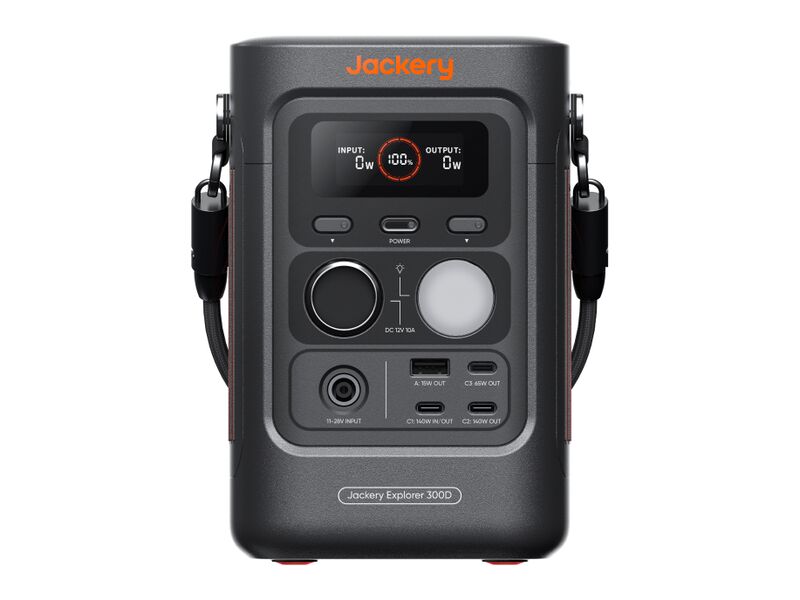
Two and a half kilos, 288 Wh of LiFePO4 and not a single fan: a station that fits in a camera bag and that you never hear.
Buy at AmazonAs an Amazon Associate I earn from qualifying purchases.
Characteristics
- Capacity: 288 Wh of LiFePO4, 4,000 cycles
- Outputs: 3 USB-C (140 W max), 1 USB-A, 12 V cigarette 120 W
- Distinctive: No 230 V socket at all, DC output only
- Recharge: 2 h 18 on 140 W USB-C, 3 h 30 on 100 W solar
- 2.5 kg, fanless and therefore perfectly silent
Detailed overview: Jackery 288 Wh power station without mains sockets
The Jackery Explorer 300D opens a still-rare category for the maker: the all-DC power station. Where a conventional station carries an inverter to manufacture 230 V AC, the 300D goes without and offers only USB and 12 V outputs. That choice has direct, measurable consequences for size, weight, noise and price.
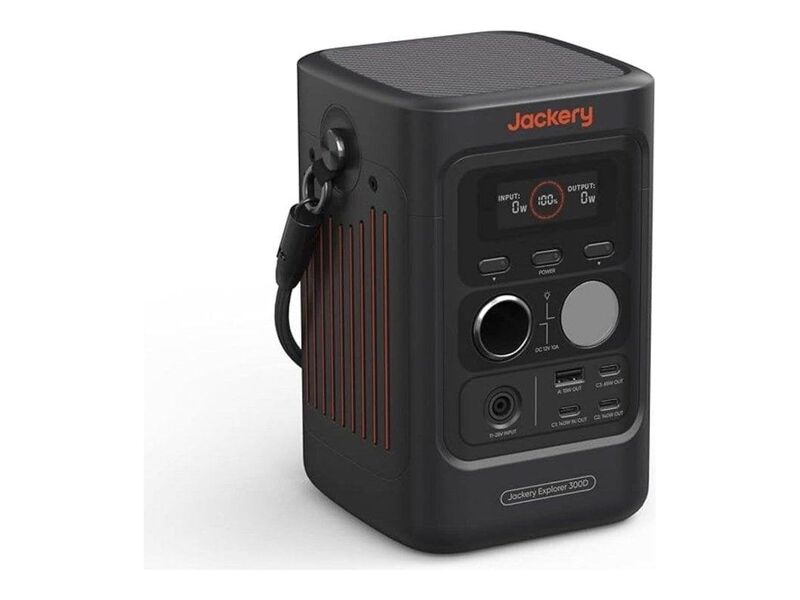
The battery is a 288 Wh LiFePO4 pack rated at 4,000 charge cycles, roughly a decade of regular use. Total available power reaches 300 W, spread across three USB-C ports, a USB-A port capped at 15 W and a 120 W 12 V cigarette-lighter output. The first USB-C port goes up to 140 W and works both ways: it is how the station recharges, and it is also what feeds a demanding laptop.
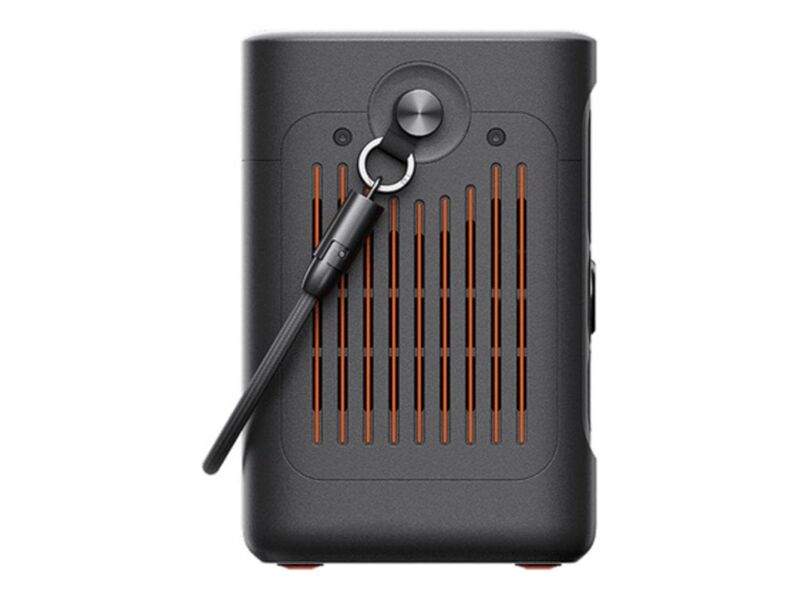
Recharging illustrates the product's philosophy well. On 140 W USB-C the station goes from empty to full in 2 h 18. On solar it accepts up to 100 W through its 8020 interface (16 to 28 V, 6 A) and fills in 3 h 30 in good conditions. From a car's cigarette lighter, allow 4 h 06. The supplied cable is a find: designed to take 10 kg, it acts as the carrying handle while being the 140 W charging lead, which rules out the classic forgotten-charger problem.
The rest comes down to a few figures: 2.5 kg, an upright format of roughly 119 x 180 x 188 mm that slips into a camera bag, an LCD screen, a built-in LED lamp and above all no fan, the removed inverter no longer needing cooling. Operation is therefore rigorously silent. There is, however, no Wi-Fi, no Bluetooth, no mobile app and no UPS function. Permitted temperatures run from 0 to 45 °C when charging and from -15 to 45 °C when discharging, and Jackery warrants the whole thing for 5 years.
Full specifications
Detailed characteristics (EAN: 0810182241586)
Battery and capacity
| Rated capacity?Total stored energy in watt-hours. The higher the figure, the longer the runtime. | 288 Wh |
|---|---|
| Delivered energy, measured?Energy that actually leaves the battery and reaches the devices. Always below the stored energy, as conversion costs heat. Taken from our in-depth review. | 267 Wh |
| Expandable capacity?Whether capacity can be increased with add-on batteries. | No |
| Removable battery?The main battery can be removed or replaced by the user. | No |
| Battery chemistry?LiFePO4 (LFP) lasts far longer and is safer than NMC. | LFP (LiFePO4) |
| Charge cycles?Number of full charges before capacity drops to the stated threshold. | 4000 cycles (70 %) |
AC output
| Number of 230 V AC outlets?Number of mains outlets available on the unit. | 0 |
|---|---|
| RV / TT-30 outlet?Dedicated 30 A outlet for North-American style RVs. | No |
Recharging
| AC charge 0-100%?Stated time for a full charge on mains power. | 138 min |
|---|---|
| Max solar input?Maximum solar power accepted at the input (PV panels). | 100 W |
| Accepted solar voltage?Panel voltage range compatible with the solar input. | 16 to 28 V |
| Max solar current?Maximum current accepted on the solar input. | 6 A |
| MPPT controllers?Number of independent MPPT solar inputs (yield optimisation). | 1 |
| Vehicle charging (12/24 V)?Can be charged from a vehicle's cigarette-lighter socket. | Yes |
| Pass-through charging?The unit can power devices while charging (pass-through). | Yes |
Ports and connectors
| USB-C ports?Number of USB-C ports and the fastest port's power (laptops, phones). | 3 × 140 W |
|---|---|
| USB-A ports?Number of USB-A ports and maximum power (small devices). | 1 × 15 W |
| 12 V output (car socket)?12 V cigarette-lighter output and its power (coolers, pumps…). | Yes (120 W) |
| Other DC outputs?Additional DC connectors (Anderson, DC5521, XT60…). | allume-cigare |
Portability
| Weight?Net weight of the unit, battery included. | 2.5 kg |
|---|---|
| Dimensions (L × W × H)?Overall size of the unit in millimetres. | 119 × 180 × 188 mm |
| Form factor?Portable (hand-carried), transportable (heavy), or wheeled. | Portable |
| Wheels?Built-in wheels for moving the unit. | No |
| Telescopic handle?Retractable handle like a wheeled suitcase. | No |
Safety and environment
| Discharge temperature?Temperature range in which the unit can deliver power. | -15 to 45 °C |
|---|---|
| Charge temperature?Temperature range in which the unit can be recharged. | 0 to 45 °C |
Backup / UPS
| UPS / EPS mode?Automatic switch to battery on a mains outage (backup). | No |
|---|
Noise and thermal
| Quiet mode?Setting that limits fan noise, often by capping charge power. | No |
|---|---|
| Self-heating battery?Battery pre-heating to allow charging in cold weather. | No |
Display and connectivity
| Display?Type of screen showing power, runtime and alerts. | LCD |
|---|---|
| Bluetooth?Bluetooth link for nearby control. | No |
| Wi-Fi?Wi-Fi connection for remote control and monitoring. | No |
| Mobile app?iOS / Android app to control the unit. | No |
| Local control (no cloud)?Control possible over Bluetooth without an account or internet. | No |
| Solar connector?Connector type of the solar input (XT60, Anderson, MC4…). | DC8020 |
Availability and warranty
| Market launch?Date the model first became available on the European market. Useful to place its generation: technology moves fast in this segment, and a device several years old may be at the end of its commercial life. | December 2025 |
|---|---|
| Warranty?Length of the manufacturer's warranty. | 5 years |
What is this power station best for?
-
Hiking & Bivouac Ideal
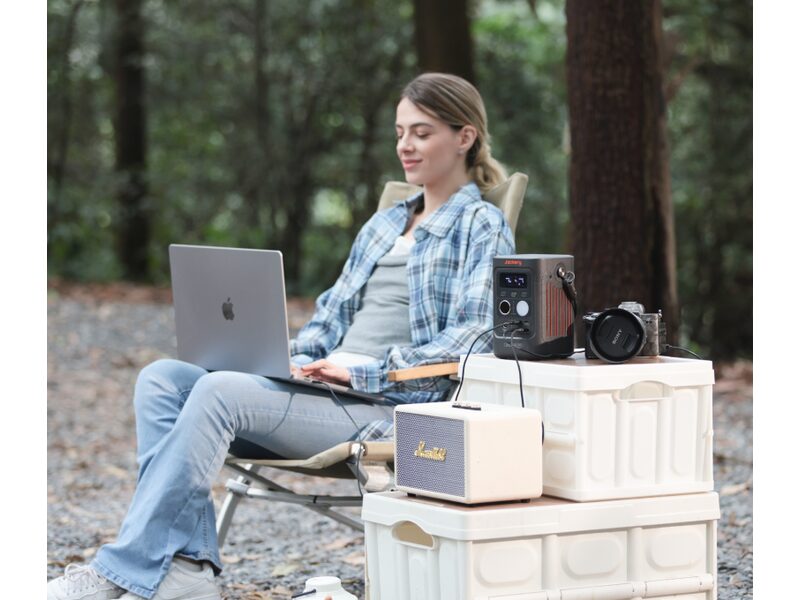
This is clearly what the 300D was drawn for. At 2.5 kg for 288 Wh it holds almost three times the energy of a large power bank without weighing much more, and its 2-in-1 carrying cable takes 10 kg while doubling as the 140 W charging lead. On a wild camp it recharges a phone about ten times, runs a head torch, an e-reader and a camera, and its built-in LED lamp serves as camp lighting. With no fan, it makes no sound at all inside a tent. Its one limit on foot remains weight: for a day hike, a 20,000 mAh power bank will do.
-
Camping & Tent Ideal
On a campsite the 300D covers everything that plugs into USB or 12 V: phones, tablets, a speaker, a fan, a mattress pump, lighting. Its three USB-C ports and USB-A port serve four devices at once, and the 120 W cigarette-lighter output takes a small 12 V cool box through the day. Its LiFePO4 chemistry (4,000 cycles) withstands years of seasons, and a 100 W solar panel refills it in 3.5 hours on a sunny pitch. The thing to check before leaving: it has no 230 V socket at all, so make sure every piece of kit you take charges over USB or 12 V.
-
Photo & Video Ideal
For a photographer or videographer working outdoors, the 300D is particularly well judged: its 288 Wh recharge dozens of camera batteries, and its 140 W USB-C port tops up a laptop so you can offload cards on site. The compact vertical format slips into a camera bag, 2.5 kg costs nothing over a day of scouting, and the absence of a fan means no stray noise during a sound take. Do check your kit, though, if any of it demands mains power, a cinema battery charger for instance: the 300D delivers DC only.
-
Road trip & Car Suitable
In a car or a converted van, the 300D plays the part of a discreet backup reserve: it recharges from the cigarette lighter in 4.1 hours while you drive, then runs phones, a laptop through the 140 W USB-C port and a 12 V cool box once parked. Its 2.5 kg stow anywhere, and total silence is a real comfort when sleeping on board. It does not replace a station with 230 V sockets if you carry small appliances: for a kettle or a hob you need to move up a class.
-
Remote work Suitable
For working outside, on a terrace, in a garden or in a co-working space with no socket, the 300D covers half a day of laptop use through its 140 W USB-C port while keeping enough left for a phone and earbuds. The absolute silence, with no fan, is welcome on video calls. Two reservations for desk use: with no 230 V socket, an external monitor or a printer stay out of reach, and with no UPS function it does not protect against a brief outage. This is a mobility station, not a backup supply for a fixed workstation.
Our team's recommendations based on the model's capacity, output power and weight.
Compatible solar panels
A selection of photovoltaic panels that suit this station's solar input (up to 28V / 100W), best match first.


Comparison
Between roughly £125 and £300, compact stations now split into two families: those that keep a 230 V socket and those that have dropped it. The table sets the 300D against its mains-socket sibling and its two direct all-DC rivals.
| Criterion | Jackery Explorer 300D | Jackery Explorer 300 Plus | Anker Solix C300X DC | EcoFlow Trail 200 DC |
|---|---|---|---|---|
| Capacity | 288 Wh | 288 Wh | 288 Wh | 192 Wh |
| 230 V socket | None | Yes | None | None |
| USB-C max | 140 W | 100 W | 140 W | 140 W |
| 12 V output | Yes, 120 W | Yes | Yes | No |
| Weight | 2.5 kg | 3.75 kg | 2.8 kg | 1.83 kg |
| Observed price | ≈ £153 | ≈ £239 | ≈ £298 | ≈ £127 |
In short, the 300D is the most interesting entry in the table if you can live without a mains socket: at identical capacity it weighs 1.25 kg less than the Explorer 300 Plus and costs nearly ninety pounds less. Against the Anker Solix C300X DC, its most direct rival, it offers the same capacity and the same USB-C power for nearly £145 less. The EcoFlow Trail 200 DC is lighter still but only holds 192 Wh and does without a 12 V output, which rules out a cool box. If on the other hand you need even one 230 V socket, the Explorer 300 Plus remains the right call despite the extra weight.
Related video
Video: Jackery Explorer 300D Portable Solar Generator Review - Published on 20/02/2026
Our tester's review: Christophe Delpuech
You need to understand this station's gamble before judging it, because it is unusual: Jackery removed the inverter and the 230 V sockets. The result: no more DC-to-AC conversion, so fewer efficiency losses (267 Wh delivered out of 288 Wh advertised at the charge bench, or 93 %), no more fan needed to clear the inverter's heat, and a much smaller housing. At equal capacity, 288 Wh, the 300D weighs 2.5 kg against 3.75 kg for the Explorer 300 Plus, its mains-socket sibling, and costs less. Excellent if everything you carry recharges over USB-C or 12 V: phone, tablet, laptop, camera, drone, e-reader, 12 V cool box, lighting. The 140 W USB-C port charges a MacBook Pro at good speed with a compatible charger, but the real speed depends heavily on the charger used, a point the spec sheet does not mention. A deal-breaker if you were counting on plugging in anything with a mains plug, even a simple older-generation laptop charger. One point deserves real caution: the 2-in-1 carrying cable, presented as a handle rated to carry 10 kg (a figure never independently corroborated), deformed after a few uses for one user, causing the unit to fall and an injury, with no compensation from Jackery despite the evidence supplied. The brand's customer service, moreover, comes up regularly in complaints for its slowness. The complete absence of a fan otherwise gives a rigorously silent station, confirmed in use including under sustained load. The deliberate omissions: no Wi-Fi, no Bluetooth, no app, no UPS function, no IP rating.
In-depth review Jackery Explorer 300D: our full review 4.0/5 Read our full review → Capacity and efficiency 4.4 Delivered power 4.0 Recharging 4.0 Ports and control 3.7 Build and endurance 3.2 Noise not measuredFrequently asked questions: Jackery 288 Wh power station without mains sockets
No, and that is its defining choice. It offers DC outputs only: three USB-C ports, a USB-A and a 12 V cigarette-lighter socket. Removing the inverter is exactly what lets it weigh 2.5 kg and run without a fan.
Yes, through its 140 W USB-C port, which charges a MacBook Pro or a Windows ultrabook at full speed. A laptop that only charges from a conventional mains brick, however, cannot be connected, since there is no 230 V socket.
Two hours and eighteen minutes on 140 W USB-C, three and a half hours with a 100 W solar panel in good conditions, and a little over four hours from a car's cigarette lighter.
Yes, completely. By removing the inverter, Jackery removed the heat source that made a fan necessary. The station therefore has no moving parts and makes no noise at all, even charging at full power.
No. The Explorer 300D has neither Wi-Fi nor Bluetooth and connects to no app. Everything is read on the built-in LCD screen, a choice consistent with its simple, compact positioning.
Need help choosing?
Other products in the "Compact power stations" category
Aferiy P040
£162.12 (11)
With 256Wh, a full mains recharge in just over an hour and a UPS mode under 10ms, the Aferiy P040 protects sensitive devices without breaking the bank.
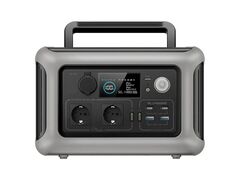
Allpowers R600
See price (7)
Affordable and backed by a 5-year warranty, the Allpowers R600 delivers 299 Wh, 600 W and a one-hour recharge, plus a built-in wireless charger.
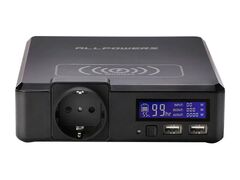
Allpowers S200
See price (6)
154Wh and 200W in an ultra-compact, book-sized station with built-in wireless charging: the mini power station that goes everywhere without weighing you down.
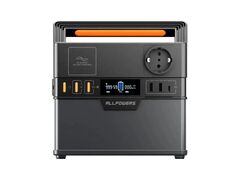
Allpowers S300 Plus
See price (5)
Compact and clever, the Allpowers S300 Plus (288 Wh) combines USB-C 100 W, a wireless charger, an LED torch and app control.
Published on 28/07/2026, updated on 14/08/2026