
EcoFlow Trail 200 DC
(2 reviews)
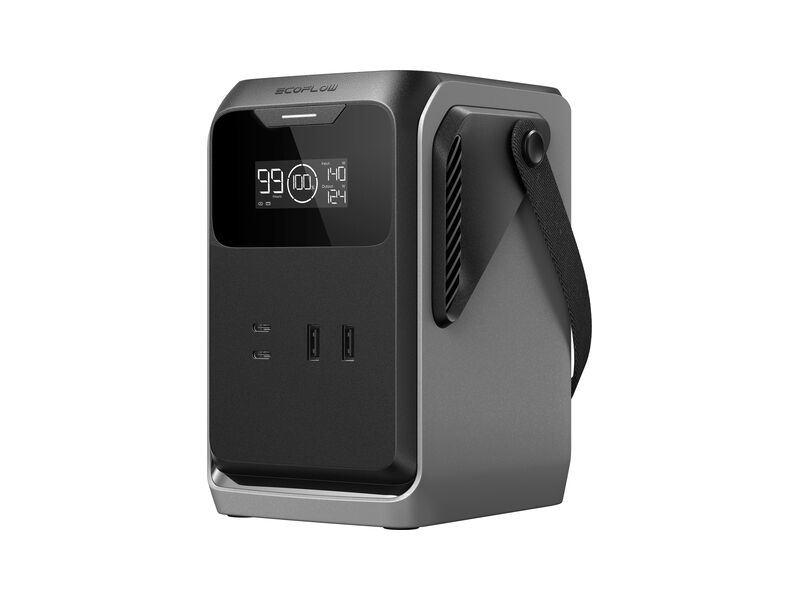
A 100% DC power station of 192Wh barely heavier than a water bottle (1.8 kg): 140W USB-C, long-life LiFePO4 battery, built for lightweight camping.
- Capacity: 192 Wh (LiFePO4, 3000+ cycles)
- Output: 220W max, 100% direct current (DC)
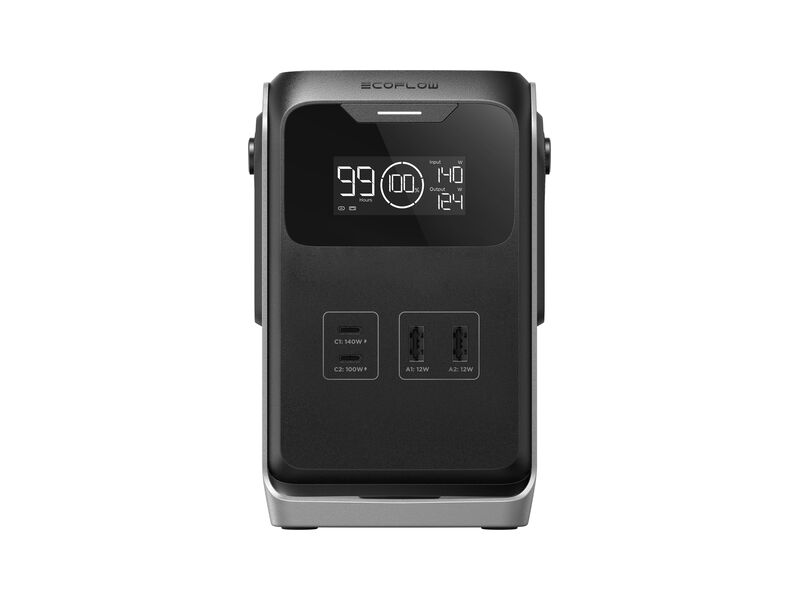
- Ports: USB-C 140W, USB-C 100W, 2 USB-A
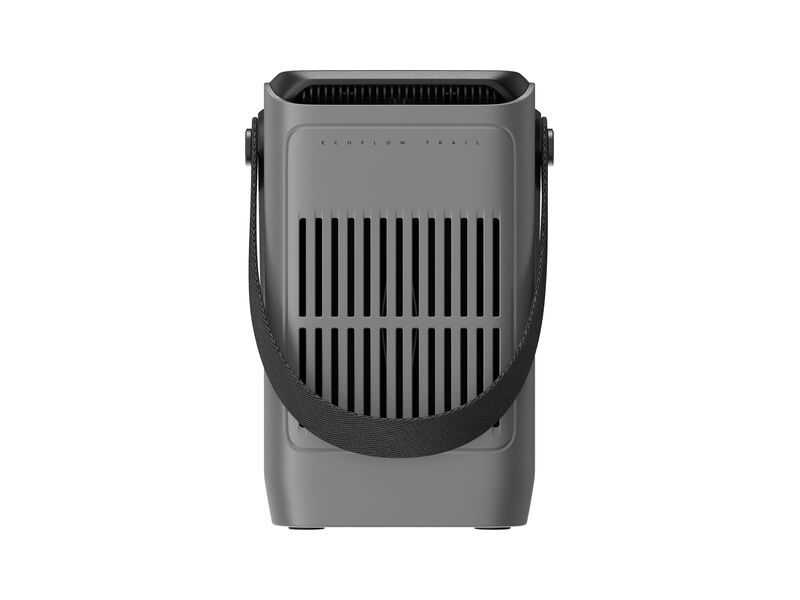
- Weight: 1.8 kg (167 x 115 x 126 mm)
- 192Wh pure DC in 1.8 kg, 140W USB-C
Detailed overview: EcoFlow Trail 200 DC 192Wh portable power station
The EcoFlow Trail 200 DC is a portable power station that takes the opposite approach to classic models: it is 100% direct current (DC), with no inverter and no 230V mains socket. This choice has two very concrete consequences. First the weight, cut to just 1.8 kg for a 167 x 115 x 126 mm format, barely more than a large water bottle. Then efficiency: by powering your devices directly over USB, it avoids the losses of conversion to 230V, which clearly extends real-world runtime.
Its 192 Wh battery uses LiFePO4 (lithium iron phosphate) chemistry, known for its longevity: over 3000 charge cycles before dropping to 80% capacity, meaning years of regular use. It delivers up to 220W across outputs designed for the outdoors: a 140W USB-C port (powerful enough for a laptop and to recharge the station itself), a second 100W USB-C port and two USB-A ports. Enough to simultaneously power camping lamps, cameras, drones, tablets, speakers and smartphones.
Built for adventure, the Trail 200 DC features drop and fire resistant construction, with an optional waterproof accessory to take it out in the rain. It recharges over USB-C, via a mains charger or a compatible solar panel, ideal for staying self-sufficient for several days.
Compact, light and rugged, EcoFlow's Trail 200 DC is aimed at campers, anglers, videographers and hikers who want a reliable energy reserve for their USB devices, without the burden of a heavy inverter-based station.
Full specifications
Detailed characteristics (EAN: 4895251668705)
Battery and capacity
| Rated capacity?Total stored energy in watt-hours. The higher the figure, the longer the runtime. | 192 Wh |
|---|---|
| Expandable capacity?Whether capacity can be increased with add-on batteries. | No |
| Removable battery?The main battery can be removed or replaced by the user. | No |
| Battery chemistry?LiFePO4 (LFP) lasts far longer and is safer than NMC. | LFP (LiFePO4) |
| Charge cycles?Number of full charges before capacity drops to the stated threshold. | 3000 cycles (80 %) |
AC output
| Continuous AC power?Power the unit can sustain continuously on its 230 V outlets. | 220 W |
|---|
Recharging
| Vehicle charging (12/24 V)?Can be charged from a vehicle's cigarette-lighter socket. | No |
|---|
Ports and connectors
| USB-C ports?Number of USB-C ports and the fastest port's power (laptops, phones). | 2 × 140 W |
|---|---|
| USB-A ports?Number of USB-A ports and maximum power (small devices). | 2 × 12 W |
| 12 V output (car socket)?12 V cigarette-lighter output and its power (coolers, pumps…). | No |
Portability
| Weight?Net weight of the unit, battery included. | 1.83 kg |
|---|---|
| Dimensions (L × W × H)?Overall size of the unit in millimetres. | 126 × 115 × 167 mm |
| Form factor?Portable (hand-carried), transportable (heavy), or wheeled. | Portable |
| Wheels?Built-in wheels for moving the unit. | No |
| Telescopic handle?Retractable handle like a wheeled suitcase. | No |
Safety and environment
| Certifications?Standards and approvals obtained (CE, RoHS, UN38.3, UL…). | CE, RoHS, UN38.3 |
|---|---|
| Ingress protection (IP)?Resistance to dust and water (e.g. IP54). | IP30 |
Backup / UPS
| UPS / EPS mode?Automatic switch to battery on a mains outage (backup). | No |
|---|
Noise and thermal
| Quiet mode?Setting that limits fan noise, often by capping charge power. | No |
|---|---|
| Self-heating battery?Battery pre-heating to allow charging in cold weather. | No |
Display and connectivity
| Display?Type of screen showing power, runtime and alerts. | LED indicators |
|---|---|
| Bluetooth?Bluetooth link for nearby control. | No |
| Wi-Fi?Wi-Fi connection for remote control and monitoring. | No |
| Mobile app?iOS / Android app to control the unit. | No |
| Local control (no cloud)?Control possible over Bluetooth without an account or internet. | No |
Availability and warranty
| Market launch?Date the model first became available on the European market. Useful to place its generation: technology moves fast in this segment, and a device several years old may be at the end of its commercial life. | September 2025 |
|---|---|
| Warranty?Length of the manufacturer's warranty. | 3 years |
⚡ How long will this power station run a device?
With 192 Wh, the EcoFlow Trail 200 DC external battery runs a fridge (50 W) for ~3h15 or an LED TV (90 W) for ~1h50.
| Home | Runtime |
|---|---|
| Mini fridge (45 W) | ~3h40 |
| Refrigerator (50 W) | ~3h15 |
| Freezer (60 W) | ~2h45 |
| American fridge (150 W) | ~1h05 |
| Outdoor & workshop | Runtime |
|---|---|
| Wi-Fi router (15 W) | ~11h |
| Electric cooler (45 W) | ~3h40 |
| LED TV (90 W) | ~1h50 |
| Games console (200 W) | ~50 min |
Rough estimate: real consumption varies, and very power-hungry appliances (heating elements) must stay below the output power.
What is this power station best for?
-
Hiking & Bivouac Ideal
Barely 1.8 kg and splash-resistant, the Trail 200 DC is one of the few stations designed for a trekking pack: it acts as a mobile charging hub for the headlamp, GPS, smartwatch, camera batteries and phone, far from any power source. Its USB-C outputs up to 140 W fill devices very fast, and its 192 Wh of LiFePO4 last several days on measured needs. Its 100 % DC architecture, with no inverter, limits losses and maximises usable energy for mobile devices, exactly what you want on the move. Rechargeable via a USB-C output solar panel, it tops up at the bivouac with no mains outlet at all.
-
Camping & Tent Ideal
For a lean camp, the Trail 200 DC is ideal: its 192 Wh and USB-C ports up to 140 W quickly recharge a lamp, phones, tablets and a laptop, with excellent efficiency since there is no conversion to 230 V. Ultra-light (1.8 kg) and rugged, it slips into a small bag and withstands outdoor conditions. Rechargeable over USB-C, including via a compatible solar panel, it tops up at camp in good weather. However, with no mains outlet or 12 V socket, it cannot power a 230 V device or a conventional 12 V device (cooler, vehicle lighting): it is a deliberate USB station, for minimalist camping.
-
Photo & Video Suitable
Compact and hardy, the Trail 200 DC replenishes the essential gear without the weight of an inverter-based station: its USB-C outputs up to 140 W quickly recharge mirrorless bodies, drone packs, mics and a laptop, and its 192 Wh of LiFePO4 last several battery cycles on a nature outing. At 1.8 kg it disappears into the camera bag and recharges via a USB-C output solar panel to extend outdoor days. Its lack of an inverter avoids conversion losses, a real plus for USB devices. For a 230 V LED panel or a mains charger, however, an inverter-equipped station is required.
-
Road trip & Car Suitable
DC-oriented, the Trail 200 DC is a minimalist van companion for mobile devices: it recharges via a USB-C adapter plugged into the vehicle's car socket and keeps phones, tablets and a laptop running at stops and overnight. Its USB-C outputs up to 140 W quickly recharge these devices, and its inverter-free architecture maximises efficiency. Ultra-light (1.8 kg) and rugged, it stows anywhere in the cabin. It does not, however, power any conventional 12 V device (cooler, vehicle lighting): unlike its bigger sister the Trail 300 DC, it has no car socket or dedicated solar/car port of its own. Its 192 Wh remain modest: for long successive nights or 230 V devices, it plays the top-up rather than the main reserve.
-
Off-grid & Solar Suitable
Rechargeable via a USB-C output solar panel, like any other USB-C device (it has no dedicated solar port like its bigger sister the Trail 300 DC), the Trail 200 DC makes a handy small autonomous energy buffer for a cabin, an observation post or an isolated shelter: its 192 Wh recharge as the sun allows and deliver energy over USB-C up to 140 W to power USB lighting, sensors, a surveillance camera or small devices. Its 100 % DC architecture, with no conversion losses, makes it a lean, efficient solution for a low-consumption isolated point. Its 192 Wh limit it to small needs, however: to power a fridge or 230 V devices, a higher-capacity inverter station is required.
Our team's recommendations based on the model's capacity, output power and weight.
Comparison
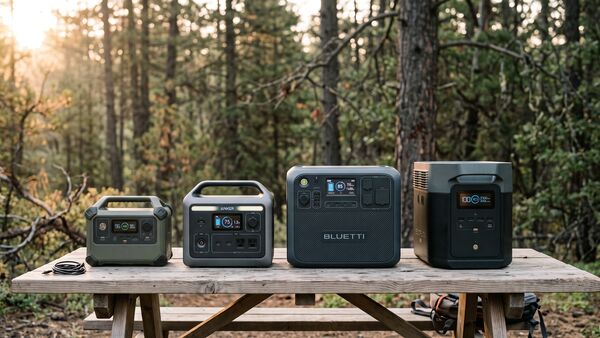
At around £128 to £197, the EcoFlow Trail 200 DC compares with compact camping power stations, targeted by searches such as "portable power station" or "camping power bank". Here is how it sits against three references: the Anker SOLIX C300 DC, the EcoFlow River 3 and its bigger sister the Trail 300 DC.
| Criterion | EcoFlow Trail 200 DC | Anker SOLIX C300 DC | EcoFlow River 3 | EcoFlow Trail 300 DC |
|---|---|---|---|---|
| Capacity | 192 Wh | 288 Wh | 245 Wh | 288 Wh |
| 230V mains socket | No (pure DC) | No (pure DC) | Yes (300W) | No (pure DC) |
| Max USB-C | 140W | 140W | 100W | 140W |
| Weight | 1.8 kg | 2.7 kg | 3.4 kg | 2.6 kg |
| Observed price | ≈ £129 | ≈ £171 | ≈ £239 | ≈ £159 |
In short, the Trail 200 DC is the lightest and most affordable of the group, ideal if you only power USB devices. The Anker C300 DC and the Trail 300 DC offer more capacity for more weight, while the River 3 is the only one to provide a real 230V mains socket, at the cost of almost double the weight. To travel light with no need for 230V, the Trail 200 DC is the smartest choice.
Related video
Video: Charge your Camera, Drone, Laptop and MORE with the EcoFlow TRAIL 200 ⚡️ - Published on 22/08/2025
Our tester's review: Christophe Delpuech
We took the Trail 200 DC out two weekends in a row, wild camping then on a photo session, and its concept won us over: by dropping the AC inverter, EcoFlow wins on both fronts, weight (1.8 kg, it slips into a backpack) and efficiency, because powering a device over USB-C directly avoids the losses of 230V conversion. In practice, you recharge a camera body, a drone, a phone and a lamp without ever draining the battery over a day. The 140W USB-C port is the real asset, it runs a laptop or recharges the station at full speed. The build inspires confidence, drop-resistant shells, and the LiFePO4 battery promises over 3000 cycles, meaning years of use. Two honest caveats: the total absence of a mains socket and a 12V port restricts it to USB devices (you cannot plug in a small 230V appliance or a 12V cooler), and 192Wh is a backup capacity, not enough for a long weekend without an interim recharge. But to travel light and power your portable devices, it is a success.
In-depth review EcoFlow Trail 200 DC: our full review 4.1/5 Read our full review → Capacity and efficiency 4.1 Delivered power 4.3 Recharging 3.8 Ports and control 3.8 Build and endurance 4.3 Noise 4.8Frequently asked questions: EcoFlow Trail 200 DC 192Wh portable power station
No. It is 100% direct current (DC): it powers your devices over USB-C and USB-A, but has neither a 230V socket nor a 12V socket (unlike its bigger sister, the Trail 300 DC). This choice makes it lighter and more efficient for portable devices.
Its 192 Wh recharge a smartphone around fifteen times, or power a lamp, a camera and a tablet over a full day of camping. For several days, you recharge it over USB-C, including via a USB-C output solar panel.
Its LiFePO4 battery lasts over 3000 charge cycles before dropping to 80% of its capacity, far more than a classic lithium battery. In regular use, that represents several years.
Yes. The 140W USB-C port powers most laptops and also serves to recharge the station itself quickly. A second USB-C port delivers up to 100W.
Need help choosing?
Other products in the "Compact power stations" category
Aferiy P040
£162.12 (11)
With 256Wh, a full mains recharge in just over an hour and a UPS mode under 10ms, the Aferiy P040 protects sensitive devices without breaking the bank.
Allpowers R600
See price (7)
Affordable and backed by a 5-year warranty, the Allpowers R600 delivers 299 Wh, 600 W and a one-hour recharge, plus a built-in wireless charger.
Allpowers S200
See price (6)
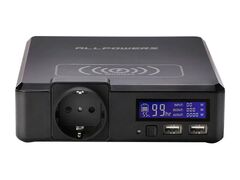
154Wh and 200W in an ultra-compact, book-sized station with built-in wireless charging: the mini power station that goes everywhere without weighing you down.
Allpowers S300 Plus
See price (5)
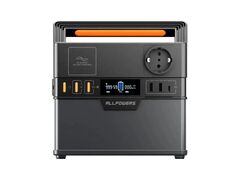
Compact and clever, the Allpowers S300 Plus (288 Wh) combines USB-C 100 W, a wireless charger, an LED torch and app control.
Published on 09/07/2026, updated on 14/08/2026