
Two crowdfunded stories, a decade apart
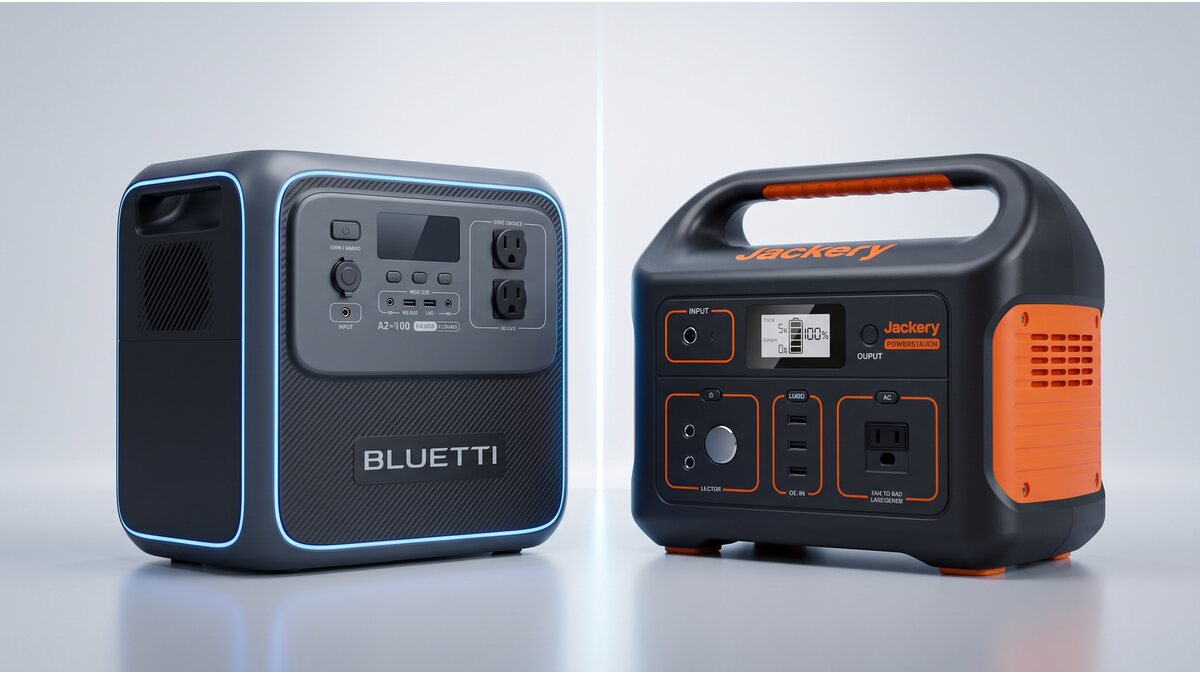
This fourth duel in our series pits together the two brands whose overall scores sit closest of our entire catalogue, with paths more alike than they first appear.
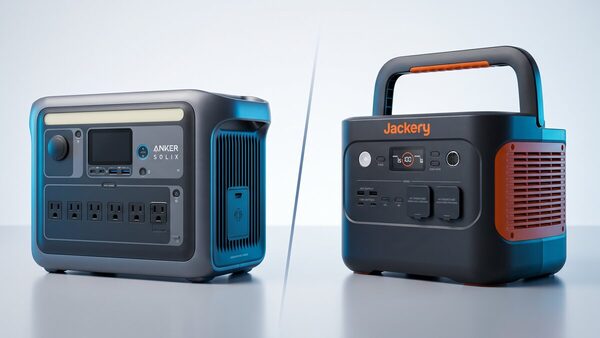
Jackery pioneered the category. Founded in 2012 in California, the company launched the first consumer portable power stations in 2016 and now claims more than seven million units sold, all gathered under the single Explorer series.
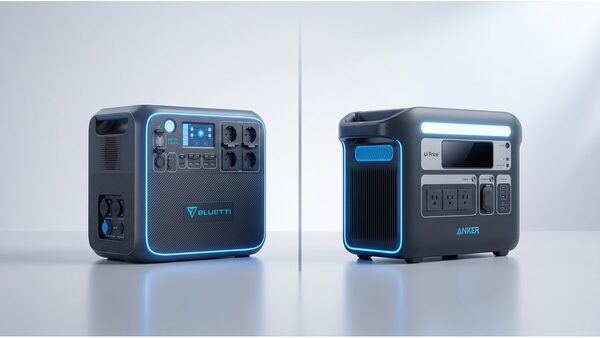
Bluetti is the consumer brand of PowerOak, a company active in Shenzhen since the early 2010s. The BLUETTI brand itself launched officially in 2019. The following year, its flagship AC200 raised nearly 7 million dollars in two months on Indiegogo, becoming one of the best-funded campaigns in the platform's history for this type of product. Like EcoFlow, Bluetti therefore owes its initial visibility to crowdfunding rather than traditional retail, unlike Jackery.
We tested twelve stations, five Bluetti and seven Jackery, scoring each on six weighted criteria and measuring the energy actually available at the socket. This duel is the fourth in our four-brand matrix: after EcoFlow against Bluetti, Anker Solix against Jackery and EcoFlow against Jackery, Bluetti against Anker Solix and EcoFlow against Anker Solix still remain to complete the picture.
4.12 against 4.11: the tightest tie of our four duels
Across our four brand comparisons, no other duel shows a gap this small. EcoFlow led Bluetti by 0.16 points and Jackery by 0.17. Anker Solix led Jackery by 0.19. Here, Bluetti (4.12) and Jackery (4.11) sit 0.01 points apart, a difference with no statistical meaning given the size of our samples.
| Scoring criterion | Bluetti | Jackery | Gap |
|---|---|---|---|
| Capacity and efficiency (25%) | 4.32 | 4.24 | -0.08 |
| Sustained power (25%) | 3.98 | 4.16 | +0.18 |
| Recharging (15%) | 4.20 | 4.10 | -0.10 |
| Connectivity and control (15%) | 4.08 | 3.97 | -0.11 |
| Build quality and endurance (12%) | 3.94 | 3.77 | -0.17 |
| Noise (8%) | 3.87 | 4.18 | +0.31 |
| Overall score | 4.12 | 4.11 | -0.01 |
The detail reveals an almost perfectly zero-sum split. Bluetti wins four of six criteria: capacity and efficiency, recharging, connectivity, build quality. Jackery wins only two: sustained power and noise. But those two wins land on the heaviest criterion in our scale (power, 25%) and the widest gap in the whole table (noise, +0.31), which exactly offsets Bluetti's four wins, more numerous but each more modest.
One concrete figure explains Jackery's edge on noise: this is the only one of our four duels where a single criterion gap exceeds 0.3 points. Bluetti's fans, particularly on the larger-capacity models, run noticeably louder.
565 EUR against 711 EUR: Jackery keeps the price edge
If the score cannot separate the two brands, the price of energy clearly does. Dividing the price paid by the kilowatt-hour actually delivered by the station, and restricting the calculation to models of 1,000 Wh and above to compare like with like, Jackery comes out at 565 EUR per kWh against 711 EUR for Bluetti, 21% less.
| Brand | Stations tested | Average score | Cost per kWh delivered |
|---|---|---|---|
| Jackery | 7 | 4.11 | 565 EUR |
| Bluetti | 5 | 4.12 | 711 EUR |
| EcoFlow | 17 | 4.28 | 712 EUR |
| Anker Solix | 5 | 4.30 | 773 EUR |
Bluetti therefore ties Jackery on score, but carries a price profile close to EcoFlow's (711 EUR against 712 EUR). Across our whole matrix, the pattern observed since the first duel holds: the more a brand costs per kilowatt-hour, the higher its average score tends to climb, with Jackery and Bluetti sitting at the two closest ends of that ranking.
But that average hides a sharp contrast between the bottom and the top of Bluetti's range, which the next section details.
Three duels at equal capacity
Brand averages stay theoretical: you buy a model. Here are three direct face-offs at comparable capacity, drawn from our measurements.
Around 280 Wh: Jackery crushes the entry segment
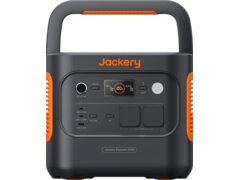
The Jackery Explorer 300D (158.99 EUR) delivers 267 Wh out of a rated 288, a 92.7% efficiency, for 595 EUR per kWh, and scores 4.0 out of 5. The Bluetti EB3A (249 EUR) delivers only 225 Wh out of 268 (84%), for 1,107 EUR per kWh, Bluetti's lowest score in our sample (3.8). This is the worst cost per kilowatt-hour in our entire Bluetti database, nearly double the Jackery's.
Build quality explains part of the gap: 3.2 for the Jackery, 3.3 for the Bluetti, an unusual near-tie that stands out against the rest of the table. On this entry segment, the EB3A simply cannot defend its price.
Around 1,100 Wh: Bluetti's comeback
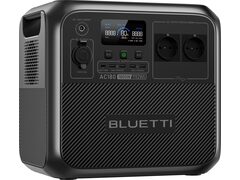
Here is the counterpoint worth the detour. The Bluetti AC180 (1,152 Wh, 569 EUR) delivers 1,030 Wh (89.4%) and scores 4.2 out of 5, for 552 EUR per kWh, the best ratio in Bluetti's entire range. The Jackery Explorer 1000 v2 (1,070 Wh, 624.71 EUR) delivers 943 Wh (88.1%) for 4.1, or 662 EUR per kWh. The AC180 is therefore cheaper, delivers 87 Wh more, and scores higher, despite a slightly higher rated capacity that could have suggested a steeper price.
Across our full database of thirty-six models spanning every brand, the AC180 ranks in the top 10 for energy-to-price ratio. It is, by a wide margin, Bluetti's strongest selling point in this comparison.
Around 2,050 Wh: Jackery regains the upper hand, by a wide margin
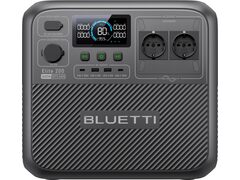
The Jackery Explorer 2000 v2 (2,042 Wh, 799 EUR) delivers 1,920 Wh (94%) for 416 EUR per kWh, the best ratio in our entire power station database, all brands included. The Bluetti Elite 200 V2 (2,074 Wh, 1,299 EUR) delivers 1,910 Wh (92.1%), essentially the same usable energy, for 680 EUR per kWh. Two stations delivering almost exactly the same amount of electricity, but 500 EUR apart, with Bluetti's best efficiency in the whole comparison for the Elite 200 V2 (which still trails the Jackery regardless).
Bluetti keeps two concrete arguments: the best rated endurance in the whole comparison, 6,000 cycles against 4,000 for Jackery, and richer connectivity. But on the immediate energy-to-price trade-off, the gap is hard to justify.
Efficiency: two tight profiles, Bluetti slightly steadier
Across the models whose delivered energy we measured, Jackery averages 90.6% efficiency against 88.2% for Bluetti, a 2.4 point gap in Jackery's favour.
The spread, however, tilts toward Bluetti: its five models range from 84% (EB3A) to 92.1% (Elite 200 V2), an 8.1 point amplitude. The seven Jackerys range from 84.6% to 94%, a 9.4 point gap. This is the first time, across our four duels, that Jackery does not hold the tighter spread of the two brands compared, even though the difference between them stays modest.
As in our three previous comparisons, the conclusion stands: efficiency is chosen model by model. Bluetti's EB3A, an entry-level model in the catalogue since 2022, drags the brand's average noticeably down; without it, Bluetti's average would climb past 91%.
What the extreme cases reveal
Beyond the averages, the extremes of our database tell each brand's strategy.
The best score in this duel goes to Bluetti with the AC180 (4.2 out of 5) and the Elite 200 V2 (4.2), both landing just under Jackery's top scores (Explorer 2000 v2 and 3000 v2, also 4.2). A neat tie at the top, with neither brand truly pulling ahead.
The weakest link in this duel is unmistakably the Bluetti EB3A, with the lowest score (3.8) and the worst efficiency (84%) of either brand combined. Conversely, no Jackery model dips below 4.0 in our sample, which points to a more consistent range at the bottom end.
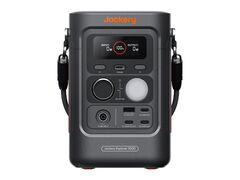
Format and weight. As in our Anker Solix against Jackery duel, Jackery alone occupies the ultra-compact segment with the Explorer 100 Plus (99 Wh, 965 g), under the 100 Wh threshold that allows carry-on transport with most airlines. Bluetti offers nothing equivalent in our sample, its lightest model, the EB3A, already weighing 4.6 kg.
Longevity. The Bluetti Elite 200 V2 is rated for 6,000 cycles, the record of this duel, tying Jackery's best (Explorer 500 v2, also 6,000). On warranty, Bluetti and Jackery both offer 5 years across most of the range, with one 2-year exception on each side: the EB3A at Bluetti, the Explorer 100 Plus at Jackery.
The match in one table
| Criterion | Bluetti | Jackery |
|---|---|---|
| Stations tested | 5 | 7 |
| Average score | 4.12 / 5 | 4.11 / 5 |
| Measured efficiency | 88.2% | 90.6% |
| Cost per kWh delivered (1,000 Wh and up) | 711 EUR | 565 EUR |
| Rated cycles | 2,500 to 6,000 | 2,000 to 6,000 |
| Warranty | 2 to 5 years | 2 to 5 years |
| Best score achieved | 4.2 (AC180 and Elite 200 V2) | 4.2 (Explorer 2000 v2 and 3000 v2) |
| Best cost per kWh | 552 EUR (AC180) | 416 EUR (Explorer 2000 v2) |
| Strength | Capacity, recharging, connectivity, build quality | Price of energy, sustained power, quietness |
| Weakness | Noise, and one entry model lagging behind (EB3A) | Connectivity and build quality behind |
These averages aggregate our individual tests: every model mentioned has its own detailed review, with the full set of measurements. You will find them all in our complete product reviews, filterable by device type.
Verdict: which one for you?
This is the most balanced duel of our series, and the verdict reflects it: neither brand dominates the other in absolute terms.
Choose Jackery by default if the price of energy is your main criterion: the 21% gap holds across almost the entire range, except around the 1,000 Wh segment. It is also the quieter choice, the noise gap being the widest in this whole comparison.
Choose Bluetti if your need sits precisely around 1,000 to 1,200 Wh: the AC180 there beats Jackery on all three counts at once, price, delivered energy and score. It is also the better pick if connectivity and build quality matter more than quietness, provided you steer clear of the EB3A, the brand's only real weak spot in our sample.
Either way, this duel illustrates better than any other why comparing brands in absolute terms has its limits: at a 0.01 point gap on overall score, it is the specific model, not the logo, that should decide. You will find those measurements model by model in our power station selection, taken according to our test methodology.