
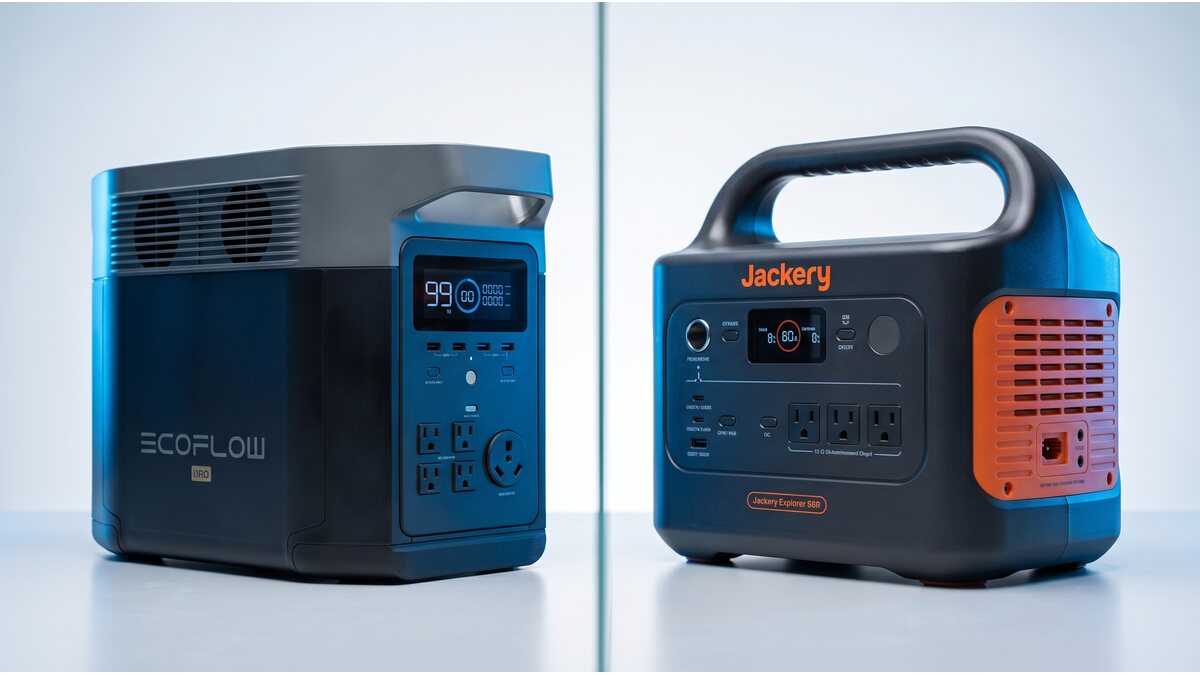
The Californian pioneer against the Shenzhen challenger
This third duel in our series pits the two most-tested brands in our catalogue against each other, with very different industrial paths.
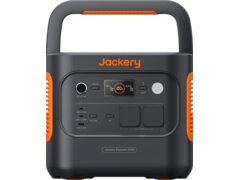
Jackery opened the category. Founded in 2012 in California, the company launched the first consumer portable power stations in 2016 and now claims more than seven million units sold, all gathered under the single Explorer series.
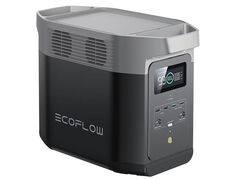
EcoFlow arrives five years later, in 2017, founded in Shenzhen by a team of engineers who had previously worked on batteries at DJI, with no ownership link between the two companies. Its first product, the RIVER and its 412 Wh, was funded through an Indiegogo campaign that raised over a million dollars. Nine years on, it is the most represented brand in our catalogue with nineteen listings and, notably, the highest rated of the big four.
We tested twenty-four stations, seventeen EcoFlow and seven Jackery, scoring each on six weighted criteria and measuring the energy actually available at the socket. That figure structures the whole comparison, and this is already the third duel in our four-brand matrix: after EcoFlow against Bluetti and Anker Solix against Jackery, Bluetti against Jackery, Bluetti against Anker Solix and EcoFlow against Anker Solix still remain to complete the picture.
565 EUR against 712 EUR per kilowatt-hour delivered
As in our previous two duels, we divide the price paid by the kilowatt-hour actually delivered, not by rated capacity: that is the only honest way to compare two devices whose electronics return different shares of the stored energy. Restricting the calculation to models of 1,000 Wh and above, Jackery comes out at 565 EUR per kWh against 712 EUR for EcoFlow, 21% less.
The figure confirms where each brand sits in our four-brand matrix.
| Brand | Stations tested | Average score | Cost per kWh delivered |
|---|---|---|---|
| Jackery | 7 | 4.11 | 565 EUR |
| Bluetti | 5 | 4.12 | 711 EUR |
| EcoFlow | 17 | 4.28 | 712 EUR |
| Anker Solix | 5 | 4.30 | 773 EUR |
EcoFlow sits in the middle: neither the cheapest (Jackery) nor the highest rated (Anker Solix), but the most favourable balance between the two, with by far the widest choice of models tested. Still, a 21% gap against Jackery is not trivial. The duels section below shows that gap is not constant across the whole range.
What our 24 tests say
Our six weighted criteria give EcoFlow a clear lead, but not a total one.
| Scoring criterion | EcoFlow | Jackery | Gap |
|---|---|---|---|
| Capacity and efficiency (25%) | 4.29 | 4.24 | +0.05 |
| Sustained power (25%) | 4.14 | 4.16 | -0.02 |
| Recharging (15%) | 4.36 | 4.10 | +0.26 |
| Connectivity and control (15%) | 4.29 | 3.97 | +0.32 |
| Build quality and endurance (12%) | 4.41 | 3.77 | +0.64 |
| Noise (8%) | 4.35 | 4.18 | +0.17 |
| Overall score | 4.28 | 4.11 | +0.17 |
First finding: on sustained power, the criterion carrying the same weight as capacity, Jackery edges ahead of EcoFlow (4.16 against 4.14). This is the first time, across our three brand duels, that Jackery wins a criterion, even by a hair.
Second finding: build quality opens the widest gap of our entire comparison series (+0.64). One concrete figure partly explains it: in our measurements, an EcoFlow Delta 2 fully recharges in 80 minutes against 138 minutes for a comparable-capacity Jackery Explorer 300D, and EcoFlow connectivity fits more mains sockets (3 to 4 depending on the model) where Jackery usually settles for 2 or 3.
Three duels at equal capacity
Brand averages stay theoretical: you buy a model. Here are three direct face-offs at comparable capacity, drawn from our measurements.
288 Wh: the widest gap in our whole comparison
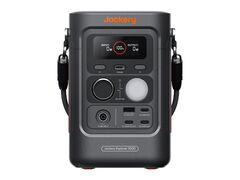
The Jackery Explorer 300D (158.99 EUR) delivers 267 Wh out of a rated 288, a 92.7% efficiency, for 595 EUR per kWh. The EcoFlow River 3 Plus (299 EUR) delivers only 231 Wh (80.8%), for 1,294 EUR per kWh, more than double. This is the widest price gap we have measured between two brands at comparable capacity, across every range.
EcoFlow keeps two real arguments: a full recharge in 60 minutes against 138 for the Jackery, more than twice as fast, and expandability up to 858 Wh with an additional battery, which the Jackery does not offer. But on this entry segment, the price of energy tilts massively toward Jackery.
Around 1,000 Wh: EcoFlow's only clean sweep
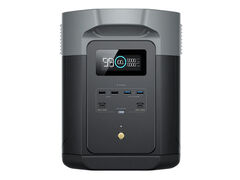
Here is the exception worth the detour. The EcoFlow Delta 2 (1,024 Wh, 599 EUR) delivers 930 Wh (90.8%) and scores 4.4 out of 5. The Jackery Explorer 1000 v2 (1,070 Wh, 624.71 EUR) delivers 943 Wh (88.1%) for 4.1. On this segment, and only this one among our three duels, EcoFlow is cheaper (644 EUR per kWh against 662 EUR), higher rated, and nearly as efficient despite a slightly lower capacity.
Jackery keeps a clear edge on noise, with a measured level of 22 dB against no figure listed for the Delta 2 on this point, and weighs 1.2 kg less. But on the energy-to-price trade-off that drives this whole comparison, EcoFlow wins here.
Around 2,000 Wh: Jackery regains the advantage, by a wide margin
The Jackery Explorer 2000 v2 (2,042 Wh, 799 EUR) delivers 1,920 Wh (94%) for 416 EUR per kWh, the best ratio in our entire power station database, all brands included. The EcoFlow Delta 2 Max (2,048 Wh, 949 EUR) delivers 1,780 Wh (86.9%) for 533 EUR per kWh, and weighs 5.5 kg more. Jackery here is 150 EUR cheaper, returns 140 Wh more and gains nearly eight points of efficiency.
EcoFlow still holds a background strength the spec sheet reveals but the price does not: it is expandable up to 6,144 Wh with additional batteries, against a fixed capacity on the Jackery side. A criterion that does not matter for the immediate purchase, but weighs for anyone planning to grow their setup over time.
Efficiency: Jackery steadier, EcoFlow more scattered
Across the models whose delivered energy we measured, Jackery averages 90.6% efficiency against 87.9% for EcoFlow. This is the only one of our three brand duels where the efficiency gap exceeds two points, and it runs against the overall score ranking.
The most striking difference is not the average, but the spread. For Jackery, measured efficiency ranges from 84.6% (Explorer 3000 v2) to 94% (Explorer 2000 v2), a 9.4 point range. For EcoFlow, it ranges from 73.6% (River 2 Max, a 2022 model) to 97.6% (Delta Pro 3, the best measurement in our entire database), a 24 point range, almost triple.
That spread tells two different stories. At Jackery, a tighter catalogue and a more recent range produce consistent results. At EcoFlow, the gap mostly reflects overlapping product generations, with older models (the River 2 Max dates from late 2022) dragging the average down alongside much newer releases already close to 98%. For the buyer, the conclusion is the same as in our previous duels: efficiency is chosen model by model, not brand by brand.
What the extreme cases reveal
Beyond the averages, the extremes of our database tell each brand's strategy.
Range breadth. With its seventeen models tested, EcoFlow covers a span from 192 Wh (Trail 200 DC) to 4,096 Wh (Delta Pro 3), a 21-fold range, with closely spaced steps at every capacity tier. Jackery, with seven models, goes from 99 Wh (Explorer 100 Plus) to 3,072 Wh (Explorer 3000 v2), a 31-fold range, but with fewer intermediate steps. EcoFlow offers finer-grained choice; Jackery alone covers the ultra-compact segment under 100 Wh.
The best ratio across all brands remains the Jackery Explorer 2000 v2 at 416 EUR per delivered kWh, a record that has held since our first comparison in the series. The best EcoFlow model, the Delta Pro, ranks fifth across all brands at 516 EUR per kWh, a very good score that still sits 24% above the Jackery record.
The best score goes to EcoFlow with the Delta 3 Max Plus (4.6 out of 5), driven by a measured efficiency of 94.7%. On the Jackery side, the top spot is shared by the Explorer 2000 v2 and the Explorer 3000 v2, both at 4.2.
Longevity. Rated cycles run from 3,000 to 6,500 at EcoFlow (the top end coming from the Delta Pro, measured down to 50% residual capacity) against 2,000 to 6,000 at Jackery. On warranty, EcoFlow runs from 3 to 5 years (the Trail 200 DC and Trail 300 DC are limited to 3 years) and Jackery from 2 to 5 years (the Explorer 100 Plus is limited to 2 years).
The match in one table
| Criterion | EcoFlow | Jackery |
|---|---|---|
| Stations tested | 17 | 7 |
| Average score | 4.28 / 5 | 4.11 / 5 |
| Measured efficiency | 87.9% | 90.6% |
| Cost per kWh delivered (1,000 Wh and up) | 712 EUR | 565 EUR |
| Rated cycles | 3,000 to 6,500 | 2,000 to 6,000 |
| Warranty | 3 to 5 years | 2 to 5 years |
| Expandable stations | 10 of 19 (53%) | 2 of 9 (22%) |
| Best score achieved | 4.6 (Delta 3 Max Plus) | 4.2 (Explorer 2000 v2 and 3000 v2) |
| Best cost per kWh | 516 EUR (Delta Pro) | 416 EUR (Explorer 2000 v2) |
| Strength | Build quality, recharging, connectivity, expandability | Price of energy, efficiency consistency |
| Weakness | Efficiency more scattered across generations | Connectivity and build quality behind |
These averages aggregate our individual tests: every model mentioned has its own detailed review, with the full set of measurements. You will find them all in our complete product reviews, filterable by device type.
Verdict: which one for you?
This duel has no constant winner across the range, which is what sets it apart from the previous two.
Choose Jackery for a first entry-level station or for a large fixed capacity around 2,000 Wh: that is where the price gap per kilowatt-hour is widest in its favour, up to twice as cheap as the equivalent EcoFlow. It is also the steadier choice if measured efficiency matters more than the brand average.
Choose EcoFlow around 1,000 Wh, the only segment where it beats Jackery on price, efficiency and score at once, or if you plan to grow your setup over time: half the EcoFlow catalogue accepts additional batteries, against barely a fifth for Jackery. It is also the safer choice if build quality and the number of sockets matter day to day.
Either way, compare on delivered watt-hours and the capacity you actually need, never on brand alone. Our duel around 1,000 Wh proves it: the same brand that costs twice as much at entry level can become the better deal one tier up. You will find those measurements model by model in our power station selection, taken according to our test methodology.