Car and motorcycle battery chargers

The charger that revives a flat battery and the maintainer that keeps one healthy all winter are not the same machine, nor the same price.

A conventional charger pushes current until the target voltage is reached, then stops. A maintainer stays connected for months and regulates continuously, which is exactly what a motorcycle or a classic car needs over winter. Chemistry compatibility is the second thing to watch: an AGM or lithium battery needs a different charging curve from a flooded lead-acid one, and a charger that ignores this shortens its life. Finally we check the real amperage, often below the claim, because that is what sets the charging time on a flat 70 Ah battery.

No product matches these criteria.

Our selection

Einhell CE-BC 4 M Battery Charger

38.95€ (26)

Forty euros for a smart, IP65-sealed charger that handles gel, AGM and lead-acid, and can stay plugged in all winter without a second thought.

  • Output: 4 A max, 6 V and 12 V batteries
  • Compatibility: Lead-acid, gel, AGM, maintenance-free
  • Sealing: IP65, dust and water splashes
  • Convenience: LCD screen, winter mode, trickle charge
  • A sealed smart charger under 40 euros
The CE-BC 4 M is the entry-level charger our selection was missing, until now stuck with premium models above a hundred euros. For around forty euros it delivers 4 amps at both 6 and 12 volts, governed by a microprocessor that breaks charging into stages rather than blindly pushing current. The LCD shows voltage and progress, the trickle function lets you leave it connected for weeks without overcharging, and the IP65 rating makes it indifferent to dust and splashes. A dedicated winter mode adapts charging below 5 °C, which matters in an unheated garage.
With close to two thousand four hundred reviews and a 4.6 average, the CE-BC 4 M is among Europe's best-selling chargers, and the reason comes down to value. At forty euros you get the essentials of what models three times dearer offer. Microprocessor control splits charging into successive stages, which avoids cooking a battery at the end of the cycle, and the trickle function lets you leave it connected all winter on a car that sits idle. That is exactly the use we recommend it for: the weekend runabout, the motorcycle stored from October to March, the motorhome on its parking space. The IP65 rating deserves a mention at this price. Most rivals in this bracket settle for a closed housing with no declared rating; here dust and splashes are officially covered, which allows a damp garage or a garden shed. The winter mode is not a gimmick either: below 5 °C a battery accepts charge less readily, and the dedicated profile avoids working it as hard as in summer. Two limits to know about. Four amps is comfortable for a small car or a motorcycle battery, but slow on a large diesel estate or motorhome pack: expect a full night for a deeply discharged 100 Ah battery. And it does not handle LiFePO4 lithium batteries, increasingly common on motorhomes and boats; for those, look at the CE-BC 5 M LiFePO4 version. For everything else, it is hard to beat at this price.
View product page

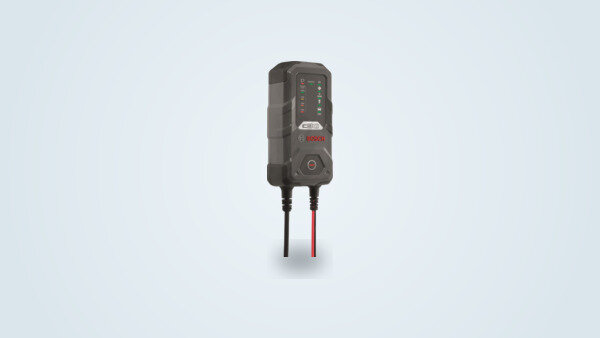
Bosch C30 Charger

See price and availability (22)

The charger you find in every other garage: simple, robust, rated for batteries up to 120 Ah, and made by the world's largest automotive supplier.

  • Output: 3.8 A, 6 V and 12 V batteries
  • Capacity: Batteries up to 120 Ah
  • Compatibility: Lead-acid, EFB, gel, AGM, SLI
  • Function: Automatic trickle charging
  • Bosch expertise on stop-start batteries
Bosch supplies a large share of Europe's original-equipment starter batteries, which lends particular weight to its chargers. The C30 sits at the centre of the C-Line range: 3.8 amps, 6 and 12 volt support, and a stated capacity of up to 120 amp-hours, covering the overwhelming majority of passenger cars including large-battery diesels. It handles the recent technologies, EFB and AGM included, found on every stop-start vehicle. Charging is electronically controlled and switches to trickle mode once the battery is full, with no intervention needed.
There is a simple reason the C30 has become the shelf reference: Bosch understands batteries better than anyone, since the supplier builds them for half of Europe's carmakers. That expertise shows on one specific point, the handling of EFB and AGM batteries. These technologies now fit every stop-start vehicle, they demand specific charging voltages, and many cheap chargers treat them as ordinary lead-acid, which shortens their life. The C30 applies the right profile. The second argument is admissible capacity: 120 amp-hours, where most chargers of this size stop well short. In practice it is not limited to the city car, it also copes with the large diesel saloon and the family MPV. At 3.8 amps charging stays slow on a deeply flat battery, but that is the very principle of this class of device: gentle charging wears the plates less than a brutal one. In use the housing is sturdy, the clamps are decent, and the supplied carrying case saves you from finding tangled cables in a corner of the garage. Two honest remarks. Status reporting is limited to indicator lights, with no screen: you know roughly where charging stands, not to the percentage, which the Einhell CE-BC 4 M displays for twenty euros less. And like most lead-acid chargers, it does not handle LiFePO4 lithium. At sixty euros it is a purchase of peace of mind rather than a bargain, but the reliability is there.
View product page

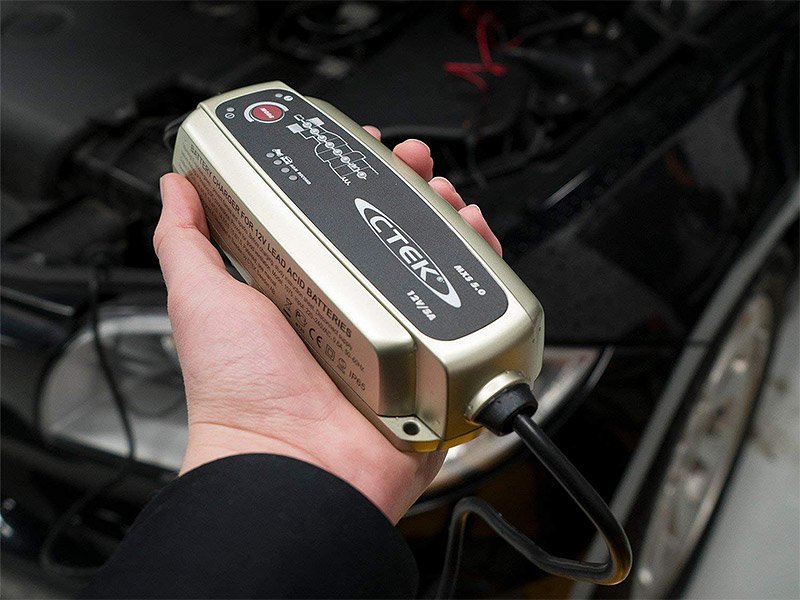
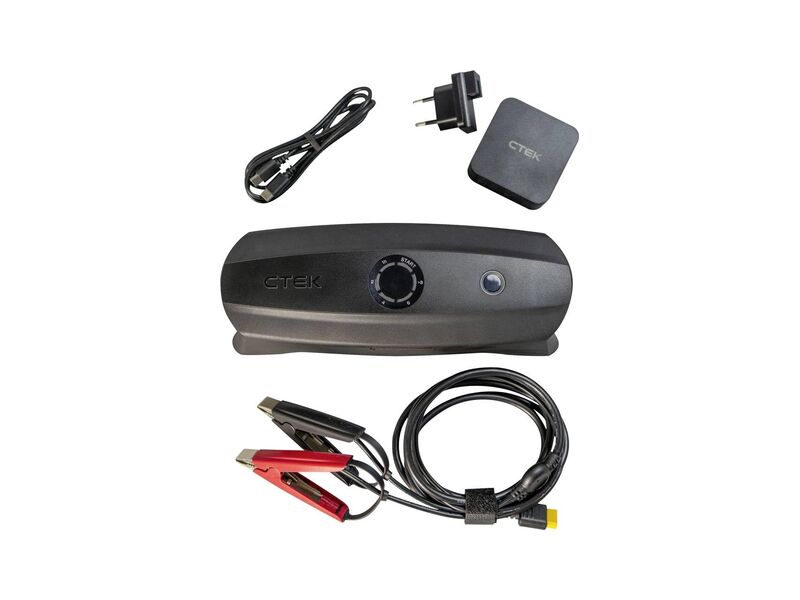
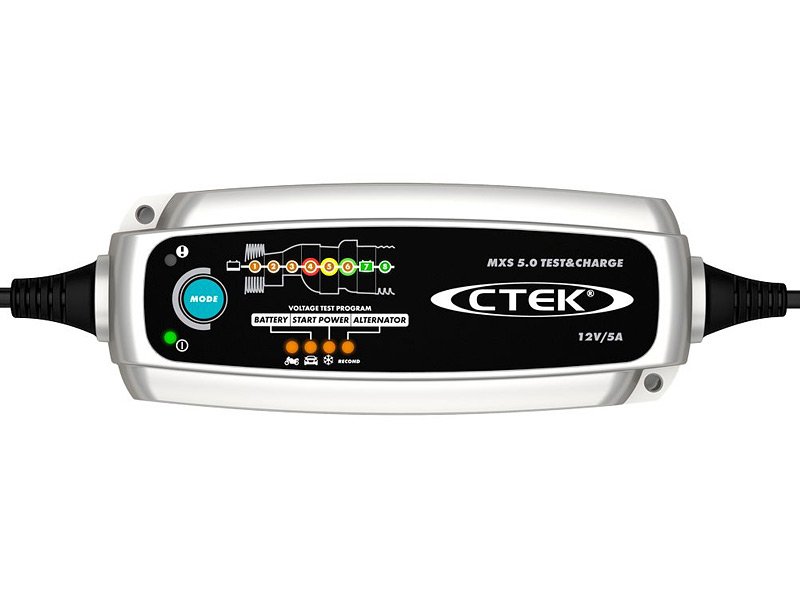
CTEK MXS 5.0

See price and availability (14)

The CTEK MXS 5.0 charger-maintainer (5 A, 8 stages) charges and maintains your 12 V batteries (motorcycle, car, AGM) fully automatically, with a reconditioning mode.

  • Charge: 0.8 / 5 A (12V)
  • Batteries: Lead-acid 1.2 to 110 Ah (maintenance 160 Ah)
  • Program: 8 stages, incl. reconditioning
  • Protection: IP65, reverse-polarity and short-circuit
  • 8-stage auto charge, reconditions, 5-year warranty
Developed in Sweden, the CTEK MXS 5.0 is one of the most popular battery chargers: fully automatic, it delivers 0.8 or 5 A and suits all 12 V lead-acid batteries from 1.2 to 110 Ah (flooded, AGM, gel). Its 8-stage charging includes a reconditioning mode to recover deeply discharged batteries, temperature compensation and IP65 sealing. Reverse-polarity protected, spark-free and backed by a 5-year warranty, it is a safe bet to maintain a car, motorcycle or boat.
We have used the CTEK MXS 5.0 for years to maintain the batteries of cars and motorcycles that sit through winter, and it has never let us down. Plug it in, choose the mode, and forget it: it does the rest, unattended, and switches off on its own once the optimal charge is reached. The reconditioning mode even saved us a motorcycle battery we thought was dead after a long lay-up. It is dead simple to use, the clamps and the permanent M8 eyelet are handy, and the IP65 sealing lets you leave it connected in the garage without worry. The only small downside is the price, a little above an entry-level charger, but the reliability, safety and 5-year warranty more than justify it. For anyone who wants a charger that lasts and looks after their batteries, it is the benchmark.
View product page

Einhell CE-BC 5 M LiFePO4 Charger

55.95€ (5)

The only charger in our selection under sixty euros that handles a lead-acid car battery and a LiFePO4 lithium pack equally well.

  • Output: 5 A max, automatic battery-type detection
  • Chemistries: LiFePO4, gel, AGM, lead-acid
  • Modes: Trickle, power supply, reconditioning
  • Protection: Overload, short circuit, reverse polarity
  • LiFePO4 lithium support for about fifty euros
Lithium iron phosphate batteries have taken over motorhomes, boats and solar installations, yet most garage chargers still refuse to touch them: their charging profile has nothing in common with lead-acid. The CE-BC 5 M LiFePO4 solves that for around fifty euros. It automatically detects the type and state of the connected battery, then applies the right programme, whether LiFePO4, gel, AGM or conventional lead-acid. Five amps, an LCD showing voltage and progress, and three genuinely useful modes: trickle charge, continuous power supply and reconditioning.
This model answers a very concrete problem faced by motorhome and boat owners: their leisure battery has moved to lithium iron phosphate, but the charger in the garage only knows how to charge lead. Connecting a lead-acid charger to LiFePO4 is not harmless: end-of-charge voltages differ, and some chargers do not even detect a protected cell that has tripped into safety mode. Einhell offers here the cheapest way to cover both worlds, with automatic battery-type detection that removes the risk of a wrong setting. The five amps place the unit a notch above the CE-BC 4 M, which partly offsets the slowness inherent to this class of domestic charger. The power supply mode is a clever addition, usually reserved for far dearer models: it keeps the vehicle's electrical circuit live while you disconnect the battery, so a modern car does not lose its stored settings. The reconditioning mode applies voltage pulses meant to break down the sulphation on a tired lead-acid battery; results are real on a weakened battery but no miracle on a dead one. Two reservations. The first is track record: with only fifty-five reviews and a 4.4 rating, this recent model lacks the history of its sibling and its two thousand four hundred reviews. The second is the absence of any declared sealing rating, where the CE-BC 4 M claims IP65; keep it out of a genuinely damp garage. If you own no lithium batteries, the 4 M remains the better buy. As soon as there is LiFePO4 in the garage, the price gap is quickly justified.
View product page

Bosch C70 Charger

See price and availability (19)

Ten amps and 24 volts on top: the only charger in our selection able to look after a truck, a tractor or a boat with a dual battery circuit.

  • Output: 10 A, 12 V and 24 V batteries
  • Compatibility: Lead-acid, EFB, gel, AGM, SLI
  • Workshop: Powers the vehicle during battery swap
  • Format: 1.15 kg, carrying case supplied
  • 24 volt support for vans and trucks
The C70 tops Bosch's C-Line range and stands apart on two counts its siblings cannot match. First 24 volts, essential as soon as you leave the passenger car behind: trucks, coaches, agricultural machinery and many boats run on two batteries in series. Then 10 amps, which cut charging time threefold against a 3.8 amp model. It keeps the modern EFB and AGM battery support and adds a function workshops value: keeping the vehicle live while its battery is replaced, so no electronic setting is lost.
The C70 targets a specific audience, and it should be said plainly: if you only have a passenger car in the garage, it is overkill and the C30 will do. Its interest begins as soon as the fleet diversifies. The 24 volt capability first opens the door to trucks, tractors, dual-circuit motorhomes and a large share of motor boats, all fitted with two batteries wired in series. No other charger in our selection can do that. The 10 amps then change your relationship with time: a half-empty 100 amp-hour battery recharges in half a day rather than a full night, which matters when the vehicle has to leave. The function we find cleverest is aimed at workshops. On a recent car, disconnecting the battery wipes the memories of the ECU, the radio, sometimes the electric windows, which then need resetting. The C70 can power the onboard circuit during the operation, much like a stabilised power supply, and the battery is swapped without losing anything. That is a service normally charged for by far dearer equipment. Two reservations. Status reporting stays basic, with indicator lights where a screen would be welcome at this price. And it does not handle LiFePO4 lithium, which is starting to be limiting on recent motorhomes. At ninety euros it is a considered investment for anyone maintaining several vehicles, and a pointless one for a single city car.
View product page

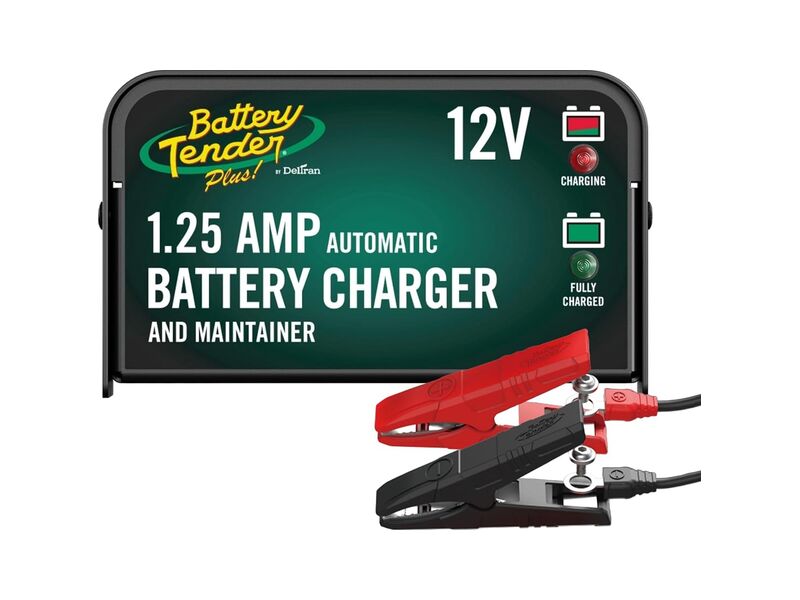
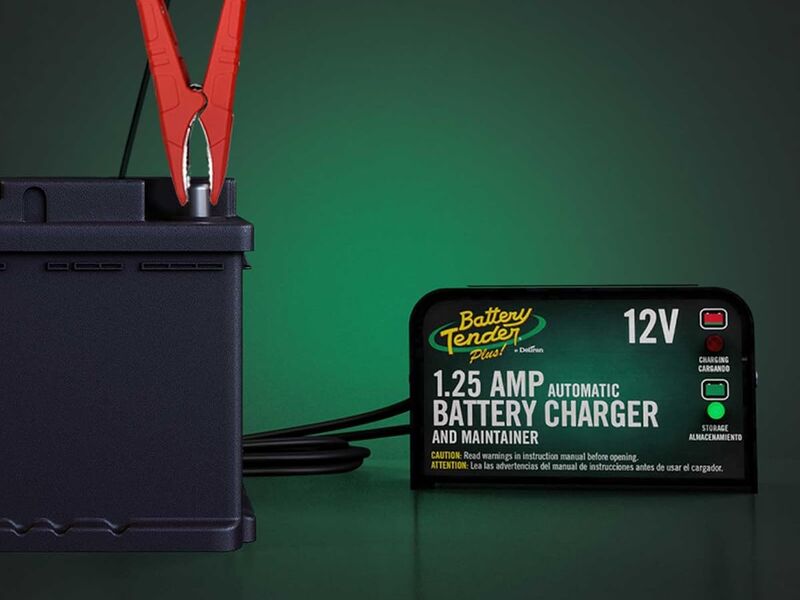
Battery Tender Plus

See price and availability (65)

One of the best-selling maintainers in the world: the Battery Tender Plus keeps your 12V batteries in top shape all year, with 4-step charging and a 10-year warranty.

  • Type: 12V charger / maintainer
  • Charge current: 1.25A
  • Charge: 4 stages with float maintenance
  • Compatibility: Flooded lead-acid, AGM, Gel
  • Bulletproof maintainer, 10-year warranty
The Battery Tender Plus is a 1.25A 12V battery charger and maintainer, famous in the US for its reliability. Its smart 4-step charge (initialization, bulk, absorption, float) recharges the battery then holds it at the ideal voltage with no overcharge. It features temperature compensation, reverse polarity protection and spark-proof connections. Compatible with flooded, AGM and Gel batteries, it comes with clamps and eyelet terminals, and is backed by a 10-year warranty.
The Battery Tender Plus is an institution across the Atlantic, and you quickly understand why. It is the kind of maintainer you hook up to a motorcycle or quad battery at the end of the season and forget until spring, confident the battery will be ready. Its 4-step charge does the job cleanly: it recharges, then switches to float maintenance and keeps the battery at exactly the right voltage without ever cooking it. Temperature compensation is a real plus in an unheated garage. The permanent eyelet terminals let you reconnect in two seconds. The 10-year warranty says a lot about the maker's confidence. Note that the classic 021-0128 version is designed for the North American market (US plug), to check depending on the imported version. Its 1.25A current reserves it for maintenance and small batteries, not fast recharging, but for storing a two-wheeler or a classic car, it is a sure bet.
View product page

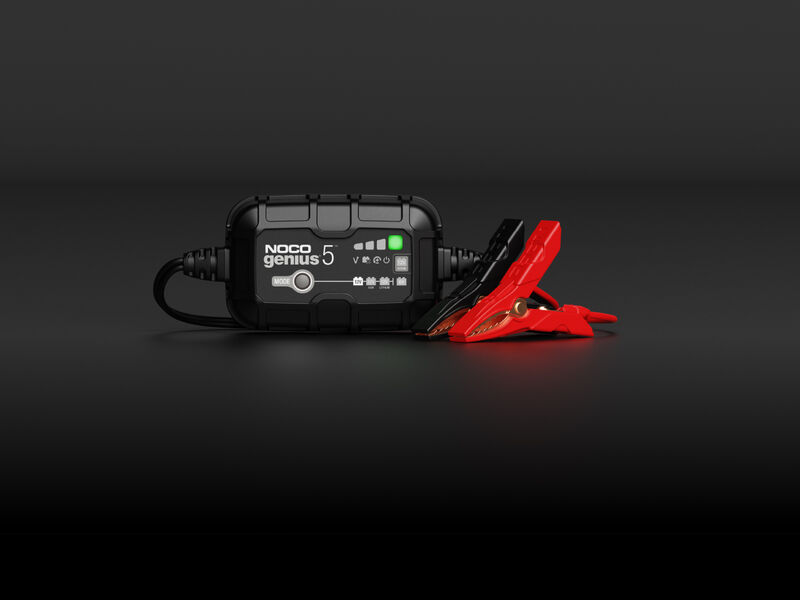
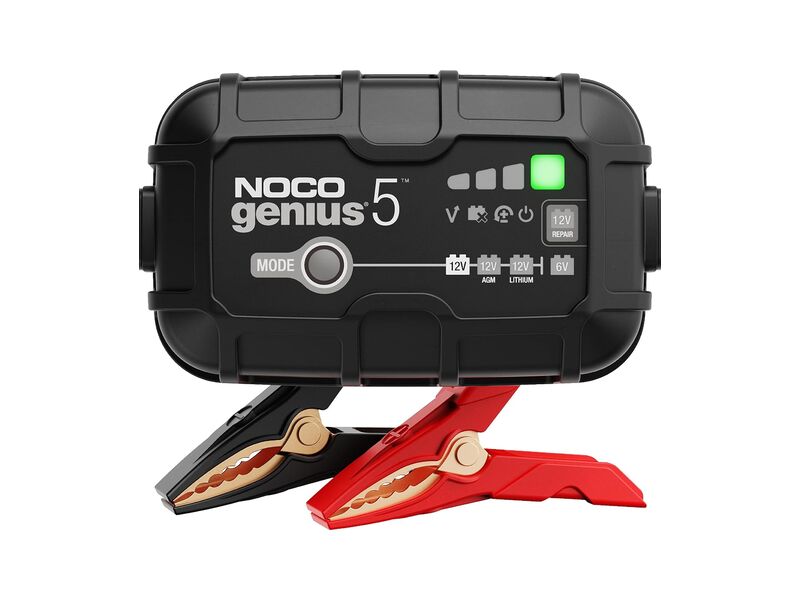
Noco Genius5

See price and availability (40)

Compact but complete: the Noco Genius5 charges, maintains and desulfates your 6V and 12V batteries, from scooter to camper, with 5A and lithium compatibility.

  • Charge current: 5A (6V and 12V)
  • Compatibility: Lead-acid, AGM, Gel, lithium LiFePO4
  • Battery capacity: Up to 120 Ah
  • Functions: Charge, maintain, desulfate, Force mode
  • 5A all-in-one, lithium compatible and fully automatic
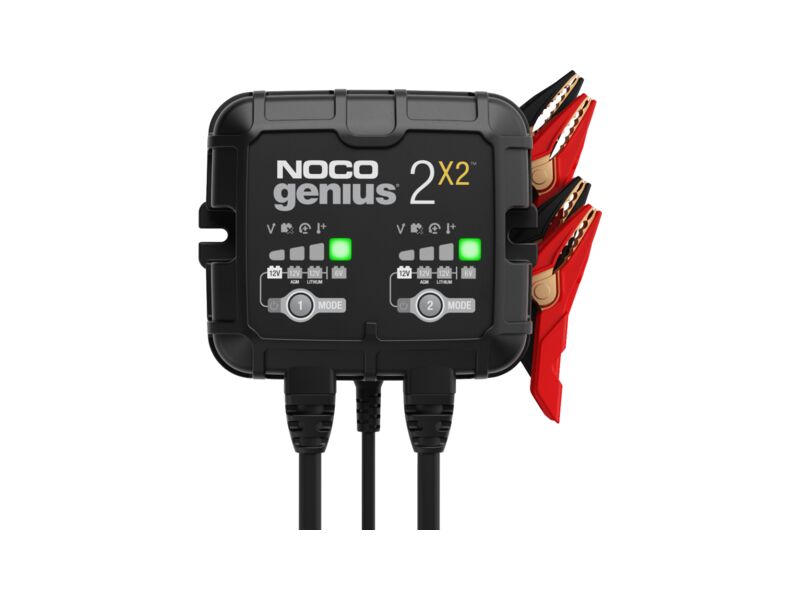
The Noco Genius5 is a smart 6V and 12V battery charger and maintainer delivering 5A. Compatible with every technology (lead-acid, AGM, Gel, lithium LiFePO4), it charges, maintains and desulfates batteries up to 120 Ah automatically. Its thermal sensor adapts charging to temperature, and its Force mode revives dead batteries down to 1 volt. You can leave it plugged in 24/7 with no risk of overcharge, ideal for storing a motorcycle, a rarely used car or a boat.
The Noco Genius5 is the little charger you end up using for everything. We hooked it up to a motorcycle battery left in the garage all winter, and come spring the scooter started first time, with nothing to monitor. What we like is its versatility: 6V or 12V, lead-acid, AGM, Gel or lithium, it adapts on its own, and you can leave it plugged in permanently without ever worrying about overcharge. Force mode is impressive for recovering a battery that has dropped very low, where a conventional charger refuses to even start charging. Desulfation genuinely gives tired batteries a second life. The supplied clamps and eyelet connectors make setup quick. The only small downside is that at 5A it is not made to urgently recharge a big camper battery, but for maintenance and batteries up to 120 Ah, it is an excellent companion, discreet and reliable.
View product page

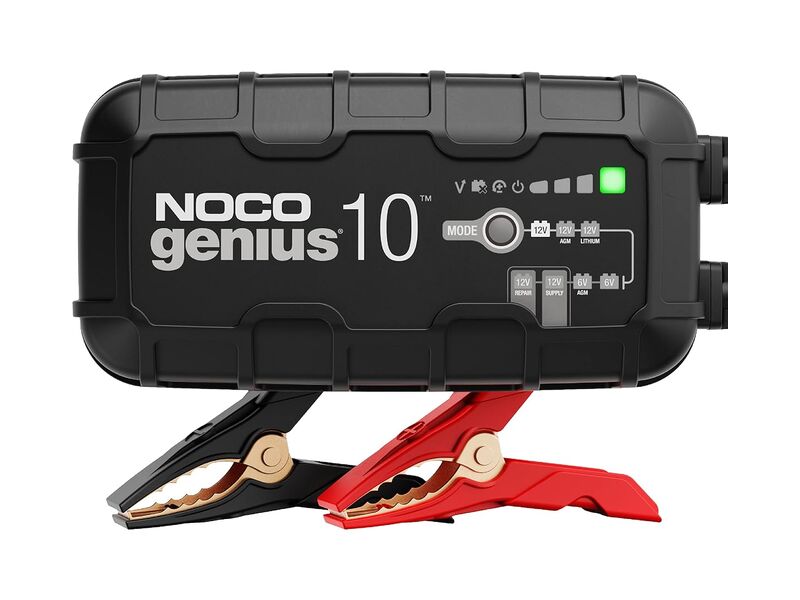
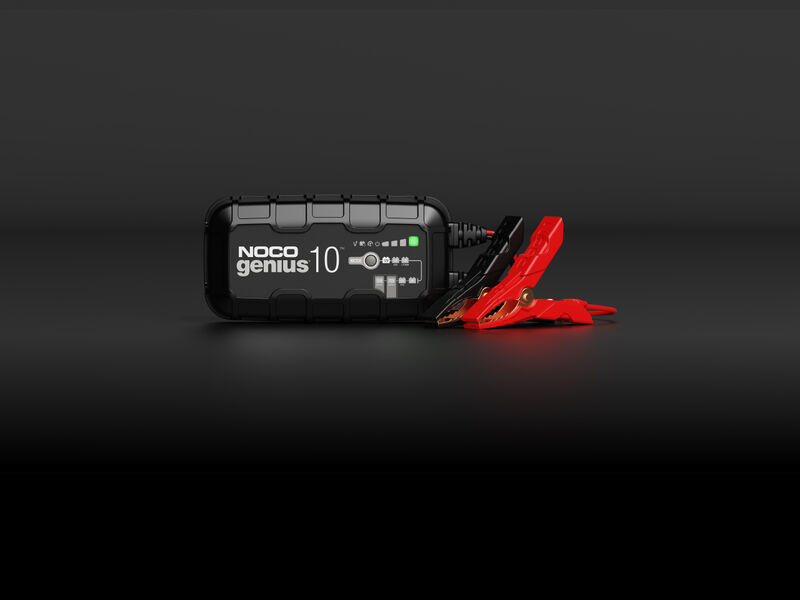
Noco Genius10

See price and availability (31)

The big brother of the Genius5: 10A to recharge and maintain batteries up to 230 Ah, from 4x4 to camper, compatible with lead-acid and lithium alike.

  • Charge current: 10A (6V and 12V)
  • Compatibility: Lead-acid, AGM, Gel, EFB, lithium LiFePO4
  • Battery capacity: Up to 230 Ah
  • Functions: Charge, maintain, desulfate, Force mode
  • 10A for large batteries, 9 modes and lithium compatible
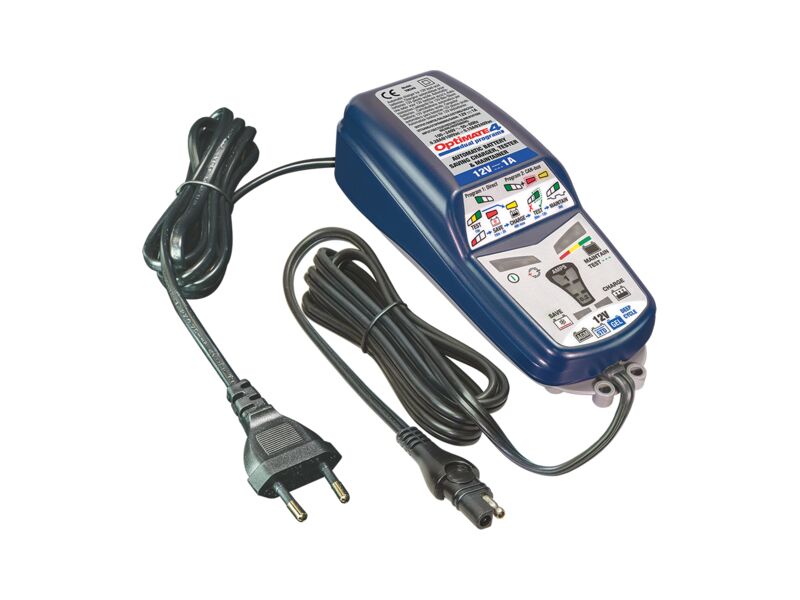
The Noco Genius10 is a smart 6V and 12V battery charger and maintainer delivering 10A. It charges, maintains and desulfates batteries up to 230 Ah, with nine modes covering lead-acid (flooded, AGM, Gel, EFB) and lithium LiFePO4. Its thermal sensor adapts charging to temperature, and its Force mode revives dead batteries down to 1 volt. Twice as powerful as the Genius5, it quickly recharges large vehicle batteries while staying compact.
The Noco Genius10 takes everything we like about the Genius5, but with double the power, and that changes the game for large batteries. We used it on a well-discharged 100 Ah 4x4 battery: where the smaller model would have taken a whole night, the Genius10 brought it back in a few hours. Its nine modes cover every case, from 6V to 12V lithium, with a Repair mode that is very effective at desulfating. Like the rest of the range, it is fully automatic and can stay plugged in on maintenance with no risk. The casing is sturdy, a bit heavy, and the output cables are generous. We also like the Supply mode, which lets you use it as a regulated power supply when changing a battery without losing the vehicle's memory. The only real rival at this level is CTEK, but the Noco's lithium and 6V compatibility often makes the difference. An excellent charger for anyone with several vehicles to maintain.
View product page

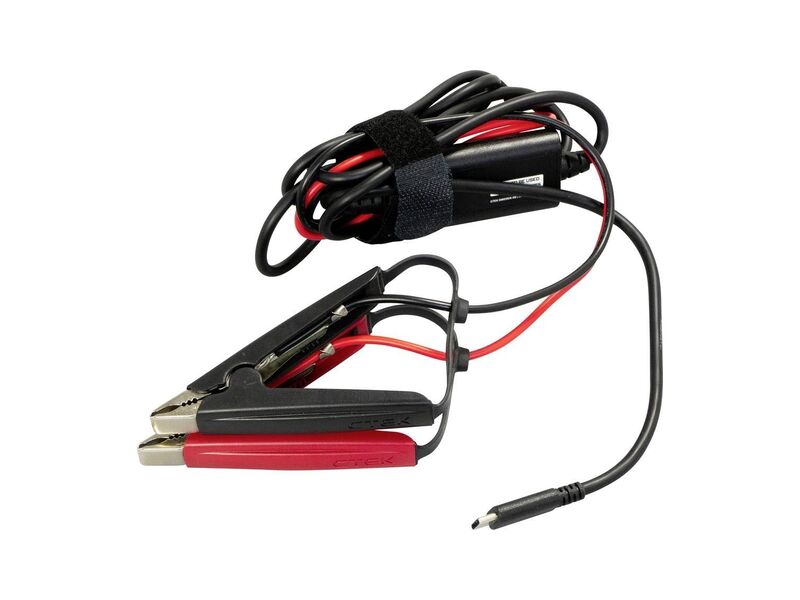
CTEK CS Free

See price and availability (15)

The first truly cordless 12V battery charger: the CTEK CS Free revives a flat battery in 15 minutes, with no socket, thanks to its internal battery and Adaptive Boost.

  • Type: Portable 12V charger + booster
  • Internal battery: 20 Ah lithium
  • Charge current: Up to 20A (Adaptive Boost)
  • Outputs: USB-C, USB-A (power bank function)
  • Cordless 12V charger that revives a battery in 15 min
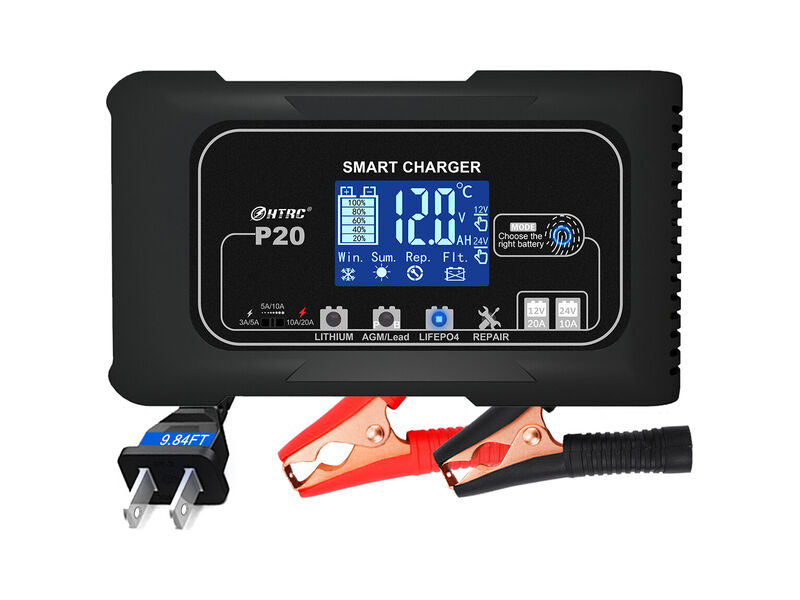
The CTEK CS Free is a fully portable 12V battery charger with a 20 Ah internal lithium battery. Thanks to its patented Adaptive Boost technology, it analyses the battery's condition and delivers up to 20A to restart a flat vehicle in 10 to 15 minutes, with no mains socket. It also works as a smart maintainer and a power bank via its USB-C and USB-A ports. It recharges from mains, a 12V socket or a solar panel, and holds its charge for up to a year.
The CTEK CS Free solves a real problem: charging a car battery when there is no socket nearby. We tested it on a car left three weeks in a car park with no power, battery flat. Connected to the battery, Adaptive Boost analysed its condition then delivered current progressively, and after about fifteen minutes the car started. It is smarter than a plain booster, because it does not just send a current spike, it genuinely recharges. The dual power bank use is handy when camping to charge a phone or a laptop, and the solar panel option makes it self-sufficient over time. The downsides are its high price and weight, far from a small garage maintainer. Some reviews also note fairly slow charging in maintainer use. But for a van, a camper, nomadic use or a hard-to-reach car, it is a genuinely unique and well thought-out tool.
View product page

Renogy DCC50S

£199.99 (9)

Recharge your auxiliary battery while driving AND from the sun: the Renogy DCC50S combines a 50A DC-DC charger and an MPPT solar controller in a single unit, made for vans.

  • Charge current: 50A (12V)
  • Inputs: Alternator + solar (built-in MPPT)
  • Power / efficiency: 660W, up to 94%
  • Compatibility: Lead-acid (flooded, Gel, AGM), lithium LiFePO4
  • 50A DC-DC charger and solar MPPT in a single unit
The Renogy DCC50S is a 12V dual-input on-board battery charger delivering 50A. It recharges the auxiliary (service) battery of a van or camper from the vehicle's alternator and/or from solar panels, thanks to a built-in MPPT controller. With 660W of power and 94% efficiency, it is compatible with lead-acid (flooded, Gel, AGM) and lithium LiFePO4 batteries. Its voltage-sensitive relay (VSR) isolates the two batteries, and an optional Bluetooth module allows monitoring via the app.
The Renogy DCC50S is one of the key pieces of equipment in a converted van, and in use it delivers on its promises. We installed it to recharge an auxiliary lithium battery, with one input from the alternator and another from roof-mounted solar panels. The result is impressive: while driving, the service battery recharges at 50A, far faster than with a simple split charger, and once parked, the MPPT controller takes over with solar. Having both functions in a single unit greatly simplifies installation and wiring. The voltage-sensitive relay cleanly isolates the starter battery, avoiding a dead battery in the morning. Adding the optional Bluetooth module lets you monitor charging on the app, which is very handy. Points to plan for: you must size the cables properly (50A is a lot of current) and set the right battery profile, and with a smart alternator an ignition wire is needed. But for a serious van or 4x4 installation, it is a sure bet.
View product page

← Back to Chargers

Related questions

With the charger unplugged from the mains, first attach the red clamp to the positive terminal, then the black clamp to the negative terminal or to a metal earth point on the chassis. Only then plug the charger into the mains. To disconnect, work in reverse order: mains, black clamp, red clamp.

Divide the capacity by the charger current, then add 20 per cent for losses. A flat 60 Ah battery on a 4 A charger therefore needs around 18 hours, against 9 hours with an 8 A model. Smart chargers deliberately slow at the end of the cycle, which stretches the total time a little.

Yes with a smart charger that has a maintenance mode, designed for exactly that: it switches to float as soon as the battery is full and then only supplies a trickle current. No with an old unregulated charger, which would keep charging and cause gassing and then plate damage.

Only if the charger offers a motorcycle mode or an adjustable current below 2 A. A motorcycle battery holds 6 to 14 Ah, and the rule is that charging current should not exceed 10 per cent of capacity. A car charger set to 8 A would therefore destroy a 9 Ah battery in a few hours.

Sometimes, if the sulphation is recent and mild. The reconditioning or desulphation mode applies higher voltage pulses to dissolve the lead sulphate crystals. On a battery left flat for several months, or with a shorted cell, no charger will work miracles.

With a modern smart charger, no: its regulation protects the on-board electronics, and disconnecting would wipe the memories of the ECU, the radio and the windows. With an old unregulated charger, on the other hand, disconnecting remains sensible, always starting with the negative terminal.