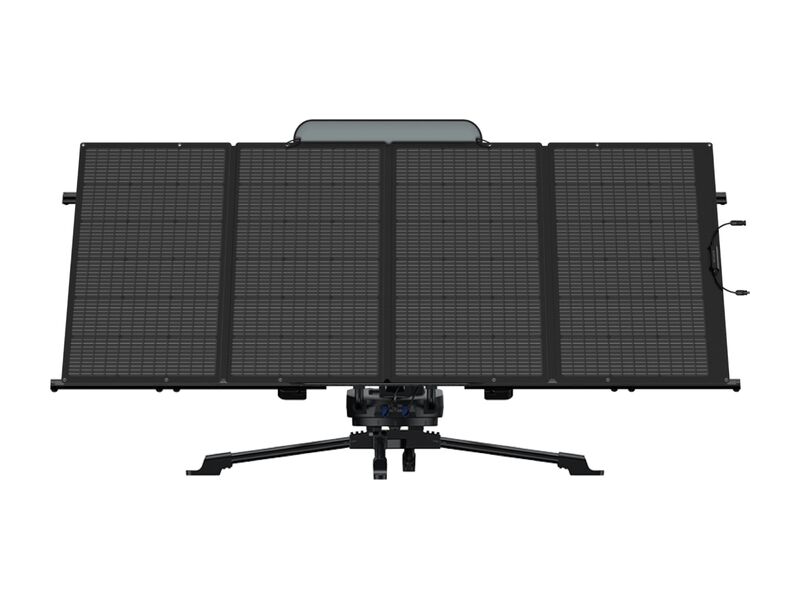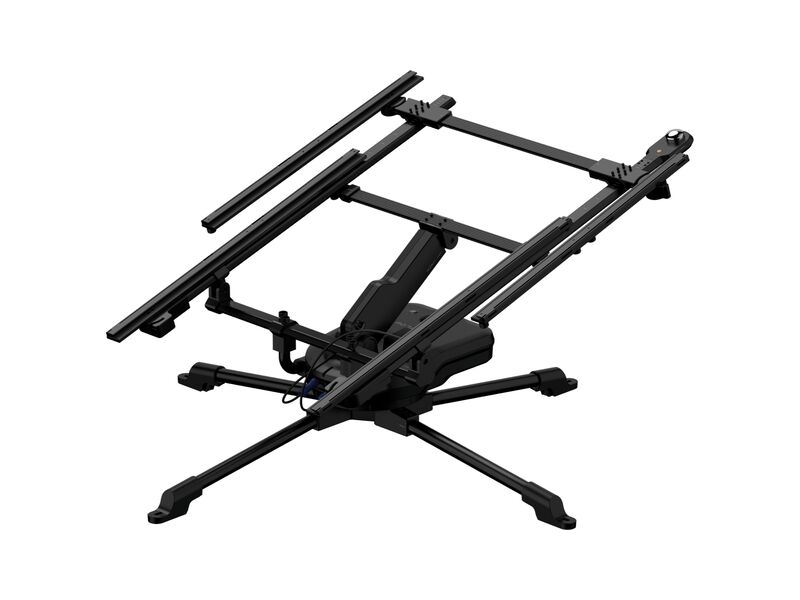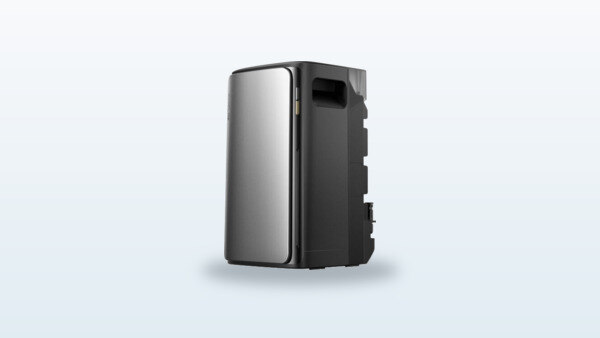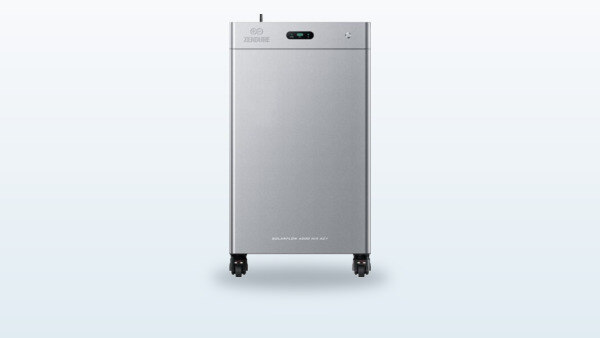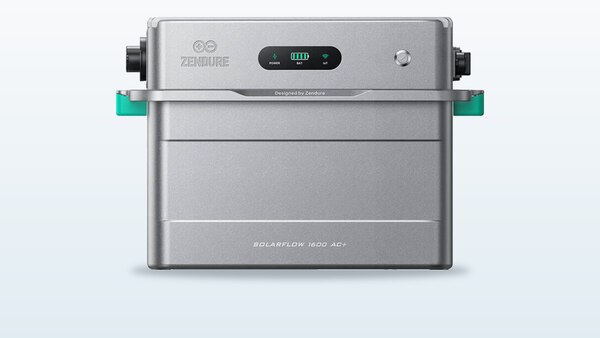
Discover in this part of our shop, our top picks of the best photovoltaic panels and other solar equipment in 2026.
Whether camping, on a sailboat, for your home, in a motorhome, or hiking far from civilisation, when you need to power your devices, solar energy can be one of the best solutions. As today's range of solar and photovoltaic panels is huge, we have decided to offer you our selection of the best solar equipment, after testing several dozen, whether flexible panels, rigid or foldable panels, 12V or 24V batteries for solar kits, or other related equipment. Discover the current top solar equipment and photovoltaic panels:
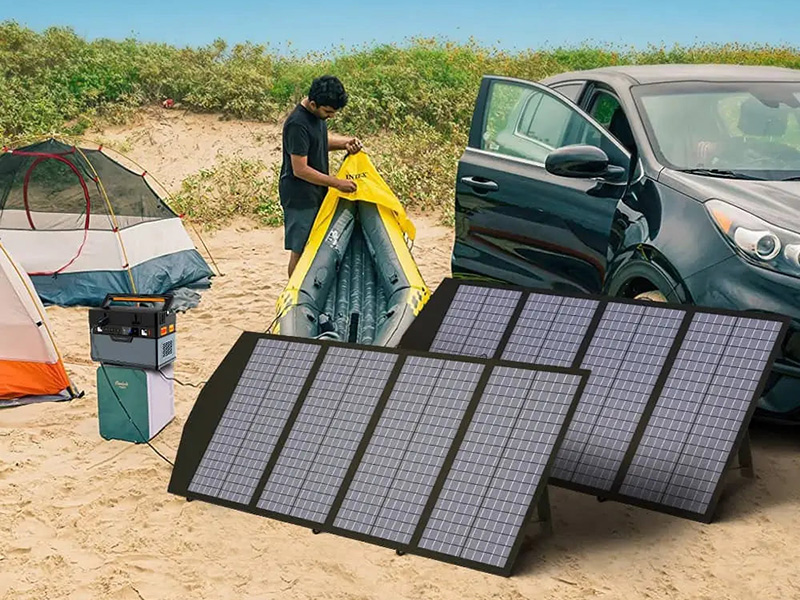
To hang on your backpack or to put where you want, one of the most practical ways to enjoy solar energy is the portable solar panel, which is foldable, lightweight and takes up very little space. Discover our selection of portable photovoltaic panels.
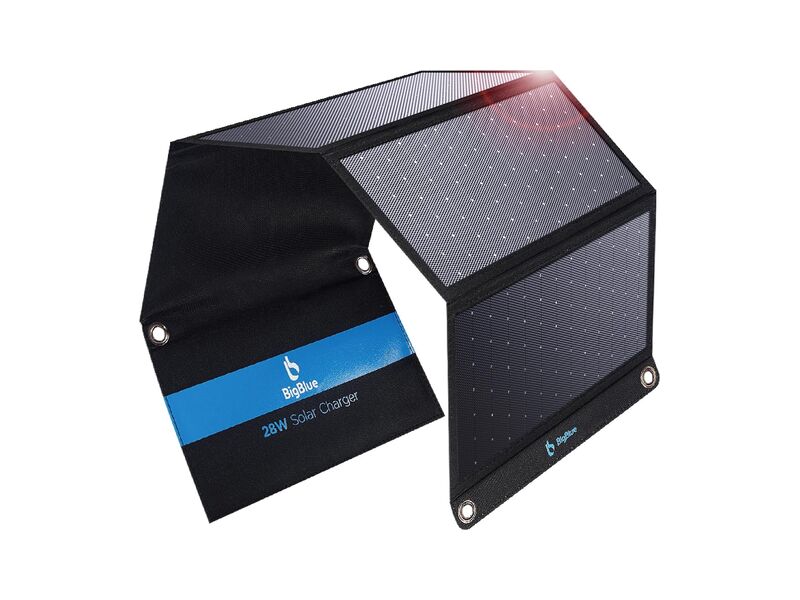
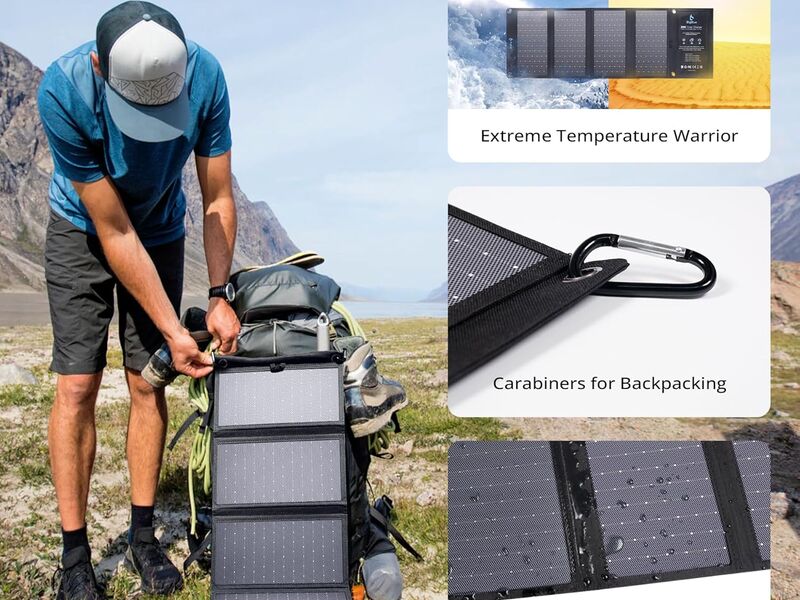
A panel that fits in your pack and charges three devices in the sun: the BigBlue 28W combines high-efficiency SunPower cells, three USB ports and weather resistance.
Power: 28W
Ports: 3 (2 USB-C + 1 USB-A), 5V/4.8A
Cells: SunPower monocrystalline (~24%)
Resistance: IP44 (rain, splashes)
3 devices charged at once, high-efficiency cells
The BigBlue 28W is a foldable solar charger designed for hiking, camping and emergencies. Its SunPower monocrystalline cells reach around 24% efficiency, among the best for a portable panel. It has three ports (2 USB-C and 1 USB-A) delivering up to 5V/4.8A total, enough to charge a phone, a power bank and earbuds at once. Light and resistant to splashes and rain (IP44), it folds down to the size of a magazine and clips onto your pack with its carabiners. Note: it has no internal battery, it charges directly in the sun.
The BigBlue 28W is one of those accessories you pack without a second thought and that earns its place. On multi-day hikes, I clip it to the back of my pack with the supplied carabiners: in full sun, it recharges an iPhone at a genuinely decent speed, often as fast as a wall socket, and lets me head out each morning with a full power bank. The three ports are a real plus when there are two of you, or to charge phone and external battery at the same time. The SunPower cells deliver on their promise: even under a hazy sky, it keeps producing, where cheaper panels collapse. The build inspires confidence, reinforced PET canvas, solid stitching, and the folded format slips into a pack pocket. Two honest caveats: it has no built-in battery, so you need to pair it with a power bank to store energy, and like any panel, orientation toward the sun changes everything (in the shade, output drops fast). For a reliable, affordable portable solar charger, it is a reference I recommend without hesitation.
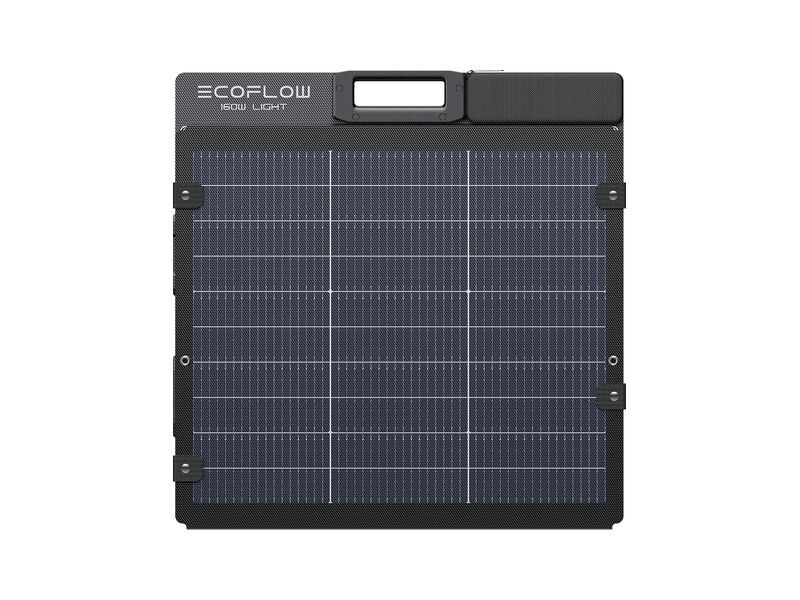
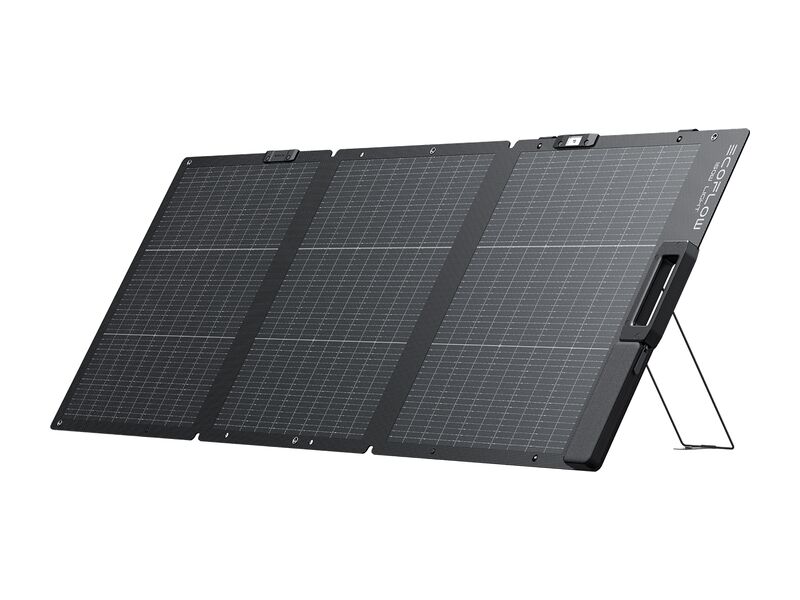
The EcoFlow 160W portable solar panel brings the range's bifacial design in a lighter, more affordable format: its front face catches direct sun, its rear face recovers reflected light, for a conversion efficiency of up to 25%. Foldable, it deploys on an adjustable 30 to 60° stand with a built-in solar angle guide. Its XT60 cable is built in for direct connection to EcoFlow power stations (River and Delta series). IP68 certified against water and dust and backed by a 5-year warranty, it is the balanced portable panel for camping, van life or solar top-up.
The EcoFlow 160W panel is the one we recommend to those who want the essentials of a good portable panel without going up in size or price. Lighter and more compact than the 220W, it travels easily and deploys in seconds on its adjustable stand. The bifacial design, taken from the high end, makes a difference as soon as you place it on a light surface, you gain watts effortlessly, and the built-in angle guide helps aim at the sun with no guesswork. The already-integrated XT60 cable plugs straight into our EcoFlow stations, no adapter to look for. While wild camping, it recharged our River in a few hours of full sun, and the IP68 rating let us leave it out without stress when a cloud bursts. Two honest caveats: 160W suits compact and mid-size stations best, for a large station you would prefer the 220W or two panels in parallel, and like any bifacial panel, maximum yield depends on good placement. But for a versatile, durable and well-thought-out panel, it is excellent value.
A bifacial panel that catches the sun on both sides: up to 25% efficiency, built-in XT60 cable, adjustable 30 to 60° stand and IP68 protection for every trip.
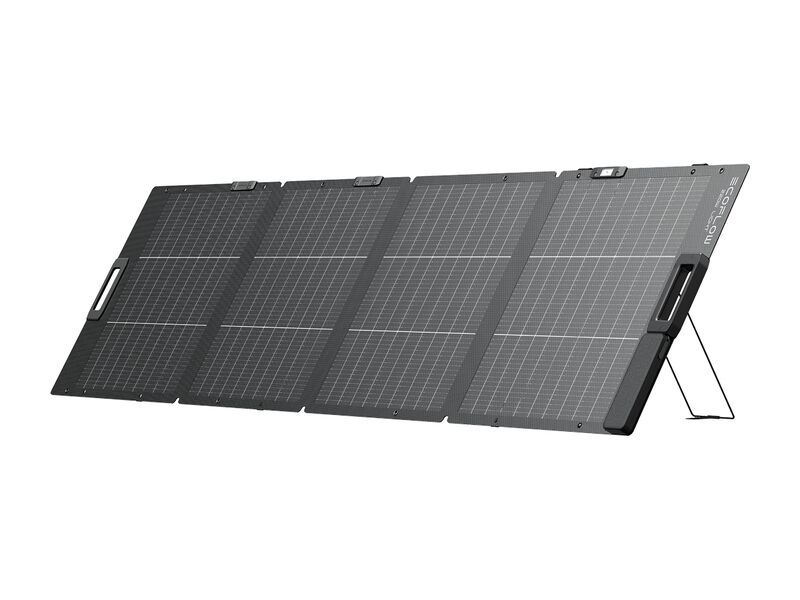
The EcoFlow 220W portable solar panel uses a bifacial design: its front face catches direct sun, its rear face recovers reflected light, for a conversion efficiency of up to 25%. Foldable and light, it travels easily and deploys on an adjustable 30 to 60° stand, with a built-in solar angle guide to aim for the best sunlight. Its XT60 cable is built in for easy storage and direct connection to EcoFlow power stations (River and Delta series). IP68 certified against water and dust, it carries a 5-year warranty, ready for camping, van life or off-grid autonomy.
We used this 220W panel to recharge a power station while wild camping, and the bifacial design really makes a difference: placed on a light surface or grass, it grabs extra watts through its rear face, and you feel the gain on recharge time compared with a classic panel of equivalent power. The built-in solar angle guide is clever, you tilt the stand between 30 and 60° until you find the best yield, no guesswork. The already-integrated XT60 cable avoids carrying adapters and plugs straight into our EcoFlow stations. It folds neatly into its case and stays transportable, though it must be said that at 220W it is not the lightest (around 9.5 kg). The IP68 rating is reassuring when the weather turns, we left it out in a shower with no issue. Two honest caveats: the 25% efficiency depends on ideal placement (a reflective surface behind), and its deployed footprint needs a bit of space. But to quickly recharge a station in the sun, it is an excellent portable panel.
The EcoFlow 400W portable solar panel is the most powerful in the portable range: its bifacial design catches the sun on both faces for a conversion efficiency of up to 25%, enough to recharge a large power station in record time. Despite its power, it stays foldable and transportable, and deploys on a three-angle stand (30°, 45°, 60°) with a built-in sun exposure guide. Its XT60 cable is built in for easy storage and direct connection to EcoFlow stations. IP68 certified against water and dust, it is the portable panel of choice for off-grid autonomy.
At 400W, this panel plays in a different league from classic portable models: it is the one you bring out to quickly recharge a large power station, and it delivers. In full sun, the bifacial design grabs extra watts from the rear, and we saw our station climb noticeably faster than with a 200W panel. The three-angle stand (30, 45, 60°) and the built-in exposure guide help find the best yield with no guesswork, and the already-in-place XT60 cable plugs straight into our EcoFlow stations. It stays foldable and transportable, but let's be clear: at 400W it is large once deployed and needs space, this is not a panel you carry for a simple day trip. The IP68 rating is reassuring when the weather turns. One point to note: EcoFlow advises against leaving it hung permanently outside or on a vehicle, it is made to be deployed then stowed, not for a fixed installation. To quickly recharge a large station while camping or off-grid, it is the most efficient panel in the range.
The compact, clever portable panel: bifacial design up to 25% efficiency, built-in XT60 cable, adjustable 30 to 60° stand and IP68 protection for every trip.
The EcoFlow 110W portable solar panel brings the range's bifacial design in a compact, affordable format: its front face catches direct sun, its rear face recovers reflected light, for a conversion efficiency of up to 25%. Light and foldable, it deploys on an adjustable 30 to 60° stand with a built-in sun exposure guide. Its XT60 cable is built in for direct connection to EcoFlow power stations (River and Delta series). IP68 certified against water and dust and backed by a 5-year warranty, it is the ideal solar companion to recharge a compact station as the sun moves.
The EcoFlow 110W panel is the solar companion you take without thinking: light, compact once folded, it slips easily into the van or the boot. Once deployed on its stand, you aim it between 30 and 60° using the exposure guide, and the bifacial design, taken from the more powerful models, grabs a few watts from the rear as soon as you place it on a light surface. The already-integrated XT60 cable plugs straight into our compact EcoFlow stations, no adapter. On a sunny camp, it kept a River charged effortlessly, and the IP68 rating let us leave it out without worry. Two honest caveats: 110W is a modest power, ideal for a top-up or a compact station but not enough to quickly recharge a large station (for that, aim for the 220W or 400W), and like any bifacial panel, maximum yield depends on good placement. But for a versatile, light and durable portable panel at a contained price, it is a very good entry into the range.
200W bifacial and barely 4.8 kg: the foldable solar panel that captures light on both faces to produce up to 10% more energy. The lightest in its class.
Power: 200 W bifacial (N-type cells)
Efficiency: Over 25%, +10% bifacial
Weight: 4.8 kg, foldable
Protection: IP68, adjustable stand 30-80°
200W bifacial, 4.8 kg, IP68
The Anker Solix PS200 is a 200 W bifacial portable solar panel that captures light on both faces: the rear side recovers reflected light (sand, snow, concrete) to add up to 10% energy. Its next-generation N-type cells exceed 25% efficiency, and it weighs just 4.8 kg, over 30% less than a classic 200W panel. IP68 certified, it resists water and dust, and its adjustable multi-angle stand (30 to 80°) orients it ideally toward the sun. Compatible with Anker Solix stations (F2000, C1000X, C800X, C300X) and any generator with an MC4 input.
The PS200 wowed us on two points: its lightness and its bifacial design. At 4.8 kg, it is one of the rare 200 W panels you carry without complaint, and the adjustable stand is genuinely well thought out, you set the angle in seconds depending on the sun's position. The rear face is no gimmick: placed on light sand, a concrete terrace or snow, you really do gain a few percent of output, which counts at the end of the day. The N-type cells keep their promises in good weather, and the IP68 rating is reassuring, you do not stress if a shower catches the bivouac. Compatibility with Anker Solix stations (F2000, C1000X, C800X, C300X) via MC4 is a real plus to stay in the ecosystem. Two honest caveats: like any portable panel, orientation remains decisive and output drops fast in the shade, and the bifacial gain depends heavily on the ground surface. But for a 200 W panel that is light, rugged and smart all at once, it is a very fine success.
A pocket solar panel with a USB-C output: charge your phone, tablet or laptop directly in the sun, with no station, in a format as thin as a book.
Power: 60W, direct USB-C output
Efficiency: Up to 25% (TOPCon technology)
Format: 4-fold, 317 x 309 x 45 mm folded
Durability: ETFE, fiberglass, IP68
USB-C output, ultra-compact, TOPCon 25%
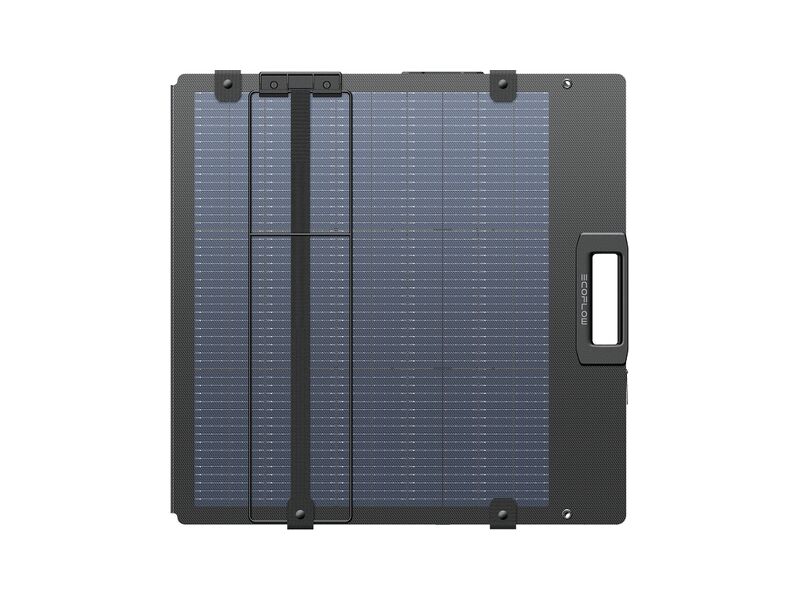
The EcoFlow 60W (USB-C) portable solar panel is designed to charge your devices directly in the sun: fitted with a USB-C output port, it powers phones, laptops, air pumps and more, with no power station. Its four-fold structure measures just 317 x 309 x 45 mm when folded, as thin as a book, and slips into a bag. Thanks to TOPCon solar technology, a first on compact panels, it reaches a conversion efficiency of up to 25%. Rugged (fiberglass circuits, ETFE coating) and IP68 certified, it withstands harsh conditions: the ultra-portable solar companion.
This 60W panel won us over for its different approach: here, no need for a power station, you plug the phone or laptop straight into its USB-C output and charge in the sun. It is strikingly simple on a hike or a light camp, you hang it on the bag or set it facing the sun, and devices climb back up. The format is its big asset: folded in four, it is as thin as a book and slips in anywhere, we carried it without even feeling it. The TOPCon technology, rare on such a compact panel, pushes efficiency up to 25%, which shows in charging speed compared with small entry-level panels. The fiberglass construction and ETFE coating, with IP68 certification, are reassuring for outdoor exposure. Two honest caveats: 60W is a top-up power, perfect for USB devices but not enough to recharge a large battery, and real yield depends heavily on orientation and sunlight. But to charge your gadgets directly in the sun in a pocket format, it is exactly what you need.
200W of foldable solar power to take anywhere: high-efficiency monocrystalline cells, tough ETFE coating and adjustable kickstands to capture the best of the sun.
Power: 200 W (monocrystalline)
Efficiency: Up to 23.4%
Protection: IP65, ETFE coating
Connectivity: MC4, adjustable kickstands
200W foldable, ETFE, adjustable stands
The Bluetti MP200 is a 200 W portable solar panel designed to recharge your power stations in the sun. Its monocrystalline cells reach up to 23.4% efficiency, well above ordinary panels. Foldable into four sections, it carries like a briefcase and deploys in under a minute thanks to its adjustable kickstands that angle it toward the sun. Its durable ETFE coating and IP65 rating let it shrug off dust and splashes. With a standard MC4 output, it powers Bluetti stations but also most solar generators on the market.
The MP200 does exactly what you want from a good portable panel: it unfolds in seconds, the kickstands hold well even on uneven ground, and it is easy to angle south to maximise the harvest. In strong sun, you get close to the rated figures, enough to fill a 1000 Wh station over the day without trouble. We like the briefcase format with its handle, easy to slip into the boot for a van weekend or a camping trip. The ETFE coating inspires confidence and holds up to repeated handling. Two honest caveats: like any panel, output drops fast as soon as a cloud passes or a shadow crosses the surface, so you have to reposition it regularly, and its 9 kg or so are noticeable on a long hike. But for van, camping or home backup use, with its universal MC4 plug, it is a versatile and reliable panel that recharges Bluetti stations just as well as those of other brands.
60W of solar power in barely 1.4 kg: the ultralight foldable panel that slips into your bag to recharge phone, power bank and small stations out in nature.
Power: 60 W (monocrystalline)
Efficiency: Up to 24.7%
Weight: 1.4 kg, foldable
Protection: IP65, ETFE coating
60W, just 1.4 kg, ultra-portable
The Bluetti PV60 is a 60 W portable solar panel built for mobility. At just 1.4 kg, it folds into a compact format that slips easily into a backpack, onto a bike or into a tent. Its monocrystalline cells reach up to 24.7% efficiency, and its ETFE coating combined with an IP65 rating let it face dust and splashes. Ideal for recharging a phone, a power bank or a small Bluetti station (AC50P, AC180P, Premium 30 V2) on a hike, a bivouac or a day out.
The PV60 plays the lightness card and plays it well: at 1.4 kg, you take it without a second thought, folded in the backpack or strapped to a bike. Deployed, it is plenty to keep a phone, a power bank or a small station charged during a bivouac or a long day outdoors. The ETFE coating and finish inspire confidence for a panel this size, and the IP65 rating is reassuring in case of morning dew or a short shower. You do need realistic expectations, though: 60 W is meant for portable top-ups, not for recharging a big station in a few hours, and like any small panel, it is very sensitive to orientation and shadows, output drops as soon as a cloud passes or a branch casts its shade. Well oriented in full sun, it nonetheless keeps its promises. For the hiker, cyclist or camper looking for genuinely portable solar for their small devices, it is a discreet and effective companion.
200W of foldable solar power, a third lighter than average: the versatile portable panel that recharges your station in the sun, compatible with most generators.
Power: 200 W
Efficiency: Up to 22%
Weight: About 1/3 lighter, foldable
Compatibility: Anderson adapters, multi-connector
200W foldable, light, multi-compatible
The Allpowers SP033 is a 200 W portable solar panel that aims for the best value. With an efficiency of up to 22% and a weight about a third lower than a classic panel of the same power, it efficiently recharges your power stations in the sun. Foldable and fitted with kickstands, it deploys in a minute and angles toward the sun. Its universal connectivity (with Anderson adapters and various connectors) makes it compatible with most solar generators on the market. A versatile portable panel for camping, the van or backup.
The SP033 plays the value card, and plays it well. Deployed, it unfolds in a minute, the kickstands hold decently, and it is easy to angle south to maximise the harvest. In strong sun, it easily recharges a several-hundred-Wh station over the day, enough to clearly extend runtime in a van or camping. We really appreciate its lightness, noticeably lower than classic 200 W panels, which changes everything when you have to move or store it. Its versatile connectivity, with Anderson adapters and various connectors supplied, makes it compatible with the vast majority of stations on the market, a real asset. Two honest caveats: like any panel, output drops fast as soon as a cloud passes or a shadow crosses the surface, so you have to reposition it, and the rated 200 W remains a theoretical value reached only in ideal conditions. To recharge a station in the sun without breaking the bank, it is an excellent choice.
100W of solar power in a light, foldable panel with kickstands and USB outputs: enough to recharge a Jackery station or your devices straight from the sun.
The Jackery SolarSaga 100W is a portable, foldable solar panel with monocrystalline cells, offering a conversion efficiency of up to 23%. Designed to recharge Jackery Explorer power stations via its DC output, it also has USB-C and USB-A ports to power smartphones, tablets and cameras directly. Foldable with a handle and adjustable built-in kickstands, splash-resistant, it deploys in seconds and carries easily while camping or in a van.
The SolarSaga 100W is the logical companion for a Jackery station, and it does the job with real seriousness. Unfolded, it sets up in seconds thanks to its built-in kickstands, and well-aimed in full sun it easily climbs to around 70 to 85 real watts, enough to recharge an Explorer 300 or 500 within the day. What we like most is the versatility: on top of the DC output for stations, its USB-C and USB-A ports let you plug in a phone or a tablet directly, handy on a hike when you leave the station behind. Foldable and fitted with a handle, it slides flat into the boot. Two honest gripes: like any panel, its output drops fast under hazy skies, and you have to re-aim it at the sun regularly to get the most out of it. For reliable, portable solar charging, it is a safe bet.
The smallest EcoFlow solar panel with a USB-C output: charge your phone or tablet directly in the sun, in a mini format as thin as a book.
Power: 45W, direct USB-C output
Efficiency: Up to 25% (TOPCon technology)
Format: 4-fold, 221 x 310 x 41 mm folded
Durability: ETFE, fiberglass, IP68
USB-C output, mini format, TOPCon 25%
The EcoFlow 45W (USB-C) portable solar panel is the most compact in the range: fitted with a USB-C output port, it charges phones, tablets, laptops and air pumps directly in the sun, with no power station. Its four-fold structure measures just 221 x 310 x 41 mm when folded, as thin as a book, and slips in anywhere. Thanks to TOPCon solar technology, a first on mini portable panels, it reaches a conversion efficiency of up to 25%. Rugged (fiberglass circuits, ETFE coating) and IP68 certified, it is the pocket solar charger to take everywhere.
The 45W is the newest addition to the EcoFlow solar range, and it is the one you take when every gram counts. You plug the phone straight into its USB-C output and charge in the sun, with no station: ideal on a hike, where it slips into the bag without weighing anything or taking up space, as thin as a book once folded in four. Despite its mini size, the TOPCon technology does the job, you gain charging speed compared with an entry-level solar charger, and the fiberglass construction with ETFE coating and IP68 certification make it reassuring outdoors. We hung it on the backpack for a full day of walking, and the phone stayed charged without us worrying about it. Two honest caveats: 45W is a top-up power reserved for USB devices, not enough to recharge a large-capacity battery, and in overcast weather the output drops noticeably, as on any small panel. But to charge your gadgets in the sun in the smallest possible format, it is exactly what you need.
A panel that captures light from both sides: the dual-sided Jackery SolarSaga 80W reaches 25% efficiency, is waterproof (IP68) and folds to follow you anywhere.
Power: 80W
Technology: Dual-sided monocrystalline (25%)
Protection: IP68, 2.8mm toughened glass
Weight: About 5 kg (foldable)
Dual-sided 25% efficiency panel, light and waterproof
The Jackery SolarSaga 80W is a foldable, portable solar panel with a dual-sided monocrystalline design. Thanks to extra-white back glass, it captures light from both sides and reaches a 25% conversion efficiency, among the highest on the market. Light (about 5 kg) with its built-in handle, it is IP68 certified (waterproof and dustproof) and made of 2.8mm toughened glass. Compatible with Jackery power stations, it comes with a 2m extension cable and a carrying case.
The Jackery SolarSaga 80W stands out for its dual-sided technology, still rare on portable panels. By capturing light from the front and the back (thanks to the extra-white glass on the rear), it gains efficiency and climbs to 25% conversion, which is excellent for a portable panel. In use, it efficiently recharges a Jackery station in full sun, and its build inspires confidence: toughened glass, corners protected by rubber bumpers, IP68 certification making it impervious to rain and dust. Its built-in handle and contained weight (around 5 kg) make it easy to carry hiking or camping. Points to note: like any solar panel, its real output depends heavily on sunlight and orientation (you rarely get the theoretical 80W), and above all this model is mainly distributed in the North American market, so barely available in France. But technically, it is an excellent portable panel, rugged and high-performing.
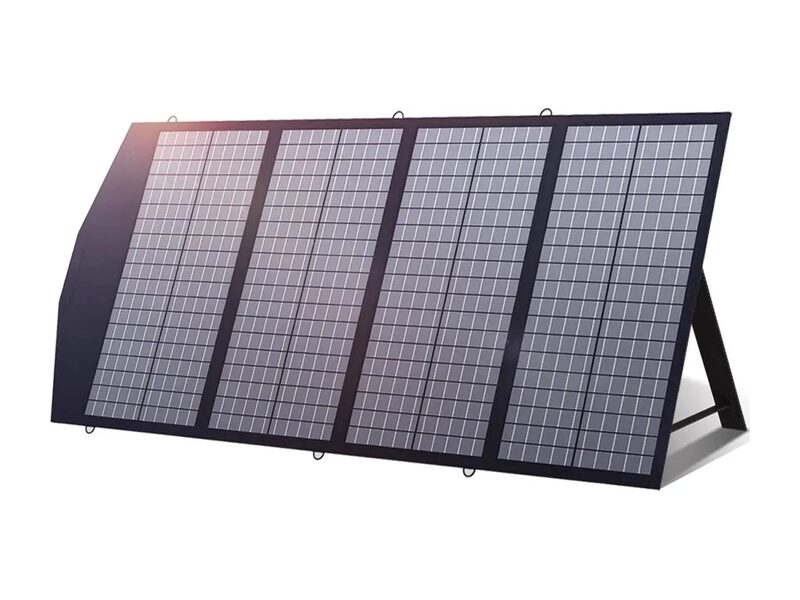
The Allpowers Solax SE200 portable solar panel delivers 200 W thanks to high-efficiency monocrystalline ETFE cells (23 to 25%). Foldable, easy to carry and fitted with angle-adjustable kickstands, it deploys in seconds to recharge a power station while camping, in a van or during an emergency. Its one-piece laminated build and IP68 rating protect it from rain, dust and knocks. Compatible with Allpowers stations (R600, R1500, S300 Plus...) and many other brands.
We used the Solax SE200 over several outings, plugged into different power stations, and it delivers. Deployed facing the sun with the kickstands set at the right angle, it ramps up quickly: in good weather it really gets close to the advertised 200 W, enough to fill a 300 Wh station in two to three hours. The efficiency of the monocrystalline cells shows, especially late in the day as the light fades. On the practical side, we like the foldable format that stows away easily, and the sturdy kickstands that keep it well aimed even on uneven ground. The laminated finish and IP68 rating are reassuring: a shower does not worry it. Two honest reservations: unfolded, it is bulky (over two metres long), and its weight is that of a real 200 W panel, you do not carry it for hours. But to recharge your station off-grid, without relying on the mains, it is an efficient, well-built companion at a contained price.
The rare portable panel that stores what it captures: the BioLite SolarPanel 10+ has a 3200 mAh onboard battery and a 360° kickstand to charge day and night.
Power: 10W
Battery: Onboard 3200 mAh
Output: USB-A
Aiming: 360° kickstand + sundial
Portable panel with onboard battery that stores energy
The BioLite SolarPanel 10+ is a 10W foldable solar panel with a rare feature: a 3200 mAh onboard battery. It captures energy by day and stores it to deliver later, even at night, through its USB-A port. Its 360° kickstand and built-in sundial make it easy to angle optimally toward the sun on uneven ground. Light (550 g) and rugged, it suits camping, bivouacs and outdoor weekends. Ideal for recharging a smartphone far from any socket, with the bonus of an energy buffer that smooths over cloudy spells.
The BioLite SolarPanel 10+ stands out for a clever idea: a 3200 mAh battery built right into the panel. In practice, that is very handy at a bivouac, you set it on a rock or hang it from the tent with the 360° kickstand, aim it with the little sundial (a centered shadow means optimal orientation), and let it work through the day. In the evening, you draw on the stored charge to recharge your phone, even after the sun has set. That energy buffer also smooths over cloudy spells, where a plain panel simply stops. BioLite's finish is careful, the metal kickstand is solid and the format stays compact. Two honest reservations, which explain mixed customer reviews: first, 10W and 3200 mAh are enough for a smartphone but not to quickly charge a tablet or a large power bank; second, in prolonged full sun, the battery can heat up and temporarily go into protection above around 38°C. Kept within its intended use (recharging a smartphone on light camping trips), it is a smart and practical portable panel.
200W and bifacial technology at 26.7% efficiency: Jackery's premium solar panel to recharge a station far faster, even under cloudy skies.
Power: 200W (bifacial IBC cells)
Efficiency: Up to 26.7%
Waterproofing: IP68, weatherproof
Design: Foldable, built-in kickstands, DC output
Bifacial 200W at 26.7% efficiency
The Jackery SolarSaga 200W is a premium portable, foldable solar panel with bifacial IBC cells, offering a conversion efficiency of up to 26.7%, among the best on the market. Its rear side captures reflected light for extra output. IP68 waterproof and built to withstand the weather, it powers Jackery Explorer stations via its DC output and deploys with built-in kickstands. A powerful panel for fast solar charging in an RV or off-grid.
The SolarSaga 200W clearly plays in the premium panel league. Its bifacial technology is not just a marketing claim: placed on a light surface or sand, we saw output climb noticeably thanks to the rear side. In full sun, it charges a large station far faster than a 100W, and its 26.7% efficiency shows even when the sky hazes over a little. The IP68 rating is reassuring: we left it out under a passing shower without worry. In return, it is a large, heavy panel (8 kg), better suited to an RV or a semi-fixed setup than to hiking. It also has no USB outputs, being designed to recharge a station via its DC output. For anyone wanting serious, fast solar charging, it is one of the best portable panels on the market.
21W foldable and ultralight: the little solar panel that maintains a 12V battery and charges phone or power bank anywhere, with no socket or bulk.
Power: 21 W (monocrystalline)
Outputs: 12V and USB 5V
Format: Foldable, ultralight
Use: 12V battery maintenance, phone, power bank
21W foldable, 12V + USB outputs, light
The Allpowers SP001 is an ultralight 21 W foldable solar panel, built for portable top-ups. With its 12V and USB 5V outputs, it maintains the 12V battery of a parked car, motorcycle or motorhome, or directly charges a phone and power bank in the sun. Folding into three sections, it slips into a bag or sits on a dashboard and deploys in an instant. Light, discreet and practical, it is a clever accessory to avoid flat batteries and keep your small devices charged on the move.
The SP001 is a clever little accessory you end up always keeping in the boot. Its primary purpose, maintaining a parked 12V battery (a rarely-used car, a motorcycle, a motorhome in storage), it fulfils very well: placed on the dashboard or windscreen, it offsets self-discharge and avoids the nasty surprise of a flat battery. Its USB 5V outputs also help out charging a phone or power bank during a break out in nature. We like its foldable format and featherweight, which make it easy to take along and store. The limits are obvious and accepted: with 21 W, you are in top-up and maintenance territory, not fast charging, and like any panel, orientation and sunlight make all the difference. To keep a battery charged or help out your small devices, at this sale price, it is a genuinely useful accessory.
60W of light, foldable solar power: the portable panel that recharges phone, power bank and small station in the sun, with up to 25% efficiency.
Power: 60 W (monocrystalline)
Efficiency: Up to 25%
Format: Foldable and light
Use: Phone, power bank, small station
60W foldable, 25% efficiency, light
The Allpowers Solax SE60 is a 60 W portable solar panel built for mobility. Its monocrystalline cells reach a conversion efficiency of up to 25%, a very good figure for this format. Foldable and light, it slips into a backpack and deploys in seconds to recharge a phone, a power bank or a small power station in the sun. Rugged and easy to carry, it is an ideal companion for hiking, bivouacs, camping or a day out.
The Solax SE60 bets on lightness and simplicity, and it delivers. You unfold it in seconds, angle it toward the sun, and it easily keeps a phone, a power bank or a small station charged during a bivouac or a long day outdoors. Its stated efficiency of up to 25% is a real plus for a panel this size: in full sun, the output is there. The foldable format is easy to store and carry, and the build inspires confidence. Like any small panel, you need realistic expectations: 60 W is meant for portable top-ups, not for quickly recharging a big station, and output drops as soon as a cloud passes or a shadow crosses the surface, so you have to reposition it regularly. For the hiker, camper or traveller looking for genuinely portable solar for their small devices, at this sale price, it is excellent value.
200W in CIGS thin-film flexible to 360 degrees, shade-tolerant and ultra-light: the BougeRV panel fits on the curved roofs of RVs, vans or boats.
Power: 200W (CIGS thin-film technology)
Flexibility: 360 degrees, fits curved surfaces
CIGS asset: Shade and heat tolerance
Format: Ultra-light (~2.7 kg), 2.5 mm, IP68
Flexible 360 degree CIGS, shade-tolerant
The BougeRV CIGS 200W is a new-generation flexible solar panel, based on CIGS thin-film technology rather than conventional monocrystalline silicon. The result: 360 degree flexibility, excellent tolerance to partial shading and heat, and a featherweight (about 2.7 kg) at 2.5 mm thick. IP68 waterproof and pre-drilled for mounting, it installs on curved or uneven surfaces (RV, van, boat, cabin roof) where a rigid panel cannot go.
The BougeRV CIGS 200W does not play in the same category as conventional flexible panels. Its CIGS (thin-film) technology changes the game on two points you really notice in use: first the flexibility, impressive, letting it wrap onto a curved van roof where a rigid mono panel would be impossible to fit; second the shade tolerance, where CIGS keeps producing far more stably when a branch or a roof accessory casts a partial shadow, while a mono panel collapses. Its featherweight and thinness make it easy to handle and stick down, and the IP68 rating is reassuring in marine or rainy use. In return, CIGS efficiency per square metre stays lower than a good mono: at equal surface, it produces a little less in full direct sun, and its price is higher. But for mounting on a curved or shade-prone surface, it is a genuinely clever solution.
Plenty of solar power, portable anywhere: two 100W panels on a folding frame, with a built-in controller and a carry case, ready to charge your batteries.
When a small foldable panel lacks power and a fixed panel is too bulky to move, the solar suitcase is the ideal solution. Renogy's brings together two 100W monocrystalline panels on a folding steel frame, pre-wired with a Renogy Voyager 20A charge controller and MC4 cables, so it is usable straight away. Rugged and well designed, supplied in a semi-rigid carry case, it easily charges a 12V battery or a power station in a motorhome, a van, on a boat or at an off-grid site.
Unlike the photovoltaic panels presented in the previous category, the solar panels presented below are not intended to be moved, but to be fixed on the roof of a house or permanently installed on an isolated site.
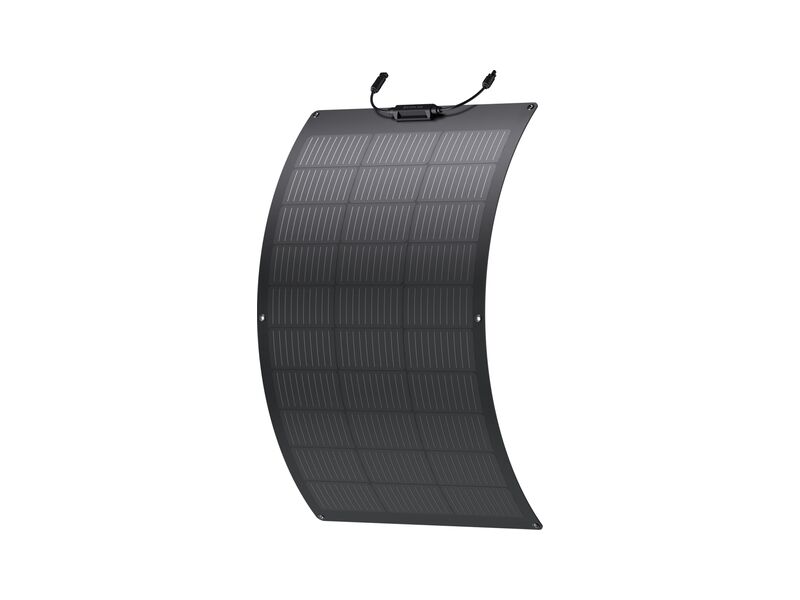
Ultra-light (2.3 kg) and flexible up to 258°, it hugs the roof of a van, a boat or a motorhome: the discreet solar panel that disappears once fitted.
Power: 100W, flexible panel
Weight: 2.3 kg (ultra-light)
Flexibility: Curve up to 258°
Durability: IP68 rating, universal compatibility
Flexible 258°, 2.3 kg, hugs surfaces
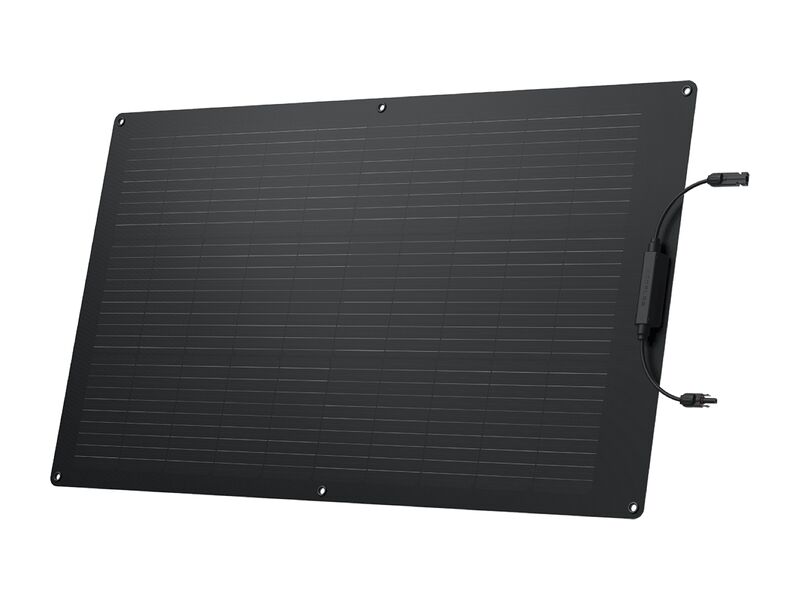
The EcoFlow 100W flexible solar panel is designed for fixed installations on curved surfaces: van, motorhome, boat or cabin roofs. It weighs just 2.3 kg and curves up to 258°, letting it easily hug almost any shape where a rigid panel could not fit. Thin and discreet, it fixes flat against the surface for a clean, aerodynamic look. Its IP68 certification protects it durably against water and dust, and its universal compatibility lets it fit most solar setups, EcoFlow or third-party. The light, permanent solar solution for portable autonomy.
This 100W flexible panel won us over for everything a rigid panel cannot do: permanent installation on a curved surface. On the domed roof of a van, it lay flat effortlessly thanks to its flexibility (up to 258°), and once fixed, you forget it completely, it does not stick out, catch the wind or break the vehicle's line. Its 2.3 kg are a real asset, you can put it on light structures without worrying about weight, unlike a framed rigid panel. In use, 100W is enough to maintain a leisure battery or give a constant daytime top-up, ideal to never run flat on a trip. The IP68 rating is reassuring for permanent exposure to the weather. Two honest caveats: like any flexible panel, it must stay well ventilated (laid directly on a dark surface, it heats up and loses a little yield), and it has no stand or kickstand, this is not a foldable portable panel but a permanent solution. To fit out a van, a boat or a cabin without adding weight or drilling, it is exactly what you need.
100W monocrystalline with N-type cells at 25% efficiency and a rugged aluminium frame: the Renogy rigid panel is the reliable base of any fixed solar setup.
Power: 100W (N-type 16BB monocrystalline)
Efficiency: Up to 25%
Frame: Anodised aluminium, tempered glass
Format: Rigid, about 5.9 kg, 86.6 x 57.9 cm
N-type cells at 25% efficiency, rugged frame
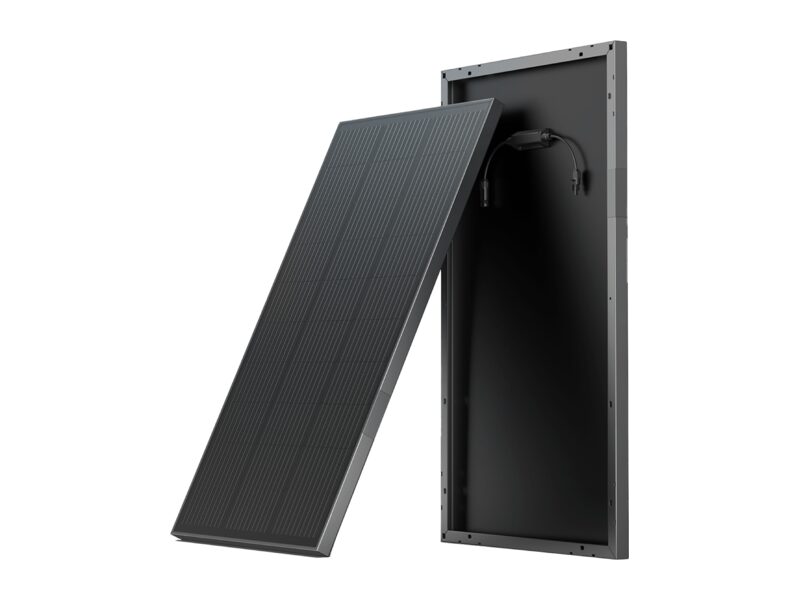
The Renogy 100W 12V rigid solar panel is a monocrystalline module with N-type 16BB cells, offering a conversion efficiency of up to 25%, among the best in its class. Its anodised aluminium frame and tempered glass make it rugged and durable, for a fixed installation on an RV roof, a van, a cabin or a boat. Light for a rigid panel (about 5.9 kg), it produces up to 500Wh per day depending on sunlight and comes with a long power warranty.
The Renogy 100W rigid panel is a classic of fixed solar setups, and its latest N-type cell version marks a real step forward. Its efficiency of up to 25% shows: at equal surface, it produces noticeably more than a conventional PERC panel, which matters when roof space on a van is limited. The aluminium frame and tempered glass inspire confidence for an installation that will stay outside for years, and we like that it stays relatively light (about 5.9 kg) for a rigid panel. Its real output obviously depends on sunlight and orientation, but well-aimed at the sun, it easily charges a leisure battery via an MPPT controller. The only things to plan for are the installation (mounting, MC4 wiring, a separately supplied controller) and needing several panels for a large setup. For the base of a reliable, durable solar kit, it is a safe bet.
Fit two EcoFlow 400W rigid solar panels at home or on your RV: 23% efficiency, IP68 rating and long-lasting weather resistance built to last.
Power: 400W per panel (x2 included)
Efficiency: 23%, monocrystalline cells
Waterproofing: IP68
Weight: 21.8 kg per panel
23% efficiency, IP68 rated, withstands 209 km/h winds
Sold as a pack of two panels, the EcoFlow 400W rigid solar kit uses monocrystalline cells rated at 23% efficiency to charge your PV system, RV or EcoFlow Power Kit faster. Its anti-corrosion aluminium frame and IP68 rating let it withstand winds up to 209 km/h and 551 kg of snow per square metre. A durable solution built for a fixed install on a roof, wall or outdoor structure, backed by up to a 10-year warranty.
We tested these rigid panels mounted flat on a garden shed roof, in an area that is not exactly known for constant sunshine. Result: even under a hazy sky, output stays decent, and as soon as the sun breaks through, current climbs fast thanks to EcoFlow's claimed 23% efficiency. What catches you off guard on unboxing is the weight: each panel is close to 22 kg, so handling one alone once it is up on a roof or fence is not an option. Installation itself is straightforward if you have done some DIY before: pre-drilled holes, a sturdy rigid aluminium frame, a reliable solar connector on the back. Small downside: neither the mounting feet nor the XT60i cable needed to plug directly into an EcoFlow power station are included, so budget for those separately. Over time, the IP68 rating is genuinely reassuring: rain, salt spray, frost, none of it seems to dent performance across the seasons. For a fixed, long-term install this is a very solid pick; for daily portable use, EcoFlow's foldable panels are the better fit.
Two 500W dual-glass bifacial panels that catch light on both faces: up to 1300 Wp combined, 22.5% efficiency and genuine all-weather toughness.
Power: 2 x 500W bifacial (up to 1300 Wp)
Efficiency: Up to 22.5%, dual-glass
Toughness: Wind 2400 Pa, snow 5400 Pa, IP68
Capture: Both sides, excellent in low light
High-efficiency bifacial for balcony and roof
This set of two Zendure 500W bifacial solar panels catches light on the front and the back, for a combined potential of up to 1300 Wp depending on ground reflection. Monocrystalline dual-glass, with a claimed efficiency of up to 22.5%, they excel in low light and withstand strong winds (2400 Pa) and snow loads (5400 Pa). IP68 junction box and MC4 connectors: a rigid, durable base for a balcony, a terrace or a flat roof.
Bifacial changes the game when you have a bright surface behind the panels (light ground, white railing, gravel, snow): by also catching the light reflected onto the rear face, these Zendure modules recover extra output that ordinary panels leave on the table. On paper two 500W modules, but up to 1300 Wp combined in good reflection conditions: the gain is real at midday and in clear weather. The dual-glass build inspires confidence over time, and the wind (2400 Pa) and snow (5400 Pa) resistance certifications confirm they are built to stay outdoors all year. The 22.5% efficiency and the good low-light behaviour (morning, overcast sky) are there. Two caveats: these are rigid, heavy panels, so they need solid mounting and a suitable frame, ideally slightly raised to let light reach the rear face; and without a reflective surface behind, the bifacial bonus stays modest. But to maximise output on a balcony or a flat roof, it is an excellent choice.
Two 210W flexible solar panels that hug the curves of a balcony or roof: 23% efficiency, bendable to 213 degrees, IP67 and just 4.3 kg each.
Power: 420W (2 x 210W monocrystalline)
Efficiency: Up to 23%
Flexibility: Bendable up to 213 degrees
Weight: 4.3 kg per panel, IP67
Light flexible panels, 12-year warranty
This set of two Zendure 210W flexible solar panels (420W total) is built for balcony solar and curved surfaces. Monocrystalline with a claimed 23% efficiency, they bend up to 213 degrees to fit a rounded railing or a curved roof, while staying very light (4.3 kg per panel). Their IP67 junction box and MC4 connectors make them reliable in the rain, easy to fit with no heavy drilling, and backed by a 12-year warranty.
These flexible panels solve a real balcony-solar problem: mounting on a rounded railing or a surface that is not perfectly flat. With a claimed flexibility of up to 213 degrees, they fit where a rigid panel would refuse to sit, and their featherweight (4.3 kg per panel) lets you handle and fix them on your own, with no heavy drilling. In use, you appreciate the matte finish and the ETFE surface that lets light through well; the 23% efficiency is very decent for a flexible panel, and output holds up even under a hazy sky. The IP67 junction box and MC4 connectors plug straight into a microinverter or a SolarFlow hub, with no adapter. Two honest caveats: like any flexible panel, they run hotter than a well-ventilated rigid one, which nibbles at output in high summer, and they remain more fragile to repeated bending. But to dress a balcony or a garden shed discreetly and lightly, with a 12-year warranty, this pair of 210W panels is an excellent choice.
If the quality of your photovoltaic panels is essential to have an efficient solar kit, you should not underestimate the importance of the batteries you choose. This is where your energy will be stored until you need it. Here is our selection of batteries for solar kits.
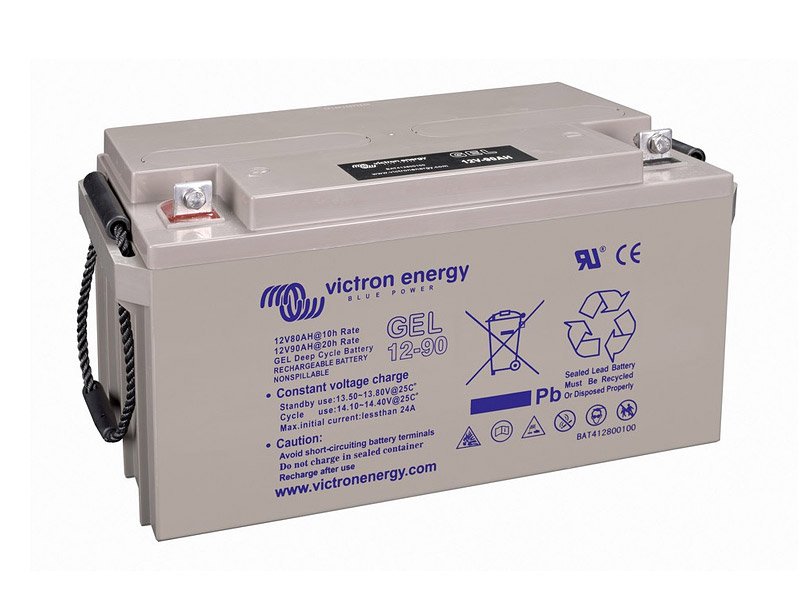
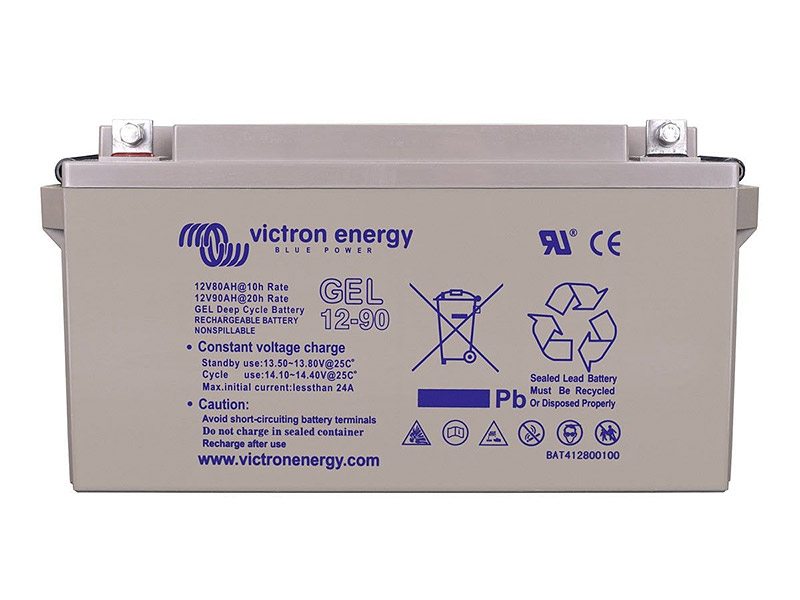
This Victron gel battery (90 Ah, 12 V) is sealed and maintenance-free, with a very long service life: an excellent storage core for your solar kit.
Capacity: 90 Ah (C20), 80 Ah (C10)
Voltage / Type: 12 V / Gel VRLA
Service life: Up to 12 years
Weight: 26 kg
Sealed gel VRLA, maintenance-free, very durable
The battery is the heart of a solar kit: it stores the energy from the panels and releases it when needed. This Victron Energy battery uses gel (VRLA) technology, so it is 100% sealed and maintenance-free, with a very long service life even after deep discharges. At 90 Ah and 12 V, it offers one of the best compromises between capacity and size for most installations, with Victron's proven reliability.
We use this Victron gel battery on an off-grid installation, and it inspires confidence. No maintenance, no fumes: we even installed it in a poorly ventilated box without issue. After several deep-discharge cycles (nights without sun), it comes back without weakening and holds its voltage well. The 26 kg are felt when carrying it, and the price is not the lowest on the market, but here you pay for Victron's longevity and reliability. As the core of a solar kit built to last, it is a reassuring investment.
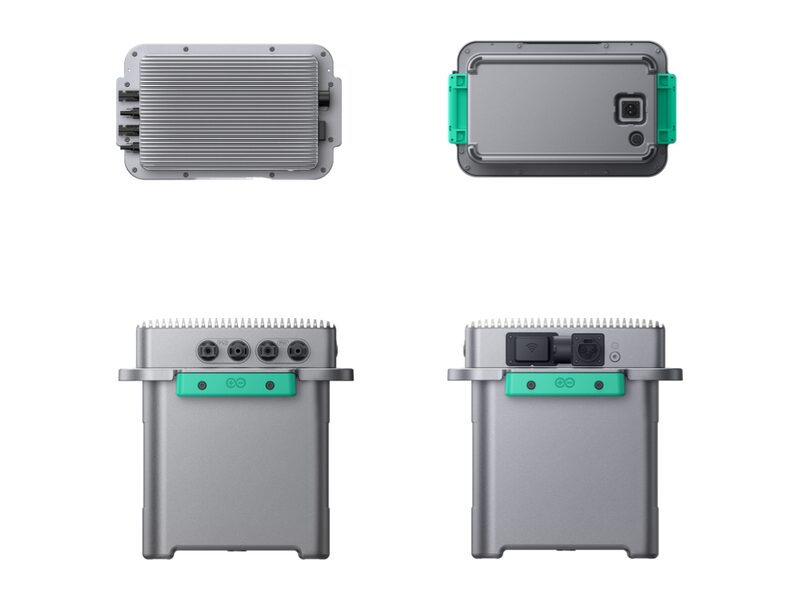
3.84 kWh of LiFePO4, a built-in hybrid inverter and up to 2300 W: the EcoFlow Stream Ultra X is the flagship of balcony solar storage.
Capacity: 3.84 kWh (LiFePO4)
Output: 2300 W (2 AC outlets) + 800 W grid
Solar: 4 MPPT, up to 2000 W
All weather: IP65, self-heating to -20 C
Battery + built-in inverter, microinverter included
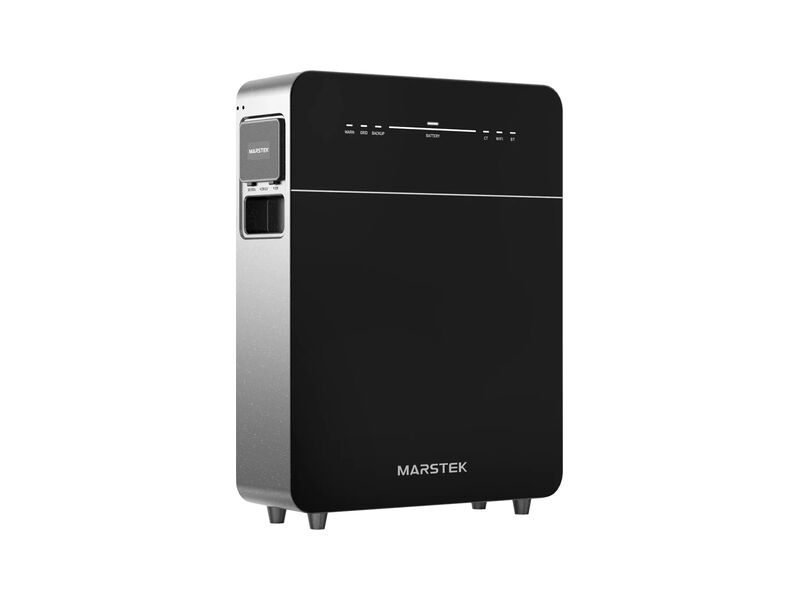
The EcoFlow Stream Ultra X is an all-in-one balcony solar storage system built to maximise self-consumption. It combines a 3.84 kWh LiFePO4 battery, a built-in hybrid inverter and four MPPT solar inputs (up to 2000 W of panels). It stores energy generated during the day to release it in the evening: up to 800 W fed back into the home grid, and up to 2300 W through its two AC outlets. IP65 rated with self-heating down to -20 degrees C, it installs outdoors and is controlled by app. The microinverter is included.
The Stream Ultra X is the most accomplished balcony storage system to date. Where most systems settle for a battery module wired to a hub, EcoFlow packs everything into one box: 3.84 kWh of LiFePO4 cells, a hybrid inverter, four MPPT controllers and even two AC outlets. In practice, you plug in your panels (up to 2000 W), store the day's surplus and release it in the evening, either fed back into the grid (800 W, within balcony limits) or straight to its outlets at up to 2300 W during an outage. The IP65 housing and self-heating down to -20 degrees C allow year-round outdoor installation, and the app control is thorough. Two reservations: at 39 kg, plan a solid mount and a two-person install, and its price places it firmly at the premium end of balcony solar. But for anyone who wants to maximise self-consumption without stacking boxes, it is a very convincing proposition.
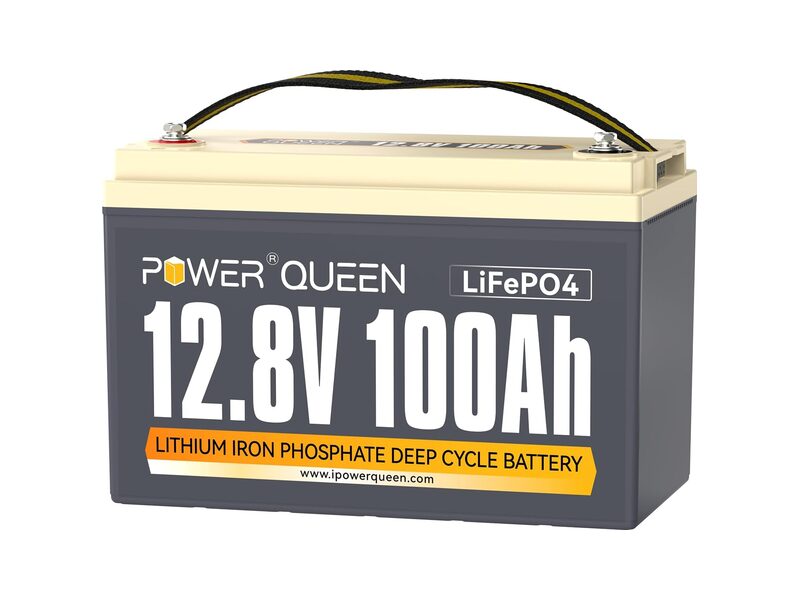
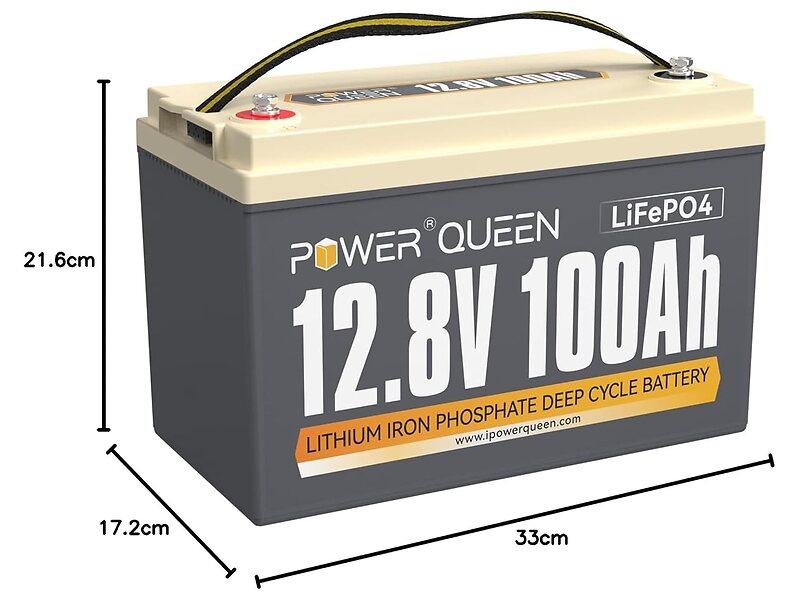
1280Wh of reliable, light lithium: the 12V 100Ah LiFePO4 battery that replaces lead, lasts thousands of cycles and unlocks the runtime of a motorhome, boat or solar kit.
Capacity: 12V 100Ah (1280 Wh, LiFePO4)
Cycles: 4000 to 15000 cycles
Protection: 100A BMS, low temperature
Dimensions: 329 x 172 x 214 mm
1280Wh LiFePO4, 100A BMS, long life
The Power Queen 12V 100Ah is a lithium iron phosphate (LiFePO4) battery of 1280 Wh built for off-grid independence. Far lighter and more durable than a lead-acid or gel battery, it offers 4000 to 15000 cycles depending on depth of discharge and can be discharged to 100% without damage. Its built-in 100A BMS protects against overcharge, deep discharge, short circuit and overcurrent, with a low-temperature protection that cuts charging in the cold. Perfect for the motorhome, caravan, boat, electric outboard or an off-grid solar system.
The Power Queen 100Ah holds up very well against pricier batteries. Fitted in a motorhome in place of an old lead-acid battery, the difference in runtime is obvious: you actually use nearly all of the 1280 Wh, whereas lead does not tolerate deep discharges. The weight saving is welcome, and the built-in BMS is reassuring day to day against overcharge and short circuits. The low-temperature protection is a real plus to avoid damaging the cells in winter. We use it both to power a fridge, lighting and a pump in a van, and to store the output of a small solar kit. Two honest caveats: the 100A BMS limits discharge current, which is enough for most uses but may restrict a very powerful inverter, and like any LiFePO4, charging below 0°C is not advised (hence the protection). To replace lead with reliable lithium without breaking the bank, it is excellent value.
2688Wh of plug-and-play solar storage: 4 MPPT, a bidirectional 1200W microinverter and an AI that optimises your self-consumption on its own. Balcony solar finally pays off.
Capacity: 2688 Wh (LiFePO4, expandable 16 kWh)
Solar: 4 MPPT, up to 3600W PV input
Inverter: Bidirectional 1200W, plug&play
Intelligence: Anker Intelligence (AI), meter
2688Wh, 4 MPPT, optimising AI
The Anker Solix Solarbank 3 E2700 Pro is a balcony solar storage battery, plug-and-play, that makes home solar genuinely worthwhile. Its 2688 Wh (2.7 kWh) of LiFePO4 store your panels' energy to release it in the evening or at peak hours, instead of losing it. It packs 4 MPPT controllers (up to 3600 W solar input), a bidirectional 1200 W microinverter, and above all Anker Intelligence, an AI that manages the flows on its own to maximise your savings. Its capacity expands to 16 kWh, and a smart meter avoids any waste.
The Solarbank 3 E2700 Pro reconciled us with balcony solar: without it, the energy produced during the day is fed to the grid and lost if no one consumes it; here, you store it to bring it back in the evening, when the home actually needs it. Installation is simple, genuinely plug-and-play, you connect the panels and the microinverter, and the app does the rest. The 4 MPPT let you connect several panels facing different directions with no loss, a real plus on a balcony or facade. What impressed us most is the Anker Intelligence AI: it learns our habits and decides on its own when to store, when to release and how much to feed in, without us having to think about it, which genuinely optimises the savings. The 2688 Wh capacity covers a good part of the evening consumption, and the expansion to 16 kWh lets you go bigger. Two honest caveats: the price remains an investment, to be paid back over several years, and the payback depends on your consumption profile and sunlight. But to make a balcony solar kit finally smart and worthwhile, it is a success.
The 2880 Wh LiFePO4 storage module that unlocks the SolarFlow 2400 AC: expandable to 17.28 kWh, rated for 6000 cycles and backed by a 10-year warranty.
Capacity: 2880 Wh (LiFePO4, 48 V)
Expandable: Up to 17.28 kWh (6 modules)
Lifespan: 6000 cycles, 10-year warranty
Cold weather: Self-heating, works down to -20 °C
Large 2880 Wh stackable module for SolarFlow 2400 AC
The Zendure AB3000X is a 2880 Wh LiFePO4 storage module built for the SolarFlow 2400 AC balcony system. A single unit already covers an evening, and it stacks up to six modules for 17.28 kWh. Long-life cells (6000 cycles, around 15 years of use), self-heating that keeps it charging down to -20 °C and a 10-year warranty make it a solid base for storing your solar energy all year round.
The AB3000X is the storage brick that makes the SolarFlow 2400 AC truly worthwhile: with 2880 Wh in a single module, you already cover a good part of an evening without drawing from the grid. What we like is the stacking logic: you start with one battery, then add more over time, up to six, with nothing to reconfigure. The LiFePO4 cells rated for 6000 cycles inspire confidence over the long run, and the internal heating, which keeps the battery active down to -20 °C, is a real plus for a year-round outdoor install. The build is hefty and reassuring, but that is also the trade-off: at over 26 kg, the module is not made to be moved often, so plan its permanent spot from the start. Another point to keep in mind: the AB3000X is designed for the SolarFlow 2400 AC ecosystem and is not a universal block. But within that setup, it is an efficient, durable extension, covered by a 10-year warranty, for anyone who really wants to maximise self-consumption.
The 1920 Wh LiFePO4 storage module of the SolarFlow ecosystem, with aerosol fire suppression: 6000 cycles, expandable to 7.68 kWh, IP65 and a 10-year warranty.
The Zendure AB2000L is a 1920 Wh LiFePO4 storage module for SolarFlow balcony solar systems (Hub 2000, Hyper 2000). It stacks up to four units for 7.68 kWh. It includes an aerosol fire suppression system that smothers any fire without toxic gas, anti-thermal-runaway protection and self-heating down to -20 C. Long-life cells (6000 cycles), an IP65 enclosure and a 10-year warranty make it a reliable, affordable extension for storing your solar energy.
The AB2000L is the new generation of extension battery for SolarFlow hubs (Hub 2000, Hyper 2000): with 1920 Wh per module, it already covers a good part of an evening, at a noticeably gentler price than the previous generation. It keeps the safety pitch that reassures on this kind of permanently installed product: an aerosol fire suppression system that can smother a fire without toxic gas, anti-thermal-runaway protection and an IP65 enclosure for the outdoors. The self-heating, which keeps it charging down to -20 C, makes it a genuine outdoor battery, usable year-round. Stacking remains the ecosystem's great strength: you start with one battery, then add up to four (7.68 kWh). The LiFePO4 cells rated for 6000 cycles and the 10-year warranty reassure over the long run. The only real downside is its weight, which makes it worth choosing its spot carefully at install time. To extend an existing SolarFlow system without breaking the bank, it is now the most logical choice.
The 960 Wh LiFePO4 storage module of the SolarFlow ecosystem: compact (11.5 kg), expandable to 3.84 kWh, self-heating -20 C, IP65 and a 10-year warranty.
Capacity: 960 Wh (LiFePO4, 20 Ah, 48 V)
Expandable: Up to 3.84 kWh (4 batteries)
All weather: Self-heating -20 C, IP65
Weight: 11.5 kg, 10-year warranty
Compact 960 Wh battery, the most affordable
The Zendure AB1000 is a 960 Wh LiFePO4 storage module for SolarFlow balcony solar systems (Hub 2000, Hyper 2000). Compact (11.5 kg) and compatible with the other AB batteries, it stacks up to four units for 3.84 kWh. Self-heating keeps it charging down to -20 C and the IP65 enclosure allows outdoor installation. With its 10-year warranty, it is the ideal entry-level extension to get into solar storage on a budget.
The AB1000 is the gateway to storage in the SolarFlow ecosystem: at 960 Wh and 11.5 kg, it is the lightest and most affordable of Zendure's extension batteries, ideal for a first step or a small balcony. It carries the essentials: an IP65 enclosure for the outdoors, self-heating that keeps it charging down to -20 C, and the range's stacking logic (up to four units, or 3.84 kWh, and compatible with the other AB batteries to size your capacity). The 10-year warranty covers the whole thing. Two things to keep in mind: its capacity stays modest, so for genuine evening autonomy you are better off with the AB2000L or stacking several modules; and, unlike the newer versions, it does not have the aerosol fire suppression system reserved for the higher-end models. But to start out without investing too much and discover balcony storage, the AB1000 remains an excellent entry point.
The all-in-one solar storage that combines a hub and a 2400 Wh battery in a sleek metal case: 2 MPPT, self-heating to -20 C, IP65 and easy install.
Capacity: 2400 Wh built-in (LiFePO4, 48 V)
Solar input: 1560 W, 2 MPPT controllers
Design: All-in-one hub + battery, pairs with a microinverter
All weather: Self-heating -20 C, IP65
All-in-one 2400 Wh balcony storage with design
The Zendure AiO 2400 is an all-in-one solar storage unit for balcony solar that combines the management hub (PV-Hub) and a 2400 Wh LiFePO4 battery in a single case. With two MPPT controllers (up to 1560 W of panels, 1200 W for charging), it connects to a microinverter to feed the stored energy in. Its slim metal design, self-heating down to -20 C and IP65 rating make it a polished, easy-to-install way to store your solar energy all year round.
The AiO 2400 takes the opposite approach to modular SolarFlow systems: instead of stacking a hub and batteries, everything sits in a single metal case, slim and genuinely elegant, one of the best-looking in the category. In use, its simplicity is what wins you over: you connect the panels to its two MPPT inputs, link a microinverter (often the bundled EZ1-M), and the built-in 2400 Wh battery does the rest, storing daytime energy to release it in the evening. The self-heating that keeps it charging down to -20 C and the IP65 rating make it a true outdoor product, usable year-round. The LiFePO4 cells last up to 4000 cycles at 80% (8000 at 70%), a sign of longevity, and the 10-year warranty reassures. Two caveats: its capacity is fixed (2400 Wh), so you need to size it right at purchase, with no stacking like on an AB system; and you have to add a microinverter for feed-in. But for a clean, good-looking, fuss-free balcony install, the AiO 2400 is one of the best options around.
1280Wh of lithium storage with a 150A BMS, 6000 cycles and Bluetooth monitoring: the Renogy 100Ah 12V battery is the ideal heart of a solar kit, RV or boat.
Capacity: 100Ah / 1280Wh (12V LiFePO4)
BMS: Up to 150A discharge
Lifespan: Over 6000 cycles
Monitoring: Bluetooth (Renogy app), IP67
100Ah lithium, 6000 cycles and Bluetooth monitoring
The Renogy 100Ah 12V battery is a 1280Wh LiFePO4 lithium battery, designed for energy storage in a solar installation, RV, van, boat or trolling motor. Its built-in BMS handles up to 150A discharge, and its LiFePO4 chemistry ensures over 6000 cycles, a lifespan of several years. IP67 waterproof, it resists splashes and dust, and is monitored remotely via Bluetooth with the Renogy app. A reliable, durable battery for any 12V setup.
The Renogy 100Ah 12V battery is one of those lithium batteries that made off-grid and solar energy genuinely accessible. In a van or RV setup, its 1280Wh offer a solid reserve, and above all its LiFePO4 chemistry lets you discharge it almost fully without harming it, unlike old lead-acid batteries. Its 150A BMS is a real asset: it allows high power peaks, enough to run a beefy inverter. We really like the Bluetooth monitoring via the Renogy app, which lets you keep an eye on the charge level and battery health from your phone, along with the reassuring IP67 rating on a boat. The only downsides are the weight (a 100Ah battery is still heavy) and a price above lead-acid, quickly offset by the lifespan. For the heart of a reliable solar kit, it is a safe bet.
125Ah of maintenance-free runtime: the sealed, rugged 12V Gel battery, built for motorhomes and leisure, that takes regular discharges without weakening.
Capacity: 12V 125Ah (Gel)
Technology: Gel electrolyte, monobloc
Cycles: Around 1000 cycles
Maintenance: Maintenance-free, sealed
125Ah Gel, maintenance-free, rugged
The Antarion 125Ah Gel battery is a 12V deep-cycle leisure battery designed for the independence of motorhomes, caravans and boats. Its gel-electrolyte technology makes it fully maintenance-free, sealed and safe: no water to top up, no gassing in normal use, and good tolerance of repeated deep discharges. Rated for around 1000 cycles, it easily powers the lighting, fridge, water pump and 12V sockets of your living area. A reliable, rugged choice for those who want a proven leisure battery without switching to lithium.
The Antarion 125Ah Gel is a safe bet for anyone who wants leisure runtime without complications. Fitted in a motorhome, it does exactly what you expect: it powers the lighting, fridge and pump for several self-sufficient days, and takes the daily discharge and recharge cycles without flinching. The big advantage of Gel is zero maintenance: no electrolyte level to watch, no gassing in normal use, and installation possible in various positions. It is also more tolerant than flooded lead of slightly deep discharges. Two honest caveats: like any Gel battery, it remains heavy and should not be discharged too low to preserve its lifespan, and recharging requires a Gel-suitable charger to avoid damaging it. For classic, reliable, no-surprise motorhome use, on a controlled budget against lithium, it is a reassuring choice.
2600Wh of plug & play solar storage: the hybrid balcony battery that stores your production to release it in the evening and finally make self-consumption pay off.
Capacity: 2600 Wh (LiFePO4)
Power: 2400 W, hybrid grid/off-grid
Solar: Dual MPPT, anti-backflow
Protection: IP65, plug & play
2600Wh, hybrid, dual MPPT, IP65
The Allpowers BS2500 Pro is a plug & play home solar storage system designed for balconies and facades. With 2600 Wh of capacity and 2400 W of power, it stores your panels' energy to release it in the evening or at peak hours, instead of losing it. Hybrid (grid and off-grid), it packs a dual MPPT to connect several panels, an anti-backflow protection, a durable LiFePO4 battery and an IP65 rating for the outdoors. The simple way to make solar self-consumption genuinely worthwhile, with no heavy work.
The BS2500 Pro reconciled us with balcony solar. The principle is clear: without storage, the energy produced during the day goes to the grid and is lost if no one consumes it; here, you keep it to release it in the evening, when the home actually needs it. Installation lives up to its plug & play promise, you connect the panels and the inverter, and the system handles the rest. The dual MPPT lets you connect several panels, even facing different directions, with no loss, a real plus on a balcony. The anti-backflow protection avoids sending unwanted current back to the grid, and the IP65 rating is reassuring for an outdoor install. Its 2600 Wh capacity covers a good part of the evening consumption. Two honest caveats: the price remains an investment to be paid back over several years, and the payback depends on your consumption profile and sunlight. But to make a balcony solar kit finally smart and worthwhile, the BS2500 Pro is a success.
230Ah of lithium storage with built-in Bluetooth and heating, on Grade A EVE cells: the Fogstar Drift is a premium leisure battery for vans and boats.
Capacity: 230Ah / about 2944Wh (12V LiFePO4)
Cells: Grade A EVE, built-in BMS
Monitoring: Bluetooth (Fogstar Drift app)
Heating: Automatic (charging in cold weather)
230Ah, Bluetooth and heating, Grade A cells
The Fogstar Drift 12V 230Ah (Gen2) is a premium LiFePO4 lithium leisure battery, very popular in the UK for van, RV and boat conversions. It uses Grade A cells from manufacturer EVE, a built-in BMS and Bluetooth via the Fogstar Drift app for monitoring. Its automatic heating function allows safe charging in cold weather, and its LiFePO4 chemistry lasts over 4000 cycles at 80% depth of discharge. Note: it replaces the older 200Ah model.
Fogstar has become a UK benchmark for lithium leisure batteries, and the Drift 12V 230Ah shows exactly why. In a van or boat conversion, its 230Ah offer a comfortable reserve, and the fact that it uses Grade A cells from manufacturer EVE inspires confidence over time. The Bluetooth monitoring via the app is a real plus: you keep an eye on the charge level and battery health from your phone. We really like the built-in heating, which allows safe charging even in cold weather, a point too many batteries neglect. Its LiFePO4 chemistry ensures a very long life (over 4000 cycles). Its main drawbacks for the European market are its availability, the brand being mainly distributed in the UK, and its price, in line with its premium positioning. Note too that it replaces the older 200Ah model, with slightly higher capacity.
5 kWh of solar storage for your balcony: 4 MPPT, a bidirectional PluginPower 2.0 inverter, IP66 rating and a capacity expandable to 30 kWh.
Capacity: 5024 Wh (LiFePO4, expandable 30 kWh)
Solar: 4 MPPT, up to 5000W PV input
Output: 800W fed to grid, 2500W off-grid
Durability: IP66, 10,000 cycles, BT/Wi-Fi
5 kWh storage, 4 MPPT, expandable 30 kWh
The Anker Solix Solarbank 4 E5000 Pro is a next-generation solar storage battery for plug-and-play installation on a balcony or at home. With 5024 Wh (5 kWh) of LiFePO4 capacity, it stores your solar panels' energy to release it when you need it, cutting your bill. It packs 4 MPPT controllers (up to 5000 W solar input), a bidirectional PluginPower 2.0 inverter, an IP66 rating and a capacity expandable to 30 kWh with add-on modules. Built to last (10,000 cycles), it is controlled over Bluetooth and Wi-Fi.
A charge controller is used to ensure and regulate the charging of batteries, as electricity from solar panels (or wind turbines) is not regulated. Of several types (PWM or MPPT), they are essential for the proper functioning of a solar kit. Let us introduce you to several of them.
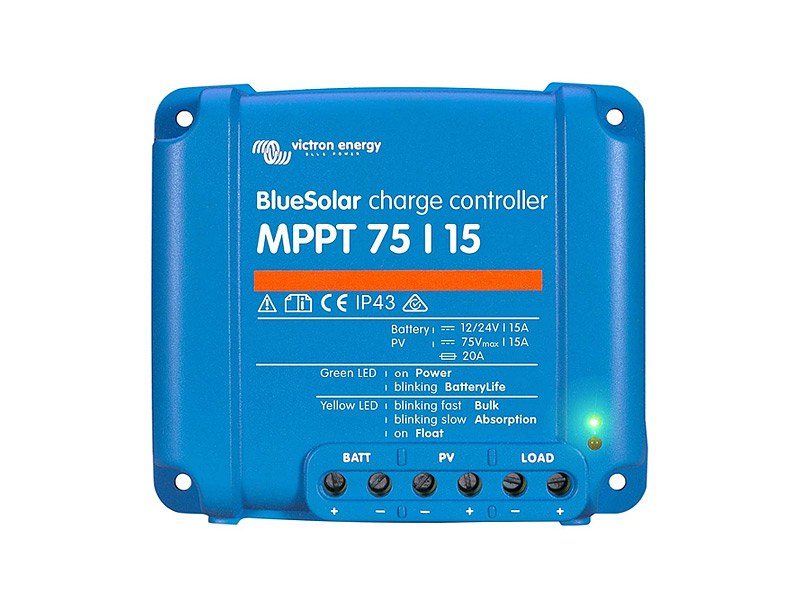
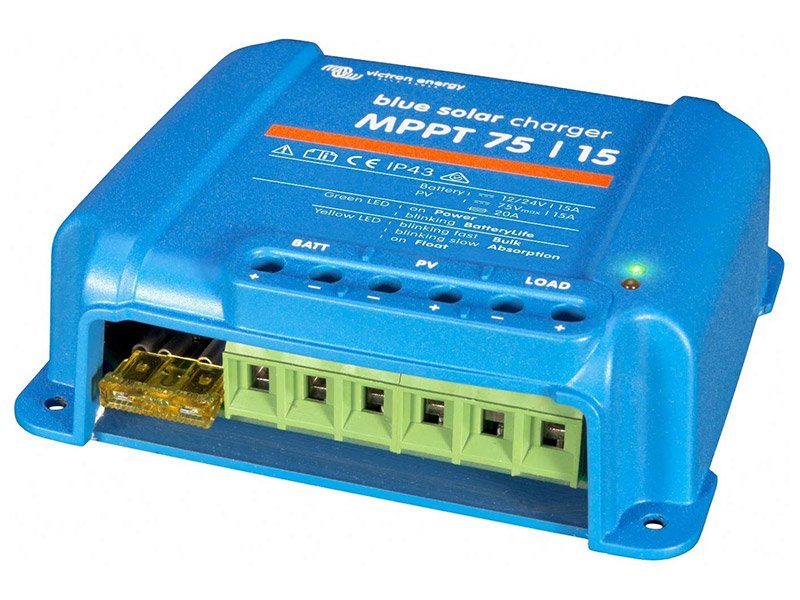
One of the most popular and affordable MPPT charge controllers. The ideal choice if you prefer this type of solar controller.
Charge current: 15 A
PV input: Max 75 V
Type: MPPT
Battery voltage: 12 / 24 V (auto)
MPPT +30% vs PWM, 12/24V auto, BatteryLife
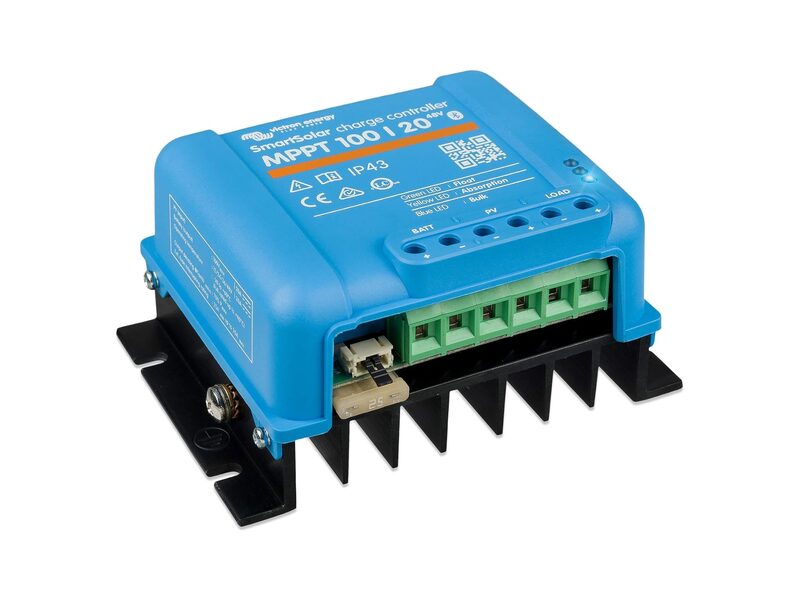
The BlueSolar 75/15 from Victron Energy is an MPPT (Maximum Power Point Tracker) solar charge controller. Placed between the panels and the battery, it constantly locates the maximum power point of the panels, which improves energy harvest, especially under cloudy skies, by up to 30% more than a PWM controller. With its BatteryLife function, battery management is intelligent and optimal. An excellent choice for a small off-grid solar installation.
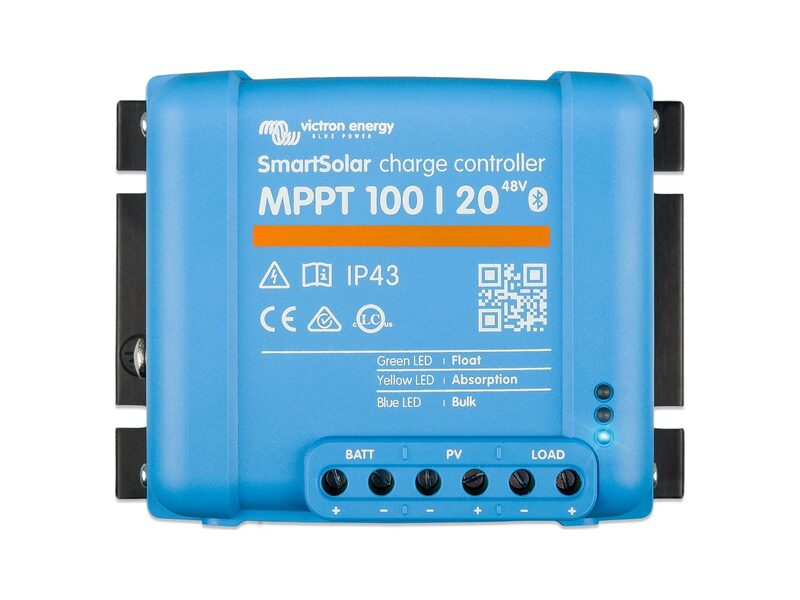
The benchmark solar charge controller: 100V, 20A, built-in Bluetooth and up to 98% efficiency. The Victron SmartSolar MPPT 100/20 gets the most from your panels.
Max PV voltage: 100V (12/24/48V auto)
Charge current: 20A
Efficiency: Up to 98% (MPPT)
Monitoring: Built-in Bluetooth (VictronConnect)
98% MPPT with Bluetooth and Victron reliability
The Victron SmartSolar MPPT 100/20 is a premium solar charge controller, renowned for its reliability and efficiency. It accepts up to 100V solar input and delivers 20A of charge, on 12V, 24V or 48V systems (automatic detection). Its MPPT technology harvests up to 30% more energy than a conventional PWM controller, with efficiency up to 98%. Its built-in Bluetooth lets you track output in real time and adjust settings from the VictronConnect app.
The Victron SmartSolar MPPT 100/20 is a bit the controller you fit when you never want to worry again. The Victron brand is a benchmark in the off-grid world, and this model is a good example: in a van or RV setup, it really gets the most from the panels thanks to its MPPT technology, with efficiency you can feel over a plain PWM controller, especially under hazy skies. The built-in Bluetooth is a real everyday plus: from the VictronConnect app, you track solar output in real time, check the history and adjust charge settings without a single cable. The build quality inspires confidence for an installation meant to last years. Its only downsides are a price above budget Chinese controllers, and the need to size the model (100/20) correctly for your solar power. But for a reliable, durable installation, Victron remains the safe bet.
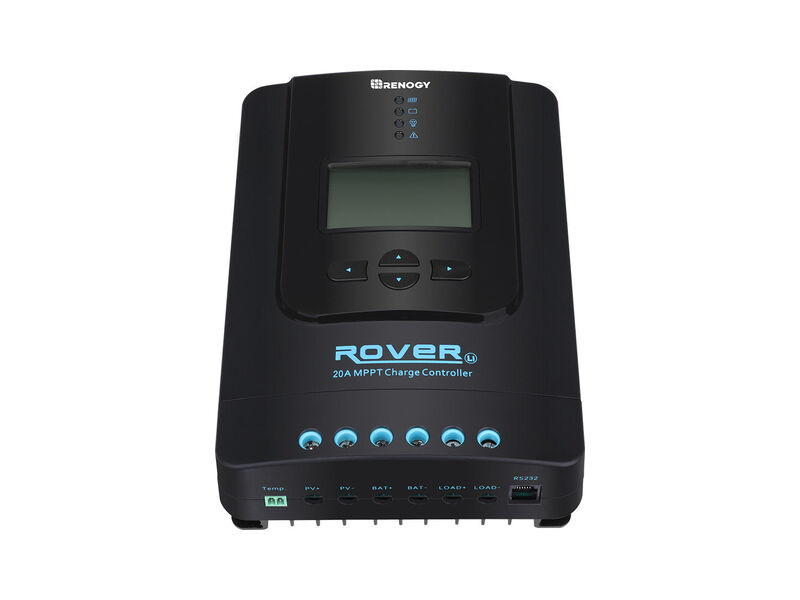
40A of charge, 100V input and up to 99% tracking efficiency, with an LCD screen: the Renogy Rover 40A handles the most generous 12/24V solar setups.
Max PV voltage: 100V (12/24V auto)
Charge current: 40A
Tracking efficiency: Up to 99% (MPPT)
Screen: LCD, Bluetooth optional
40A and LCD screen for large 12/24V setups
The Renogy Rover 40A is a premium MPPT solar charge controller, designed for 12V and 24V setups. It accepts up to 100V solar input and delivers 40A of charge, meaning up to 520W of panels at 12V and 1040W at 24V. Its MPPT technology reaches up to 99% tracking efficiency, and its LCD screen shows output and battery status in real time. Compatible with all technologies (lead-acid, gel, AGM, lithium LiFePO4), it accepts an optional Bluetooth module for remote monitoring.
The Renogy Rover 40A is the controller you choose when your solar setup starts getting serious. Its 40A charge current lets it handle large panel arrays, up to 520W at 12V and double at 24V, where a 20A controller would quickly saturate. Its MPPT technology really gets the most from the panels, with tracking efficiency that climbs very high. We really like the built-in LCD screen, which shows output, voltage and charge status directly without needing a phone, while still allowing you to add a Bluetooth module for remote monitoring. It handles all battery types, including lithium, via configurable profiles. The only things to plan for are the price, above a small controller, and the Bluetooth not being built in as standard, unlike some rivals. But for a robust, reliable 12/24V setup, it is an excellent controller.
A 10A MPPT controller that harvests up to 30% more output: the Epever XTRA1210N optimises your small solar kit and protects your battery, with a display to match.
Type: MPPT, 10A
Voltage: 12/24V automatic
PV input: Up to 100V
Compatibility: Lead, Gel, AGM, lithium
MPPT 10A, up to 30% gain, display
The Epever XTRA1210N is a 10A MPPT solar charge controller designed for small 12V or 24V solar kits (automatic detection). Thanks to its MPPT technology, it extracts more energy from panels than a simple PWM controller, with a gain of up to 30% in low light. It accepts a PV input voltage up to 100V, handles all battery types (lead, Gel, AGM, lithium) and protects against overcharge, deep discharge, short circuit and reverse polarity. Available with the remote XDS2 display to track output and state of charge at a glance.
The XTRA1210N is an excellent entry into serious MPPT, at a contained price. On a small van or shed solar kit, the difference with a PWM controller shows mainly in cloudy weather or at the start and end of the day: MPPT harvests a few percent, sometimes much more, where PWM plateaus. The automatic 12/24V detection is handy, and compatibility with lithium as well as lead or Gel batteries makes it versatile. The remote XDS2 display is genuinely appreciated for monitoring output and state of charge without contorting near the controller. The built-in protections (overcharge, short circuit, reverse polarity) are reassuring at install. Two honest caveats: 10A limits it to small kits (about 130W at 12V, 260W at 24V), and fine setup requires a minimum of reading the manual, especially for the lithium profile. To optimise a small solar system without breaking the bank, it is a safe bet from the reference brand Epever.
The smart PV hub that adds storage to an existing balcony setup: 2 MPPT (1800 W), AB batteries up to 7.68 kWh and fine control, at a lower cost.
Solar input: 1800 W, 2 MPPT controllers
Storage: AB batteries expandable to 7.68 kWh
Function: Storage hub to pair with a microinverter
Protection: IP65, app monitoring
Adds storage to a balcony array on a budget
The Zendure SolarFlow Hub 2000 is a smart PV hub that brings storage to an existing balcony system. With two MPPT controllers (1800 W of solar input), it drives the charging and discharging of Zendure AB batteries up to 7.68 kWh, and pairs with a microinverter to feed energy into the home. An IP65 enclosure, app monitoring and Shelly compatibility make it an affordable way to optimise self-consumption without starting from scratch.
The Hub 2000 is the piece that early balcony kits were missing: rather than replacing everything, it grafts an energy reserve onto an existing setup. Its role is clear: manage solar input through its two MPPT trackers (up to 1800 W), charge the Zendure AB batteries during the day, then discharge them in the evening through a microinverter. In our tests, the app integration is polished, with real-time monitoring of production and charge, and Shelly compatibility appeals to home-automation fans. It is also the most affordable way in the range to try storage. Two limits to understand before buying: unlike the Hyper 2000, the Hub 2000 has no built-in inverter, so you need to add a compatible microinverter; and it handles only two MPPT inputs, where the Hyper offers four. But to turn a simple balcony kit into a system with storage, without a big investment, the Hub 2000 remains a smart gateway into the SolarFlow ecosystem.
At the heart of balcony solar systems, the microinverter turns the panels' DC into AC that plugs straight into a household socket, and often manages the charging of a storage battery too. Here is our pick of microinverters for self-consumption, from plug-and-play setups to smart storage.
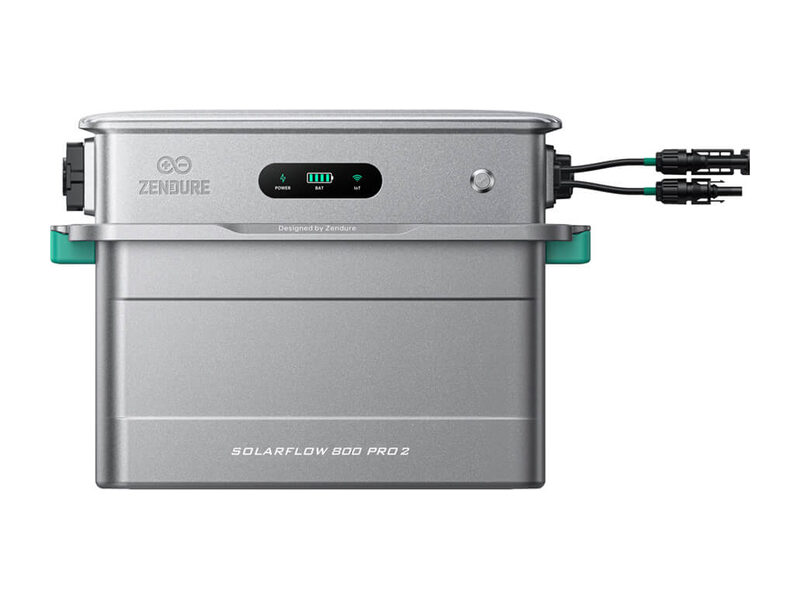
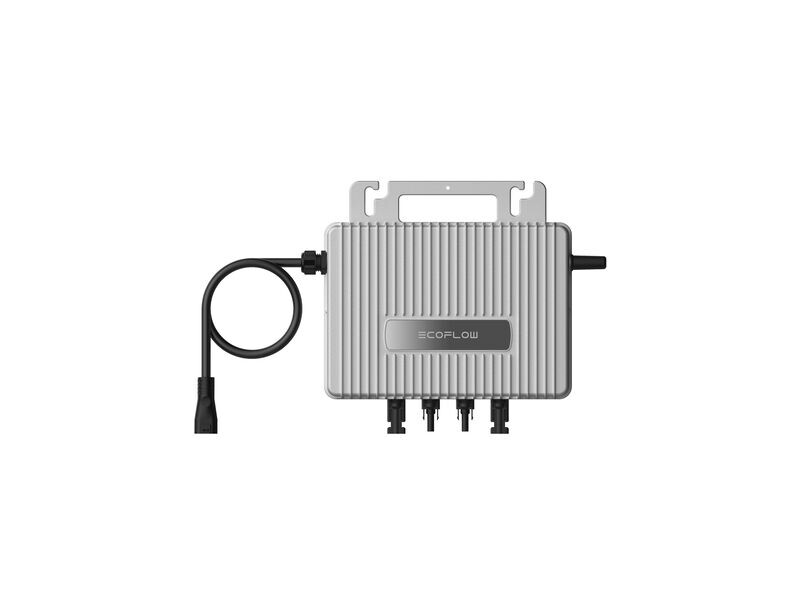
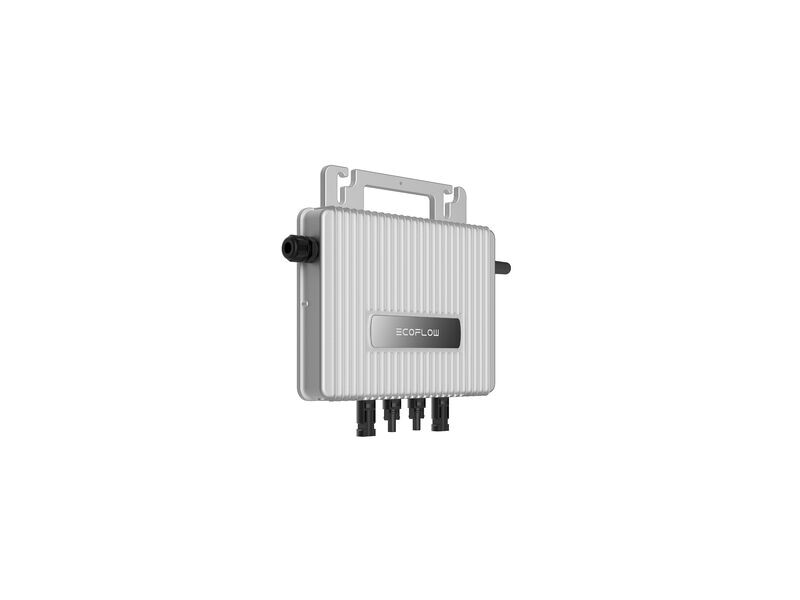
The entry-level microinverter of the EcoFlow Stream ecosystem: 800 W output, 2 MPPT, 3 W startup and an IP67 rating rare on this kind of product.
Grid output: 800 W (2 MPPT, 230 VAC)
Solar input: 1200 W (2 x 600 W), MC4
Startup: From 3 W, MPPT range 16-60 V
Protection: IP67, -40 to 65 C, 10-year warranty
800 W plug-and-play microinverter, IP67 and Eco-AI
The EcoFlow Stream Microinverter converts your solar panels' DC into 230 V AC fed into your home through a standard socket. With 800 W of grid output, two MPPT trackers taking up to 1200 W of panels and a startup from just 3 W of input, it produces from dawn to dusk. IP67 rated, compatible with 99% of panels (MC4 connectors) and driven by the EcoFlow app with Eco-AI smart management, it is the plug-and-play, 10-year-warranty gateway to the Stream balcony solar ecosystem.
The Stream is the microinverter with which EcoFlow simplifies the way into balcony solar, and in use it is convincing. Installation genuinely lives up to the plug-and-play promise: you screw on the bracket, clip in the panels' MC4 connectors, plug the supplied mains cable into a socket, and the EcoFlow app walks you through the rest in about fifteen minutes, with no electrician. Two details make the difference day to day. First, sensitivity: the microinverter kicks in from just 3 W of input, so it scavenges energy early in the morning and at dusk, where others stay idle. Second, ruggedness: the IP67 rating, rare on this kind of device, makes it indifferent to driving rain, and it works from -40 to 65 C. App control, with the peak/off-peak mode and the Eco-AI assistant, is clear and gives precise production graphs. Two honest caveats: on its own, without a Stream ecosystem battery, the appeal is limited to daytime self-consumption (unused energy is lost); and the output is capped at 800 W to stay within grid rules, although the hardware could do more. But to start cleanly, it is an excellent base.
The 800 W hybrid microinverter that turns a balcony kit into a real energy reserve: 96% efficiency, batteries expandable to 11.52 kWh, plug and play.
Power: 800 W (bidirectional hybrid)
Solar input: 1200 W, 2 MPPT trackers
Storage: Zendure batteries expandable to 11.52 kWh
Efficiency: 96%, watt-level regulation
Plug-and-play hybrid microinverter, expandable and affordable
The Zendure SolarFlow 800 is an 800 W bidirectional hybrid microinverter for balcony solar. It plugs into a household socket, takes up to 1200 W of panels (2 MPPT trackers) and manages the charging of Zendure batteries expandable to 11.52 kWh. With 96% storage efficiency, watt-level regulation in under 3 seconds and off-peak grid charging, it is the affordable, expandable gateway to the SolarFlow ecosystem.
Setting up the SolarFlow 800 really is fuss-free: you connect the panels, plug the inverter into a socket, and the Zendure app handles the rest in a few minutes. What changes everything versus a plain microinverter is the hybrid side: as soon as you add a Zendure battery, midday energy is no longer wasted but stored for the evening. In our tests, the switching between solar, battery and grid is impressively quick, and the watt-level adjustment genuinely avoids giving power away to the grid. The claimed 96% efficiency shows in the energy you actually use. We also like the modular logic: you can start small with just the inverter, then grow over time. Two honest caveats: without a battery you are back to a plain microinverter and much of the appeal disappears; and the fine-tuning (off-peak hours, priorities) takes a little time to master. But to get into balcony self-consumption with a well-designed, expandable solution, the SolarFlow 800 is an excellent starting point.
The balcony solar storage that finally makes self-consumption pay off: an 800 W inverter, LiFePO4 batteries expandable to 11.52 kWh and smart-home control.
Inverter: Hybrid 800 W (1000 W off-grid)
Solar input: 2640 W (4 x 660 W)
Storage: AB2000X 1920 Wh, expandable to 11.52 kWh
Technology: 48 V, GaN, IP65, 10-year warranty
Expandable 48 V balcony storage, run via Home Assistant
The Zendure SolarFlow 800 Pro is an all-in-one storage system for balcony solar that pairs an 800 W hybrid microinverter with LiFePO4 AB2000X batteries expandable up to 11.52 kWh. Its 48 V architecture and GaN components sharply cut losses, while watt-level regulation and deep smart-home integration (up to Home Assistant) maximise self-consumption. IP65 rated and backed by a 10-year warranty, with self-heating batteries that run down to -20 °C.
We hooked the SolarFlow 800 Pro up to an existing balcony setup, and the plug-and-play promise largely holds: the microinverter plugs into a standard household socket, and the Zendure app walks you through setup in a few minutes. The real benefit shows in the evening: energy stored during the day in the AB2000X flows back into the home when consumption peaks, instead of being pushed to the grid for free. Over several weeks, the self-consumption share climbed noticeably. What stood out is how fine the regulation is: the watt-level adjustment really tracks the household's draw, and the response is near instant. Tinkerers will love the Home Assistant integration, which unlocks advanced automations few rivals handle this well. Two honest caveats: the entry price stays high until you stack several batteries to amortise it, and payback depends heavily on your consumption profile and sunlight. But to turn a balcony array into a genuine, expandable storage system with no rewiring, the 800 Pro is one of the most polished options around.
The hybrid hub that makes balcony solar genuinely smart: 1800 W MPPT, 1200 W bidirectional output, 4 inputs and batteries expandable to 7.68 kWh.
MPPT power: 1800 W across 4 solar inputs
Output: 1200 W bidirectional (feed-in + charging)
Storage: AB batteries expandable to 7.68 kWh
Panels: Up to 2400 W of modules
Hybrid hub, 4 inputs, ZenLink and off-peak charging
The Zendure Hyper 2000 is a hybrid microinverter that packs MPPT trackers, a bidirectional inverter and battery management into a single unit for balcony solar. It takes 1800 W of MPPT power across 4 solar inputs, feeds 1200 W into the home and drives Zendure AB1000 or AB2000 batteries up to 7.68 kWh. With off-peak grid charging, ZenLink multi-set coordination and an IP65 enclosure, it targets optimised self-consumption with no rewiring.
The Hyper 2000 is arguably the most accomplished unit in the SolarFlow range: it brings MPPT, inverter and battery control together in a single IP65 module, and installation stays genuinely plug and play, with no electrician. What stands out in use is the flexibility: four independent solar inputs let you aim panels in different directions without loss, and the 1200 W bidirectional output handles both feed-in and charging the battery from the grid during off-peak hours. In our tests, the adjustment to the home's consumption is fast and the app gives a clear view of production, charge and usage. The ZenLink feature, which coordinates several Hyper units on the same phase, opens the door to scalable installs, up to more than 23 kWh of storage across multiple units. Two caveats: without an AB battery you lose most of the appeal, and the unit costs more than a plain microinverter. But to build a genuinely smart, piece-by-piece balcony power plant, the Hyper 2000 is a remarkably complete foundation.
You don't need to have excellent solar panels, or the best MPPT controller of the moment, if you don't opt for cables with reliable MC4 connectors, well sized and really waterproof. Here are the products matching these criteria that we have chosen.
Three extra metres of reach for your solar panel: keep your power station in the shade while the panel stays in full sun.
Type: Solar extension cable (MC4)
Length: 3 m
In the box: 2 extension cables
Moves the station away, into the shade
The EcoFlow solar extension cable adds 3 metres to your solar charging cable (with MC4 connectors). Handy for moving your power station away from the panel: you leave the panel in full sun while keeping the station in the shade, cool, or sheltered inside the tent. The box contains two extension cables, enough to extend a series connection or two panels. A simple, rugged accessory to optimise your portable solar setup.
Wire several solar panels in parallel to recharge your EcoFlow station faster: the essential cable to multiply the power you capture.
Type: Parallel connection cable (MC4)
Compatibility: EcoFlow Delta and River stations
Use: Up to 4 panels in parallel (Delta)
Adds panels together to charge faster
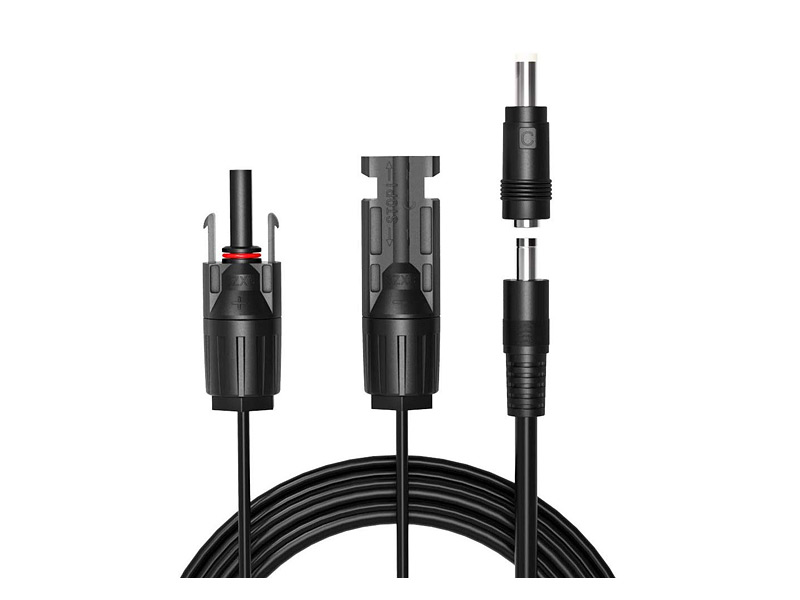
The EcoFlow solar parallel connection cable lets you wire several solar panels in parallel to an EcoFlow power station (Delta and River series). By adding up the current of several panels, it improves the charge rate and cuts recharge time. It is required to connect four panels in parallel to a Delta station, or two panels to the River series. Fitted with standard MC4 solar connectors, it is the key accessory to get the most out of a multi-panel setup.
This Allpowers cable connects a solar panel with an MC4 output to a power station via a 5.5 mm DC plug: the handy accessory to recharge in the sun.
Type: MC4 to 5.5mm DC cable
Length: 1.5 m (16AWG)
Connectors: 5.5 x 2.1 mm and 3.5 x 1.35 mm
Connects an MC4 solar panel to a power station
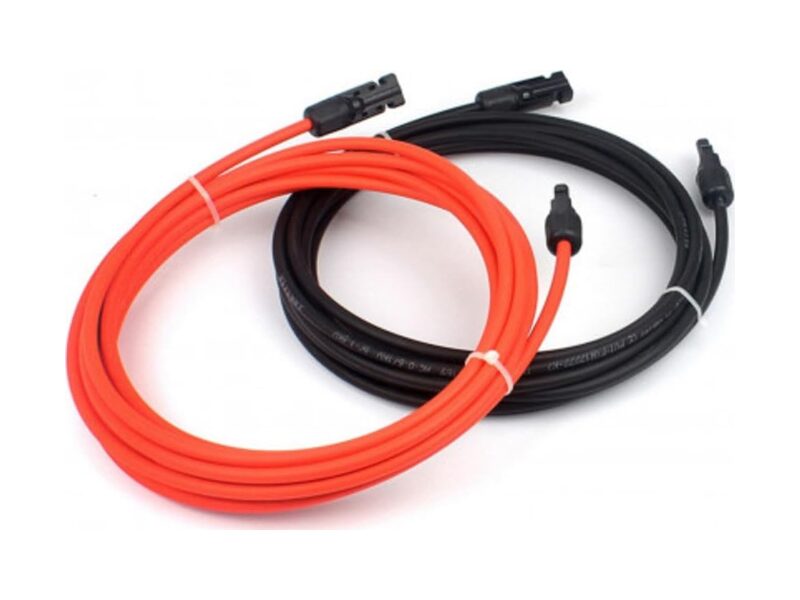
This Allpowers adapter cable has, on one side, MC4 solar connectors (male and female) and, on the other, a 5.5 x 2.1 mm DC plug, with a 3.5 x 1.35 mm adapter. At 1.5 m long in 16AWG, it lets you recharge a power station with an MPPT input directly from a solar panel with an MC4 output. A simple, sturdy and versatile accessory to connect your compatible equipment to solar.
Two 5m solar leads with pre-fitted MC4 connectors, to move your solar panel away from its battery or power station, with no wiring work.
Contents: 2 leads of 5m (red + black)
Connectors: Pre-fitted male and female MC4
Cable: 4 mm² copper, UV-resistant jacket
Ready-to-plug MC4-standard extension, for outdoor use
The Orium MC4 extension is a pair of two 5-metre solar leads (one red, one black) fitted with pre-mounted male and female MC4 connectors. It lets you move a solar panel away from its controller, battery or power station, to aim it better at the sun. The MC4 connectors, the universal photovoltaic standard, clip on in an instant, and the copper cable with a UV-resistant jacket is designed for outdoor use. A simple, reliable way to extend a solar setup.
If instead of choosing each of the components of a solar kit separately, you decided to opt for more simplicity and to be sure of compatibility between each component, why not a ready-made solar kit? Here is our selection of the best solar kits of the moment:
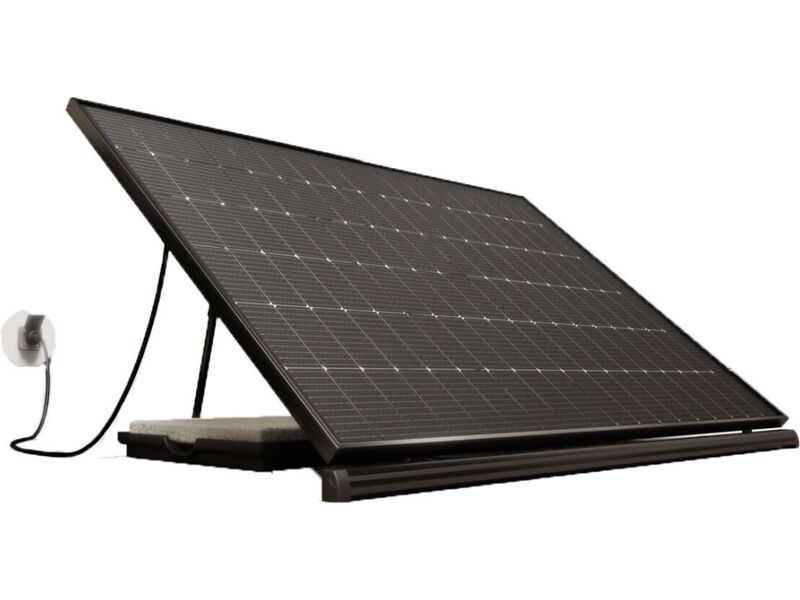
The first solar tracker for consumers: it automatically aims your panels at the sun, from dawn to dusk, for up to 30% more energy.
Type: Automatic dual-axis solar tracker
Gain: Up to +30% energy captured
Compatibility: Any panel with a solar connector
Installation: 4 deployable feet, adjustable hooks
Follows the sun alone, up to +30% energy
The EcoFlow Solar Tracker is an automatic dual-axis tracker that constantly aims your solar panels at the sun. By pivoting throughout the day, from dawn to dusk, it captures up to 30% more energy than a panel laid flat, with no intervention. With four deployable feet and adjustable mounting hooks, it fits any panel, rigid or foldable, EcoFlow or another brand, as long as it uses a solar connector. An ideal accessory for moving towards self-consumption.
EcoFlow's Solar Tracker is a fascinating thing to watch in action: set in the garden with a panel mounted on it, it slowly pivots on its two axes and follows the sun on its own, from dawn to dusk. You no longer deal with anything, where you would normally reorient panels several times a day. The gain is real, you recover noticeably more energy than with a panel laid flat: EcoFlow claims up to 30% and our readings point that way in good weather. The setup is sturdy thanks to the four deployable feet, and the adjustable hooks take an EcoFlow panel as happily as a third-party one. Two big caveats, honestly: the price is very high for consumer use, you need a real self-consumption project to justify it, and its bulk reserves it for a fixed setup in the garden or on a plot, not for portable camping. A brilliant concept, but a niche one.
A complete portable solar kit: 130W of folding panels, built-in controller, clamps and a case. The Zamp Solar charges a 12V battery directly, plug and play.
Power: 130W (folding monocrystalline panels)
Controller: Built-in (charges a 12V battery)
Included: Alligator clamps, SAE adapter, case
Use: Portable, no fixed installation
Plug-and-play portable kit with built-in controller
The Zamp Solar 130W portable solar kit is a plug-and-play solution to charge a 12V battery while camping, in an RV or on a boat. It consists of two folding monocrystalline panels, a built-in charge controller, alligator clamps and a padded carrying case. Just unfold it, aim it at the sun and connect it to the battery: no fixed installation required. A US brand well known in the RV world (now part of Go Power / Dometic).
The Zamp Solar 130W kit is the simplest way for anyone who wants solar without taking on a fixed installation. Everything is in the box: two folding panels joined by a hinge, an already-wired charge controller, alligator clamps and a handy padded carrying case. In practice, you take it out of the boot, set it in the sun, clip the clamps onto the leisure battery, and it charges. No drilling, no wiring to plan, ideal for portable use or to occasionally top up a setup. The build quality lives up to the brand's reputation, historically well loved by North American RVers. The downsides mainly concern the European market: Zamp Solar is a US brand (now part of Go Power and Dometic), rarely distributed in France, and the kit stays pricier than a plain panel to install yourself. But for simplicity and mobility, it is a safe bet.
Photovoltaic cells, most often made of silicon, are able to capture sunlight and transform it into direct current. The photons of sunlight, when they come into contact with the cells, transmit their energy to the electrons of the semiconductors of the panels, generating an electrical voltage. The inverter then converts the generated direct current into alternating current.
The choice of the number of solar panels depends on several criteria such as the surface available for their installation, their power, or the cost you wish to dedicate to them. But also elements such as sunshine or your desire to sell (or not) the additional energy produced. Listing all these elements will allow you to make an optimal choice.
Regular cleaning of solar panels is essential to maintain their energy efficiency. To do this, it is sufficient to spray the surfaces with clear water, if possible demineralised, then to remove all traces of water and dirt with a foam squeegee, avoiding overly strong movements that could scratch the glass.
Like a fuse, the solar controller acts as a guardrail that protects your photovoltaic system from short circuits and prevents overcharging or intense discharges of the batteries. The voltage of your device must be matched, and the instructions will help you estimate the short-circuit current of your panels: that of your controller must be higher than this value.