


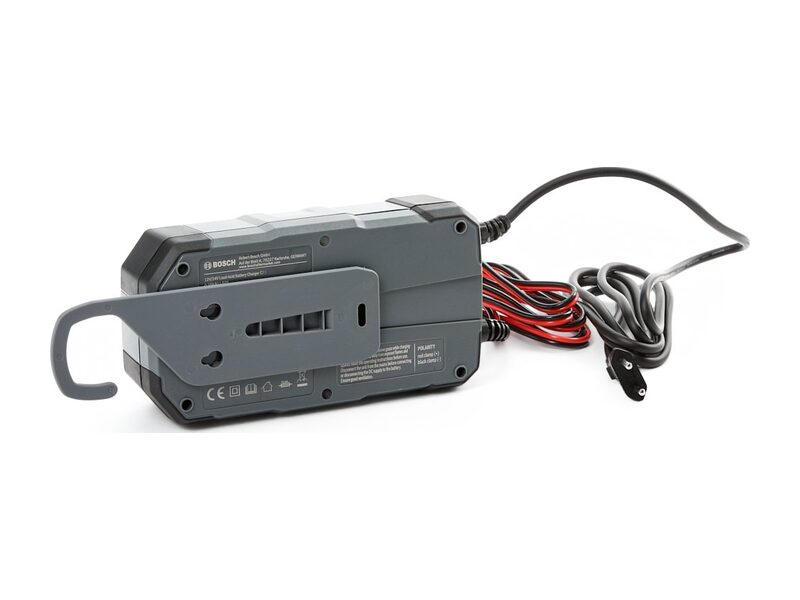
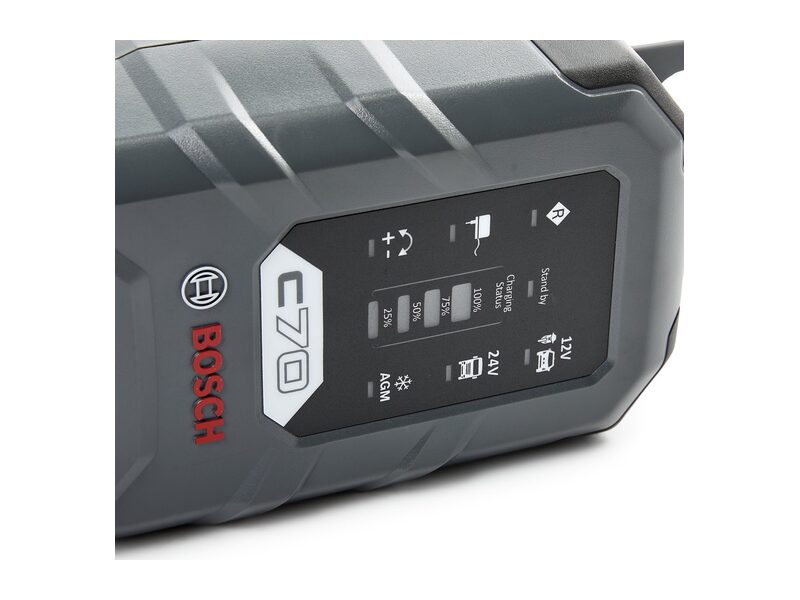
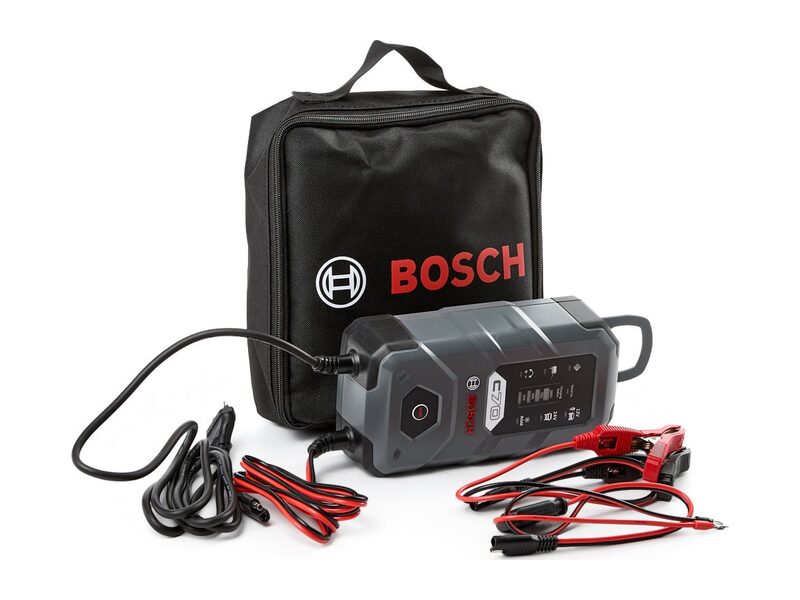
Bosch C70 Charger
(19 reviews)
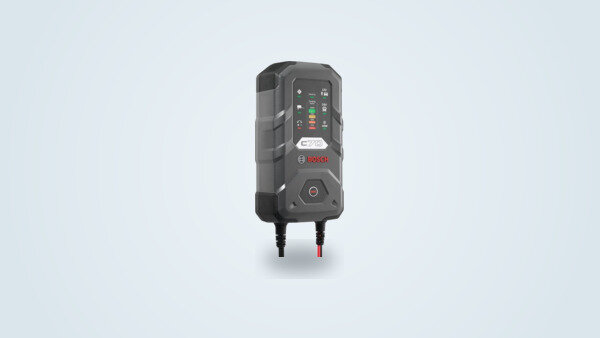
Ten amps and 24 volts on top: the only charger in our selection able to look after a truck, a tractor or a boat with a dual battery circuit.
Buy at AmazonAs an Amazon Associate I earn from qualifying purchases.
Characteristics
- Output: 10 A, 12 V and 24 V batteries
- Compatibility: Lead-acid, EFB, gel, AGM, SLI
- Workshop: Powers the vehicle during battery swap
- Format: 1.15 kg, carrying case supplied
- 24 volt support for vans and trucks
Detailed overview: Bosch C70 12 and 24 volt battery charger
The C70 sits at the top of Bosch's renewed C-Line range. Its difference lies first in dual voltage: 12 volts for ordinary motoring, 24 volts for everything larger. A truck, a coach, a piece of agricultural machinery or a motor boat runs on two 12 volt batteries wired in series, and a 12 volt charger can do nothing for them.
The 10 amp maximum follows logically from that target. On the high-capacity batteries found in such vehicles, often 100 amp-hours and beyond, a 4 amp charger would take more than a day. The C70 cuts that by two or three, while keeping electronically controlled charging that switches to trickle mode once the battery is full.
Like the rest of the range, it supports lead-acid, gel, EFB and AGM. The last two equip stop-start vehicles and demand specific charging voltages: treating them as ordinary lead damages the battery slowly. Bosch, which manufactures these batteries, applies the correct profiles.
The most interesting function for a workshop or a methodical enthusiast is powering the vehicle while the battery is replaced. On modern cars, cutting the supply erases memories: ECU settings, radio codes, window initialisation. The C70 can feed a stable current to the onboard circuit during the swap, and you drive off without having to reprogramme anything.
For strictly domestic use on one or two cars, the Bosch C30 covers the need for nearly thirty pounds less. And if your batteries are lithium iron phosphate, neither will do: you then need the CE-BC 5 M LiFePO4.
Comparison
At just under eighty pounds the C70 does not play in the same league as domestic chargers. The table shows what you actually buy.
| Criterion | Bosch C70 | Bosch C30 | Noco Genius10 | CTEK MXS 5.0 |
|---|---|---|---|---|
| Max current | 10 A | 3.8 A | 10 A | 5 A |
| 24 V support | Yes | No | No | No |
| Vehicle power supply | Yes | No | Yes | Yes |
| LiFePO4 lithium | No | No | Yes | No |
| Observed price | ≈ £77 | ≈ £50 | ≈ £102 | ≈ £83 |
The real rival is the Noco Genius10, which delivers the same current, adds lithium support, but stays at 12 volts and costs twenty-five pounds more. The decision is simple: if you need 24 volts, the C70 is the only one in the selection to offer it and the question is settled. If you stay at 12 volts but own lithium, the Noco is the right pick. And if you only have a passenger car, the C30 does the job for far less.
Related video
Video: Bosch C-Line Battery Charger - Published on 14/10/2024
Our tester's review: Christophe Delpuech
The C70 targets a specific audience, and it should be said plainly: if you only have a passenger car in the garage, it is overkill and the C30 will do. Its interest begins as soon as the fleet diversifies. The 24 volt capability first opens the door to trucks, tractors, dual-circuit motorhomes and a large share of motor boats, all fitted with two batteries wired in series. No other charger in our selection can do that. The 10 amps then change your relationship with time: a half-empty 100 amp-hour battery recharges in half a day rather than a full night, which matters when the vehicle has to leave. The function we find cleverest is aimed at workshops. On a recent car, disconnecting the battery wipes the memories of the ECU, the radio, sometimes the electric windows, which then need resetting. The C70 can power the onboard circuit during the operation, much like a stabilised power supply, and the battery is swapped without losing anything. That is a service normally charged for by far dearer equipment. Two reservations. Status reporting stays basic, with indicator lights where a screen would be welcome at this price. And it does not handle LiFePO4 lithium, which is starting to be limiting on recent motorhomes. At just under eighty pounds it is a considered investment for anyone maintaining several vehicles, and a pointless one for a single city car.
In-depth review Bosch C70: our full review 3.9/5 Read our full review → Actual charging current 4.0 Battery compatibility 3.6 Safety and protections 4.0 Build and endurance 4.2 Cables and connectors 3.2 Actually delivered power not measured Multi-port power sharing not measured Protocol compatibility not measured Size and technology not measured Format and chemistry compatibility not measured Charging precision not measured Display and control not measuredFrequently asked questions: Bosch C70 12 and 24 volt battery charger
Trucks, coaches, tractors and many motor boats run on two 12 volt batteries wired in series, giving 24 volts in total. A 12 volt charger cannot recharge them properly. That is what sets the C70 apart from the rest of the range.
The C70 has a mode that feeds a stable current to the onboard circuit while the battery is disconnected. On a recent car this avoids losing the ECU memories, the radio codes or the electric window initialisation.
No, charging remains electronically controlled and adapts to the battery: the 10 amps are a maximum, not an imposed value. It is simply oversized in budget terms if you only own a city car, in which case the C30 is plenty.
Yes, along with EFB. Both technologies equip stop-start vehicles and require specific charging voltages. Since Bosch manufactures these batteries itself, the unit applies the correct profiles rather than a generic lead-acid one.
Other products in the "Car & motorcycle battery chargers" category
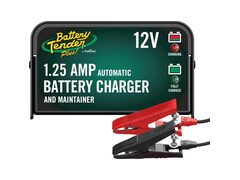
Battery Tender Plus
See price (65)
A safe bet for battery maintenance: the Battery Tender Plus keeps your 12V batteries in top shape all year, with 4-step charging and a 10-year warranty.
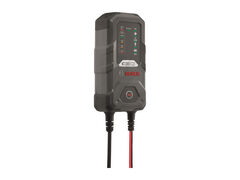
Bosch C30 Charger
See price (22)
The charger you find in every other garage: simple, robust, rated for batteries up to 120 Ah, and made by the world's largest automotive supplier.
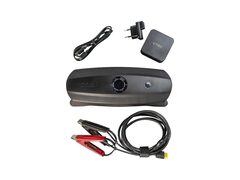
CTEK CS Free
See price (15)
The first truly cordless 12V battery charger: the CTEK CS Free revives a flat battery in 15 minutes, with no socket, thanks to its internal battery and Adaptive Boost.
CTEK MXS 5.0
See price (14)
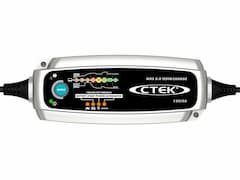
The CTEK MXS 5.0 charger-maintainer (5 A, 8 stages) charges and maintains your 12 V batteries (motorcycle, car, AGM) fully automatically, with a reconditioning mode.
Published on 26/07/2026, updated on 14/08/2026