
What the 1.25A charging current is actually worth
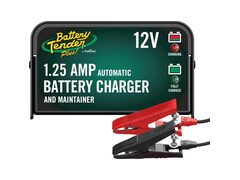
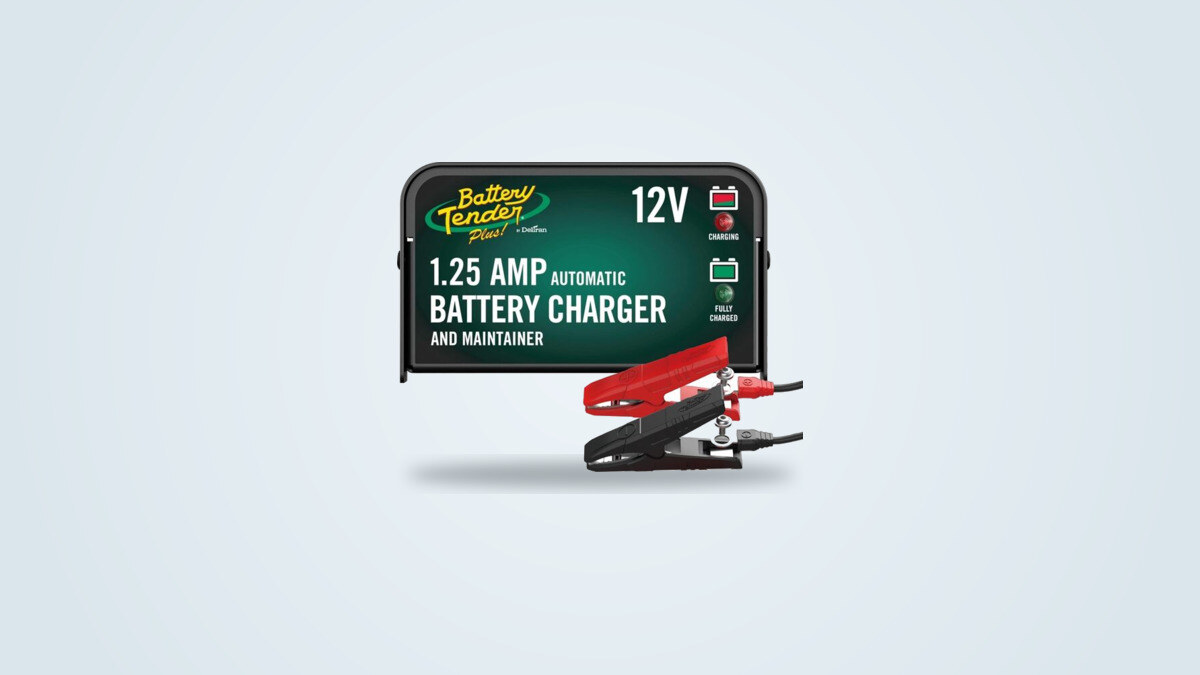
The Battery Tender Plus 021-0128 is not a fast charger, it is a maintainer, built to stay connected for weeks or months at a stretch. Its nominal current is 1.25A, with an adaptive range of 0 to 2A depending on the stage in progress. The cycle runs four stages: initialization, bulk charge, absorption at 14.6V, then float maintenance at 13.3V. Stated maximum power is 18W (at 25 °C), a figure consistent with multiplying the absorption voltage by the nominal current.
In practice, this current puts the Battery Tender Plus at the opposite end of the spectrum from a workshop charger: on a 50Ah battery at half charge, a full recharge at 1.25A easily takes a couple of dozen hours. That is not a design flaw, it is the whole point of the product, aimed at long-term upkeep of a small or medium lead-acid battery, not at reviving a vehicle stranded in a hurry. The manufacturer recommends this unit for batteries of 14 to 80Ah at 12V, which covers most motorcycle, ATV, ride-on mower and small boat batteries.
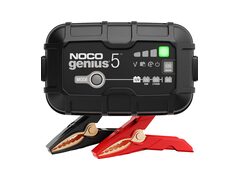
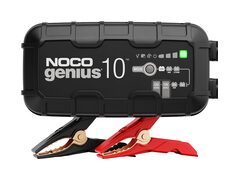
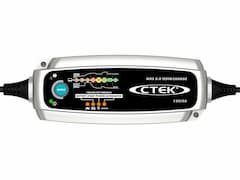
This positioning is obvious next to the most direct rival 12V maintainers: the Noco Genius5 and the CTEK MXS 5.0 both deliver 5A, and the Noco Genius10 reaches 10A. The Battery Tender Plus is not trying to compete on that ground, its promise is limited to a slow but steady charge, followed by an indefinite hold that never pushes past the float maintenance voltage.
Battery compatibility: complete lead-acid coverage, nothing beyond it
The Battery Tender Plus is built for three lead-acid chemistries: flooded, AGM and gel. That is full coverage of the most common lead-acid batteries found in motorcycles, ATVs, boats and classic cars. What it does not handle is lithium LiFePO4, increasingly common in newer leisure batteries, nor a 6V mode: this unit is strictly single-voltage, 12V only.
This limit is not a minor detail. A lithium battery has a different charge profile and different voltage thresholds from a lead-acid one, and its real protection depends on a BMS (battery management system) built into the battery itself, which a classic lead-acid charger does not address the same way. Applying a profile designed for lead-acid to a lithium battery is not what this product claims to do, and the manufacturer never markets this reference for that use.
| Criterion | Battery Tender Plus | Noco Genius5 | Noco Genius10 | CTEK MXS 5.0 |
|---|---|---|---|---|
| Flooded, AGM, gel | Yes | Yes | Yes | Yes |
| Lithium LiFePO4 | No | Yes | Yes | No |
| 6V mode | No | Yes | Yes | No |
On this specific point, the Battery Tender Plus shares the same limit as the CTEK MXS 5.0: neither handles lithium. The two Noco Genius units, of more recent design, cover a wider range. For an owner of a standard lead-acid battery, this limit changes nothing about the experience. For anyone planning a switch to lithium, or who already owns a LiFePO4 leisure battery, this is not the right tool, a charger explicitly built for lithium is needed instead.
The plug-and-forget principle: float maintenance in practice
The Battery Tender Plus's core promise fits in one sentence: plug it in during autumn and find the battery ready in spring, with no intervention needed. Once the 14.6V absorption voltage is reached, the unit automatically switches to float maintenance at 13.3V and stays there indefinitely, never letting the voltage climb back past that ceiling. It is this mechanism, not a simple timer, that makes it safe to leave the unit connected for months without watching over the battery.
Two safeguards round out this behaviour. A safety timer cuts the charge after 72 hours if the battery still has not reached its target threshold, a likely sign of a failing cell rather than a simple deep discharge: it is a safeguard against a charge cycle running indefinitely on a battery that can no longer accept a normal charge. Low-voltage detection also reaches down to 3V, letting the unit recognise and attempt to recharge a very deeply discharged battery, where an entry-level charger would simply refuse to start.
This closed-loop behaviour, charge then hold then a brief top-up if voltage drifts down slightly, is what separates a smart maintainer from a plain charger or an unregulated solar panel left connected permanently: no overcharge is possible as long as the unit stays in its automatic mode.
Safety and protections: what is built in, what differs by reference
The Battery Tender Plus's list of protections covers what is expected on a unit meant to stay connected unattended: reverse-polarity protection, spark-proof connection at hookup, and short-circuit protection. The unit carries ETL and cETL electrical certifications.
One point is worth spelling out, since it concerns regulatory compliance rather than electrical safety itself: this 021-0128 reference, the one carrying the 10-year warranty, is not approved for new sale in California or Oregon. Both states have applied energy-efficiency standards for battery chargers since 2013 and 2014 respectively (California Energy Commission), which this specific reference does not meet. The manufacturer offers a separate variant of the 1.25A Battery Tender Plus for those two states, CEC and DOE certified, with a different housing and a stated IP65 rating, but with its contractual warranty cut to 5 years instead of 10. It is therefore not strictly the same product under the same name, a buyer in California or Oregon needs to check the exact reference before ordering.
No safety recall or hazard-related failure is tied to the 021-0128 reference. The failure cases discussed later in this review concern units simply ceasing to work after several years of use, not a safety defect.
Build quality and warranty: the length that makes the difference
The 10-year contractual warranty is, by a wide margin, the Battery Tender Plus's strongest argument against its direct rivals: double the CTEK MXS 5.0's 5 years, and more than three times the Noco Genius5 and Genius10's 3 years each. A warranty that long only makes sense if the company behind it can actually afford to honour it over time.
Deltran, the company behind the Battery Tender, was founded in 1965 in Florida under the name Deltona Transformer Corp., originally focused on electrical transformers. It was in 1988 that the company launched the Battery Tender, one of the very first microprocessor-controlled battery chargers on the market. The company remains family-owned, still run by the Prelec family, now in its third generation, and passed the 60-year mark in 2025.
This corporate longevity shows up in individual unit lifespans too: some units stay in service for close to 15 to 20 years after being put into use, a real sign of durability for this type of device. Deltran also has a reputation for honouring its warranty without major friction. The picture is not entirely uniform though: a minority of units nonetheless stop working after only 3 to 5 years, with no gradual warning sign beforehand. That remains a minority against an overwhelmingly favourable whole, but real enough not to be glossed over: the 10-year warranty only helps if the buyer keeps proof of purchase to actually use it when needed.
Cables and connectors: clamps and ring terminals in the box
The Battery Tender Plus ships with both connection systems at once: a set of alligator clips for occasional use, and a quick-connect ring terminal harness meant to stay permanently fixed to the battery posts. Once that harness is installed, connecting or disconnecting the unit itself takes a few seconds, with no need to redo the terminals each time.
The mains cord runs about 1.83m, the battery-side output cable about 1.37m, extended by roughly a 0.46m lead at the clamps or terminals, for a stated total reach of over 3.60m between the wall outlet and the battery. The cables are 18 AWG, a standard gauge for this current level. That is a comfortable length for positioning the unit a reasonable distance from a garage wall outlet, without forcing an awkward cable run.
For anyone maintaining several vehicles, the logic is simple: a ring-terminal harness wired permanently to each battery, and a single Battery Tender Plus unit moved from vehicle to vehicle through the season. That is exactly the use case this connector setup was designed for, and it is a point where the product holds up well against every rival named in this review.
The real friction point: a 120V supply, not just a different plug
The most concrete friction point for a reader outside North America concerns the power supply. The 021-0128 reference reviewed here is built for the North American mains, 120V AC at 50 or 60Hz. This is not just a matter of plug shape: beyond the physical adapter, the unit's internal transformer itself is rated for a 120V input.
This constraint is not unique to the Battery Tender Plus, it applies to any electronic device built for a single mains standard with no universal input range. The Battery Tender Plus, on this specific reference, does not advertise a universal input range (such as 100 to 240V). By direct comparison, the Noco Genius10 natively accepts 100 to 240V, which removes this problem entirely on that particular rival. This is something worth checking on any product of this kind before buying it for a market different from the one it was designed for.
Real availability by market: an American institution, present differently elsewhere
Battery Tender is an institution across North America: the brand is everywhere in powersports shops, motorcycle and boat dealerships, and automotive aisles in the United States and Canada, with generations of owners who would not consider winter storage without it. That level of recognition does not carry over identically to the other markets this review covers, and it would be misleading to gloss over that.
In the United Kingdom specifically, a version genuinely adapted to the local market does exist, with a UK plug and a European-range input voltage, sold under references different from the North American 021-0128 (namely 022-0185G-DL-UK and 022-0148-DL-UK). The Battery Tender Plus name is therefore available here, but under a local reference, not the American one reviewed in this article.
On the European mainland (France, Germany, Italy, Spain), the picture is more mixed. Specialised European distributors of the brand do stock Battery Tender products with a European plug, but their range leans towards different references from this exact 1.25A Plus: a 5A model sold as the Power Tender Plus, and a 1.25A dual-select 6/12V maintainer that, unlike the American reference, does add lithium compatibility. In other words, the closest product natively available on those four markets is not an exact clone of the one covered in this review, but a related variant that differs on at least one notable point.
| Market | Situation |
|---|---|
| United States, Canada | 021-0128 reference natively sold, original 120V supply |
| United Kingdom | A locally adapted version exists, UK plug, under a reference different from the 021-0128 |
| France, Germany, Italy, Spain | Local Battery Tender range leans towards different references (different current, or added lithium compatibility) |
For a reader on one of those last markets, the practical takeaway is simple: the Battery Tender Plus name alone does not guarantee receiving the 120V unit described in this review, nor a strictly equivalent 230V version. Checking the exact reference, the stated input voltage and the plug type before ordering remains essential, all the more so when the purchase goes through a marketplace listing the same product across several sellers and shipping countries.
Against the competition: Noco Genius5, Genius10 and CTEK MXS 5.0
In the segment of 12V maintainers built for lead-acid batteries, three direct points of comparison stand out: the Noco Genius5, the Noco Genius10 and the CTEK MXS 5.0.
| Criterion | Battery Tender Plus | Noco Genius5 | Noco Genius10 | CTEK MXS 5.0 |
|---|---|---|---|---|
| Charging current | 1.25 A | 5 A | 10 A | 5 A |
| Battery capacity | 14 to 80 Ah | up to 120 Ah | up to 230 Ah | up to 110 Ah |
| Manufacturer warranty | 10 years | 3 years | 3 years | 5 years |
Against the Noco Genius5, the Battery Tender Plus is clearly less well equipped on two specific points: compatibility (neither lithium nor 6V, where the Genius5 handles both) and available current (1.25A versus 5A, meaning a much longer charge time at equal capacity). It takes back the lead on warranty length, though, 10 years against 3.
Against the CTEK MXS 5.0, the comparison favours the Battery Tender Plus more: both share the same lack of lithium compatibility, but no recurring failure of a specific part is tied to the Battery Tender Plus, unlike the CTEK's MODE button, covered in this site's own review of that unit. The Battery Tender Plus's warranty is also twice as long. Its current remains more modest still, though (1.25A against 5A), keeping it strictly in upkeep territory.
Against the Noco Genius10, the newest and most powerful of the three, the current gap widens further (1.25A against 10A) and lithium compatibility is still absent. The Genius10 also natively accepts 100 to 240V power, a real advantage outside North America that the Battery Tender Plus does not offer on this reference. Warranty remains the Battery Tender Plus's constant edge against all three, 10 years against 3 or 5.
Who the Battery Tender Plus is for, and who should look elsewhere
The Battery Tender Plus suits anyone who owns, in North America or with a suitable power supply elsewhere, a flooded, AGM or gel lead-acid battery of 14 to 80Ah on a motorcycle, ATV, boat, ride-on mower or rarely used car, and who values slow, unattended upkeep over fast charging. The 10-year warranty also makes it a sound choice for anyone who would rather invest once in a unit built to last than replace a maintainer every few winters.
It suits owners of a lithium LiFePO4 battery far less well: none of this reference's charge protections are designed for that chemistry, and a charger explicitly built for lithium, such as the Noco Genius5 or Genius10, is needed instead. It is also not the right choice for a large service battery on a motorhome or a liveaboard boat, where its 1.25A would force unreasonable charge times against rivals reaching 5 or 10A.
Finally, a reader outside North America should check two things before ordering: the input voltage actually stated for the specific unit on offer (120V or 230V depending on the exact reference), and the precise reference of the unit received, which can differ meaningfully from the 021-0128 reviewed here depending on the country of sale. A buyer in California or Oregon should separately look for the CEC-certified variant for their state, at the cost of a warranty cut to 5 years.