
What the advertised 10A charging current is really worth
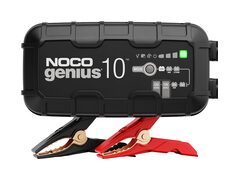
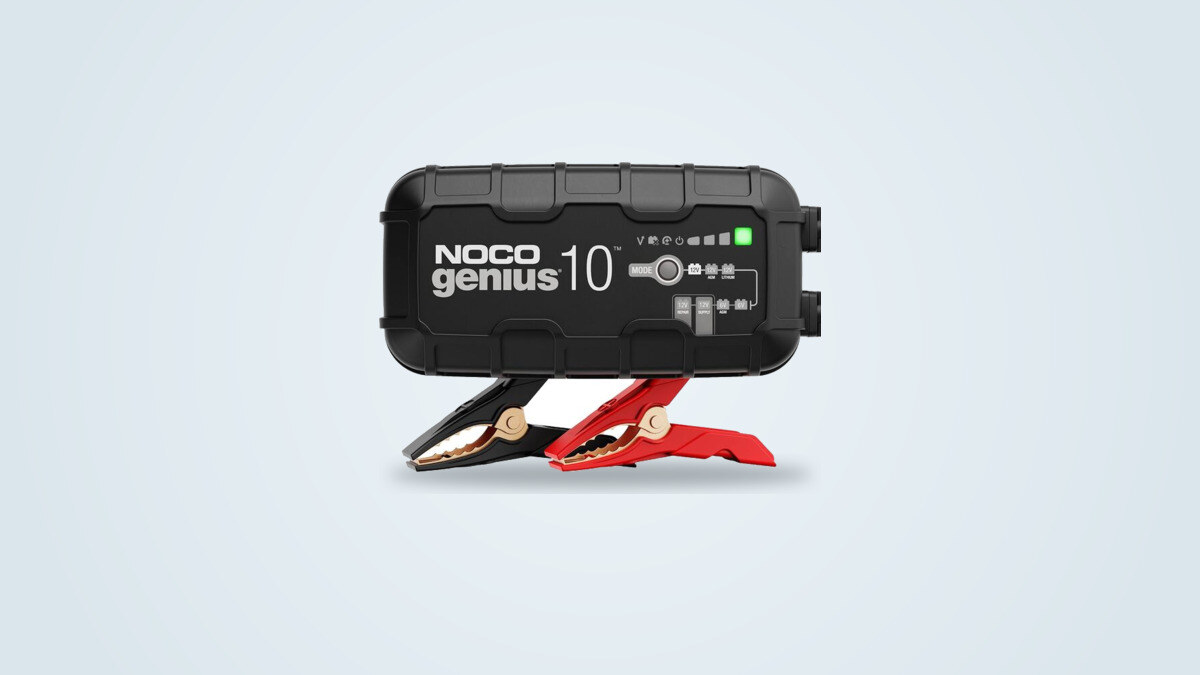
The Genius10 is the most powerful charger in Noco's Genius lineup: 10A in both 6V and 12V, where the Genius5 tops out at 5A. It runs on mains power from 100 to 240V and 50 to 60Hz, so there's no electrical compatibility issue whether it's plugged in across Europe or the United States. The roughly 182cm mains cord and the compact case, 94 x 183 x 59mm for 1.5kg, mean it slips into a toolbox or a motorhome cubby without needing dedicated storage.
That 10A figure is genuinely what comes out of the clamps, with no reduced step hidden behind the manufacturer's claim. That's not a given on this segment, where plenty of entry-level chargers quietly throttle their output as internal temperature rises: nothing of the sort shows up in normal use of the Genius10. The battery-side cable, about 195cm long, also carries a 20A fuse that limits the damage from an accidental short while handling the clamps.
Doubling the Genius5's current mainly changes things past roughly sixty amp-hours. The difference is barely noticeable on a small battery, but becomes clear once it's a motorhome, boat or 4x4 battery on the clamps. The chart below gives the typical charge duration quoted for bringing a half-discharged battery back to full, from small motorcycle packs up to the Genius10's 230Ah ceiling.
The 230Ah ceiling Noco quotes comfortably beats the Genius5's 120Ah and the CTEK MXS 5.0's 110Ah: that's this model's real reason to exist, not just a marketing line.
Genuinely broad battery compatibility, lead-acid and lithium alike
The Genius10 packs nine modes behind a single button: standby, 12V standard, 12V AGM, 12V lithium, 6V standard, 6V AGM, Supply, Repair and Force. Each lead-acid mode applies its own charge voltage, which is the real sign of a dedicated profile rather than a lithium mode bolted onto an unchanged lead-acid algorithm for the brochure: 14.5V in 12V standard, 14.8V in 12V AGM, 14.6V in 12V lithium, 7.25V in 6V standard and 7.4V in 6V AGM.
On the lead-acid side, the Genius10 accepts flooded, AGM, Gel and EFB batteries, the reinforced type increasingly common on modern start-stop vehicles, with nothing to configure beyond picking the mode. On the lithium side, the 12V Lithium mode specifically targets LiFePO4, now the standard chemistry on leisure batteries replacing lead-acid in motorhomes and boats. One reservation still applies: as with any external charger, real protection for a lithium battery also depends on its own built-in BMS (battery management system). The Genius10 supplies a suitable charge voltage, not a substitute safeguard if the battery itself lacks one.
The 230Ah ceiling spans a very wide range, from a small 4x4 battery up to the large service battery of a motorhome or a live-aboard boat. That's one thing it shares with the Genius5, which handles the same chemistries but with a 120Ah ceiling only. Picking the wrong chemistry isn't harmless either: a 14.8V voltage meant for AGM, applied continuously to an ordinary flooded battery, speeds up its water loss, which is exactly why distinct profiles matter more than a single one-size-fits-all setting for lead-acid.
Force mode: reviving a battery that has dropped very low
Force mode is reserved for batteries that have fallen below the automatic detection threshold of 1V, where most consumer chargers simply refuse to start a charge at all. In manual override, the Genius10 will attempt a revival down to 0V.
It's a feature built for the real-world case of a leisure vehicle left standing for months: a forgotten lead-acid battery can drop very low through self-discharge, particularly over winter or with small parasitic draws such as an alarm or an onboard computer. The Genius10's standard mode already recovers batteries down to 1V automatically; Force mode extends that recovery range to the most extreme cases, at the cost of a deliberate manual step from the owner.
Extending that range isn't free from a safety standpoint: below the normal threshold, the charger's usual protections are partly disabled to allow the initial current injection, a spark risk the manufacturer explicitly flags in its documentation. Force mode therefore stays a last-resort feature, reserved for batteries judged recoverable, not a mode for everyday use.
Activating it is never accidental: you have to deliberately hold the Mode button down to bring up the Force icon, something that never triggers on its own during a normal hookup. It's the typical scenario for a classic vehicle or a boat left standing an entire winter with no one keeping an eye on its battery.
Repair desulfation: a real mechanism, not a gimmick
Sulfation is the leading cause of a slow death for a lead-acid battery left flat or undercharged for months: lead-sulfate crystals build up on the plates and reduce usable capacity, even after a normal recharge. The Genius10's Repair mode specifically targets this problem, with a series of elevated-voltage pulses above the usual charging threshold, designed to progressively dissolve those crystals.
Two points matter before expecting miracles from it. First, this mode is manually selected: it isn't an automatic step in every charge cycle, whatever the name might suggest. Second, it applies to 12V lead-acid batteries; it makes no sense on lithium, which doesn't sulfate the same way, nor on 6V.
The warning sign to watch for is a start that gets weaker and weaker despite repeated full charges: that's often the symptom of sulfation that has set in over several months of storage. A Repair cycle takes noticeably longer than a normal charge, and deliberately stays within the most lead-acid-tolerant 12V voltage range, so as not to further damage a battery that's already weakened.
Supply mode: a handy backup supply, to use with care
Supply mode turns the Genius10 into a stabilised 13.6V power supply, with up to 10A available and a safety cutout if the draw exceeds 12A. In practice, it lets you disconnect a vehicle's battery, say to replace it, without losing power to the onboard computers, the radio or any stored settings.
It's an unusual feature at this price point, and particularly handy on newer vehicles where even a brief battery disconnection resets the clock, radio presets or certain electronic settings.
The manufacturer is explicit on one point: this mode disables the charger's usual protections, and the connectors stay live. It isn't a convenience feature meant to be left on by default, but a one-off tool to use with real care, clamps kept apart from each other throughout the operation.
Activation happens with the battery disconnected: you hold the Mode button for about three seconds until the dedicated icon appears. Beyond battery replacement itself, this mode also works as a steady 12V feed for small onboard accessories, such as a compressor or a drain pump, for the length of a workshop job.
The real limit: a fixed current that isn't always the right call
The Genius10 offers no reduced current step: the 10A rate applies across every 12V voltage and chemistry, with no intermediate setting. That makes sense for a large motorhome or 4x4 battery, where 10A is a reasonable fraction of total capacity. It stops being true on a small motorcycle, quad or garden-equipment battery, typically under 20Ah: a sensible maintenance charge rate sits closer to a tenth of capacity, or 2 to 3A for that size, against 10A here.
That isn't a design flaw, it's a segmentation choice the manufacturer openly makes: Noco splits its Genius range into increasing current steps, 1, 2, 5 and then 10A, precisely to offer a different product depending on the size of battery being maintained. The Genius10 explicitly targets large batteries; smaller formats remain the territory of the Genius5, or of even smaller models further down the same range.
On capacities genuinely suited to this current, though, the Genius10 delivers on its promise: the charge-time progression by battery size shown earlier stays consistent from one size to the next, with no anomaly or hidden step.
Build, clamps and cables: what's actually in the box
The case follows the same design language as the rest of the Genius range: rugged plastic shell with rubber corner guards, a built-in carry handle and rubber covers over the connection ports to shield them from dust and moisture. The whole unit is IP65-rated, which covers use in a garage or a sheltered outdoor spot, without amounting to full submersion protection.
The clamps are metal, with a fine needle-nose tip for reaching awkward battery terminals, and noticeably heavier-duty than those on the Genius5 or Genius1. They detach by hand to reveal quick-connect eyelet terminals, supplied with the unit: a permanent hookup on a vehicle and nomadic clamp-based use can coexist without buying any extra accessory. The battery-side cable runs about 195cm and carries a 20A fuse; the mains cord adds roughly 182cm.
The one material gripe: no storage pouch ships in the box, even though this is the kind of unit that gets tossed into a boot or a toolbox between uses. It's sold as a separate accessory by the manufacturer and by several retailers. A mounting bracket and a hook-and-loop strap are included, though, for securing the case permanently near a battery on a fixed installation.
Safety, warranty and long-term reliability
The claimed protection list is comprehensive: short-circuit, open-circuit, overheating, overcharge, spark-proof and reverse-polarity. That's the expected baseline for a unit meant to stay connected for months unattended, exactly the use case a winter battery maintainer is built for.
A built-in thermal sensor automatically adjusts the charge voltage to ambient temperature, to limit overcharging in hot weather and undercharging in cold. The manufacturer states an operating range of -20 °C to 40 °C and a storage range of -30 °C to 60 °C, consistent with year-round use in a sheltered outdoor spot or an unheated garage.
The manufacturer's warranty runs 3 years, the same length as the Genius5, but shorter than the CTEK MXS 5.0's 5 years. The warranty terms are worth reading before buying rather than after a failure: the unit must be registered to validate coverage, return shipping to the service centre is the owner's responsibility, and the stated turnaround runs 4 to 6 weeks. None of that is unusual for this type of product, but it does mean keeping proof of purchase on hand and not expecting an instant swap if something goes wrong.
No safety recall has been identified for this model to date.
Against the competition: the Genius5 and the CTEK MXS 5.0
On this exact segment, the lithium-compatible 12V maintainer, two comparison points stand out: the Genius5, its own direct little sibling, and the CTEK MXS 5.0, the most commonly cited alternative outside the Noco range.
| Criterion | Noco Genius10 | Noco Genius5 | CTEK MXS 5.0 |
|---|---|---|---|
| Charging current | 10 A | 5 A | 5 A |
| Voltages handled | 6V / 12V | 6V / 12V | 12V |
| Lithium LiFePO4 | Yes | Yes | No |
| Max capacity | 230 Ah | 120 Ah | 110 Ah |
| Manufacturer warranty | 3 years | 3 years | 5 years |
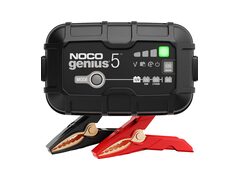
Against the Genius5, the Genius10 doubles the charging current and pushes maximum capacity from 120 to 230Ah, for barely any extra size or weight. The difference really pays off past roughly sixty amp-hours; below that, the Genius5 remains the better-balanced pick.
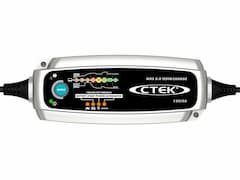
Against the CTEK MXS 5.0, the gap is about versatility: the Genius10 handles 6V and lithium LiFePO4, two things the CTEK doesn't do at all, at twice the current. The CTEK keeps a clear edge on warranty length, 5 years against 3, a factor that genuinely matters on a unit meant to last a decade or more in a garage. The choice between these three, then, comes down less to brand than to actual use: high volume and varied chemistries for the Genius10, occasional upkeep of a single small battery for the Genius5, loyalty to a long warranty for the CTEK.
Who the Genius10 suits, and who it doesn't
The Genius10 suits anyone who needs to charge or maintain medium-to-large batteries: a 4x4, a motorhome, a boat, a garden tractor, or a vehicle fitted with a large service battery. Its LiFePO4 lithium compatibility also makes it a sensible pick after a recent leisure-battery conversion from lead-acid to lithium, without swapping chargers.
It's less suited to anyone with only a small motorcycle, quad or garden-equipment battery under 20Ah: the fixed 10A output is overkill there, and the Genius5, or an even smaller model further down the same range, will do a better-matched job for less money.
On a boat or a caravan fitted with two separate batteries, house and starter, the Genius10 remains a single-output unit: switching between the two means disconnecting and reconnecting by hand. Noco does offer multi-bank versions elsewhere in its Genius range for exactly this scenario, but the Genius10 itself isn't one of them.
The purchase price, higher than the Genius5's, mainly pays for that headroom on large capacities: spending it on a single small motorcycle battery means paying for versatility that never gets used. For anyone maintaining several vehicles of different sizes at once, the calculation shifts: either a single Genius10 for the big batteries paired with a smaller model for the rest, or one default pick sized to the most demanding battery in the fleet, deliberately oversized for everything else.