
What the dual 2A banks are really worth
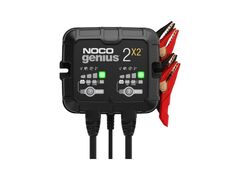
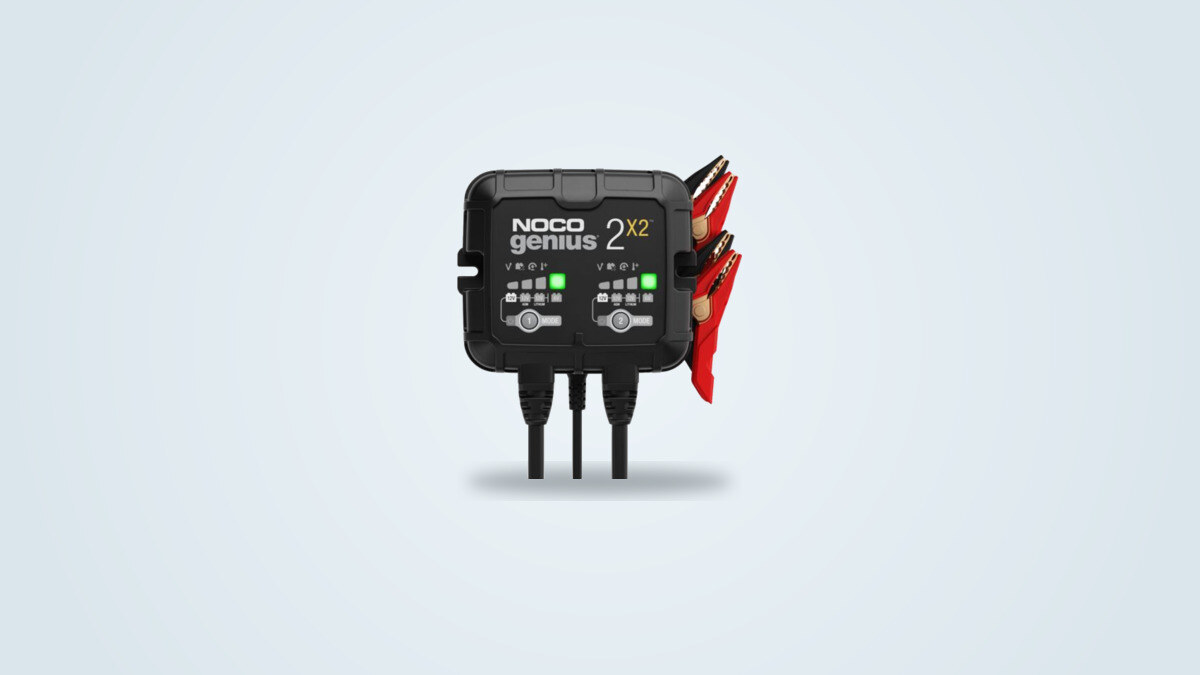
The Genius2X2 is a charger with two fully independent banks: each delivers up to 2A continuously, for a combined 4A split across the two connected batteries. The unit accepts AC power from 120V to 240V at 50Hz to 60Hz, which rules out any electrical compatibility issue, in Europe as anywhere else. At 114 x 132 x 48 mm for just 0.5 kg, it fits into a camper storage pocket or a toolbox without adding real weight to the rest of the kit.
This 2A per bank is genuinely what comes out of the clamps, with no reduced step-down from the manufacturer's spec sheet: each bank has its own internal supply and keeps its 2A even while the other bank is charging at the same time, with no sharing between the two. That's not a given on a two-output unit running off a single AC plug.
2A remains a modest current next to the Genius5's 5A or the Genius10's 10A. With a 40Ah ceiling per bank, charging a large, deeply discharged battery takes patience: the chart below applies the manufacturer's own charge-time formula (amp-hours to restore divided by current, plus the margin for the absorption stage) for a battery at 50% discharge.
The 40Ah ceiling per bank covers a small motorcycle, quad, or ride-on mower battery, and is enough to maintain a mid-size camper leisure battery. Beyond that, charging remains possible but noticeably slower: for a single large battery that needs a fast recharge, the Genius5 or Genius10 remain the better fit.
Wide battery compatibility, with a mode to pick yourself on each bank
The Genius2X2 handles seven lead-acid variants (flooded, gel, maintenance-free, calcium, EFB, AGM) alongside lithium LiFePO4, across both 6V and 12V. Each bank has its own Mode button, independent from the other: a brief press cycles through four positions, 12V standard, 12V AGM, 12V Lithium, and 6V, before dropping back to standby.
One nuance is worth spelling out, since a quick read of the spec sheet could suggest automatic chemistry sensing: that isn't the case. It's up to the user to pick the right mode on each bank before starting a charge, exactly as on the Genius5 or Genius10. Connecting a lithium battery without switching to 12V Lithium mode applies a voltage profile designed for lead-acid instead.
The 12V Lithium mode specifically targets LiFePO4 batteries fitted with a BMS (battery management system): that's a condition set by the manufacturer itself, not an excessive precaution. Without a BMS to cut charging in case of a cell imbalance, the voltage the Genius2X2 delivers has no way to protect the battery on its own. On the lead-acid side, the 40Ah ceiling per bank covers a small to mid-size battery; beyond that, the unit still maintains it, but a full charge from a deeply discharged state takes a long time.
This is where the dual-bank design earns its keep: each side can take a different chemistry without either setting affecting the other. An AGM lead-acid battery on bank 1 and a lithium battery on bank 2 charge under two entirely separate voltage profiles, in parallel, with no need to choose between them.
Force mode: restarting a battery that has dropped very low
Each bank on the Genius2X2 automatically detects and restarts a battery down to 1V, where many consumer chargers simply refuse to begin a charge at all. For more extreme cases, below that 1V threshold, Force mode is switched on manually and allows one attempt to restart a battery down to 0V.
It's a feature built for a battery forgotten for months on a leisure vehicle sitting idle: natural self-discharge, made worse by a small parasitic draw such as an alarm or an ECU, can pull a lead-acid battery well below the normal detection threshold. On the Genius2X2, as on the rest of the Genius range, switching on Force mode means deliberately holding down the Mode button on the affected bank, an action that never triggers by accident during a normal connection.
Both banks manage their own Force mode independently: nothing stops you from forcing a restart on bank 1's battery while bank 2 carries on with a normal charge on the other vehicle.
Pulse desulfation, built in and automatic
Sulfation is the leading cause of a slow death for a lead-acid battery left flat or undercharged for months: lead sulfate crystals build up on the plates and reduce usable capacity, even after a normal recharge. The Genius2X2 runs a pulse-charging routine that automatically detects and corrects this sulfation, along with acid stratification on flooded batteries.
The difference from the Genius5 or Genius10 lies in how this function is triggered: both of those models offer a separate Repair mode, selected manually at the Mode button for a dedicated, extended desulfation cycle. The Genius2X2 doesn't offer that separate mode: sulfation correction is folded into the normal automatic charge cycle, with nothing extra to switch on. That's simpler to use, but also less targeted than a dedicated Repair cycle on a badly degraded battery.
The warning sign stays the same across the whole range: an engine that cranks more and more sluggishly despite repeated full charges often points to sulfation built up over months of storage. A battery badly degraded by long-standing sulfation won't necessarily regain its original capacity, but recovering enough for a reliable start remains a common outcome on a battery that was merely neglected.
Two vehicles at once: what the dual bank is really for
The Genius2X2's real selling point isn't speed, it's the ability to handle two batteries in parallel without compromising either one. A motorcycle and a car sharing the same garage, a boat and a quad stored side by side, or both batteries of a camper, leisure and starter: this is exactly the setup where a single two-cord unit replaces two separate chargers, for a single AC outlet used.
Each bank keeps its full 2A whether the other is in use or not: the two charging circuits are independent of each other, not split from a single shared power stage. Plugging in both banks at once doesn't slow either one down.
On a vehicle fitted with two separate batteries, leisure and starter, or engine bank and bow thruster bank on a boat, the Genius2X2 avoids the usual back-and-forth with a single-output charger that has to be unplugged and reconnected from one battery to the other. That's a genuine gain in simplicity for winter storage or routine maintenance, where a single-output model forces a choice over which battery to handle first.
IP60: the waterproofing limit that sets it apart from the Genius5 and Genius10
The Genius2X2's housing is rated IP60. The first digit, 6, means complete protection against dust. The second, 0, means there is no protection against water at all, not even against simple vertical drips. That's a real step down from the Genius5 and Genius10, both rated IP65 (protected against water jets from any direction), and a fair question to ask given that the manufacturer also markets the Genius2X2 for boats, quads, or trailers, environments where moisture is common.
In practice, this doesn't undermine the unit's main use, winter maintenance in a dry garage or shed, but it does call for mounting it somewhere genuinely free of moisture: not in a boat locker exposed to sea spray, not in an unsealed trailer left outdoors, not near an opening in a utility room that can drip. On a boat or a camper, it's better to mount the housing indoors, away from the batteries if needed thanks to the included extensions, rather than in the same damp compartment as the batteries themselves.
This isn't a build defect as such: NOCO states this rating plainly on its official spec sheet, nothing hidden. It is, however, a genuine gap between the housing's protection and some of the use cases the manufacturer itself promotes, one worth knowing before buying rather than after an unfortunate install.
Build, cables and warranty
The clamps supplied with the Genius2X2 are described by NOCO as redesigned for greater clamping force and a wider opening range than the previous generation in the line, with a fine tip for reaching hard-to-access battery terminals. Each one has a built-in eyelet terminal, for a permanent mount on the battery with nothing to remove for each charge. Each bank has its own battery-side cable of about 86 cm with a 4A blade fuse built in, and the AC cord reaches about 1.9 m.
Two 3 m extensions are included for mounting the housing away from the batteries, a common need on a camper or boat where space near the batteries is tight. The unit ships with four AC cords with interchangeable plugs (Europe, UK, US, Australia), a sensible choice for a manufacturer selling the same unit internationally. The stated operating range runs from -20 °C to 40 °C, and the storage range from -30 °C to 60 °C, consistent with use in a sheltered outdoor spot or an unheated garage year-round.
The manufacturer warranty is 3 years, the same length as the Genius5 and Genius10, but shorter than the 5 years offered by rival CTEK MXS 5.0: a difference worth weighing before buying if after-sales longevity matters to the decision.
Electrical safety and winter storage in float mode
The stated electrical protection list is complete and matches the Genius5 and Genius10 exactly: short-circuit, open-circuit, overheating, overcharge, spark-proof, and reverse-polarity protection. That's the baseline expected on a unit designed to stay connected for months unattended, exactly the use case a winter battery maintainer is built for.
A built-in thermal sensor automatically adjusts each bank's charge voltage to the ambient temperature, limiting overcharge in hot weather and undercharge in cold weather, independently on both banks. Once a battery is fully charged, its bank switches on its own to float maintenance and keeps monitoring voltage continuously, with no overcharge risk according to the manufacturer: that's what allows both banks to stay connected permanently, including for months at a stretch.
No safety recall has been logged for this model to date. The one caveat, as covered above, concerns Force mode, which temporarily disables some of the usual protections to attempt restarting a battery under 1V: a deliberate action, not routine operation.
Versus the competition: Genius5, Genius10 and the option of two separate chargers
In the lithium-compatible 12V maintainer segment, three points of comparison stand out: the brand's own Genius5 and Genius10, single-bank but more powerful, and the CTEK MXS 5.0, the most cited alternative outside the Noco range.
| Criterion | Noco Genius2X2 | Noco Genius5 | Noco Genius10 | CTEK MXS 5.0 |
|---|---|---|---|---|
| Charging banks | 2 simultaneous | 1 | 1 | 1 |
| Current | 4A (2 x 2A) | 5A | 10A | 5A |
| Voltages | 6V / 12V | 6V / 12V | 6V / 12V | 12V |
| Lithium LiFePO4 | Yes (with BMS) | Yes | Yes | No |
| Max capacity | 40 Ah per bank | 120 Ah | 230 Ah | 110 Ah |
| Protection rating | IP60 | IP65 | IP65 | IP65 |
| Manufacturer warranty | 3 years | 3 years | 3 years | 5 years |
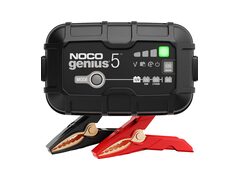
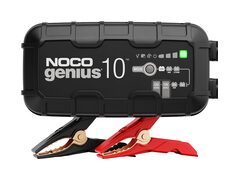
Against the Genius5 and Genius10, the Genius2X2 is the only one that handles two batteries at once: the other two are limited to a single battery per unit, regardless of their current. In exchange, each Genius2X2 bank caps out at 2A and 40Ah, well below the Genius5's 5A/120Ah and the Genius10's 10A/230Ah: for a single large battery that needs a fast recharge, those two remain noticeably quicker.
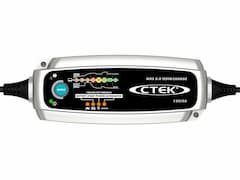
Against the CTEK MXS 5.0, the gap comes down to versatility: the Genius2X2 handles 6V and lithium LiFePO4, two use cases the CTEK doesn't cover at all, on top of handling two batteries at once. The CTEK keeps a clear edge on warranty length, 5 years versus 3.
Against buying two separate single-bank chargers instead of one Genius2X2, the case leans toward the single unit: one AC outlet to use, one unit to store, for a footprint and weight (0.5 kg) lighter than a single Genius5 (0.68 kg) alone. The flip side is losing flexibility if one of the two banks fails: both charging circuits then depend on the same housing, where two separate units would remain independent of each other.
Who the Genius2X2 is for, and who should look elsewhere
The Genius2X2 suits anyone who needs to maintain two vehicles or two batteries in parallel, away from moisture: a motorcycle and a car in the same garage, a boat and a quad stored together somewhere dry, or both batteries, leisure and starter, of a camper parked in an enclosed space. Its lithium LiFePO4 compatibility also makes it a sound choice for anyone who has converted just one of two lead-acid batteries to lithium, with the other bank staying on a standard lead-acid profile.
It suits less well anyone with only a single battery to charge, especially one well above 40Ah: the Genius5 or Genius10, single-bank but more powerful, will get the job done faster. It suits even less an installation exposed to sea spray or direct weather, where its IP60 rating leaves it well behind the Genius5 or Genius10, both IP65.
For anyone after a Repair mode for extended desulfation or a Supply mode for backup power during a battery swap, the Genius10 remains the logical pick: the Genius2X2 offers neither, its functions staying deliberately automatic and limited to dual charging and maintenance.
Its price, close to the Genius10's and noticeably above the Genius5's, is mainly justified by having two independent banks: paying it for a single small battery means paying for capacity that never gets used.