
Xtorm XP2W300
The Xtorm XP2W300 packs 204.8Wh and 300W (500W with PowerBoost) into a 3.65kg case you can control over WiFi, ready for camping and remote work.
Buy at AmazonAs an Amazon Associate I earn from qualifying purchases.
Characteristics
- Capacity: 204.8Wh (LiFePO4)
- Power: 300W (500W PowerBoost)
- Charging: ≈ 1h30 on mains power
- Weight: 3.65kg
- WiFi + Smart Life app, pure sine wave, 10ms EPS switchover
Detailed overview: Xtorm portable power station 300W
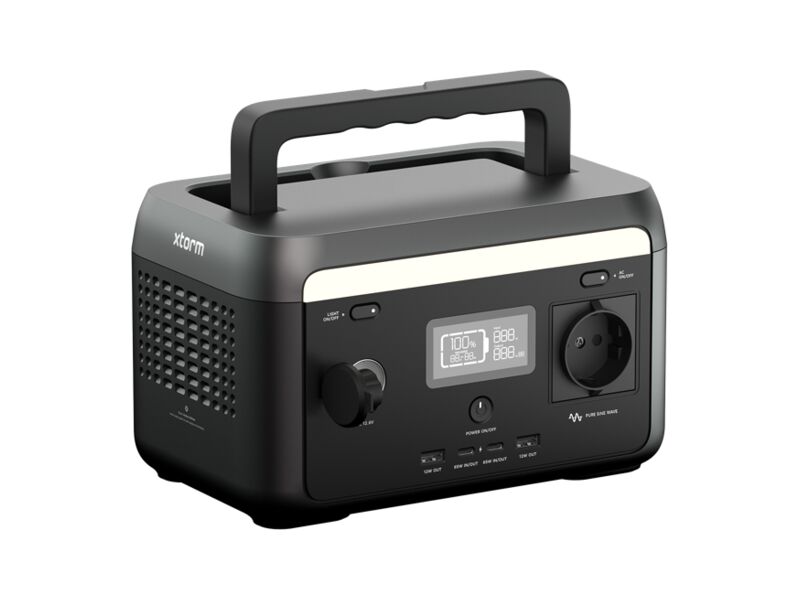
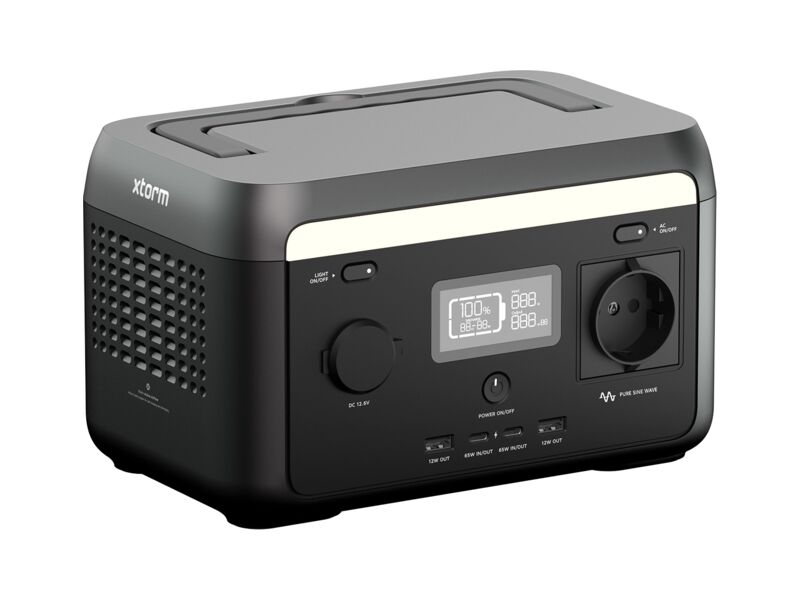
The Xtorm XP2W300, marketed as the Powerstation Smart 300W, is the most compact power station in the Dutch brand's Xtreme Power 2 range. It packs a 204.8Wh LiFePO4 battery (25.6V, 8Ah) rated for more than 3000 cycles down to 80% remaining capacity, roughly 10 years of regular use. Housed in a 3.65kg case (248 x 164 x 150mm) with a built-in handle, it is as easy to carry as a picnic cooler and fits into a backpack, a car boot or a nomadic desk setup.
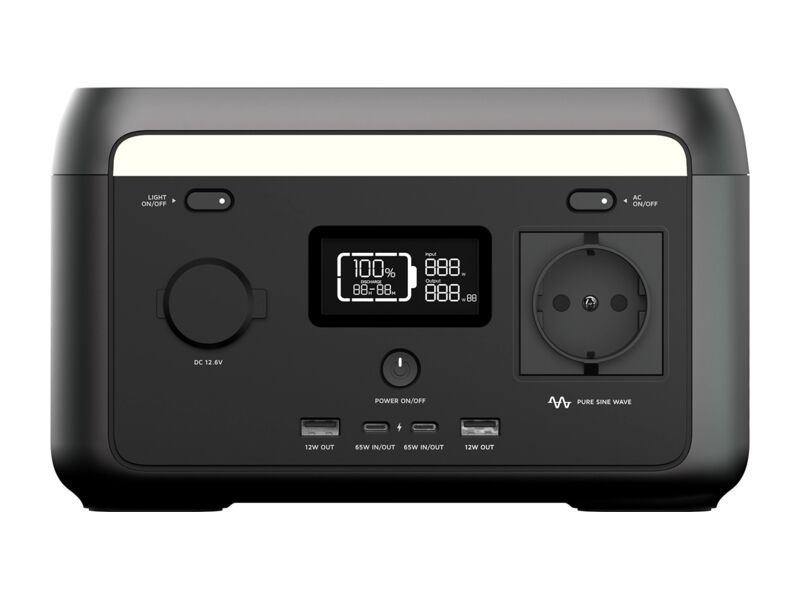
On the output side, it brings together a 300W mains socket with a pure sine wave inverter (500W peak), two 65W USB-C ports, two 12W USB-A ports and a 100W 12V car socket, enough to power a laptop, a cooler, a drone and camping lights at the same time. Its PowerBoost technology lets you briefly connect an appliance rated above 300W (up to 500W, such as an electric kettle) by intelligently lowering the voltage instead of refusing the connection.
A full mains recharge takes around 1h30 (250W max), and the XP2W300 accepts up to 120W of solar input through its DC7909 connector (an MC4 adapter is available), enough to top it up at camp during a sunny spell. Its EPS function switches to battery power in 10 milliseconds during a mains outage, a real plus for protecting a home router or a sensitive small appliance, though Xtorm itself notes this switchover time is not suited to critical loads such as servers.
Its real differentiator is remote control: the Smart Life app (WiFi and Bluetooth) lets you check the charge level, switch each output on or off and schedule timers, a feature rarely found at this price point where most rivals stick to Bluetooth alone. A built-in LCD screen shows live power draw, remaining runtime and temperature.
Its one real limitation is capacity: at 204.8Wh, the XP2W300 is aimed at light loads and short sessions, with no add-on battery available. As a first compact, remotely controllable power station with solid fundamentals (pure sine wave, LiFePO4, EPS), it remains a serious option against the established names in this category.
Full specifications
Detailed characteristics (EAN: 8718182278385)
Battery and capacity
| Rated capacity?Total stored energy in watt-hours. The higher the figure, the longer the runtime. | 204.8 Wh |
|---|---|
| Expandable capacity?Whether capacity can be increased with add-on batteries. | No |
| Removable battery?The main battery can be removed or replaced by the user. | No |
| Battery chemistry?LiFePO4 (LFP) lasts far longer and is safer than NMC. | LFP (LiFePO4) |
| Charge cycles?Number of full charges before capacity drops to the stated threshold. | 3000 cycles (80 %) |
| Pack nominal voltage?Internal battery voltage; higher voltage helps deliver high power. | 25.6 V |
AC output
| Continuous AC power?Power the unit can sustain continuously on its 230 V outlets. | 300 W |
|---|---|
| Surge power?Brief peak tolerated when starting motor or compressor devices. | 500 W |
| Boost-mode power?Extended power via a proprietary mode (X-Boost, AmpUp…) by lowering voltage. | 500 W |
| Inverter type?A pure sine wave is essential for sensitive electronics and motors. | Pure sine wave |
| AC voltage / frequency?Voltage and frequency of the AC output (230 V / 50 Hz in Europe). | 230 V / 50 Hz |
| Number of 230 V AC outlets?Number of mains outlets available on the unit. | 1 |
| RV / TT-30 outlet?Dedicated 30 A outlet for North-American style RVs. | No |
Recharging
| Max AC charging power?Maximum power drawn from a wall socket; higher means faster charging. | 250 W |
|---|---|
| AC charge 0-100%?Stated time for a full charge on mains power. | 90 min |
| Max solar input?Maximum solar power accepted at the input (PV panels). | 120 W |
| Accepted solar voltage?Panel voltage range compatible with the solar input. | 12 to 24 V |
| Max solar current?Maximum current accepted on the solar input. | 8 A |
| MPPT controllers?Number of independent MPPT solar inputs (yield optimisation). | 1 |
| Vehicle charging (12/24 V)?Can be charged from a vehicle's cigarette-lighter socket. | Yes |
| Pass-through charging?The unit can power devices while charging (pass-through). | Yes |
Ports and connectors
| USB-C ports?Number of USB-C ports and the fastest port's power (laptops, phones). | 2 × 65 W |
|---|---|
| USB-A ports?Number of USB-A ports and maximum power (small devices). | 2 × 12 W |
| 12 V output (car socket)?12 V cigarette-lighter output and its power (coolers, pumps…). | Yes (100 W) |
| Other DC outputs?Additional DC connectors (Anderson, DC5521, XT60…). | DC7909 |
Portability
| Weight?Net weight of the unit, battery included. | 3.65 kg |
|---|---|
| Dimensions (L × W × H)?Overall size of the unit in millimetres. | 248 × 164 × 150 mm |
| Form factor?Portable (hand-carried), transportable (heavy), or wheeled. | Portable |
| Wheels?Built-in wheels for moving the unit. | No |
| Telescopic handle?Retractable handle like a wheeled suitcase. | No |
Safety and environment
| Certifications?Standards and approvals obtained (CE, RoHS, UN38.3, UL…). | CE, RoHS, UN38.3 |
|---|---|
| Discharge temperature?Temperature range in which the unit can deliver power. | -20 to 45 °C |
| Charge temperature?Temperature range in which the unit can be recharged. | 0 to 45 °C |
Backup / UPS
| UPS / EPS mode?Automatic switch to battery on a mains outage (backup). | Yes |
|---|---|
| Switchover time (rated)?Delay before switching to battery; under 20 ms suits a PC or router. | 10 ms |
Noise and thermal
| Quiet mode?Setting that limits fan noise, often by capping charge power. | No |
|---|---|
| Self-heating battery?Battery pre-heating to allow charging in cold weather. | No |
Display and connectivity
| Display?Type of screen showing power, runtime and alerts. | LCD |
|---|---|
| Bluetooth?Bluetooth link for nearby control. | Yes |
| Wi-Fi?Wi-Fi connection for remote control and monitoring. | Yes |
| Mobile app?iOS / Android app to control the unit. | Yes |
| Local control (no cloud)?Control possible over Bluetooth without an account or internet. | Yes |
| Solar connector?Connector type of the solar input (XT60, Anderson, MC4…). | DC7909 |
Availability and warranty
| Market launch?Date the model first became available on the European market. Useful to place its generation: technology moves fast in this segment, and a device several years old may be at the end of its commercial life. | February 2025 |
|---|---|
| Warranty?Length of the manufacturer's warranty. | 2 years |
User manual / Instructions for use
⚡ How long will this power station run a device?
With 205 Wh, the Xtorm XP2W300 external battery runs a fridge (50 W) for ~3h30 or an LED TV (90 W) for ~1h55.
| Home | Runtime |
|---|---|
| Mini fridge (45 W) | ~3h50 |
| Refrigerator (50 W) | ~3h30 |
| Freezer (60 W) | ~2h55 |
| American fridge (150 W) | ~1h10 |
| Outdoor & workshop | Runtime |
|---|---|
| Wi-Fi router (15 W) | ~12h |
| CPAP machine (40 W) | ~4h20 |
| Water pump (60 W) | ~2h55 |
| Games console (200 W) | ~50 min |
Rough estimate: real consumption varies, and very power-hungry appliances (heating elements) must stay below the output power.
What is this power station best for?
-
Camping & Tent Ideal
For a light camping weekend, the XP2W300 is built for the job: its 204.8Wh cover LED lighting, charging several smartphones, a camera and a small speaker through a whole evening, and its 300W (500W with PowerBoost) is enough for an electric pump or a small tent fan. Its compact case (3.65kg, 248 x 164 x 150mm) with a built-in handle makes it easy to slip into a backpack or a car boot without ever weighing you down. The solar input, up to 120W, lets you top it up at camp on a sunny day through a portable panel (DC7909 connector, MC4 adapter available), and a full mains recharge in 1h30 means you set off charged again quickly after a break. The Smart Life app, controllable over WiFi, lets you check the battery level and switch outputs off without leaving the tent. For a light bivouac or a weekend for two, it is a reliable, well thought out power reserve.
-
Road trip & Car Suitable
On a road trip, the XP2W300 stays out of the way: at 3.65kg it fits easily in the boot and recharges phones, a camera, a drone and a laptop between stops thanks to its 65W USB-C ports. A 1h30 mains recharge means you leave each stop fully charged again, and its solar input up to 120W extends range on long driving days. The Smart Life app lets you check the charge level without taking the station out of the boot. With 204.8Wh, it stays best suited to light devices, not to running a cooler for several days.
-
Remote work Suitable
For nomadic remote work, the XP2W300 brings a genuine edge rarely seen at this price point: WiFi remote control through the Smart Life app, letting you switch outputs on or off and check the charge level without leaving your desk. Its EPS function switches to battery power in 10 milliseconds during a brief outage, enough to protect a home router or internet box. Its 65W USB-C ports charge a laptop at full speed. With 204.8Wh, it covers several hours of connectivity for a light setup; for a full day with an external monitor, a higher capacity model is a better fit.
-
Health & CPAP Suitable
For a CPAP machine on the move, the XP2W300 offers genuine peace of mind: its 204.8Wh usually cover one night of treatment without a heated humidifier, and its EPS function switches to battery in 10 milliseconds during a mains outage, without a jarring wake-up. A full recharge in 1h30 lets you top it up quickly each day, and its compact build (3.65kg) makes it an easy travel companion. Check your device's actual power draw before you leave: with heated humidification, runtime will be noticeably shorter.
-
Home & Power cuts Backup only
As a backup during a mains outage, the XP2W300 steps in through its EPS function (10ms switchover): it keeps a home router and a small light running with no noticeable interruption. With only 204.8Wh, it covers short outages and essential devices only; it does not replace a higher capacity station for powering a household over several hours.
Our team's recommendations based on the model's capacity, output power and weight.
Compatible solar panels
A selection of photovoltaic panels that suit this station's solar input (up to 24V / 120W), best match first.


Comparison
Around £250, the Xtorm XP2W300 competes with compact power stations of roughly 250 to 290Wh, often compared through searches such as "XP2W300 vs EcoFlow River 3 Plus" or "Xtorm power station vs Anker SOLIX C300". Here is how it stacks up against three alternatives: the EcoFlow River 3 Plus, expandable and highly searched in this price bracket, the Anker SOLIX C300, similarly priced, and the ALLPOWERS S300 Plus, the most affordable of the group.
| Criterion | Xtorm XP2W300 | EcoFlow River 3 Plus | Anker SOLIX C300 | ALLPOWERS S300 Plus |
|---|---|---|---|---|
| Capacity | 204.8Wh | 286Wh (expandable to 858Wh) | 288Wh | 288Wh |
| Continuous / peak power | 300W / 500W | 600W / 1200W | 300W / 600W | 300W / 600W |
| Connectivity | WiFi + Bluetooth, Smart Life app | WiFi + Bluetooth | WiFi + Bluetooth | Bluetooth only |
| Mains recharge 0-100% | ≈ 1h30 | ≈ 1h | ≈ 1h | ≈ 1h |
| Weight | 3.65kg | ≈ 4kg | ≈ 4.1kg | ≈ 3.7kg |
| Observed price | ≈ £255 | ≈ £219 | ≈ £222 | ≈ £130 |
In short, the Xtorm XP2W300 shares WiFi and Bluetooth control with the River 3 Plus and the Anker SOLIX C300, with only the ALLPOWERS S300 Plus limited to Bluetooth. It gives up ground on power to the River 3 Plus instead (600W continuous versus 300W here), on capacity to all three rivals, and on price to the Anker SOLIX C300 and the ALLPOWERS S300 Plus. It remains a credible pick for buyers who prioritise compactness and Xtorm's build quality over raw power.
Our tester's review: Christophe Delpuech
Out of the box, the XP2W300 impresses with its size: barely bigger than a picnic cooler, it slips into a backpack without you noticing its 3.65kg. During a weekend of outdoor remote work, the Smart Life app let us switch off the USB output remotely from the sofa, a detail that genuinely changes daily use compared with rivals that only offer short-range Bluetooth control. Camping overnight, it comfortably covered LED lighting and charging two phones and a camera without breaking a sweat. The EPS function proved itself during a test mains outage, the home router did not even have time to flicker. One honest downside: 204.8Wh remains modest next to the River 3 Plus or SOLIX C300, which pack in about 80Wh more in a similar footprint, and there is no add-on battery to grow with your needs. As a first connected, compact power station built on solid fundamentals (pure sine wave, LiFePO4, EPS), it remains a serious option, best kept for light-duty use.
In-depth review Xtorm XP2W300: our full review 3.8/5 Read our full review → Capacity and efficiency 3.6 Delivered power 4.0 Recharging 3.6 Ports and control 3.9 Build and endurance 3.8 Noise not measuredFrequently asked questions: Xtorm portable power station 300W
With 204.8Wh, it recharges a smartphone around fifteen times, a laptop 3 to 4 times, or runs a cooler for several hours. Actual runtime depends on the power draw of the connected device.
About 1h30 for a full charge on mains power (250W max). Via solar, it accepts up to 120W through its DC7909 connector, and it can also recharge from a car's 12V socket.
It lets you plug in an appliance rated above the 300W nominal output (up to 500W), such as an electric kettle, by intelligently lowering the voltage instead of refusing the connection.
Yes, through the Smart Life app over WiFi or Bluetooth: you can check the charge level, switch each output on or off and schedule timers, a feature rarely found at this price point.
It includes an EPS function that switches to battery power in 10 milliseconds during a mains outage, useful for protecting a home router, though Xtorm advises against relying on it for critical equipment such as servers.
No. At 204.8Wh it exceeds the 100Wh limit allowed in aircraft cabins by most airlines.
Need help choosing?
Related articles
Other products in the "Compact power stations" category
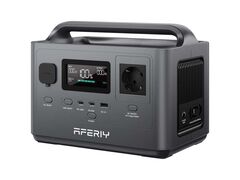
Aferiy P040
£162.12 (11)
With 256Wh, a full mains recharge in just over an hour and a UPS mode under 10ms, the Aferiy P040 protects sensitive devices without breaking the bank.
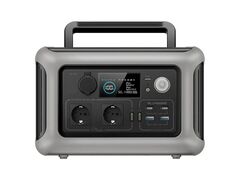
Allpowers R600
See price (7)
Affordable and backed by a 5-year warranty, the Allpowers R600 delivers 299 Wh, 600 W and a one-hour recharge, plus a built-in wireless charger.
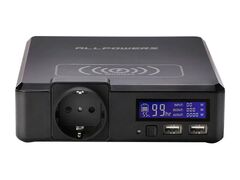
Allpowers S200
See price (6)
154Wh and 200W in an ultra-compact, book-sized station with built-in wireless charging: the mini power station that goes everywhere without weighing you down.
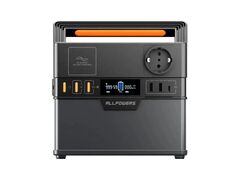
Allpowers S300 Plus
See price (5)
Compact and clever, the Allpowers S300 Plus (288 Wh) combines USB-C 100 W, a wireless charger, an LED torch and app control.
Published on 30/08/2026