
What the claimed 204.8Wh are really worth
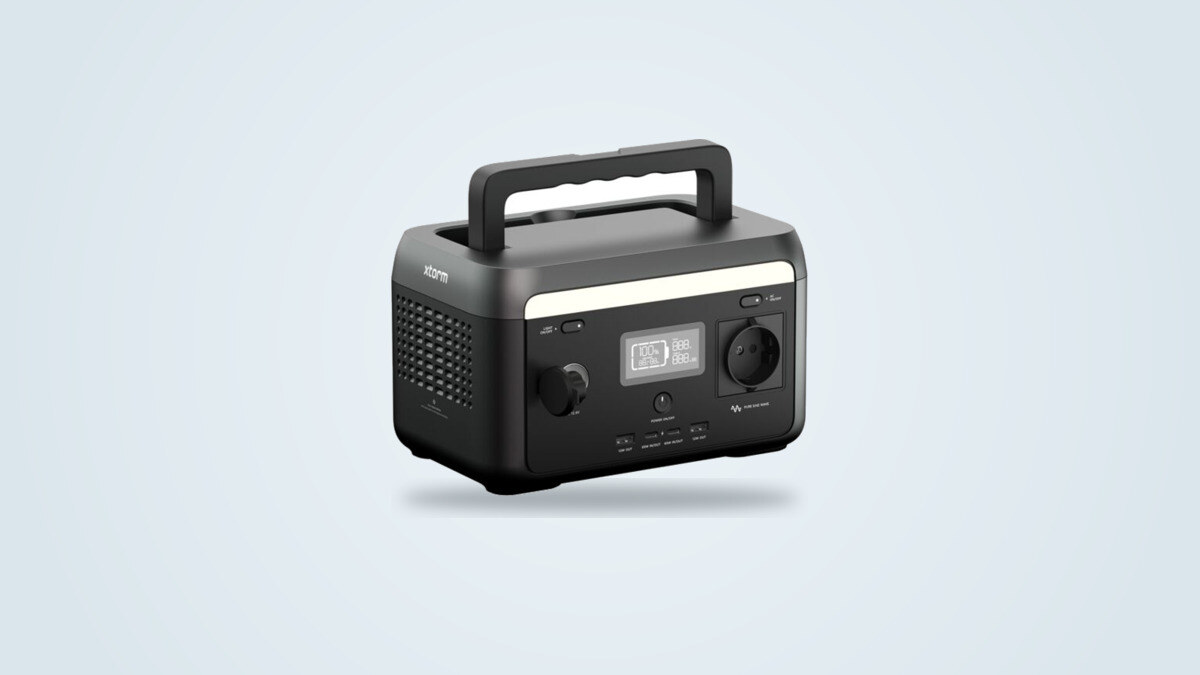
The Xtorm XP2W300 packs a 204.8Wh LiFePO4 battery (25.6V, 8Ah), rated by the manufacturer for more than 3000 cycles down to 80% remaining capacity, or roughly 10 years of regular use according to Xtorm. No independent measurement of the actual delivered capacity was found for this model, which is newer and less covered by test labs than flagship references from larger brands: the figures below are therefore the manufacturer's own claims, not lab-verified values.
The real story is not chemistry reliability, LiFePO4 is a solid choice shared by most direct rivals, but sizing. At an equal or similar power rating (300W), the EcoFlow River 3 Plus is rated at 286Wh and both the Anker Solix C300 and the Allpowers S300 Plus at 288Wh each, roughly 40% more capacity than the XP2W300 at a similar price. Unlike the River 3 Plus, which accepts an add-on battery up to 858Wh, the XP2W300 offers no expansion path at all: the capacity you buy is the capacity you keep.
PowerBoost and the 500W peak: how it works, and its limits
The XP2W300's mains output is rated at 300W continuous with a pure sine wave inverter, a detail that protects sensitive electronics (switch-mode chargers, small appliances). Xtorm adds a feature called PowerBoost, which temporarily allows an appliance rated up to 500W to be connected. The manufacturer explains the mechanism itself without ambiguity: rather than refusing the connection, PowerBoost intelligently lowers the output voltage to let the appliance run, an electric kettle is the example given in the official documentation.
This is an important difference from a true peak mode that would hold the nominal voltage: an appliance plugged in near the 500W ceiling will likely run, but not necessarily at its full rated performance, since the voltage feeding it has been reduced. No independent protocol was found to verify how PowerBoost actually behaves under a resistive load close to its upper limit, nor how long that mode can be sustained before a protection cutoff. The upside is the manufacturer's transparency about the mechanism: a kettle or a small heater rated at 500W will not necessarily behave as it would on a standard mains socket, and Xtorm states this plainly rather than implying otherwise.
Smart Life: WiFi control through a generic ecosystem, not a bespoke app
The XP2W300 pairs over Bluetooth for initial setup and is then controlled over WiFi through the Smart Life app: checking the charge level, switching each output on or off independently, and scheduling timers. Genuine remote control, not just short-range local Bluetooth, remains a real asset for a station at this size and price.
One nuance is worth stating before treating this as an outright exclusive: the Anker Solix C300 and the EcoFlow River 3 Plus, two of the three direct rivals covered in this review, also add WiFi on top of Bluetooth. Only the Allpowers S300 Plus is limited to Bluetooth. The XP2W300's real point of difference lies elsewhere: Smart Life is not a bespoke app built by Xtorm, but a generic smart-home ecosystem used by hundreds of connected-device brands with no link to portable power. The upside is the platform's maturity, and the option, for a household already using Smart Life devices, to bring the station into the same dashboard. The downside is what any generic app of this kind implies: an account is required, remote control depends on a cloud server, and the interface is designed for dozens of product categories rather than specifically for a power station.
Runtime and real-world use: camping, remote work, backup power
With 204.8Wh, the XP2W300 covers a light camping evening: LED lighting, charging several smartphones, a camera and a small speaker. Its two 65W USB-C ports charge a laptop at full speed, plenty for the vast majority of current ultrabooks. The 12V/100W output covers a portable cooler or a small piece of automotive equipment.
For nomadic remote work, the EPS function is the real difference-maker: during a brief mains outage, the switch to battery power happens in 10 milliseconds, fast enough that a home router or internet box will not reboot. Xtorm itself states, in its own documentation, that this delay is not suited to critical loads such as a server, an honest caveat that avoids overselling the feature. For a CPAP machine on the move, the 204.8Wh will generally cover one night of therapy without a heated humidifier; with humidification switched on, runtime drops noticeably, something worth checking against the actual draw of your specific device.
The format's real limit is duration: with no capacity expansion available, the XP2W300 is built for occasional needs and light devices, not for running a cooler over several days or for a full workstation (laptop plus external monitor) across an entire day.
Mains, solar and car charging: what is fast, what lags behind
A full mains recharge takes about 90 minutes, at up to 250W. Relative to the unit's capacity, this pace lags behind more generous rivals: the EcoFlow River 3 Plus, with 40% more Wh, recharges fully in about 60 minutes thanks to a rated mains charging power of 360W. The XP2W300 therefore takes longer to fill for less total energy, a gap that matters in practice for anyone topping the station up between outings.
On solar, the XP2W300 accepts up to 120W through its DC7909 connector (an MC4 adapter is available as an accessory), a higher input than the Anker Solix C300 and the Allpowers S300 Plus, both capped at 100W, though it remains well behind the EcoFlow River 3 Plus's 220W. Xtorm rates a full solar recharge at around 2 hours under ideal sunlight with a suitable panel, a duration that stretches considerably as soon as clouds roll in, as with any portable solar panel. Charging from a car's 12V socket is rated at around 2.5 hours, a useful option on a road trip but slower than charging from the mains.
The built-in light and the EPS function: two safety nets
A light bar runs along the front top edge of the case, with three brightness levels and a flashing SOS mode. No lumen figure has been published by the manufacturer: this light bar illuminates a nearby space (a camping table, inside a tent) but does not replace a headlamp or a dedicated lantern for extended or distant use.
Neither feature is the main reason to buy this station, but both usefully round out the picture for light home backup or camping use, without pretending to replace a dedicated home UPS or a primary light source.
Against the direct competition: Solix C300, River 3 Plus, Allpowers S300 Plus
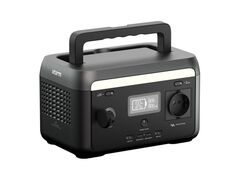
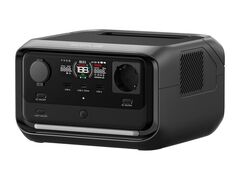
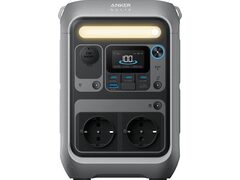
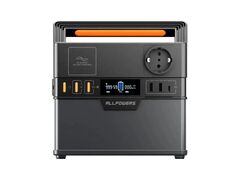
Three stations sit in the same price bracket as the XP2W300: the EcoFlow River 3 Plus, the Anker Solix C300 and the Allpowers S300 Plus. The comparison below, based on each manufacturer's official specifications, shows fairly precisely where the XP2W300 gains ground and where it gives it up.
| Criterion | Xtorm XP2W300 | EcoFlow River 3 Plus | Anker Solix C300 | Allpowers S300 Plus |
|---|---|---|---|---|
| Capacity | 204.8 Wh | 286 Wh (expandable to 858 Wh) | 288 Wh | 288 Wh |
| Chemistry | LiFePO4 | LiFePO4 | LiFePO4 | NMC |
| Continuous / peak power | 300 W / 500 W | 600 W / 1200 W | 300 W / 600 W | 300 W / 600 W |
| Mains sockets | 1 | 3 | 2 | 1 |
| USB-C | 2 x 65 W | 1 x 100 W | 3 x 140 W | 1 x 100 W |
| Max solar input | 120 W | 220 W | 100 W | 100 W |
| Control | WiFi + Bluetooth | WiFi + Bluetooth | WiFi + Bluetooth | Bluetooth only |
| Warranty | 2 years (+1 free) | 5 years | 5 years | 2 years |
The table sums up the situation: the XP2W300 holds its own on solar input and remote control, but gives ground on capacity, mains socket count and, most notably, warranty length against two of its three rivals. The starkest gap is USB-C connectivity: the Anker Solix C300, at an identical 300W power rating, offers three USB-C ports up to 140W each, more than double the power of the XP2W300's two 65W ports.
Build quality, warranty and brand reliability
Xtorm is a Dutch manufacturer specialising in portable charging accessories, with a generally solid reputation for careful build quality and responsive after-sales support, even though a handful of slower-to-resolve warranty cases exist as well, as with most brands in this space. The XP2W300 itself carries no report of a recurring fault or a documented safety issue at the time of writing, a positive sign for a product launched in February 2025 and therefore still fairly new to the market.
The base warranty is 2 years, extended to 3 if the buyer registers the product within 3 months of purchase, a simple but non-automatic step. Against a 5-year warranty from the Anker Solix C300 and the EcoFlow River 3 Plus, the gap remains clear, even after the bonus year. No dust or water ingress rating is published for the XP2W300, a data point also missing from the three rivals covered in this review, but still a point worth flagging for a product marketed around camping use.
Who the XP2W300 suits, and who it does not
The Xtorm XP2W300 suits anyone looking for a first, compact, remotely controllable power station for light camping, a short home outage, or a nomadic remote-work setup limited to a laptop and a few peripherals. Its LiFePO4 chemistry, its EPS function and its built-in light make it a well thought out object for these occasional uses.
It suits fewer people who need to run a cooler over several days, power several appliances at once from a single mains socket, or plan to grow their capacity over time: on all three points, the EcoFlow River 3 Plus (higher, expandable capacity, more sockets) and the Anker Solix C300 (far more generous USB-C connectivity, 5-year warranty) answer the need better, at a similar price. The choice comes down to a simple question: the most compact, best remotely controlled station, or the one that offers more Wh and more sockets for a comparable budget.