
DJI Power 1000 Mini
(9 reviews)
1 kWh in 11.5 kg: DJI squeezes a genuine 800 W station into a format half the size, with 80% charge in under an hour.
Buy at AmazonAs an Amazon Associate I earn from qualifying purchases.
Characteristics
- Capacity: 1008 Wh (LiFePO4, 4000 cycles)
- Power: 800 W continuous (1000 W peak)
- Recharge: 80% in 58 min, 400 W solar
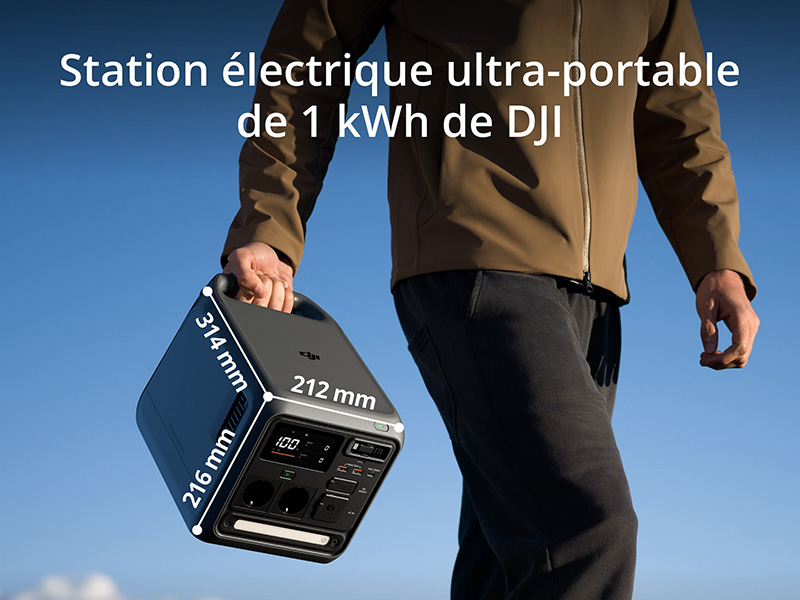
- Weight: 11.5 kg (314 x 212 x 216 mm)
- 1 kWh in 11.5 kg, retractable 100 W USB-C
Detailed overview: DJI Power 1000 Mini 1008 Wh portable power station
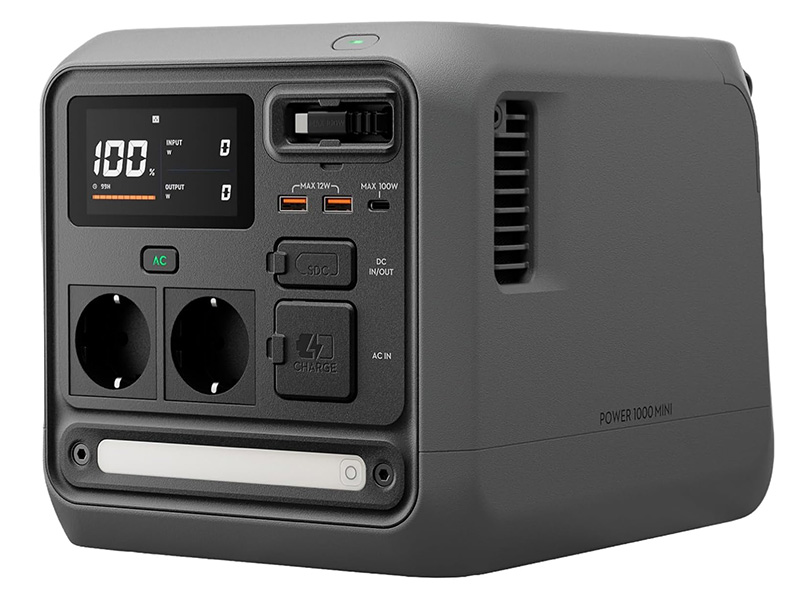
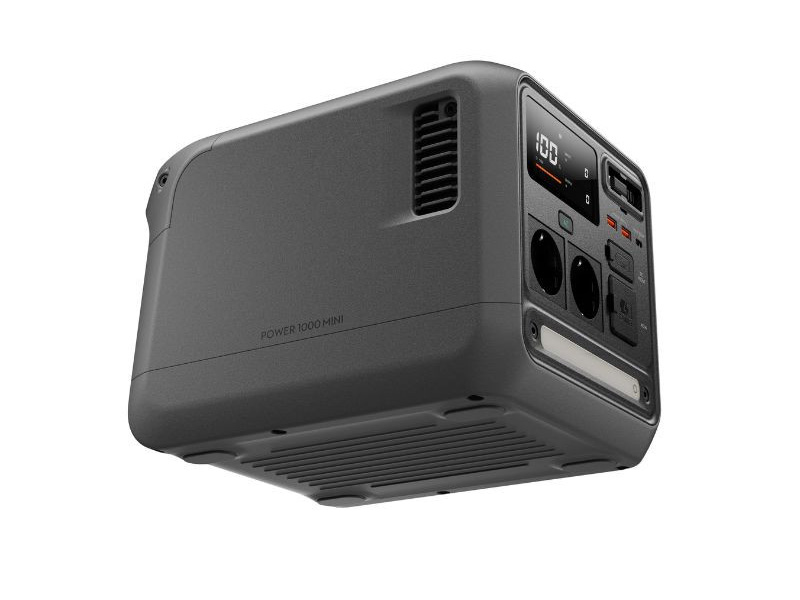
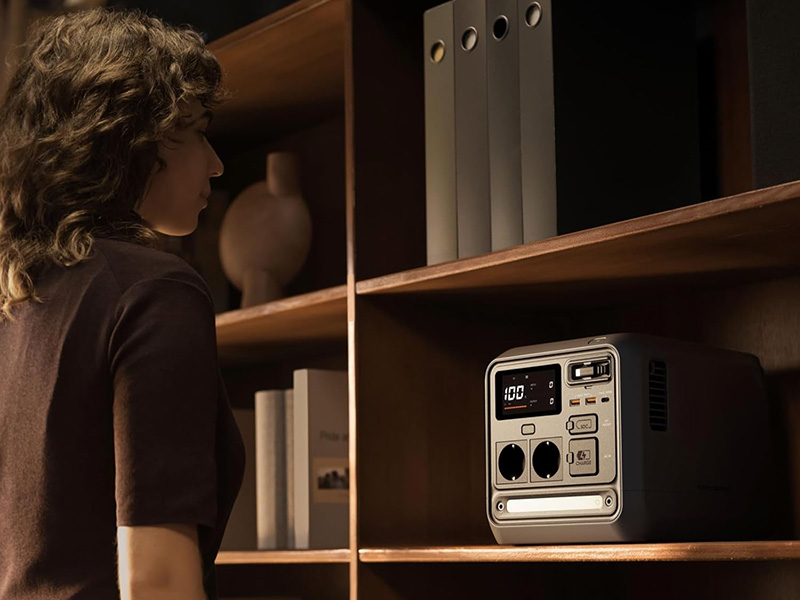
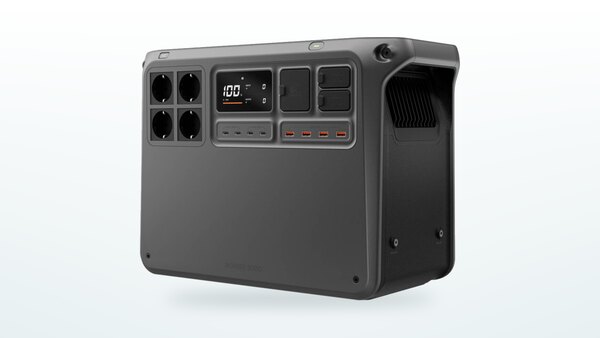
The DJI Power 1000 Mini answers a frustration well known to power station users: useful capacity usually means awkward bulk. DJI keeps the 1008 Wh of its 1000 range here but in a 314 x 212 x 216 mm body weighing 11.5 kg, roughly half the volume of classic stations of this capacity. That density defines the product.
The battery uses LiFePO4 chemistry, the most durable on the market, rated for around 4000 charge cycles. In practice, a station recharged every two days will last more than twenty years before losing a significant share of its capacity, where NMC chemistry fades much faster. It is a coherent choice for intensive professional use.
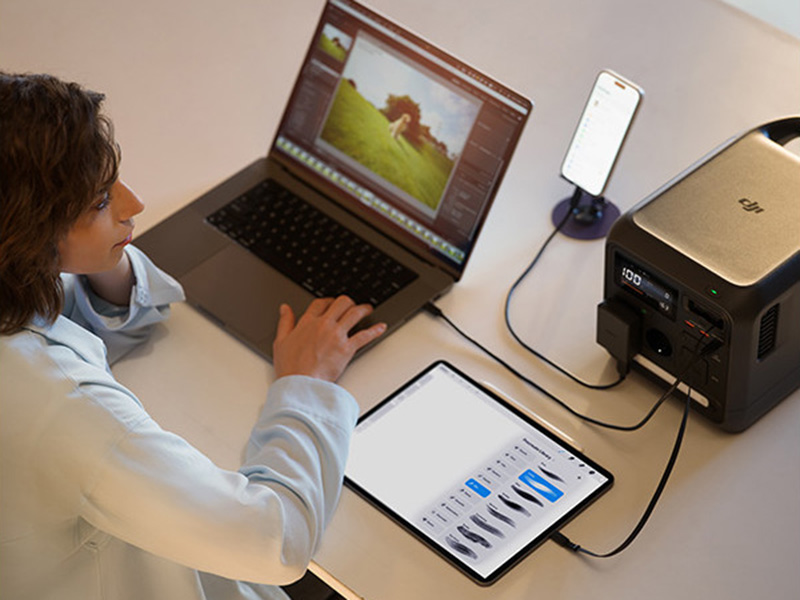
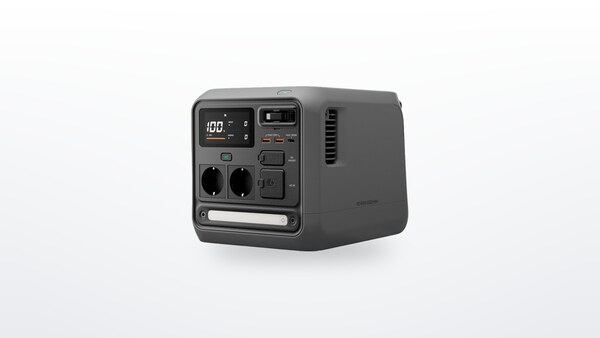
On outputs, it offers two 230 V sockets delivering 800 W continuous, with a tolerated peak of 1000 W. Added to that are two 100 W USB-C ports, one of them a retractable USB-C cable built directly into the casing, plus two 12 W USB-A ports. This configuration betrays the target: content creators, who charge drone batteries, mirrorless bodies and laptops rather than site tools.
Recharging is one of its strengths. From the mains it reaches 80% in 58 minutes, making it usable on a fast cycle between two work sessions. It also integrates a 400 W solar MPPT module (SDC input, 9 to 28 V) and a 400 W car charger, with no external accessory. Control goes through the DJI app over Wi-Fi and Bluetooth, with real-time consumption tracking.
Quiet unless heavily loaded, it operates from -10 to 45 °C and up to 5000 m altitude. It primarily targets videographers, photographers, vanlifers and campers who want transportable 1 kWh. To back up a whole house or run large appliances, a 2 kWh station or more remains better suited.
Full specifications
Detailed characteristics (EAN: 6937224125698)
Battery and capacity
| Rated capacity?Total stored energy in watt-hours. The higher the figure, the longer the runtime. | 1008 Wh |
|---|---|
| Delivered energy, measured?Energy that actually leaves the battery and reaches the devices. Always below the stored energy, as conversion costs heat. Taken from our in-depth review. | 860 Wh |
| Expandable capacity?Whether capacity can be increased with add-on batteries. | No |
| Removable battery?The main battery can be removed or replaced by the user. | No |
| Battery chemistry?LiFePO4 (LFP) lasts far longer and is safer than NMC. | LFP (LiFePO4) |
| Charge cycles?Number of full charges before capacity drops to the stated threshold. | 4000 cycles (80 %) |
AC output
| Continuous AC power?Power the unit can sustain continuously on its 230 V outlets. | 800 W |
|---|---|
| Surge power?Brief peak tolerated when starting motor or compressor devices. | 1000 W |
| Inverter type?A pure sine wave is essential for sensitive electronics and motors. | Pure sine wave |
| AC voltage / frequency?Voltage and frequency of the AC output (230 V / 50 Hz in Europe). | 230 V / 50 Hz |
| Number of 230 V AC outlets?Number of mains outlets available on the unit. | 2 |
| RV / TT-30 outlet?Dedicated 30 A outlet for North-American style RVs. | No |
Recharging
| AC charge 0-80%?Stated time to go from 0 to 80% on mains power. | 58 min |
|---|---|
| Max solar input?Maximum solar power accepted at the input (PV panels). | 400 W |
| Accepted solar voltage?Panel voltage range compatible with the solar input. | 9 to 28 V |
| MPPT controllers?Number of independent MPPT solar inputs (yield optimisation). | 1 |
| Vehicle charging (12/24 V)?Can be charged from a vehicle's cigarette-lighter socket. | Yes |
| Pass-through charging?The unit can power devices while charging (pass-through). | Yes |
Ports and connectors
| USB-C ports?Number of USB-C ports and the fastest port's power (laptops, phones). | 2 × 100 W |
|---|---|
| USB-A ports?Number of USB-A ports and maximum power (small devices). | 2 × 12 W |
| 12 V output (car socket)?12 V cigarette-lighter output and its power (coolers, pumps…). | No |
| Other DC outputs?Additional DC connectors (Anderson, DC5521, XT60…). | SDC |
Portability
| Weight?Net weight of the unit, battery included. | 11.5 kg |
|---|---|
| Dimensions (L × W × H)?Overall size of the unit in millimetres. | 314 × 212 × 216 mm |
| Form factor?Portable (hand-carried), transportable (heavy), or wheeled. | Portable |
| Wheels?Built-in wheels for moving the unit. | No |
| Telescopic handle?Retractable handle like a wheeled suitcase. | No |
Safety and environment
| Certifications?Standards and approvals obtained (CE, RoHS, UN38.3, UL…). | CE, RoHS, UN38.3 |
|---|---|
| Discharge temperature?Temperature range in which the unit can deliver power. | -10 to 45 °C |
| Charge temperature?Temperature range in which the unit can be recharged. | -10 to 45 °C |
Backup / UPS
| UPS / EPS mode?Automatic switch to battery on a mains outage (backup). | Yes |
|---|---|
| Switchover time (rated)?Delay before switching to battery; under 20 ms suits a PC or router. | 10 ms |
Noise and thermal
| Quiet mode?Setting that limits fan noise, often by capping charge power. | Yes |
|---|---|
| Self-heating battery?Battery pre-heating to allow charging in cold weather. | No |
Display and connectivity
| Display?Type of screen showing power, runtime and alerts. | LCD |
|---|---|
| Bluetooth?Bluetooth link for nearby control. | Yes |
| Wi-Fi?Wi-Fi connection for remote control and monitoring. | Yes |
| Mobile app?iOS / Android app to control the unit. | Yes |
| Local control (no cloud)?Control possible over Bluetooth without an account or internet. | Yes |
| Solar connector?Connector type of the solar input (XT60, Anderson, MC4…). | SDC |
Availability and warranty
| Market launch?Date the model first became available on the European market. Useful to place its generation: technology moves fast in this segment, and a device several years old may be at the end of its commercial life. | April 2026 |
|---|---|
| Warranty?Length of the manufacturer's warranty. | 5 years |
User manual / Instructions for use
⚡ How long will this power station run a device?
With 1,008 Wh, the DJI Power 1000 Mini external battery runs a fridge (50 W) for ~17h or an LED TV (90 W) for ~9h30.
| Home | Runtime |
|---|---|
| Mini fridge (45 W) | ~19h |
| Refrigerator (50 W) | ~17h |
| Dehumidifier (300 W) | ~2h50 |
| Washing machine (500 W) | ~1h45 |
| Outdoor & workshop | Runtime |
|---|---|
| Wi-Fi router (15 W) | ~57h |
| Water pump (60 W) | ~14h |
| E-scooter (charging) (100 W) | ~8h35 |
| Desktop PC (250 W) | ~3h25 |
Rough estimate: real consumption varies, and very power-hungry appliances (heating elements) must stay below the output power.
What is this power station best for?
-
Photo & Video Ideal
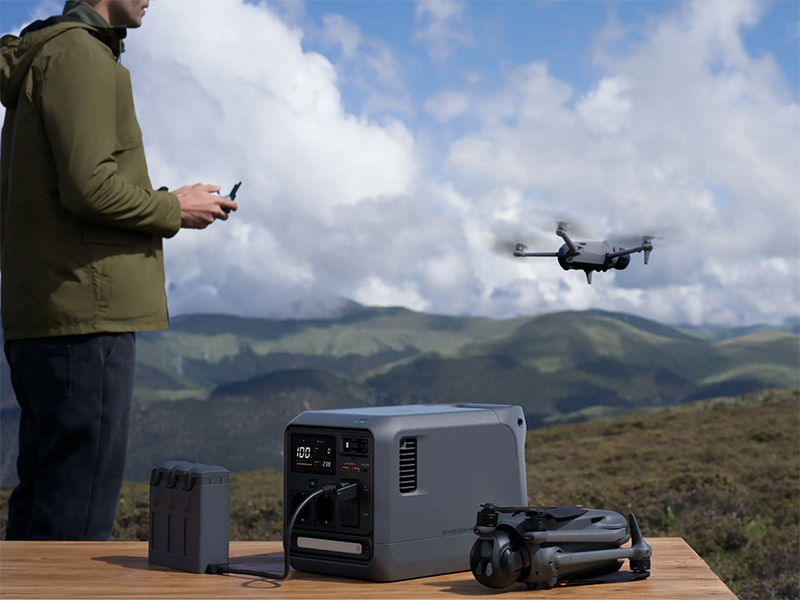
This is the natural playground of this station, and DJI makes no secret of it. Its two USB-C ports each deliver up to 100 W, exactly what is needed to quickly recharge drone batteries, a mirrorless body, an external monitor or an editing laptop in the field. The built-in retractable USB-C cable saves carrying one more cord in an already full bag. Its 1008 Wh comfortably cover a shooting day: several sets of drone batteries, an LED fill light and recharging the sound kit. Its 800 W continuous output (1000 W peak) feeds an LED panel, a multi-device charging station or a powerful laptop without trouble. Quiet operation matters enormously in sound recording: the fan only kicks in under heavy load, so the station can sit near a microphone without polluting the take. Finally, at 11.5 kg it moves from one location to another without needing two people, and the 80% recharge in under an hour lets you refill during a lunch break.
-
Motorhome & Van life Ideal
In a van or motorhome, the Power 1000 Mini strikes a rare balance between capacity and bulk. Its 1008 Wh feed an onboard fridge, lighting, a water pump and the charging of all personal devices over an evening and a night, while its 31 cm width lets it slide under a bench or into a side locker. Its MPPT module accepts up to 400 W of solar panels, enough to fully recharge it during the day with two portable panels. It also recharges while driving thanks to its built-in car charger, avoiding a separate converter. Its LiFePO4 chemistry (around 4000 cycles) withstands the daily cycling of converted-vehicle use, unlike classic lithium batteries that age faster. At 11.5 kg, it remains easy to lift out of the vehicle for an evening outside.
-
Camping & Tent Ideal
For family or group camping, this station covers the essentials without the weight of a 2 kWh model. Its 1008 Wh run an electric cool box through a full night, feed camp lighting, recharge several phones and a speaker, and can occasionally run a small travel kettle thanks to the 800 W available on its two 230 V sockets. Its compact format and 11.5 kg make it carryable one-handed over a few dozen metres, from boot to pitch. Quiet operation is a real plus at night, the fan staying discreet as long as you do not demand full power. The 400 W solar module lets you refill it during the day for an extended stay without mains electricity.
-
Home & Power cuts Suitable
For home backup, the Power 1000 Mini covers the essentials of a short to medium outage. Its 1008 Wh feed a fridge for several hours, the internet router, some LED lighting and the charging of the household's phones and computers. Its 800 W continuous suits most domestic appliances, excluding large heating appliances. The 80% recharge in 58 minutes is a real asset during repeated outages, since it lets you refill as soon as power returns. To secure a whole house or last several days, aim for a 2 kWh station or more, ideally expandable.
-
Remote work Suitable
For a home office or a nomadic coworking spot, it secures an entire workstation. Its two 100 W USB-C ports charge a laptop at full speed without a mains socket, and the 230 V outlets feed screens, router and printer. Its 1008 Wh last a full working day during an outage or in a place without electricity. Quiet operation means it can sit under a desk without disturbing a video call. It is, however, oversized for simple fixed office use where a classic UPS would suffice.
-
Off-grid & Solar Suitable
With its 400 W MPPT module, it is a good entry point to temporary solar autonomy, for a cabin, a garden workshop or a home occupied a few days a month. Two portable panels are enough to refill it during the day, and its 1008 Wh cover lighting, a small fridge and device charging. Its LiFePO4 chemistry withstands daily cycles for years. For genuine permanent autonomy, an expandable station of larger capacity remains necessary.
Our team's recommendations based on the model's capacity, output power and weight.
Compatible solar panels
A selection of photovoltaic panels that suit this station's solar input (up to 28V / 400W), best match first.


Comparison
Around £550, the DJI Power 1000 Mini compares to 1 kWh stations sought for nomadic and creative use, via searches like "compact 1000W power station" or "portable battery filming". Here is how it stands against three alternatives: the DJI Power 1000, the EcoFlow Delta 3 and the Anker Solix C1000.
| Criterion | DJI Power 1000 Mini | DJI Power 1000 | EcoFlow Delta 3 | Anker Solix C1000 |
|---|---|---|---|---|
| Capacity | 1008 Wh | 1024 Wh | 1024 Wh | 1024 Wh |
| Power | 800 W | 2200 W | 1800 W | 2000 W |
| Weight | 11.5 kg | ≈ 13 kg | 12.5 kg | 11.3 kg |
| USB-C max | 100 W (retractable cable) | 140 W | 100 W | 100 W |
| Observed price | ≈ £555 | ≈ £854 | ≈ £640 | ≈ £683 |
In short, the Power 1000 Mini is the lightest and most compact of the group at equivalent capacity, with the only built-in retractable USB-C cable, a concrete asset for outdoor work. Its trade-off is clear: 800 W of continuous power against 1800 to 2200 W for the others, which rules it out for large heating appliances. If you mainly charge photo, video and computing gear and portability matters, it is the best choice. If you want to run a kettle or a power tool, look to the Delta 3 or the C1000.
Related video
Video: DJI Power 1000 Mini Review - The BEST Portable Power Station? - Published on 05/07/2026
Our tester's review: Christophe Delpuech
We tested the DJI Power 1000 Mini over several shooting days and a weekend in a van, and it is the density that strikes you first. Having 1 kWh in a 31 cm box weighing 11.5 kg changes how you carry a station: it slides under a bench, wedges into a car boot between two bags, and can be carried one-handed on location. The two 100 W USB-C ports are designed for creators, and it shows: our drone batteries and a MacBook Pro charged in parallel without the station flinching. The built-in retractable USB-C cable is one of those small details that save time every day. Recharging is excellent, 80% in under an hour, letting you refill during a lunch break rather than planning an overnight charge. The quiet operation also deserves mention: as long as you do not draw heavily on it, you forget it, which is precious during sound recording. Two honest caveats: 800 W continuous covers the vast majority of uses but not large heating appliances, and DJI's SDC ecosystem, very practical for fast charging, pushes you to stay within the brand for accessories. For a videographer or a vanlifer, the balance is excellent.
In-depth review DJI Power 1000 Mini: our full review 4.0/5 Read our full review → Capacity and efficiency 4.2 Delivered power 3.7 Recharging 4.4 Ports and control 3.9 Build and endurance 4.3 Noise 3.6Frequently asked questions: DJI Power 1000 Mini 1008 Wh portable power station
The Mini offers near-identical capacity (1008 against 1024 Wh) in a body half the volume and 11.5 kg instead of around 13 kg. In exchange, its continuous output power is 800 W against 2200 W for the Power 1000.
Yes, and that is one of its flagship uses. Its two USB-C ports each deliver up to 100 W, and DJI offers dedicated SDC cables that further speed up charging of its own drone batteries.
From the mains it reaches 80% charge in 58 minutes. It also accepts up to 400 W of solar through its built-in MPPT module, plus charging while driving thanks to its 400 W car charger.
That depends on the model. Its 800 W continuous (1000 W peak) suits a small travel kettle, but not a classic 2000 W domestic kettle. For that use, aim for a station of 1800 W or more.
Its LiFePO4 chemistry targets around 4000 charge cycles, i.e. more than ten years at one cycle a day. That is well above the NMC lithium batteries of entry-level stations.
Need help choosing?
Other products in the "Versatile power stations" category
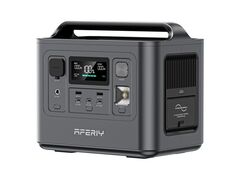
Aferiy P010
See price (5)
512Wh and 800W (1600W surge) in a 6.5kg footprint, backed by a 7-year manufacturer warranty: the Aferiy P010 bets on longevity as much as on compactness.
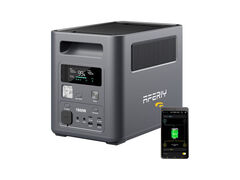
Aferiy P180
See price (12)
With 1024 Wh, 1800 W (up to 3600 W peak), a 90% recharge in 60 minutes and just 11.6 kg, the Aferiy P180 aims for lightweight versatility.
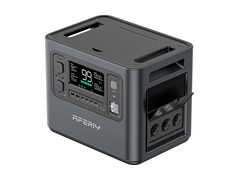
Aferiy P210
See price (7)
With 2048 Wh, 2400 W (up to 4800 W peak), a LiFePO4 battery and a 7-year warranty, the Aferiy P210 targets the best capacity-to-price ratio on the market.
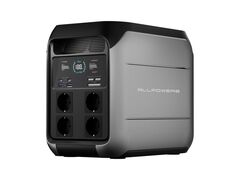
Allpowers P1800
£494.95 (6)
A 1 kWh LiFePO4 power station with plenty of punch, fast mains recharging and quiet running: a smart pick for campervans, camping trips and power cuts.
Published on 25/07/2026, updated on 14/08/2026