
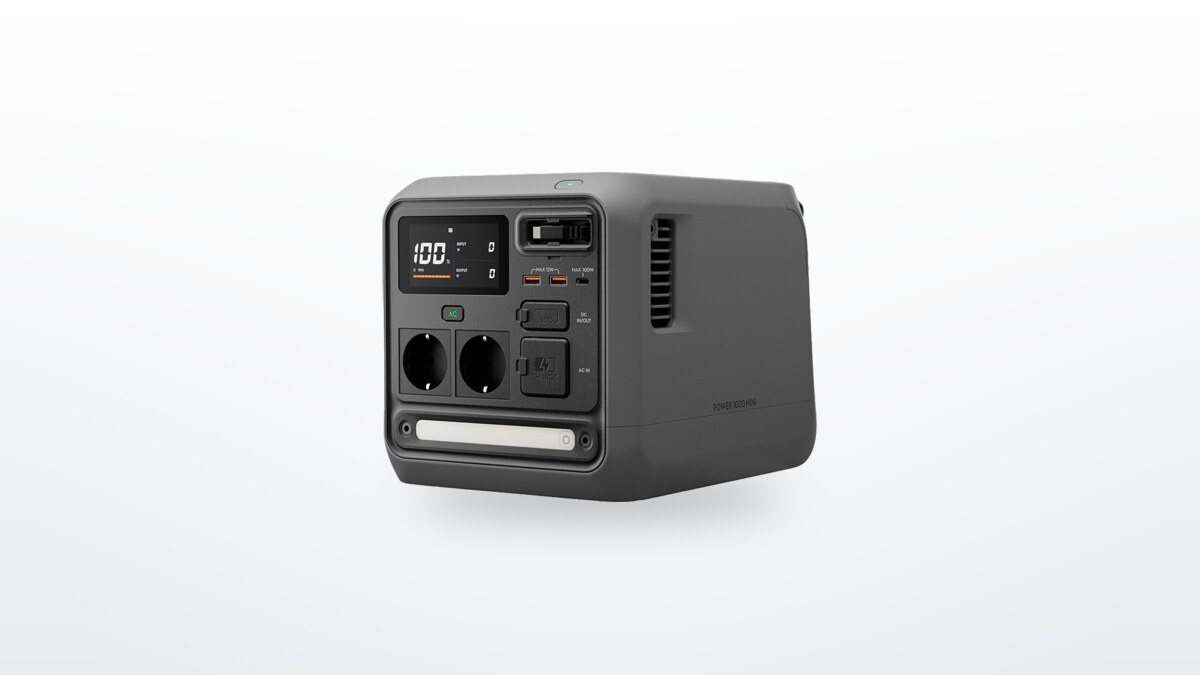
800 W continuous documented by the manufacturer, well short of the 1000 W headline figure
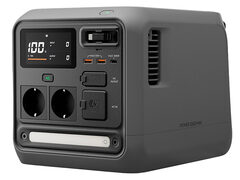
The product page advertises a 1000 W output, with some appliances said to draw up to 1200 W. The manufacturer's detailed technical documentation, though, clearly distinguishes a continuous power of 800 W from a peak power of 1000 W. That 800 W figure is confirmed by the rating label on the unit itself.
The 1200 W figure "for some appliances" is not documented anywhere with technical precision by the manufacturer, and behaves like a surge tolerance of a few seconds only, comparable to an inrush current, not a sustained operating level. A separate "bypass" mode also exists, which lets up to 2200 W pass straight through from the mains without going through the battery: not to be confused with the power actually available from the battery itself.
In practical terms, this gap puts the unit well below direct competitors of comparable capacity, which advertise 1500 to 1800 W continuous instead.
"30 dB" advertised, between 47 and 53 dB(A) measured in use
The product page advertises operation at 30 dB maximum. In real-world use under heavy load, the actual noise level sits in a noticeably higher range: 47 to 53 dB(A), closer to a normal conversation than a whisper.
During fast charging on mains power, the noise level instead sits between 46 and 58.5 dB(A) depending on measurement conditions, a gap wide enough to change how loud the unit feels. No strictly comparable protocol is available to date to settle between the two bounds: best treated as a wide range rather than a single figure.
Overload protection cuts out with no warning in some cases
The inrush current at startup of some refrigerator compressors (commonly around 1300 W at startup, for a unit that draws 750 W once running) can trigger the unit's protection, which then cuts out with no error message, requiring a manual restart to resume operation.
This is not a fault: it is the protection mechanism doing its job. But the lack of an explicit message can be confusing, especially for an appliance plugged in remotely with no direct supervision (a refrigerator, a freezer). Worth anticipating before plugging in any appliance with a high startup inrush current.
The UPS function is genuinely there, switchover of around 10 ms
Contrary to what its absence from some simplified spec sheets might suggest, the UPS function, which switches over automatically during a mains outage, is genuinely present on this unit, with a switchover time announced at around 10 ms, with no perceptible cutoff on sensitive computer or network equipment.
One activation condition is worth knowing: the protected appliance and the station must already both be drawing mains power at the same time for the switchover to engage correctly. So it is not automatic in every wiring configuration.
Built-in MPPT solar module, but a single tracker and a never-verified limit
Unlike the standard version in the lineup, which sells its MPPT solar module as a separate option, the Mini builds it in as standard: a genuine practical and budget advantage. The input accepts 9 to 28 V for a claimed power of up to 400 W, through a single MPPT tracker.
The 400 W upper limit has never been verified in real-world conditions to date. The single tracker also means differently oriented panels cannot be used independently at their own optimum, unlike systems with several trackers.
80 % in 58 minutes, genuinely fast charging
Fast mains charging lives up to its promise: 80 % charge in 58 minutes, a figure that lines up with the manufacturer's spec sheet. This is one of the unit's strongest points, particularly valuable for anyone who needs to top up between two sessions rather than plan an overnight charge.
A proprietary ecosystem that does not fully lock you in, but comes at a cost
The proprietary SDC connector is not a total lock-in: an adapter cable to the standard MC4 solar connector exists, which allows panels from other brands to be connected. But getting the most out of the system carries a real cost on top of the purchase price: around 25 to 49 € for an MC4 solar cable or a car battery cable depending on the market, and around 20 € per dedicated fast-charging cable for one specific drone battery model. For anyone who owns several drone models, that can mean several different cables to buy.
The two standard 100 W USB-C ports, on the other hand, remain usable with any off-the-shelf cable and device, at no extra cost.
A new entrant in portable power stations, still too recent to judge longevity
DJI is best known for drones and cameras; power stations remain a recent segment for the brand, and this specific model is itself very recent (released in the first half of 2026). No multi-month usage feedback has surfaced yet to judge how it holds up over time.
DJI's established customer support track record centres on drones: nothing found confirms or rules out whether it is just as responsive specifically for power stations. The manufacturer recommends storing the unit at around 60 % charge for long periods without use, with a full cycle roughly every four months, a standard precaution for LiFePO4 chemistry but worth repeating.
Price observed around 579 €
The price observed on the French market is 579 €, in stock. On the German market, occasional promotions have pushed the price noticeably below its launch tariff, a sign that this price moves regularly depending on the commercial period: checking the current tariff before buying remains worthwhile.
Content creators and location shoots, the best-documented use case
Beyond the marketing pitch, devices typically recharged by content creators include a laptop at 67 W, tablets at 20 W, phones at 45 W, a camera, and a 120 W LED panel, which can run for six hours straight with no incident. The unit also works well as a central charging hub on multi-day shoots.
Dedicated fast charging for drone batteries via the SDC cable (10 to 95 % in around 30 minutes for compatible models) confirms the clear positioning toward this use category.
Against direct competitors, the lightest but also the least powerful
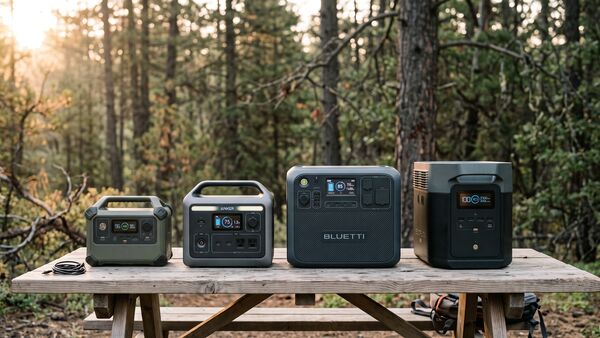
In this segment of roughly 1 kWh stations for nomadic use and content creation, the Power 1000 Mini goes up against three direct alternatives.
| Criterion | Power 1000 Mini | EcoFlow Delta 3 | Anker Solix C1000 | DJI Power 1000 |
|---|---|---|---|---|
| Capacity | 1008 Wh | 1024 Wh | 1024 to 1056 Wh | 1024 Wh |
| Continuous power | 800 W | ≈1500 W | 1800 to 2000 W | 2200 W |
| Weight | 11.5 kg | 12.5 kg | 11.3 to 12.9 kg | 13 kg |
| Built-in solar MPPT | Yes, 400 W | Yes | Yes | No, optional |
The Power 1000 Mini remains the lightest of the group and the only one to build in its MPPT module as standard, but it takes a clear hit on continuous power against competitors that mostly sit around 1500 to 2200 W. For anyone recharging mostly photo, video, and computer gear without targeting large heat-generating appliances, that gap matters less. For anyone wanting a single station capable of doing everything, including powerful appliances, the heavier competitors remain better equipped.
Who it suits, and who it does not
It suits anyone who prioritizes lightness and compactness above all for nomadic use (filming, van life, camping), recharges mostly electronic gear (photo, video, computing, phones) rather than power-hungry appliances, and values very fast mains charging.
It does not suit anyone who needs to run power-hungry appliances continuously (power tools, large heat-generating appliances), anyone looking for a genuinely quiet unit in the strict sense of the word, or anyone wanting to rely on a proven multi-year reliability track record, since that hindsight does not exist yet for this model.