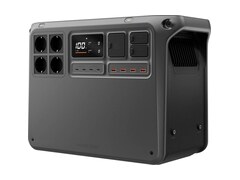

1573 to 1725 Wh returned, with the peak in the middle
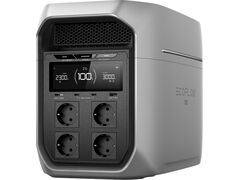
The DJI Power 2000 claims 2048 Wh. What actually comes out of its sockets depends on the power drawn, and the curve holds a surprise: the station returns most neither at low load nor at high load, but between the two.
At low power, standby draw eats the reserve. The electronics, the screen and the WiFi consume around 14 W continuously. A discharge at 100 W lasts some fifteen hours, and those 14 W siphon off more than 200 Wh along the way, never reaching the appliance plugged in. That is exactly the gap between the 1573 Wh measured at 100 W and the 1725 Wh measured at 500 W.
At high power, conversion losses take over. At 1600 W the inverter works close to its limits, the cooling runs, and the return falls back to 1579 Wh. Depending on the power drawn, the station therefore returns between 1570 and 1830 Wh, or 77 to 89 % of its nominal capacity.
The practical consequence is simple and runs against intuition: this station is not built to watch over a small appliance for two days. It gives its best on solid loads, from a few hundred watts to a good kilowatt, which is precisely what you buy 3000 W for.
Fast charging, and the one time in six it declines
The charging mode is not chosen in the app but on the front panel: a physical switch toggles between fast and standard charging. That is unusual, and rather convenient.
| Mode | Power | Full charge |
|---|---|---|
| Fast | around 2350 W | 65 to 75 minutes |
| Standard | around 1200 W | 2 to 2.5 hours |
| Claimed by the maker | 2200 W | 80 % in 45 min, 100 % in 75 min |
On this point the station keeps its promise and even betters it: in fast mode it fills in a little over an hour, where the maker claims 75 minutes. It is one of the quickest recharges on the market.
Two further conditions come with that mode. The maker explicitly recommends standard mode to extend battery life, and notes that where the temperature is abnormal, the actual charging power may be reduced to preserve the cells.
Then there is the energy cost of the operation. A full charge draws around 2300 Wh at the metre, for 1725 Wh returned at best from the 230 V outlet. Round-trip efficiency therefore sits near 75 %, which is average for the market but worth knowing when working out a running cost.
The 1800 W of solar, which are not solar
This is the most heavily promoted claim, and the one demanding the most care. The DJI Power 2000 is advertised with 1800 W of input. The figure exists, but it does not match what most buyers picture.
The 1800 W belong to the super fast charger sold as an accessory, and they add together two different sources: 1200 W arriving from solar panels through an MC4 connector, and 600 W arriving from the vehicle battery through an XT90 connector. On solar alone the ceiling is therefore 1200 W, and you must already own the accessory.
| Accessory | Solar input | Street price |
|---|---|---|
| Car-socket to SDC cable | 100 W | around 20 € |
| MPPT adapter module | 400 W | 60 € |
| 1.8 kW super fast charger | 1200 W, plus 600 W from the vehicle | 299 € |
| The maker's 200 W panel | to be added | 249 € |
Two wiring rules complete the picture, and they are mandatory: up to three panels may be connected in parallel, never in series, and the panels must not be of different types. When several sources are connected at once, solar takes priority by default, which is the right setting.
Finally, a useful order of magnitude for sizing: a 200 W portable panel delivers peaks around 180 W in practice and a far lower average as soon as the light fades. With a single panel, filling 2048 Wh from the sun is counted in days, not hours.
22,528 Wh, and the sum to do first
The other headline claim is expandability: up to 22,528 Wh. The figure is accurate. It corresponds to the station plus ten expansion batteries of 2048 Wh each.
The sum is quickly done, and it changes the perspective. The expansion battery costs around 923 €, when the complete station goes for 899 €.
| Configuration | Capacity | Price |
|---|---|---|
| Station alone | 2048 Wh | 899 € |
| Station and one expansion battery | 4096 Wh | 1822 € |
| Two stations | 4096 Wh | 1798 € |
| Station and ten batteries | 22,528 Wh | over 10,000 € |
The finding is clear: doubling capacity through expansion costs more than buying a second station, which would additionally bring a second 3000 W inverter, four extra sockets and a screen. Expansion is only justified where you want a single reserve managed from one point, with a single inverter, which remains a real but specific use case.
On how it works, there is nothing to fault: the expansion battery plugs into the station, and it is the station you then put on charge. The whole assembly updates as one, accessories included.
Backup: 10 ms claimed, but a "basic" UPS
Switchover to battery is stated at 10 milliseconds, which is excellent on paper and places the DJI Power 2000 among the best stations on the market. The maker nonetheless qualifies that figure itself, in three ways.
Two further reservations appear in the same place, and they are regulatory in nature. "This function does not work in some regions", on the one hand. And on the other, owing to local laws and regulations in certain countries, "the actual output power of the station may be reduced in UPS mode".
For everyday use that remains ample: a router, a desktop computer, a television or a fridge will never notice the 10 milliseconds. For a server, a NAS or medical equipment you need an online UPS, and the maker says so bluntly, which is to its credit.
Tied to the grid, it delivers only 800 W
The DJI Power 2000 can behave as a small domestic storage system: connected to the metre, it stores electricity during off-peak hours and feeds the home during peak hours. That function is rare at this price, and it is also the one imposing the most spectacular limit.
| Mode | Output | Charging |
|---|---|---|
| Normal use | 3000 W, 3600 W surge | 2200 W |
| Tied to the electricity grid | 800 W | 2200 W |
| Grid-tied, with backup | 1200 W total at the 230 V outlet | 2200 W |
A 3000 W station brought down to 800 W: the gap is striking, but it is not arbitrary. It matches the ceiling most European countries impose on small installations feeding the grid without heavy paperwork. This is not a flaw in the device, it is the regulatory framework, and it applies to every station offering the function.
Grid-tied mode also calls for real work: a solar installation, a compatible smart metre, a connection application complying with local rules, and installation by a qualified electrician. The maker notes that grid-related functions are supported only in certain countries and regions.
One last piece of common sense, written by the maker: when you unplug the station to take it outdoors or into a vehicle, it is better to switch off the energy optimisation settings, otherwise output power may remain unstable.
The output that shuts itself off, and the trick that stops it
Here is the trap most likely to spoil a weekend, and it takes two seconds to defuse once you know about it.
The 230 V output switches off automatically after 30 minutes if the station is powering nothing, and the whole station shuts down after 60 minutes with no input or output. On paper that is an excellent idea: it stops a device left switched on from draining itself through its 14 W of standby draw.
In practice it is a problem for any intermittent appliance. A fridge whose compressor stops between cycles draws nothing for long minutes. If the cut-off lands during one of those pauses, you come back to a warm cool box.
One reassuring detail, surprising as it is on first use: the maker notes that a slight odour may be given off under heavy load, owing to the waterproof coating on the internal components, and that it dissipates naturally.
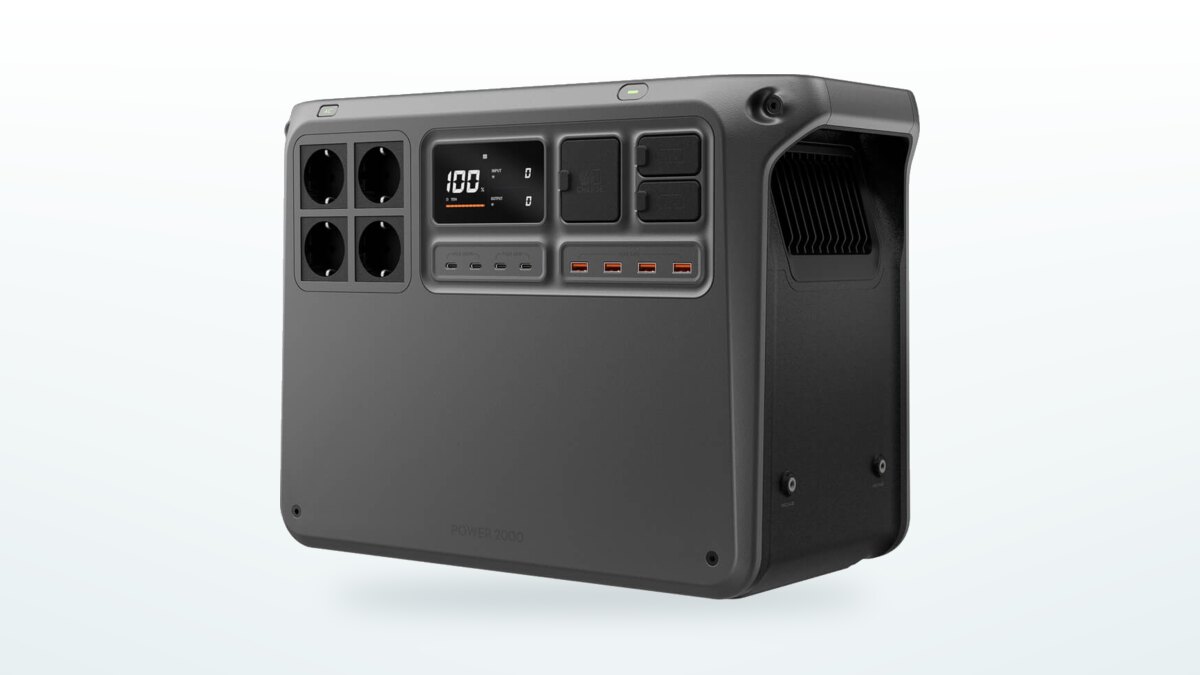
Fourteen outputs, two of which do not hold their 140 W
With fourteen outputs, the DJI Power 2000 is among the best equipped stations in its class. One detail nonetheless deserves a close reading.
| Output | Detail |
|---|---|
| 230 V sockets | 4, pure sine wave, 3000 W in total |
| USB-C | 4 ports, but two at 140 W and two at 65 W |
| USB-A | 4 ports, 24 W each |
| SDC | 2 ports, 9 to 28 V, 12 A maximum |
| 12 V output | only through an SDC cable sold separately, 13.6 V and 10 A |
The four USB-C ports are not identical. Two do reach 140 W, enough to run a demanding laptop, but the other two cap at 65 W. The marking is on the front panel, provided you look before plugging in.
Nor is there a built-in car socket. The 12 V necessarily goes through an SDC cable sold separately, delivering 13.6 V at 10 A. For van or motorhome use, where 12 V is the norm, that is an accessory to budget for at purchase.
The two SDC ports are, on the other hand, this station's real signature. They take dedicated cables that charge the maker's drone batteries directly, across the Mavic, Air, Inspire and Matrice ranges, at speeds no mains socket allows. If you fly, that argument alone justifies choosing this brand; if you do not, those two ports will mainly serve as the gateway for solar charging and capacity expansion.
Two closing reservations, minor but real. The USB and SDC ports have no covers at all, leaving dust and splashes free access, a notable gap on a device meant for the outdoors. And on Android, the app does not install from the usual app store: you have to download an APK file from the maker's site, a step not everyone will want to take.
Noise, and why the claimed 29 dB is true
The maker highlights 29 dB. The figure is accurate, but it holds for one precise case only, and the gap with other situations is wide.
| Situation | Level |
|---|---|
| DC and USB outputs only | silent |
| Charging in standard mode | 29 dB claimed, blends into the ambient noise |
| Fast charging at 2300 W | up to 45 dB(A) |
| Output at full power, 3000 W | up to 50 dB(A) after a quarter of an hour |
These values are not comparable with one another, since they correspond to very different demands. What they do say is clear: the station is discreet when treated gently and frankly audible when pushed.
The good news is that standard mode, the one the maker recommends for battery longevity, is also the one that lets you leave it charging in a bedroom or a motorhome cabin without a second thought. The rise in noise at full output is not immediate either: it appears after some fifteen minutes, the time it takes the cooling to clear the accumulated heat.
For reference, the operating range runs from -10 to 45 °C, and charging is only possible between 0 and 45 °C. For storage, the maker asks that the station be kept at around 60 % charge, and put through a full cycle every six months: run it below 15 %, switch it off for more than two hours, then take it back to 100 % in standard mode.
Against the 2 kWh field, and by country of purchase
In its segment the DJI Power 2000 holds a singular position: it is the only 2048 Wh station delivering 3000 W for under 1000 €. Here is where it stands, at prices seen in mid-August 2026.
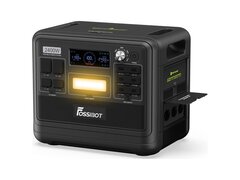
| Criterion | DJI Power 2000 | EcoFlow Delta 3 Max Plus | Fossibot F2400 |
|---|---|---|---|
| Street price | 899 € | ≈ 1430 € | ≈ 730 € |
| Capacity | 2048 Wh | 2048 Wh | 2048 Wh |
| Output | 3000 W | 3000 W | 2400 W |
| 230 V sockets | 4 | 4 | 3 |
| Cycles | 4000 | 4000 | 3500 |
| Expandable | yes, 22,528 Wh | yes | no |
| Backup switchover | 10 ms | 10 ms | 10 ms |
| Weight | 22 kg | 22.1 kg | 22 kg |
The verdict of that table is unambiguous: at near-identical specification, the DJI costs around 530 € less than its direct rival. Against the Fossibot it asks 170 € more, but brings 600 W of extra power, one more socket, 500 more cycles and expandability.
One variable is rarely discussed and weighs heavily here: the price of this station varies by more than 250 € depending on the country of purchase, for a strictly identical model.
| Country | From |
|---|---|
| Germany | 868 € |
| France | 899 € |
| Austria | 1002 € |
| Italy | 1099 € |
| Spain | 1099 € |
| United Kingdom | 1122 € |
At 1099 € the reasoning changes entirely: the station stays cheaper than the Delta 3 Max Plus, but the gap with the Fossibot widens from 170 to 370 €, and the question of how much power you actually need then deserves serious thought.
Who it suits, and who it does not
The DJI Power 2000 is a very good machine sold at an aggressive price, whose faults owe less to its design than to the way it is presented. All its limits are written into its documentation, and none appear on its product page.
It suits very well anyone after 3000 W without spending 1500 €, which is currently its own private ground. It suits the building site and the workshop, where its 3600 W of surge start tools a 2400 W station would refuse. It suits vans and motorhomes, provided the 12 V cable is budgeted for. It suits home backup, with its 10 ms switchover and above all its off-peak scheduling, which pays for itself year-round rather than only on outage days. And it suits, obviously, anyone flying a drone: the two SDC ports change life in the field and have no equivalent among rivals.
It suits poorly anyone wanting to stretch a small draw over several days: its 14 W of standby cost too much on that ground, and a more modest station will do better. It suits poorly anyone buying for the 1800 W of solar, which exist only by adding panels and vehicle together, with a 299 € charger. It suits poorly anyone aiming at 22,528 Wh, given how dearly expansion is priced against a simple second station. It suits poorly the protection of a server or medical equipment, as the maker says itself. And it suits poorly, finally, a purchase in Italy or Spain at the going rate, where its 200 € premium reshuffles the deck.
What remains is the essential. No other station currently offers 2048 Wh, 3000 W, 4000 cycles and 22 kg for 899 €, and its documentation is among the rare ones to state its own limits rather than bury them. It is a very good buy for anyone who knows what they are buying, and a source of disappointment for anyone who stops at the claims on the box.