

The first ten minutes: the right order
Everything goes dark at once. Before you even look for a light, six actions will cost you two minutes and save you most of the damage. In this order.
- Look out of the window. Street lights out and neighbours dark means the fault is on the network and there is nothing for you to fix. Everything lit outside means the problem is inside your home, so head for the consumer unit or breaker panel.
- Note the time. You will need it for the freezer, to know whether this is a real outage or a momentary blink, and for any compensation claim.
- Switch off the big loads. Oven, hob, tumble dryer, water heater, desktop computer: unplug them or trip their breakers. When power returns, everything restarts in the same second, and that surge is what actually destroys equipment.
- Leave one light switched on. That is your telltale: you will know the moment power is back, even asleep.
- Stop opening the fridge. Every opening costs hours of cold. Take out what you need for tonight now, then leave it shut.
- Report the outage. Call the company that owns the wires, not the company that sends your bill. They are almost never the same business.
Network fault or your own wiring? The three-minute test
Half of all reported power cuts are not power cuts at all: the home's own protective devices have done their job. The diagnosis takes three minutes and saves you waiting for a repair crew that was never coming.
If you are the only one in the dark
Head for the panel with a head torch on. Three cases, three answers.
- The residual current device has tripped (the main protective switch with a test button, called an RCD, GFCI or safety switch depending on where you live): something is leaking to earth. Switch every individual breaker off, reset the main device, then bring the breakers back one at a time. The one that trips everything again identifies the faulty circuit, and often the appliance to carry outside.
- A single circuit breaker has tripped: that circuit is simply overloaded. Unplug whatever you had just switched on and reset it.
- The main incoming breaker has tripped: you exceeded your supply capacity. Turn appliances off before resetting. If it happens regularly, the contracted capacity is too small for the way you live, and no amount of rewiring will change that.
If the whole street is dark
There is nothing to fix. Report it, check your network operator's outage map or app, and move to the during-the-outage section below. An urban network fault is usually cleared within one to three hours; after a storm, in a rural area, think in days rather than hours.
Momentary blinks are a symptom worth reporting
A one-second interruption that resets the clocks is not a fault in itself: it is usually the network reclosing automatically after a transient problem, a branch on a line, distant lightning, a bird. Harmless to you, less so to your equipment, because repeated blinks are what wear out switch-mode power supplies and corrupt hard drives. If you get several a week, report them. They point to a genuine defect on the line, and reporting is the only way it gets investigated.
Planned outages
For maintenance work you normally get a letter, an email or a text a few days ahead. Where supply is tight, some countries also run rotating load shedding, cutting whole zones for a limited period on an announced schedule. Households that depend on declared medical equipment are excluded from those rotations, but only if they have registered in advance, which is worth doing today rather than on the day.
Before: the kit that fits in one drawer
Preparing for an outage is not a survivalist project. One evening, one drawer, and well under a hundred pounds or dollars for the essentials. The rule is simple: everything that matters during an outage lives in the same place, known to the whole household, reachable in the dark.
- A head torch per person. Not a hand torch: a head torch. It leaves both hands free, which changes everything when you are feeling for a breaker or making food.
- An LED lantern to light a whole room, far more useful than a torch aimed at the ceiling.
- A battery or wind-up radio. It is the one information channel that survives a long outage, once the mobile masts have run their backup batteries flat.
- A charged power bank, topped up every three months. A power bank forgotten in a drawer for two years is an empty power bank.
- Bottled water, around three litres per person per day. Without electricity, booster pumps in apartment blocks stop and upper floors lose pressure at the tap.
- Cash. No card terminals and no cash machines during a mains outage.
- A paper list: outage number, doctor, insurer, family. Your phone will eventually die.
Your freezer is free storage
A full freezer lasts roughly twice as long as a half-empty one, because the frozen mass acts as a cold battery. If yours is sparsely filled, fill the gaps with bottles of water. They freeze, they cost nothing, and on the day they buy you extra hours of cold before melting into drinking water.
The situations that do not tolerate improvisation
Home medical equipment such as overnight ventilation or an oxygen concentrator, insulin in the fridge, a single lift in a building of elderly residents: these call for a solution sized in advance, not an extension lead found in a panic. Register with your utility and your medical supplier, and keep a backup supply that you have actually tested with the device in question, checking that it delivers a pure sine wave output.
The five mistakes that can kill
This section is the reason this article exists. Power cuts themselves rarely kill anyone. What kills people is the improvised fix, and the same five come back year after year with depressing regularity.
1. The double-ended cord, never to be made or plugged in
This is the lead with a plug on both ends, used to connect a generator to a wall socket so that the house is fed “through the outlets”. Electricians call it a suicide cord and the name is earned. Once one end is live, the exposed pins on the other end are energised and within reach of a hand. The current then travels back through your panel to the neighbourhood transformer, which steps it up to several thousand volts: the lineworker repairing the circuit, convinced it is dead, is electrocuted. And nothing protects the circuit, because you have bypassed every protective device in the house.
The only correct way to run a home from a backup source is a transfer switch fitted by a licensed electrician, which makes it physically impossible for the grid and the generator to be connected at the same time. Every national wiring regulation requires it, and it is not an optional refinement.
2. Running a generator indoors, or too close
An engine-driven generator produces carbon monoxide, a gas with no colour and no smell that kills in minutes. A single machine emits as much carbon monoxide as hundreds of cars. No garage, no basement, no shed, no porch, not even with the doors and windows wide open: natural ventilation never removes that volume. Outdoors only, at least 6 m (20 feet) from doors, windows and vents, with the exhaust pointing away from the house. In the United States alone, portable generators are linked to roughly a hundred carbon monoxide deaths every year, concentrated in exactly the days after a storm, when the machines come out of the garages. One more rule: never refuel a hot engine.
3. Plugging solar panels into a socket with a home-made rig
The idea sounds neat: a few panels, an inverter bought online, a plug into a kitchen socket, and the house is fed. In practice this stacks up hazards. A non-compliant inverter has no anti-islanding protection forcing it to disconnect when the grid fails, so it backfeeds a line that crews believe is dead, exactly like the suicide cord. On the direct-current side, an insulation fault across panels creates an arc that a household residual current device cannot see, and those arcs set roofs on fire. Finally, household sockets and circuits are designed to distribute energy, not to receive it.
The worst part is that it does not even work when you need it. See the section on solar during an outage. If plug-in balcony kits interest you, there are certified products and a legal framework, which we cover in our article on plug and play balcony solar.
4. Candles
Candles are the postcard image of a power cut, and a leading cause of house fires. One candle forgotten, knocked over by a pet or left near a curtain, in a home where the smoke alarm may still work but where the fire service will take longer to reach you, is a wildly disproportionate risk next to an LED lantern that costs ten pounds and lights the room better.
5. Burning fuel indoors for heat
Barbecues, charcoal braziers, camping gas stoves, workshop kerosene heaters not designed for living spaces: all of them produce carbon monoxide, and all of them claim lives every winter. The right answer to being cold without power is not to burn something in the living room. It is to retreat to a single room, close the doors, block draughts and pile on the blankets.
During: cold, light, warmth and information
Once the emergency actions are done, an outage becomes a management exercise. Four areas, in order of real importance.
Keeping food safe
With the door kept shut, a refrigerator holds a safe temperature for about four hours. A full freezer lasts up to forty-eight hours, a half-full one about twenty-four. Those figures assume you do not open them. Group the most perishable items, raw meat and fish, in the middle of the frozen mass. A cheap fridge thermometer beats any estimate: the safety limit is 4 °C (40 °F).
Light
Head torch to move around, lantern for the room you live in. Resist using your phone as a torch: its light is a heavy drain and you are flattening precisely the battery you will need to make calls.
Phone and information
As soon as the signal becomes unstable, switch to aeroplane mode. A phone hunting for a mast uses three to four times more power than one at rest. Drop the screen brightness to minimum, turn off background data, and switch the radio back on for a few minutes at a time to collect messages. Mobile masts carry backup batteries sized for a few hours only; beyond that, the battery radio becomes the most reliable medium again.
Warmth and water
A reasonably insulated home loses 1 to 2 °C (2 to 4 °F) a day in winter. Close curtains and shutters at night to keep heat in, open the sunny side during the day to gain some. Live in one room with the doors closed. Watch out for gas and pellet boilers: they are electrically controlled and stop with the power, even though 80 to 150 W is often enough to run their pump and electronics. That is one of the best possible uses of a backup supply in winter.
Neighbours
Two minutes to knock on the door of the elderly neighbours upstairs. A long outage is first of all a social problem: the lift is stuck, the door entry system is dead, and a landline routed through a broadband box no longer works.
How many watt-hours do you actually need?
This is the question that decides everything, and it is answered on a sheet of paper before you look at a single product. List what you genuinely want to keep running, multiply each appliance's power by the hours you need it, add it up. The result is in watt-hours (Wh), the only unit that matters.
| Appliance | Real draw | Over a 24 h outage |
|---|---|---|
| Recent fridge freezer | 90 to 120 W, running about 30 % of the time | 250 to 500 Wh |
| Broadband router and modem | 15 W continuous | 360 Wh |
| Boiler pump and controls | 80 to 150 W | 1,000 to 1,800 Wh |
| Four smartphones, one charge each | 15 Wh per charge | 60 Wh |
| Three LED lamps, 5 hours | 6 W each | 90 Wh |
| Laptop, 4 hours | 45 W | 180 Wh |
| Overnight ventilation device, no humidifier | 30 to 60 W | 300 to 500 Wh per night |
| Microwave, 5 minutes | 1,000 W | 85 Wh |
| Kettle or induction hob | 1,500 W on 120 V, up to 2,400 W on 230 V | forget it |
Two lessons jump out. First, anything that makes heat (kettle, hob, heater, hair dryer) is out of reach of any reasonable battery: fifteen minutes of kettle costs as much as a full day of refrigeration. Second, the genuinely useful loads are modest. Keeping the cold, the light, the communications and the central heating running is far cheaper than most people assume.
Three profiles, three energy budgets
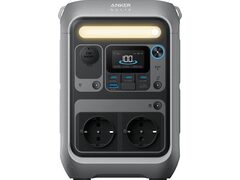
- An evening and a night: 300 to 500 Wh. Light, phones, router, laptop. A compact unit such as the Anker Solix C300 covers this and lives in a cupboard.
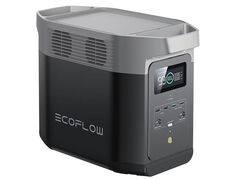
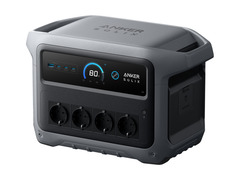
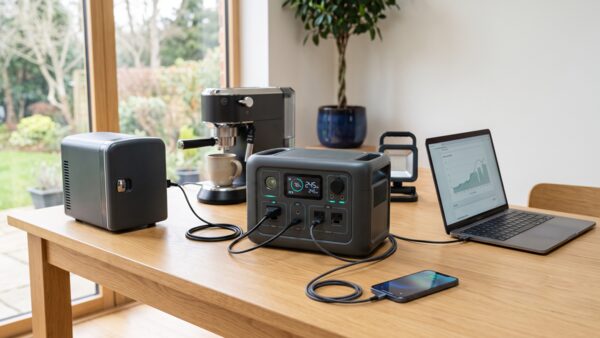
- 24 to 48 hours with the fridge: 1,000 to 1,500 Wh. This is the sweet spot for a household, the format of an EcoFlow Delta 2 or an Anker Solix C1000. Refrigeration becomes possible again, with enough left over to live normally.
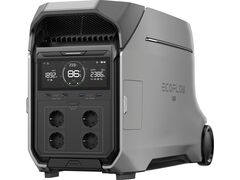
- Several days including heating: 3 kWh and up, with solar. Now we are in the territory of large units such as the EcoFlow Delta Pro 3, and a recharging source is compulsory, otherwise the reserve is only a stay of execution.
Three details that decide the outcome
Surge power before capacity: a fridge compressor or a boiler pump draws several times its rated power at startup. Pure sine wave next: cheap inverters output a modified wave that overheats motors and that some medical devices refuse outright. Transfer time last: a unit with a backup function (usually labelled EPS or UPS) takes over in under thirty milliseconds, fast enough that the fridge, the router and the computer never notice. Without it, every outage means a full router reboot, three minutes with no internet.
To put numbers on your own case instead of relying on these orders of magnitude, our which power station do I need and real fridge consumption tools do the arithmetic from your actual appliances. And if you wonder why a 1,024 Wh unit never delivers 1,024 Wh, the answer is in our article on the real capacity of power stations.
Gel battery, AGM or power station: which one?
The question comes up constantly, and for good reason: a 100 Ah lead-acid battery costs a third of a power station with comparable capacity. The comparison deserves to be made honestly, because the sticker price is not the real price.
| 12 V gel or AGM lead battery, 100 Ah | LiFePO4 power station, 1,000 Wh | |
|---|---|---|
| Stored energy | 1,280 Wh on paper | 1,000 Wh |
| Usable energy | about 640 Wh (discharge limited to 50 %) | about 900 Wh |
| Weight | 28 to 32 kg | 11 to 14 kg |
| Service life | 300 to 500 cycles at 50 % depth of discharge | 3,000 to 4,000 cycles at 80 % |
| Also required | inverter, charger, cables, fuse, enclosure | nothing, all integrated |
| Maintenance | permanent float charge, or it sulphates | a top-up every three to six months |
| Constraints | ventilated space, hydrogen is released on charge | none, it sits in the living room |
Once you add a pure sine inverter, a charger, protection and wiring, the price gap halves while the usability gap widens. Above all, lead is unforgiving: a gel battery left for a year in a garage without a float charge is dead, sulphated, without ever having been used. That is precisely the life of a backup reserve, which by definition almost never gets used.
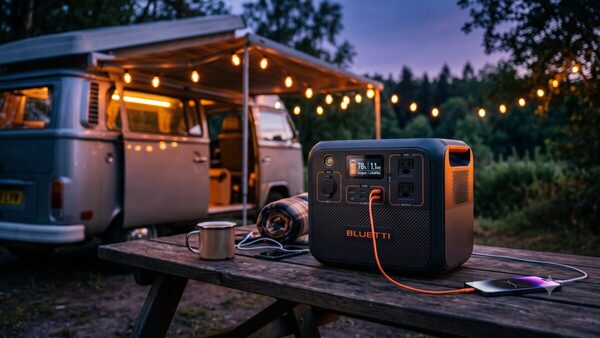
Lead still makes sense in one case: you already have a plant room, an inverter and a charger, or you are building a fixed installation in a cabin, a workshop or a commercial unit. The power station wins in the only scenario that concerns us here, the unexpected outage at home: it works immediately, with no wiring, no polarity mistakes, and it moves from room to room. The chemistry side of the argument is developed in our Li-ion versus LiFePO4 comparison, and the full range is in the power stations section.
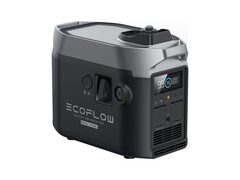
As for the engine generator, nothing beats it over a long outage, since you simply add fuel. It also brings noise, outdoor-only operation, fuel storage and the carbon monoxide precautions above. Recent auto-start models such as the EcoFlow dual-fuel generator are designed to sit behind a power station: the battery covers the first hours in silence, the engine takes over if the outage drags on. We compared the two approaches in detail for motorhomes, and most of the reasoning transfers to a house.
Solar during an outage: what actually works
Here is the most counter-intuitive fact in this article, and the one that shocks solar owners the most: a grid-tied photovoltaic system produces nothing during a power cut. A roof covered in panels, full sunshine, and not one working light bulb.
The reason is as much regulatory as technical. Every grid-connected inverter carries anti-islanding protection that forces it to shut down the moment the grid disappears. Without it, your system would keep energising the neighbourhood line, and the crew working on a circuit they believe is dead would be electrocuted. The requirement exists in every developed grid code, from EN 50549 in Europe to IEEE 1547 in North America, and it applies in exactly the same way to plug-in balcony kits with micro-inverters. A plug and play kit will not give you a single watt during a mains failure.
There are only two ways to have real solar power during an outage.
- A hybrid inverter with a backup output, paired with a fixed battery. This is the complete answer, feeding a dedicated sub-panel, but it runs into thousands and is installed during a build or a retrofit, not the day before a storm.
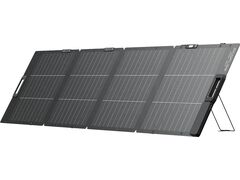
- A portable panel feeding a power station. This is the accessible route, and it suits the need perfectly: the station is your reserve, the panel extends it.
What a portable panel really delivers
Let us be precise, because marketing figures are optimistic. A well-aimed 220 W portable panel delivers 120 to 160 W in practice at the best of the sun. On a fine summer day that is 700 to 1,000 Wh, enough to refill a 1 kWh station within the day. In December, at northern European or Canadian latitudes, the same panel will yield 200 to 400 Wh, so the same result takes three days. That is the whole difference between a summer outage, where solar makes the whole thing almost comfortable, and a winter one, where it merely slows the decline.
We measured these gaps in detail in our feature on what solar charging really delivers, and the portable solar panels section lists the models compatible with the main power stations.
After: the return of power is the riskiest moment
Against expectation, equipment does not usually die during the outage. It dies when power comes back. Every appliance in the neighbourhood draws current in the same instant, voltage swings, and electronic power supplies hate that.
- Reconnect gradually. Wait five to ten minutes after power returns, then bring circuits back one at a time, starting with refrigeration and finishing with sensitive electronics.
- Reset in the right order if the panel tripped: the residual current device first, then the individual breakers.
- Reprogram what was wiped: clocks, thermostats, heating schedule, alarm, ventilation, alarm clock. Plenty of homes spend the winter badly set because nobody went back to the heating programmer after an outage in October.
The freezer test, to set up now
Fill a cup with water, freeze it, put a coin on top of the ice and leave the cup in the freezer. After an outage the position of the coin tells the whole story: still on the surface, nothing thawed; halfway down, thawing began but stayed partial; at the bottom of the cup, everything melted and refroze, and the contents must go, however solid they now feel. It is the only way to know what happened while you were away.
Otherwise the food safety rule is clear: anything that stayed below 4 °C (40 °F) or still holds ice crystals can be refrozen; above that it goes in the bin. Never taste to check, because bacterial contamination changes neither taste nor smell.
Your rights, and they vary widely
Compensation rules differ enormously from one country to the next, and even between regions. Some regulators impose an automatic payment beyond a set number of hours, credited to your bill without you asking. Others provide nothing at all for households and leave you to claim through the operator's liability. Look up your own regulator's rules once, calmly, before you ever need them.
Damage to appliances is a separate matter and always requires action on your part: keep the damaged item, get a written quote or an assessor's report, notify your home insurer, and file a claim with the network operator. A documented over-voltage engages their liability; a simple abrupt restart does so far less readily.