
Segway Cube 1000
(7 reviews)
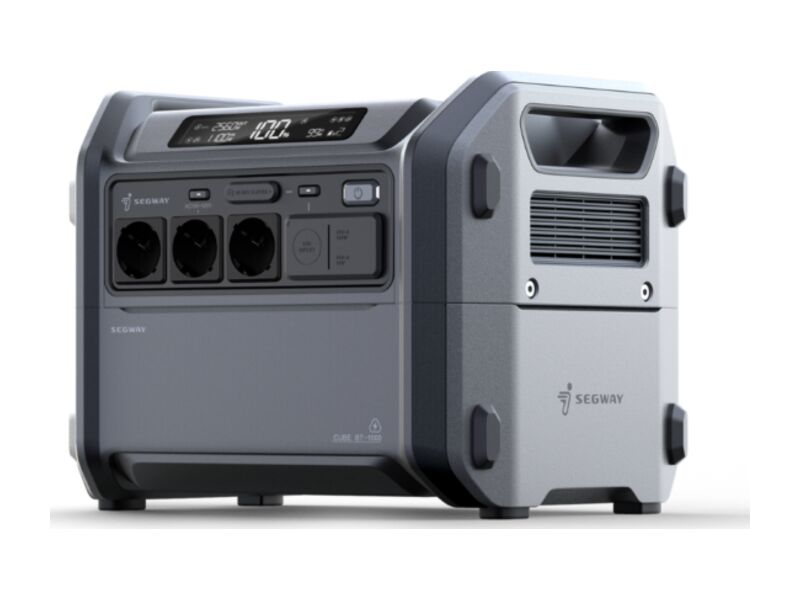
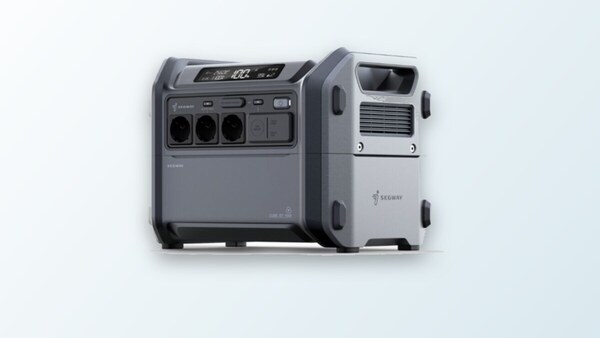
Expandable from 1024 Wh to 5120 Wh with cable-free add-on batteries, plus 2200 W continuous and 4400 W peak: the Segway Cube 1000 grows with your power needs.
Characteristics
- Capacity: 1024 Wh, expandable up to 5120 Wh (LFP battery)
- Power: 2200 W continuous, 4400 W peak (R-Drive)
- Recharge: 0 to 100% in 1h12 on mains, up to 800 W solar
- Weight: 16.2 kg, IP56 (battery), 5-year warranty
- Expandable to 5120 Wh cable-free, 30 ms UPS
Detailed overview: Segway 1024 Wh modular power station
The Segway Cube 1000 is the manufacturer's first power station, a brand better known until now for its scooters and self-balancing vehicles, and it makes a strong first impression with a modular architecture that is unusual at this price point. Its base battery packs 1024 Wh of LFP (LiFePO4) chemistry, but what really sets it apart is its ability to take up to four cable-free add-on batteries: total capacity then climbs to 5120 Wh, turning a simple weekend power reserve into a genuine home backup hub.
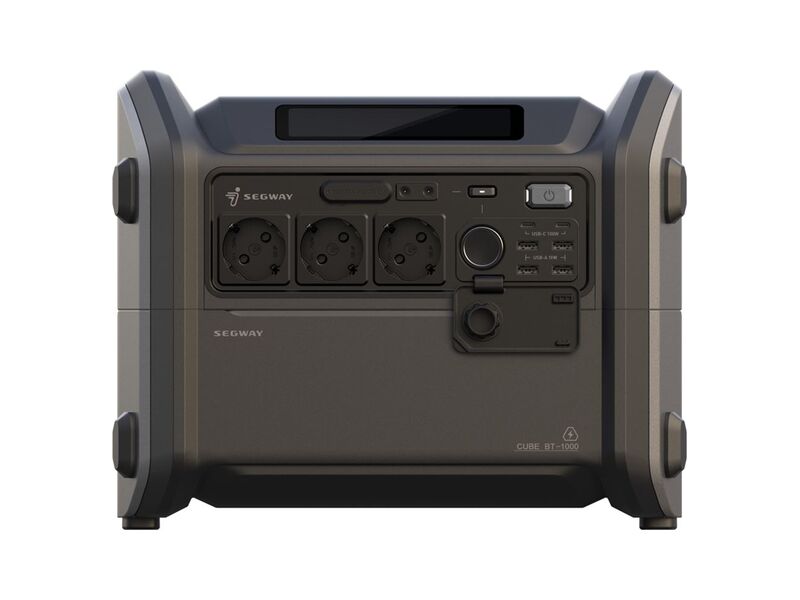
On power, the Cube 1000 delivers 2200 W continuous and up to 4400 W peak thanks to its R-Drive function, designed for demanding resistive loads such as a kettle, an electric oven or power tools. Three pure sine wave mains outlets, two 100 W USB-C ports, four USB-A ports and two DC5525 outputs round out a generous set of 12 output sockets in total.
Recharging runs at up to 1250 W on mains power (0 to 100% in roughly 1h12) or up to 800 W via solar input with MPPT, one of the highest figures in its capacity class. A 12/24 V car input can also top up a car battery in an emergency (charging only, not starting).
On the safety side, the magnesium alloy AM60B housing and the battery's IP56 rating (IPX3 for the whole unit) promise solid resistance to damp and dusty environments. The UPS function switches over in just 30 milliseconds during a mains outage, a valuable feature for protecting a computer or a medical device. Its discharge temperature range runs from -10 °C to 45 °C. The LFP battery is rated for over 4000 cycles, roughly a decade of regular use, all backed by a 5-year warranty.
The one real drawback: at 16.2 kg, it is noticeably heavier than most rivals of comparable capacity, and the Segway-Ninebot app only talks over Bluetooth, with no remote WiFi monitoring. For anyone after a scalable power base that can grow with their needs rather than being replaced by a bigger station, the Segway Cube 1000 remains a very convincing option.
Full specifications
Detailed characteristics (EAN: 8720254406787)
Battery and capacity
| Rated capacity?Total stored energy in watt-hours. The higher the figure, the longer the runtime. | 1024 Wh |
|---|---|
| Max capacity (with extensions)?Total capacity reachable by adding extra batteries. | 5120 Wh |
| Expandable capacity?Whether capacity can be increased with add-on batteries. | Yes |
| Removable battery?The main battery can be removed or replaced by the user. | No |
| Battery chemistry?LiFePO4 (LFP) lasts far longer and is safer than NMC. | LFP (LiFePO4) |
| Charge cycles?Number of full charges before capacity drops to the stated threshold. | 4000 cycles |
| Pack nominal voltage?Internal battery voltage; higher voltage helps deliver high power. | 51.2 V |
AC output
| Continuous AC power?Power the unit can sustain continuously on its 230 V outlets. | 2200 W |
|---|---|
| Surge power?Brief peak tolerated when starting motor or compressor devices. | 4400 W |
| Inverter type?A pure sine wave is essential for sensitive electronics and motors. | Pure sine wave |
| AC voltage / frequency?Voltage and frequency of the AC output (230 V / 50 Hz in Europe). | 230 V / 50 Hz |
| Number of 230 V AC outlets?Number of mains outlets available on the unit. | 3 |
| RV / TT-30 outlet?Dedicated 30 A outlet for North-American style RVs. | No |
Recharging
| Max AC charging power?Maximum power drawn from a wall socket; higher means faster charging. | 1250 W |
|---|---|
| AC charge 0-100%?Stated time for a full charge on mains power. | 72 min |
| Max solar input?Maximum solar power accepted at the input (PV panels). | 800 W |
| Accepted solar voltage?Panel voltage range compatible with the solar input. | 12 to 60 V |
| MPPT controllers?Number of independent MPPT solar inputs (yield optimisation). | 1 |
| Vehicle charging (12/24 V)?Can be charged from a vehicle's cigarette-lighter socket. | Yes |
| Pass-through charging?The unit can power devices while charging (pass-through). | Yes |
Ports and connectors
| USB-C ports?Number of USB-C ports and the fastest port's power (laptops, phones). | 2 × 100 W |
|---|---|
| USB-A ports?Number of USB-A ports and maximum power (small devices). | 4 × 18 W |
| 12 V output (car socket)?12 V cigarette-lighter output and its power (coolers, pumps…). | Yes (136 W) |
| Other DC outputs?Additional DC connectors (Anderson, DC5521, XT60…). | DC5525 |
Portability
| Weight?Net weight of the unit, battery included. | 16.2 kg |
|---|---|
| Dimensions (L × W × H)?Overall size of the unit in millimetres. | 354 × 289 × 284 mm |
| Form factor?Portable (hand-carried), transportable (heavy), or wheeled. | Portable |
| Wheels?Built-in wheels for moving the unit. | No |
| Telescopic handle?Retractable handle like a wheeled suitcase. | No |
Safety and environment
| Certifications?Standards and approvals obtained (CE, RoHS, UN38.3, UL…). | UL1778 |
|---|---|
| Discharge temperature?Temperature range in which the unit can deliver power. | -10 to 45 °C |
| Charge temperature?Temperature range in which the unit can be recharged. | 5 to 45 °C |
| Ingress protection (IP)?Resistance to dust and water (e.g. IP54). | IPX3 |
Backup / UPS
| UPS / EPS mode?Automatic switch to battery on a mains outage (backup). | Yes |
|---|---|
| Switchover time (rated)?Delay before switching to battery; under 20 ms suits a PC or router. | 30 ms |
Noise and thermal
| Quiet mode?Setting that limits fan noise, often by capping charge power. | No |
|---|---|
| Self-heating battery?Battery pre-heating to allow charging in cold weather. | No |
Display and connectivity
| Display?Type of screen showing power, runtime and alerts. | LCD |
|---|---|
| Bluetooth?Bluetooth link for nearby control. | Yes |
| Wi-Fi?Wi-Fi connection for remote control and monitoring. | No |
| Mobile app?iOS / Android app to control the unit. | Yes |
| Local control (no cloud)?Control possible over Bluetooth without an account or internet. | Yes |
Availability and warranty
| Market launch?Date the model first became available on the European market. Useful to place its generation: technology moves fast in this segment, and a device several years old may be at the end of its commercial life. | October 2023 |
|---|---|
| Warranty?Length of the manufacturer's warranty. | 5 years |
⚡ How long will this power station run a device?
With 1,024 Wh, the Segway Cube 1000 external battery runs a fridge (50 W) for ~17h or an LED TV (90 W) for ~9h40.
| Home | Runtime |
|---|---|
| Mini fridge (45 W) | ~19h |
| Dehumidifier (300 W) | ~2h55 |
| Coffee maker (900 W) | ~60 min |
| Space heater (1500 W) | ~35 min |
| Outdoor & workshop | Runtime |
|---|---|
| Wi-Fi router (15 W) | ~58h |
| Laptop (60 W) | ~15h |
| LED TV (90 W) | ~9h40 |
| Nebulizer (100 W) | ~8h40 |
Rough estimate: real consumption varies, and very power-hungry appliances (heating elements) must stay below the output power.
What is this power station best for?
-
Home & Power cuts Ideal
The Cube 1000 is built for home backup thanks to a UPS function that switches over in just 30 milliseconds: your router, computer, lights and a small fridge stay powered through an outage with no reboot. Its base 1024 Wh already covers several hours, but the real strength is its modularity: up to four add-on batteries clip on with no cables, taking total capacity to 5120 Wh, enough to run a whole household for several days without buying a second station. Its 2200 W continuous output (4400 W peak via R-Drive) runs an oven, a kettle or a vacuum cleaner without flinching, and it recharges at up to 1250 W on mains or 800 W via solar to keep going through a prolonged outage. The one trade-off for a fixed setup: at 16.2 kg it's less portable than a lighter station, a fair price for this level of expandability.
-
Job site & Tools Ideal
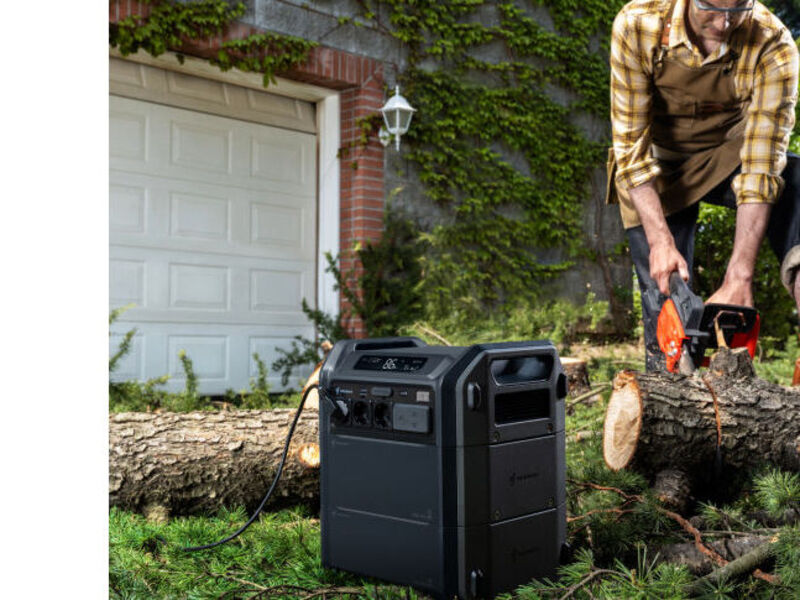
On a job site, the Cube 1000 brings power rarely seen at this capacity: its 2200 W continuous output, and especially its 4400 W peak (R-Drive function), absorb the start-up surge of a circular saw, a drill or an air compressor, loads that often stall rival stations of similar size. Its magnesium alloy housing and the battery's IP56 rating make it tough against dust and splashes on an outdoor work site. Three mains outlets and 100 W USB-C ports power several tools and devices at once, and fast mains recharging (1250 W) tops it back up during a break. At 16.2 kg it needs both hands for a comfortable carry, but it still moves easily enough between spots on site.
-
Off-grid & Solar Suitable
For an off-grid setup, the Cube 1000 stands out with solar input up to 800 W through its MPPT controller, one of the most generous figures in its capacity class. Paired with Segway SP100 or SP200 panels, it recharges efficiently even under variable sunlight, and its expandability up to 5120 Wh lets you size the installation to real needs without starting from scratch. Its 2200 W output covers most everyday needs on an isolated site. At 16.2 kg it suits a semi-fixed installation better than daily nomadic use, but for a cabin, a chalet or a stable off-grid site, it's a solid balance of power, expandability and fast solar charging.
-
Motorhome & Van life Suitable
In a motorhome, the Cube 1000 covers the essentials: its base 1024 Wh powers lighting, device charging and a small fridge, and its 2200 W handles a kettle or a portable hob. Its 12/24 V car input lets it recharge on the road, and cable-free expandability is a real plus for longer trips that need more autonomy without switching stations. It's still heavier (16.2 kg) than the lightest van-life dedicated stations, worth weighing up if onboard space and weight are tight. For a motorhome where it stays fitted rather than moved daily, it wins on power and room to grow.
-
Camping & Tent Backup only
Car camping with the vehicle nearby, the Cube 1000 does a solid backup job: its 1024 Wh runs an electric cooler, evening lighting and charges several devices, and its 2200 W allows a kettle or a small hotplate. It suits a fixed pitch better than hiking or backpacking though, as its 16.2 kg sits well above stations built for carrying. On a car-accessible site where weight isn't a concern, it earns its keep; for more nomadic use, a compact sub-12 kg station will be easier to live with day to day.
Our team's recommendations based on the model's capacity, output power and weight.
Compatible solar panels
A selection of photovoltaic panels that suit this station's solar input (up to 60V / 800W), best match first.


Comparison
With its expandable capacity and 2200 W output, the Segway Cube 1000 goes up against several sought-after stations around the 1000 Wh mark, often searched as "Cube 1000 vs Delta 2" or "Cube 1000 vs Anker Solix C1000". Here is how it compares to three of its closest rivals: the EcoFlow Delta 2, a benchmark at this capacity; the Jackery Explorer 1000 v2, the lightest of the group; and the Anker Solix C1000, a strong contender on charging speed.
| Criterion | Segway Cube 1000 | EcoFlow Delta 2 | Jackery Explorer 1000 v2 | Anker Solix C1000 |
|---|---|---|---|---|
| Capacity | 1024 Wh (expandable to 5120 Wh) | 1024 Wh (expandable to 3040 Wh) | 1070 Wh (not expandable) | 1024 Wh (not expandable) |
| Continuous / peak power | 2200 W / 4400 W | 1800 W / 2700 W | 1500 W / 3000 W | 2000 W / 3000 W |
| Battery chemistry | LFP (LiFePO4) | LFP (LiFePO4) | LFP (LiFePO4) | LFP (LiFePO4) |
| Mains recharge 0-100% | ≈ 1h12 | ≈ 1h20 | ≈ 1h00 | ≈ 49 min |
| Weight | 16.2 kg | 12 kg | 10.8 kg | 11.3 kg |
| Observed price | ≈ £756.85 | £512.26 | ≈ £509.70 | ≈ £683.30 |
In summary, the Segway Cube 1000 stands out for its output power (2200 W, the highest here) and above all for its expandability, the most generous of the group at up to 5120 Wh reachable without cables. The EcoFlow Delta 2 remains the benchmark for capacity-to-price ratio, the Anker Solix C1000 wins on charging speed, and the Jackery Explorer 1000 v2 is the lightest of the group. For anyone prioritising raw power and a capacity that can grow over time, the Cube 1000 remains the most versatile choice.
Related video
Video: SEGWAY Portable Power Station Cube 1000 Review - Published on 10/10/2023
Our tester's review: Christophe Delpuech
We took the Cube 1000 along for a long motorhome weekend and some garage DIY. First impression: it's a heavyweight, almost too much so, at 16.2 kg you carry it with both hands and think twice before moving it around. Once set up though, it delivers: the R-Drive function ran a circular saw and an air compressor without a hiccup, two loads that stall plenty of stations in this capacity class. The real selling point is modularity: clipping on an extra battery pack takes seconds with no cables, turning the base 1024 Wh into a genuine home backup reserve. The Segway-Ninebot app over Bluetooth is basic but does the job for monitoring charge levels. The downside: mains recharging takes over an hour, slower than the direct competition, and with no WiFi there is no way to check on the station remotely. For a fixed or semi-nomadic base that needs to hold a charge and grow over time, it is a genuinely convincing pick.
In-depth review Segway Cube 1000: our full review 4.2/5 Read our full review → Capacity and efficiency not measured Delivered power 4.0 Recharging 4.3 Ports and control 4.4 Build and endurance 4.0 Noise not measuredFrequently asked questions: Segway 1024 Wh modular power station
With its base 1024 Wh, it recharges a smartphone around 90 times or a laptop about 15 times, and runs a small fridge for several hours. Expanded to 5120 Wh with add-on batteries, it covers several days of everyday household use.
Up to four add-on battery packs (sold separately) clip underneath the main unit with no cables at all, raising total capacity from 1024 Wh to 5120 Wh. It is one of the simplest modular designs on the power station market.
Yes, thanks to its UL1778-certified UPS function that switches over in just 30 milliseconds during a mains outage, fast enough to avoid interrupting a computer or a sensitive medical device.
It accepts up to 800 W of solar input through its MPPT controller (12 to 60 V), one of the highest figures in its capacity class. Segway's SP100 (100 W) and SP200 (200 W) panels are compatible, with up to four panels combined.
No. At 1024 Wh, it far exceeds the 100 Wh cabin limit set by most airlines, like any power station of this capacity.
Need help choosing?
Other products in the "Versatile power stations" category
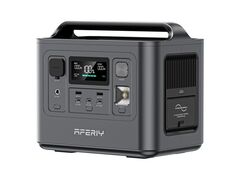
Aferiy P010
See price (5)
512Wh and 800W (1600W surge) in a 6.5kg footprint, backed by a 7-year manufacturer warranty: the Aferiy P010 bets on longevity as much as on compactness.
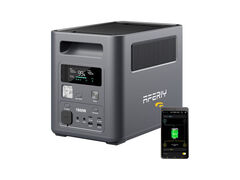
Aferiy P180
See price (12)
With 1024 Wh, 1800 W (up to 3600 W peak), a 90% recharge in 60 minutes and just 11.6 kg, the Aferiy P180 aims for lightweight versatility.
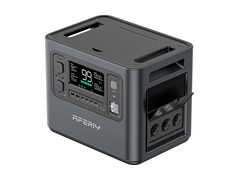
Aferiy P210
See price (7)
With 2048 Wh, 2400 W (up to 4800 W peak), a LiFePO4 battery and a 7-year warranty, the Aferiy P210 targets the best capacity-to-price ratio on the market.
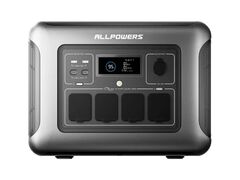
Allpowers R1500 LITE
See price (4)
1056Wh and 1600W (3200W peak), 15ms UPS and WiFi/Bluetooth control: the versatile power station for campervans, home backup or job sites.
Published on 24/08/2026