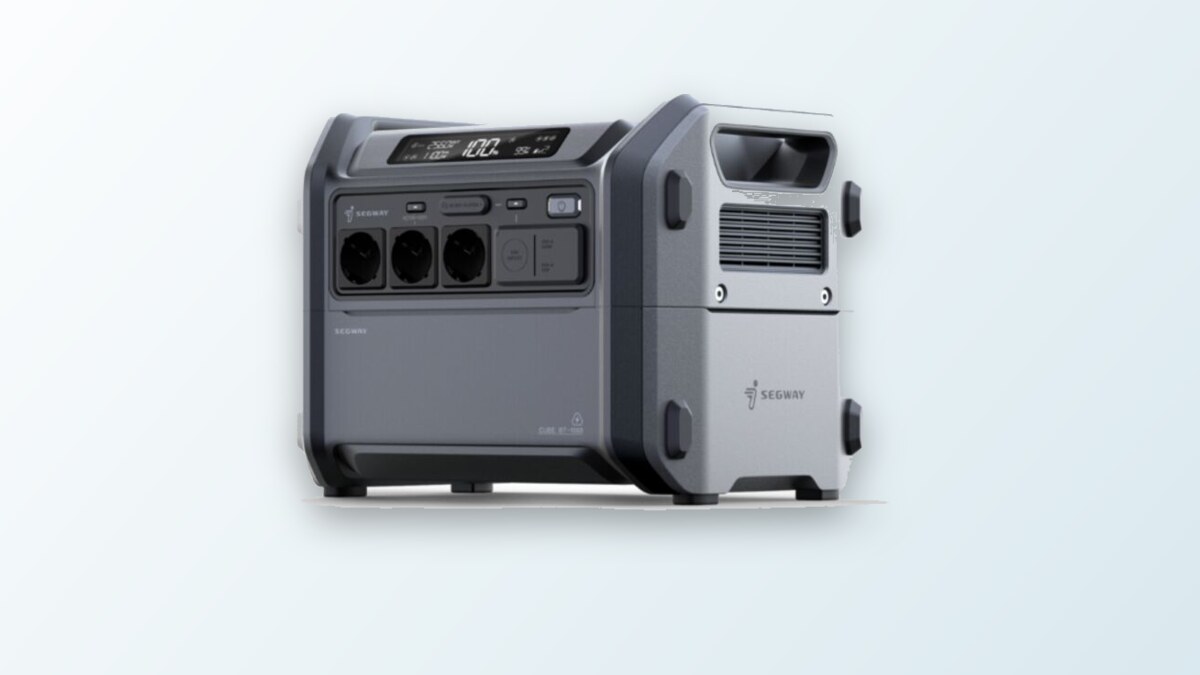
On paper: one of the most generous spec sheets in its category
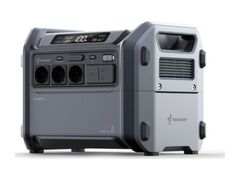
The first power station from a manufacturer better known for its electric scooters and self-balancing vehicles, the Cube 1000 posts figures that put it at the top of its capacity category: 2200 W continuous, up to 4400 W peak, an 800 W solar input and expandability up to 5120 Wh without a single cable between batteries.
The most solid finding in this review: the lack of independent testing
This is the best-established point in the whole review, and it is worth knowing before buying: nearly three years after its launch in late 2023, the Cube 1000 does not appear in any major specialist lab comparison. Its direct rivals of the same capacity, by contrast, appear in them systematically. This is not a question of insufficient time on the market, the product has more than enough track record, nor of the brand lacking visibility in other categories.
This absence proves nothing bad about the product itself, but it deprives the buyer of the usual safety net at this price point: no independent measurement of real-world efficiency, actually delivered power or noise level exists to date to confirm or contradict the official figures.
R-Drive 4400 W mode: what the manufacturer actually covers
R-Drive mode, intended to unlock 4400 W at peak, is explicitly limited by the manufacturer's official documentation to resistive appliances: electric kettles, hair dryers, simple electric ovens. That same documentation explicitly excludes air conditioners, coffee machines, tumble dryers, electric hotplates, large refrigerators, microwave ovens, lawnmowers and washing machines.
Motor-driven tools such as a circular saw, a drill or a compressor appear neither on the list of compatible appliances nor on the list of excluded ones: their start-up draws on the inverter differently from a purely resistive load, and the manufacturer itself recommends testing compatibility before use rather than assuming it. Any use planned specifically for this type of tool is therefore worth checking case by case, rather than taken for granted.
Cable-free expansion: a real strength, uncertain repairability
The modular architecture remains the range's most distinctive feature: up to four add-on batteries attach directly under the main unit, with no cable to handle, taking total capacity up to 5120 Wh. It is one of the simplest solutions on the market for growing an existing station without buying a bigger one outright.
A less visible point of concern involves repairability outside the warranty: the internal components are proprietary, with no standard, easily replaceable parts. A fault occurring after the 5-year warranty expires therefore looks difficult, if not impossible, to repair yourself or through a general repair shop.
A documented failure case on arrival
A dated incident (August 2024) involves a dead cigarette-lighter port (12V) straight out of the box, with a warranty repair that took several months. This is an isolated case, not a failure statistic, but its concrete, dated nature justifies mentioning it, particularly since no other medium-term reliability data is available for this model despite its three years on the market.
Efficiency and noise: two complete unknowns
No reliable measurement exists to date on the capacity actually delivered against the advertised 1024 Wh, nor on the station's noise level when charging or discharging. No noise figure appears in the manufacturer's official documentation or in the user manual, and no reliable alternative figure could be verified.
Price: stable in France, heavily discounted elsewhere
Launched at around 1099 € in Europe in late 2023, the Cube 1000 is now typically found at around 885 €, a drop of about 20% over nearly three years, a modest pace of decline compared with other power stations from the same period. No community deal history is available in France for this specific model, unlike most comparable power stations, which makes it harder to spot a genuinely good deal at the right time.
Against the direct competition
On paper, the Cube 1000 outperforms its most-cited rivals on power and expandability.
| Criterion | Segway Cube 1000 | EcoFlow Delta 2 | Jackery Explorer 1000 v2 | Anker Solix C1000 |
|---|---|---|---|---|
| Capacity | 1024 Wh (expandable to 5120 Wh) | 1024 Wh (expandable to 3040 Wh) | 1070 Wh (not expandable) | 1024 Wh (not expandable) |
| Continuous / peak power | 2200 W / 4400 W | 1800 W / 2700 W | 1500 W / 3000 W | 2000 W / 3000 W |
| Mains recharge 0-100 % | ≈ 1h12 | ≈ 1h20 | ≈ 1h00 | ≈ 49 min |
| Weight | 16.2 kg | 12 kg | 10.8 kg | 11.3 kg |
The three rivals listed here appear regularly in independent lab comparisons; the Cube 1000 outperforms them on paper in power and expandability, but remains the only one of the group not known to have undergone any independent verification.
Home backup, job sites, off-grid: where it makes sense
For home backup, its UPS function protects a home router, a computer or a small fridge from a power cut without a restart, and its modular expansion allows moving from a reserve of a few hours to several days without changing stations, provided the budget follows. On a job site, its 2200 W continuous covers most standard power tools, with the reservation already noted for appliances with a high starting current draw. For an off-grid installation (cabin, chalet, remote site), its generous 800 W solar input and its expandability make it a base capable of growing with the installation rather than constraining it from the outset.
For regular nomadic use, on the other hand, its 16.2 kg and the lack of wheels or a telescopic handle make it better suited to a semi-fixed position than to frequent moves from one place to another.
Who it suits, who it does not
It suits anyone looking for an expandable base with the best expandability on the market, willing to rely on the manufacturer's official figures in the absence of independent verification, and who favours simple resistive appliances for R-Drive mode.
It does not suit anyone who needs to run motor-driven tools with no margin for uncertainty, nor anyone wanting a guarantee of repairability beyond the 5-year official coverage.