
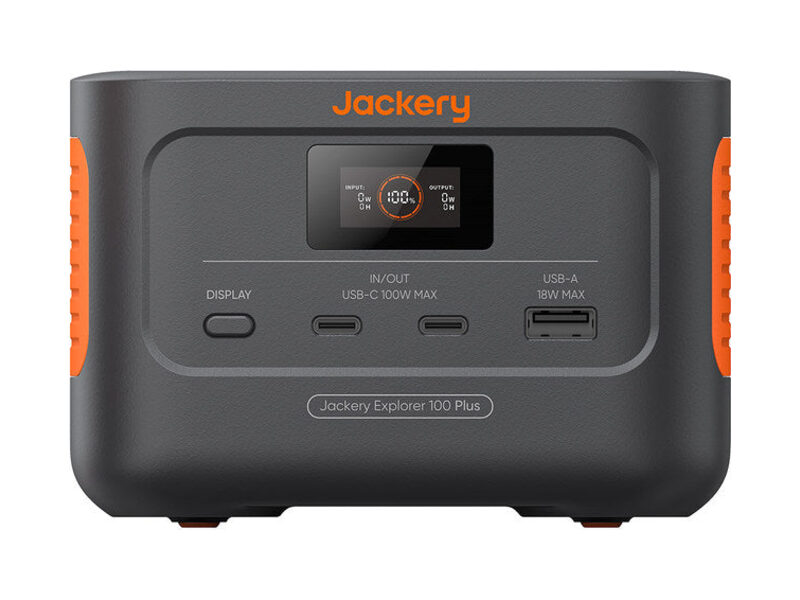
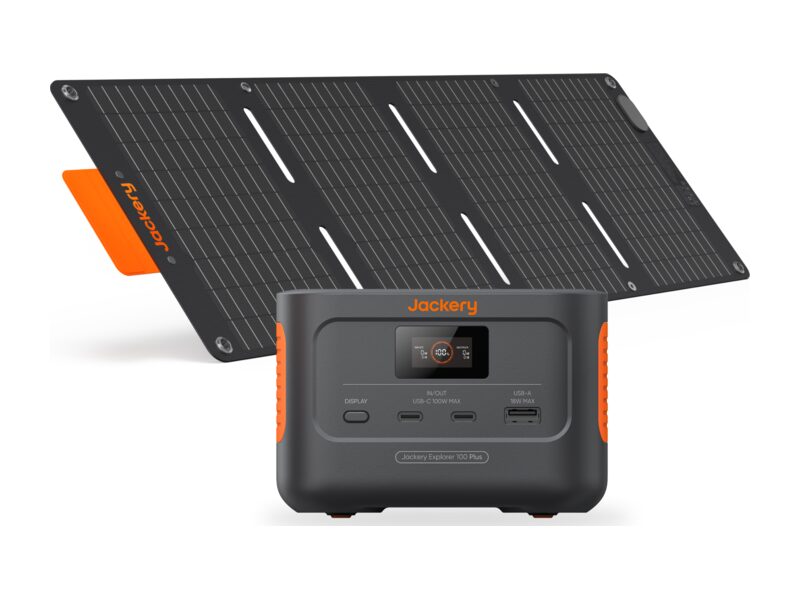
Jackery Explorer 100 Plus
(6 reviews)
99Wh and 128W in a palm-sized body (965 g): the ideal mini station to fly with, charge a laptop and keep your devices running.
Buy at AmazonAs an Amazon Associate I earn from qualifying purchases.
Characteristics
- Capacity: 99.2Wh / 31000mAh (LiFePO4)
- Power: 128W (USB-C 100W In/Out)
- Weight: 965 g, palm-sized
- Recharge: Full in about 2 h
- 99Wh, flight-friendly, in just 965 g
Detailed overview: Jackery Explorer 100 Plus mini power station 99Wh
The Jackery Explorer 100 Plus blurs the line between a big power bank and a power station. With its 99.2Wh (31000mAh) capacity for a featherweight 965 g and a body that fits in the hand, it is the ideal energy reserve for anyone wanting to travel as light as possible without giving up charging demanding devices.
Its master stroke is staying under the 100Wh mark, the threshold most airlines allow in the cabin: you can therefore take it on a plane, which is forbidden for almost all classic power stations. It delivers 128W and focuses on USB: its 100W USB-C port works as both input and output, enough to charge at full speed a laptop, a smartphone, a tablet, a drone or a camera. It also has a second USB-C port and a USB-A port to power several devices at once.
Its LiFePO4 battery is designed for 2000 charge cycles at 80% capacity, far more durable than conventional lithium power banks, and a screen shows the remaining runtime in real time. A full recharge takes about 2 hours from the mains via USB-C.
Do not confuse it with an AC-outlet station, though: the Explorer 100 Plus only offers USB outputs, it cannot power a device on a 230V socket. That is not its purpose. For nomadic use, business travel, hiking or reporting, it offers the best balance of capacity, weight and flight compatibility on the market, in a truly pocketable format.
Full specifications
Detailed characteristics (EAN: 0810105524857)
Battery and capacity
| Rated capacity?Total stored energy in watt-hours. The higher the figure, the longer the runtime. | 99 Wh |
|---|---|
| Expandable capacity?Whether capacity can be increased with add-on batteries. | No |
| Removable battery?The main battery can be removed or replaced by the user. | No |
| Battery chemistry?LiFePO4 (LFP) lasts far longer and is safer than NMC. | LFP (LiFePO4) |
| Charge cycles?Number of full charges before capacity drops to the stated threshold. | 2000 cycles (80 %) |
Recharging
| Max solar input?Maximum solar power accepted at the input (PV panels). | 100 W |
|---|---|
| Accepted solar voltage?Panel voltage range compatible with the solar input. | 18 to 27.2 V |
| Max solar current?Maximum current accepted on the solar input. | 5 A |
| MPPT controllers?Number of independent MPPT solar inputs (yield optimisation). | 1 |
| Vehicle charging (12/24 V)?Can be charged from a vehicle's cigarette-lighter socket. | Yes |
| Pass-through charging?The unit can power devices while charging (pass-through). | Yes |
Ports and connectors
| USB-C ports?Number of USB-C ports and the fastest port's power (laptops, phones). | 2 × 100 W |
|---|---|
| USB-A ports?Number of USB-A ports and maximum power (small devices). | 1 × 18 W |
| 12 V output (car socket)?12 V cigarette-lighter output and its power (coolers, pumps…). | No |
Portability
| Weight?Net weight of the unit, battery included. | 0.965 kg |
|---|---|
| Dimensions (L × W × H)?Overall size of the unit in millimetres. | 126 × 86.5 × 87 mm |
| Form factor?Portable (hand-carried), transportable (heavy), or wheeled. | Portable |
| Wheels?Built-in wheels for moving the unit. | No |
| Telescopic handle?Retractable handle like a wheeled suitcase. | No |
Safety and environment
| Certifications?Standards and approvals obtained (CE, RoHS, UN38.3, UL…). | CE, UL, UN38.3 |
|---|---|
| Discharge temperature?Temperature range in which the unit can deliver power. | -10 to 40 °C |
| Charge temperature?Temperature range in which the unit can be recharged. | 0 to 40 °C |
Backup / UPS
| UPS / EPS mode?Automatic switch to battery on a mains outage (backup). | No |
|---|
Noise and thermal
| Quiet mode?Setting that limits fan noise, often by capping charge power. | No |
|---|---|
| Self-heating battery?Battery pre-heating to allow charging in cold weather. | No |
Display and connectivity
| Display?Type of screen showing power, runtime and alerts. | LCD |
|---|---|
| Bluetooth?Bluetooth link for nearby control. | No |
| Wi-Fi?Wi-Fi connection for remote control and monitoring. | No |
| Mobile app?iOS / Android app to control the unit. | No |
| Local control (no cloud)?Control possible over Bluetooth without an account or internet. | No |
| Solar connector?Connector type of the solar input (XT60, Anderson, MC4…). | USB-C |
Availability and warranty
| Market launch?Date the model first became available on the European market. Useful to place its generation: technology moves fast in this segment, and a device several years old may be at the end of its commercial life. | November 2023 |
|---|---|
| Warranty?Length of the manufacturer's warranty. | 2 years |
User manual / Instructions for use (PDF)
What is this power station best for?
-
Hiking & Bivouac Ideal
At barely 965 g, the weight of a small water bottle, the Explorer 100 Plus is designed for the backpack: it replenishes a headlamp, GPS, smartwatch, phone and action-cam batteries over several days of bivouac, thanks to its two USB-C ports up to 100 W that charge fast, including a laptop. Its 99 Wh of LiFePO4 (2000 cycles) withstand repeated outings, and a solar input up to 100 W recharges it at camp with no outlet at all. A precious asset for distant treks: under 100 Wh, it is allowed in the aircraft cabin, unlike larger stations. A true pocket power hub for light travel.
-
Camping & Tent Ideal
Ultra-light (965 g) and tiny, the Explorer 100 Plus is perfect in the tent for a night or two: its 99 Wh power LED lighting, recharge several smartphones, a portable speaker, an e-reader and even a laptop via its 100 W USB-C ports, without cluttering the bag. Its LiFePO4 chemistry (2000 cycles) withstands years of outings, and a solar input up to 100 W recharges it at camp in good weather. Note, however: with no 230 V outlet, it only runs USB and DC devices, no mains appliances. An ideal companion for the minimalist camper who travels light.
-
Photo & Video Suitable
On a day photo outing, the Explorer 100 Plus slips into the bag (965 g) and replenishes the essentials: its USB-C ports up to 100 W quickly recharge several mirrorless camera batteries, action-cams, drones and mics, plus a laptop for editing. Its 99 Wh cover a day of scouting or a walk, and a solar input up to 100 W extends autonomy outdoors. With no inverter or 230 V outlet, it targets USB devices and cannot run a mains LED panel: for that, an inverter station is required.
-
Remote work Suitable
To work a few hours on a terrace, on the train or on the move, the Explorer 100 Plus handles the essentials via its USB-C ports up to 100 W: it recharges a modern laptop over USB-C, a phone and a tablet, or extends their autonomy over a half-day. At 965 g, it slips into a bag without a second thought. Its 99 Wh suit mobile top-up use; with no 230 V outlet, it only suits USB devices, and its capacity stays modest for a real workday. An ideal stopgap to stay productive away from an outlet.
-
Health & CPAP Suitable
Tiny (965 g), the Explorer 100 Plus slips into cabin baggage and helps out a travel CPAP compatible with 12 V or USB-C, without the heated humidifier: its 99 Wh generally cover one night of therapy on these efficient models. Being under 100 Wh, it goes in the aircraft cabin, a real asset for CPAP travellers. Its capacity remains limited to one night and to devices accepting 12 V or USB, with no 230 V outlet: for a mains CPAP with humidification or several nights in a row, a larger inverter station will be needed.
Our team's recommendations based on the model's capacity, output power and weight.
Compatible solar panels
A selection of photovoltaic panels that suit this station's solar input (up to 27.2V / 100W), best match first.


Comparison
Where does the Jackery Explorer 100 Plus sit among small portable options?
| Criterion | Jackery Explorer 100 Plus | EcoFlow River 3 | Bluetti EB3A |
|---|---|---|---|
| Capacity | 99Wh | 245Wh | 268Wh |
| Power | 128W | 300W | 600W |
| Weight | 965 g | 3.4 kg | 4.6 kg |
| AC outlets | No (USB) | Yes | Yes |
The Jackery Explorer 100 Plus plays in a league of its own: far less capacity than the EcoFlow River 3 or the Bluetti EB3A, but also three to five times lighter (965 g) and flight-friendly. It trades AC outlets for unmatched portability. Choose by use: a pocket USB reserve for travel, or a real small station for camping.
Related video
Video: Jackery Explorer 100 Plus Test and Review! Tiny and Mighty - Published on 02/04/2024
Our tester's review: Christophe Delpuech
The Explorer 100 Plus changed the way we travel light. Under the 100Wh mark, it goes through airport security into the cabin without trouble, and at 965 g you forget it in the camera bag. On the move, its 100W USB-C port charged a MacBook Air at full speed while keeping enough to top up a smartphone twice, exactly what you want from a backup reserve. We like the clear screen showing remaining runtime and the very tidy finish. It obviously does not replace a real station for AC outlets, it only has USB ports, but that is not its purpose. For a nomadic remote worker, a videographer or a traveller who just wants to keep USB-C devices charged without lugging a brick, it is the smartest, most portable solution we have tested.
In-depth review Jackery Explorer 100 Plus: our full review 4.1/5 Read our full review → Capacity and efficiency 4.3 Delivered power 4.2 Recharging 3.6 Ports and control 4.3 Build and endurance 3.6 Noise 4.8Frequently asked questions: Jackery Explorer 100 Plus mini power station 99Wh
Yes. At 99.2Wh, it stays under the 100Wh cabin threshold allowed by most airlines, unlike almost all classic power stations. Always check your airline's rules.
Yes, at full speed. Its 100W USB-C port (input and output) charges a laptop such as a MacBook Air, as well as smartphones, tablets, drones and cameras.
No. The Explorer 100 Plus only has USB outputs (two USB-C and one USB-A). It is designed for nomadic USB devices, not for powering appliances on a wall socket.
About 2 hours for a full charge from the mains via its USB-C port. Its LiFePO4 battery is designed for 2000 charge cycles, a guarantee of a long life.
Need help choosing?
Other products in the "Compact power stations" category
Aferiy P040
£162.12 (11)
With 256Wh, a full mains recharge in just over an hour and a UPS mode under 10ms, the Aferiy P040 protects sensitive devices without breaking the bank.
Allpowers R600
See price (7)
Affordable and backed by a 5-year warranty, the Allpowers R600 delivers 299 Wh, 600 W and a one-hour recharge, plus a built-in wireless charger.
Allpowers S200
See price (6)
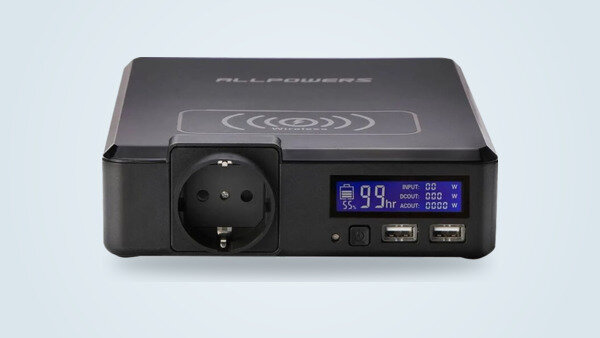
154Wh and 200W in an ultra-compact, book-sized station with built-in wireless charging: the mini power station that goes everywhere without weighing you down.
Allpowers S300 Plus
See price (5)
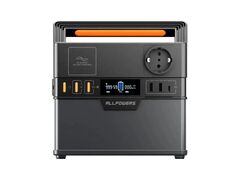
Compact and clever, the Allpowers S300 Plus (288 Wh) combines USB-C 100 W, a wireless charger, an LED torch and app control.
Published on 11/07/2026, updated on 20/07/2026