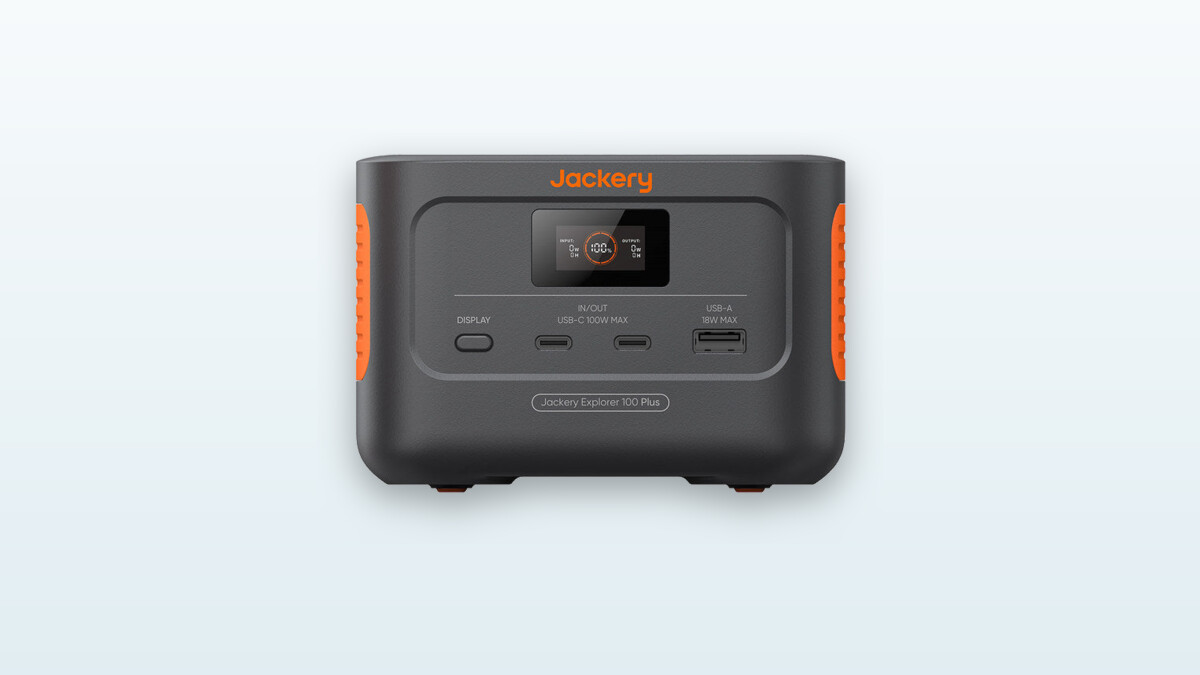
On paper: a mini station built for the bag
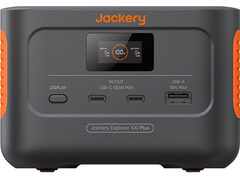
With 99.2 Wh of LiFePO4 capacity (2000 cycles at 80 %) for just 965 g, the Explorer 100 Plus fits in one hand. It delivers up to 128 W combined across three ports: two bidirectional USB-C ports (up to 100 W each, 110 W combined) that work equally well for charging the station or powering a device, plus one USB-A port. No mains socket, no inverter: a deliberate choice to keep this shape and weight.
The airplane argument: true for transport, less and less for use
At 99.2 Wh, the Explorer 100 Plus stays under the 100 Wh threshold accepted in the cabin without formalities under international aviation regulations, with a margin of less than one Wh to spare. This point remains accurate and verifiable: carry-on transport, in this format, stays permitted where larger stations are not.
What has changed is the question of use during the flight itself. Since January 15, 2026, the entire Lufthansa Group (Lufthansa, Swiss, Austrian Airlines, Brussels Airlines, Eurowings) has banned using or recharging an external battery during the flight, regardless of its Wh rating, with storage only allowed on the passenger's person or in the seat pocket, never in the overhead bin. Emirates, United Airlines, Singapore Airlines and Qantas adopted comparable restrictions between late 2025 and 2026, and South Korea and Japan went as far as banning in-flight use at the national level rather than airline by airline. The unit remains easy to carry, then, but less and less usable for recharging a phone during the trip itself on a growing number of airlines.
Real charging time: closer to 2h30 than to 1h48
The USB-C mains charger is not supplied in the box, only a cable. Without a compatible USB-C PD charger (100 W), a full charge can take considerably longer than the one hour and forty-eight minutes used in marketing, up to 4 hours according to the specifications table the manufacturer publishes itself on its own official page, which contradicts its own marketing claim shown on that same page. The full charge, timed in stages, comes out closer to 2h30, with input power climbing quickly then tapering off toward the end of the cycle, a charging behavior typical of LiFePO4 chemistry.
A charging malfunction across several markets
A malfunction affects several markets distinctly: a screen that flickers with nothing plugged in, a unit that refuses to charge, or a charge that stops before reaching 100 % for no apparent reason. This is not a single case confined to one place: the same type of symptom recurs across different markets, which makes it a genuine point of caution rather than an isolated incident, even though the exact scale of the phenomenon remains impossible to quantify precisely.
The battery warranty has a clause worth knowing
The manufacturer's official documentation states that the warranty on the battery cell does not apply if the unit is not fully recharged within 7 days of purchase, then at least once every 6 months. This clause is easy to miss for a purchase intended as a backup reserve that gets put away and left untouched: a buyer who follows that logical instinct can lose battery coverage without knowing it.
CPAP: a full night stays optimistic
CPAP power draw generally ranges from 30 to 90 W depending on the model, and higher still if the heated humidifier is switched on. At that rate, covering a full 7 to 8 hour night with only 99.2 Wh stays optimistic in most cases, except on the most efficient units without a humidifier. A short top-up is realistic, a full night is not always: worth checking case by case against the exact power draw of the model in use.
Careful electronic design
Inside, the advertised capacity matches exactly the five cylindrical LiFePO4 cells identified, with no gap between the marketing figure and what is physically present. The two USB-C ports rely on dedicated bidirectional charging controllers, paired with a charge and discharge protection chip and a battery protection circuit. Having both USB-C ports work bidirectionally, rather than a single shared port, reduces the risk of one connection point carrying the entire load.
Completely silent operation
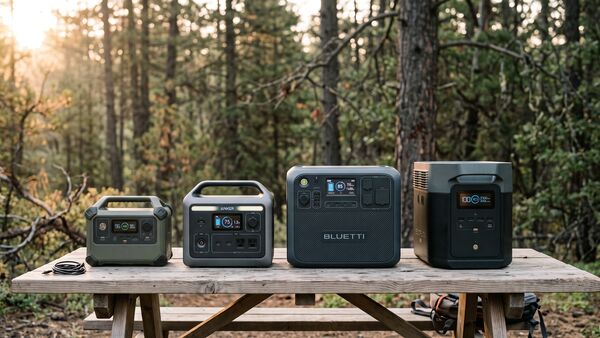
With no fan and no active cooling system, the Explorer 100 Plus runs in complete silence, both while charging and while discharging. This is a genuine advantage over larger stations for nighttime use or in an enclosed space such as a tent or a bedroom.
The price actually charged
The price seen is 79 € at the manufacturer as well as on the main platforms, against a higher list price shown as recently as a short time ago. The product has not been discontinued in France: it remains actively sold and in stock, with the marked-down price reflecting an end-of-generation phase rather than a withdrawal from this market.
Who it suits, who it does not
It suits anyone who wants an ultra-light USB reserve for a laptop, a smartphone or camera gear on the move, on a plane or on a light hike, and who accepts recharging the unit regularly to preserve the warranty.
It does not suit anyone counting on in-flight use to recharge devices during the trip (check with the airline first), anyone who needs a mains socket, or anyone planning to store it untouched as an occasional backup reserve.