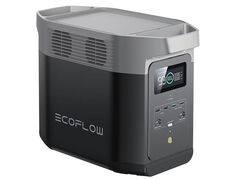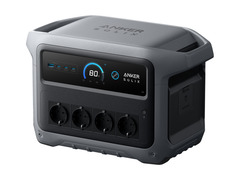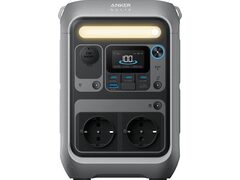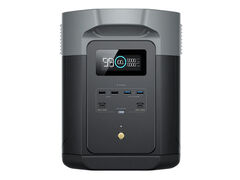

The duel that closes the loop
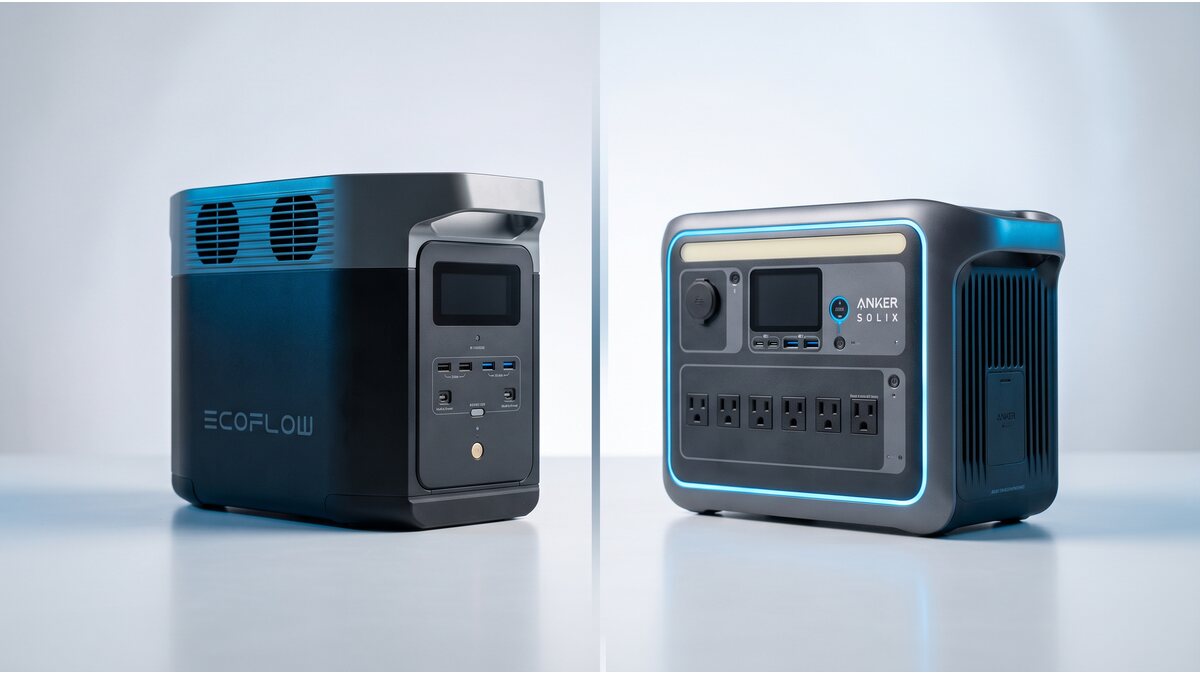
This sixth duel closes our matrix of the four major power station brands. It brings together the two highest-rated brands in our entire catalogue, the ones that finished on top in each of their four previous duels.
EcoFlow was founded in 2017 in Shenzhen by a team of engineers who had previously worked on batteries at DJI, with no ownership link between the two companies. Its first product, the RIVER and its 412 Wh, was funded through an Indiegogo campaign that raised over a million dollars.
Anker was founded in 2011, also in Shenzhen, by Steven Yang, a former Google engineer. The brand first made its name on chargers and power banks, before entering power stations in 2016 with its PowerHouse range, then folding all of its energy business into the Solix name in June 2023.
We tested twenty-two stations, seventeen EcoFlow and five Anker Solix, scoring each on six weighted criteria and measuring the energy actually available at the socket. This duel completes our matrix entirely: after EcoFlow against Bluetti, Anker Solix against Jackery, EcoFlow against Jackery, Bluetti against Jackery and Bluetti against Anker Solix, all six possible match-ups between our four major brands are now published.
4.30 against 4.28: the second-tightest tie of all
Across our six brand comparisons, only one shows a smaller score gap than this: Bluetti and Jackery, by a mere 0.01 point. Here, Anker Solix (4.30) and EcoFlow (4.28) are separated by just 0.02 points, a difference with no statistical meaning.
| Scoring criterion | Anker Solix | EcoFlow | Gap |
|---|---|---|---|
| Capacity and efficiency (25%) | 4.32 | 4.29 | +0.03 |
| Sustained power (25%) | 4.30 | 4.14 | +0.16 |
| Recharging (15%) | 4.42 | 4.36 | +0.06 |
| Connectivity and control (15%) | 4.42 | 4.29 | +0.13 |
| Build quality and endurance (12%) | 4.20 | 4.41 | -0.21 |
| Noise (8%) | 4.25 | 4.35 | -0.10 |
| Overall score | 4.30 | 4.28 | +0.02 |
Anker Solix wins four of six criteria, EcoFlow the other two. But those two wins land precisely on the two criteria where EcoFlow posts its best results elsewhere in our matrix: build quality (4.41, its highest figure against any brand compared so far) and noise (4.35, also its trademark strength). Anker Solix, for its part, shows the same strengths as in its two previous duels: sustained power and connectivity.
This result is no statistical accident: the two brands are pitting their already well-established profiles from the rest of this series against each other, and the outcome tilts only barely toward Anker Solix.
773 EUR against 712 EUR: price does not settle it either
Dividing the price paid by the kilowatt-hour actually delivered, on models of 1,000 Wh and above, Anker Solix comes out at 773 EUR per kWh against 712 EUR for EcoFlow, 8% more.
| Duel | Score gap | Price gap per kWh |
|---|---|---|
| Bluetti vs Jackery | 0.01 | 21% |
| EcoFlow vs Anker Solix | 0.02 | 8% |
| EcoFlow vs Bluetti | 0.16 | 0.1% |
| Anker Solix vs Bluetti | 0.18 | 8% |
| EcoFlow vs Jackery | 0.17 | 21% |
| Anker Solix vs Jackery | 0.19 | 27% |
This table closes the loop on our whole series: in five of our six duels, only one of the two factors, score or price, actually narrows, never both at once. EcoFlow against Anker Solix is the sole exception: a nearly identical score and a price that differs by only 8%. Two brands that resemble each other far more than a first glance would suggest.
Three duels at equal capacity
Brand averages stay theoretical: you buy a model. Here are three direct face-offs at comparable capacity, drawn from our measurements.
Around 288 Wh: Anker Solix sweeps the board
The Anker Solix C300 (229.99 EUR) delivers 240 Wh out of a rated 288 (83.3%) and scores 4.4 out of 5, for 958 EUR per kWh. The EcoFlow River 3 Plus (299 EUR) delivers 231 Wh out of 286 (80.8%) for 4.2, or 1,294 EUR per kWh. The Anker is cheaper, more efficient and higher rated all at once: it wins on all three counts, the only duel in this whole comparison where one brand sweeps this cleanly.
Exactly 1,024 Wh: EcoFlow turns the tables
Here is the counterpoint. The Anker Solix C1000 (800.56 EUR) delivers 920 Wh (89.8%) and scores 4.4 out of 5, for 870 EUR per kWh. The EcoFlow Delta 2 (599 EUR) delivers 930 Wh (90.8%) for the same 4.4 score, or 644 EUR per kWh. Rated capacity is strictly identical on both sides, yet the EcoFlow costs 201 EUR less, delivers 10 Wh more and posts better efficiency. As in nearly all our previous duels, it is around 1,000 Wh that the cheaper brand on average regains the edge, and this time without even sacrificing the score.
Exactly 2,048 Wh: each brand keeps its edge
The Anker Solix C2000 Gen 2 (1,199.99 EUR) delivers 1,850 Wh (90.3%) for 4.4 out of 5, or 649 EUR per kWh. The EcoFlow Delta 2 Max (949 EUR) delivers 1,780 Wh (86.9%) for the same 4.4 score, or 533 EUR per kWh. Rated capacity matches again: the Anker delivers 70 Wh more with better efficiency, the EcoFlow costs 251 EUR less and stays cheaper per kilowatt-hour. Two different strategies, two identical scores.
Efficiency: EcoFlow more scattered, Anker Solix steadier
Across the models whose delivered energy we measured, Anker Solix averages 89.9% efficiency against 87.9% for EcoFlow, a 2 point gap.
The spread, however, tilts clearly toward EcoFlow: its fourteen measured models range from 73.6% (River 2 Max, a 2022 model) to 97.6% (Delta Pro 3), a 24 point amplitude, the widest in our entire matrix. The five Anker Solix range from 83.3% to 94.8%, an 11.5 point range. EcoFlow's catalogue, seventeen models against five for Anker Solix, mixes more product generations, which explains the gap.
The conclusion stands as it has throughout this series: efficiency is chosen model by model. A recent Delta Pro 3 (97.6%) is more efficient than any Anker Solix in our sample; an older River 2 Max (73.6%) is far less so.
What the extreme cases reveal
Beyond the averages, the extremes of our database tell each brand's strategy.
The best score in this whole comparison goes to EcoFlow with the Delta 3 Max Plus (4.6 out of 5), driven by a measured efficiency of 94.7%. It is the best score across our entire four-brand matrix, all duels included. Anker Solix peaks at 4.4 with three models tied (Solix C300, C1000, C2000 Gen 2).
The best energy-to-price ratio also belongs to EcoFlow, with the Delta Pro at 516 EUR per kWh, fifth across all brands in our full database of thirty-six models. The best Anker Solix ratio, the Solix C2000 Gen 2, ranks sixteenth at 649 EUR per kWh.
Longevity. EcoFlow rates up to 6,500 cycles on its Delta Pro, against a 4,000-cycle ceiling at Anker Solix. On warranty, both brands run from 3 to 5 years, with 3-year exceptions on each side: the Trail 200 DC and Trail 300 DC at EcoFlow, the Solix C300X DC at Anker Solix.
Format. EcoFlow covers a far wider spectrum: from 192 Wh (Trail 200 DC) to 4,096 Wh (Delta Pro 3), a 21-fold range across seventeen models. Anker Solix, with five models, stays confined between 288 and 2,048 Wh. Across our entire matrix, EcoFlow is the only one of the four brands to offer such a broad selection.
The match in one table
| Criterion | Anker Solix | EcoFlow |
|---|---|---|
| Stations tested | 5 | 17 |
| Average score | 4.30 / 5 | 4.28 / 5 |
| Measured efficiency | 89.9% | 87.9% |
| Cost per kWh delivered (1,000 Wh and up) | 773 EUR | 712 EUR |
| Rated cycles | 3,000 to 4,000 | 3,000 to 6,500 |
| Warranty | 3 to 5 years | 3 to 5 years |
| Best score achieved | 4.4 (Solix C300, C1000, C2000 Gen 2) | 4.6 (Delta 3 Max Plus) |
| Best cost per kWh | 649 EUR (Solix C2000 Gen 2) | 516 EUR (Delta Pro) |
| Strength | Sustained power, connectivity, consistency | Build quality, quietness, choice of capacities |
| Weakness | Narrower model range, more variable efficiency floor | Efficiency spread across generations |
These averages aggregate our individual tests: every model mentioned has its own detailed review, with the full set of measurements. You will find them all in our complete product reviews, filterable by device type.
Verdict: which one for you?
This last duel closes our matrix on the most nuanced conclusion of the whole series: neither brand truly dominates the other.
Choose EcoFlow around 1,000 Wh, where it beats Anker Solix on price, delivered energy and ties on score, or if you want the widest choice of capacities: from a pocket-sized mini station to a 4 kWh unit, no other brand in our matrix offers such a range. It is also the quieter and, on average, better-built choice.
Choose Anker Solix for entry-level needs, where it beats EcoFlow on all three counts at once, or if sustained power and connectivity matter more than model choice. It is also the steadier choice, with the tightest efficiency spread between its own models across our entire matrix.
With this sixth duel, all six possible match-ups between EcoFlow, Bluetti, Jackery and Anker Solix are now published. You will find all these measurements model by model in our power station selection, taken according to our test methodology.