
Two Shenzhen companies, two different origins
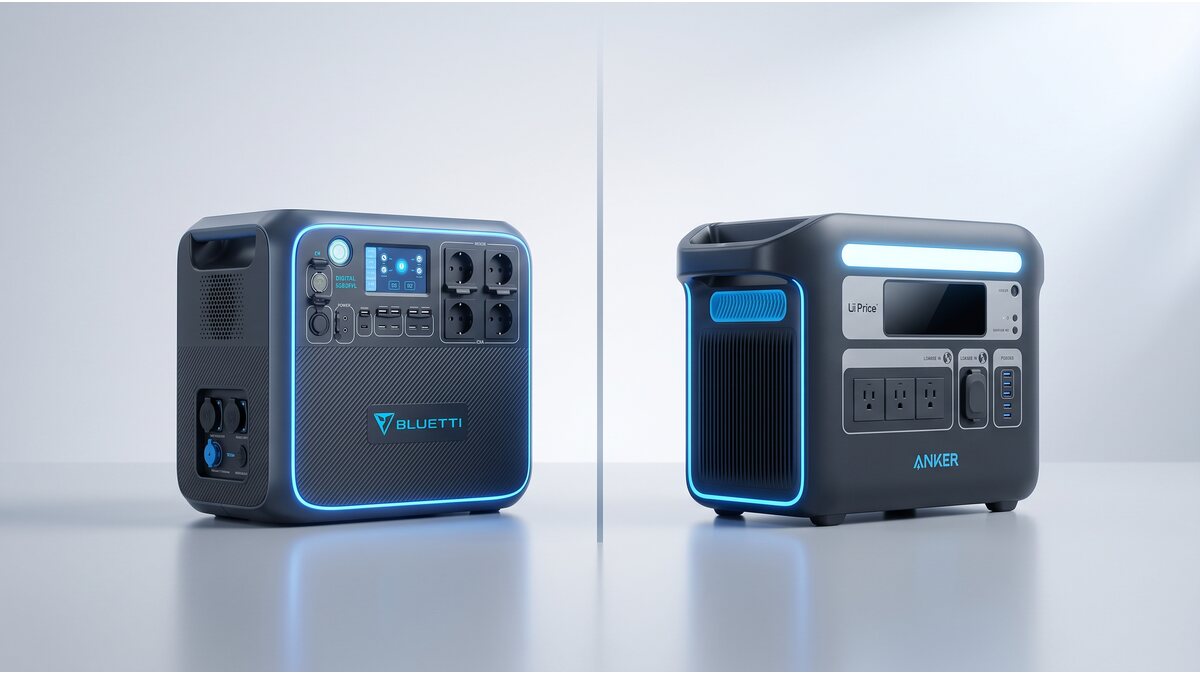
This fifth duel in our series pits together two brands born in the same Chinese city, eight years apart, but in two different trades.
Anker was founded in 2011 in Shenzhen by Steven Yang, a former Google engineer, who started out in chargers and power banks before becoming one of the biggest names in consumer electronics accessories worldwide. The brand entered power stations in 2016 with its PowerHouse range, then folded all of its energy business into the Solix name in June 2023.
Bluetti is the consumer brand of PowerOak, a company active in Shenzhen since the early 2010s, specialised from the start in energy storage rather than consumer electronics. The BLUETTI brand launched officially in 2019, and its flagship AC200 raised nearly 7 million dollars on Indiegogo the following year.
We tested ten stations, five from each brand, scoring each on six weighted criteria and measuring the energy actually available at the socket. This duel is the fifth in our four-brand matrix: after EcoFlow against Bluetti, Anker Solix against Jackery, EcoFlow against Jackery and Bluetti against Jackery, only EcoFlow against Anker Solix will remain to complete the picture entirely.
773 EUR against 711 EUR: a rare, narrow price gap
Dividing the price paid by the kilowatt-hour actually delivered by the station, and restricting the calculation to models of 1,000 Wh and above to compare like with like, Anker Solix comes out at 773 EUR per kWh against 711 EUR for Bluetti, 8% more.
| Brand | Stations tested | Average score | Cost per kWh delivered |
|---|---|---|---|
| Jackery | 7 | 4.11 | 565 EUR |
| Bluetti | 5 | 4.12 | 711 EUR |
| EcoFlow | 17 | 4.28 | 712 EUR |
| Anker Solix | 5 | 4.30 | 773 EUR |
Across our three previous duels involving Jackery, the price gap consistently exceeded 20%. Here, with two brands sitting at the top of our price ranking as well as the top of our quality ranking, the gap drops to 8%, just 62 EUR on a 1,000 Wh top-up. Only our very first duel did better: EcoFlow and Bluetti landed at nearly the same price, a single euro apart. Anker Solix and Bluetti confirm the same pattern observed since that first duel: the more a brand costs per kilowatt-hour, the higher its average score tends to climb, and the two most expensive brands in our catalogue are precisely the two highest rated.
Such a tight price gap makes the quality comparison all the more decisive: it, not the budget, should settle this duel.
What our 10 tests say
Our six weighted criteria deliver an unambiguous verdict.
| Scoring criterion | Anker Solix | Bluetti | Gap |
|---|---|---|---|
| Capacity and efficiency (25%) | 4.32 | 4.32 | 0.00 |
| Sustained power (25%) | 4.30 | 3.98 | +0.32 |
| Recharging (15%) | 4.42 | 4.20 | +0.22 |
| Connectivity and control (15%) | 4.42 | 4.08 | +0.34 |
| Build quality and endurance (12%) | 4.20 | 3.94 | +0.26 |
| Noise (8%) | 4.25 | 3.87 | +0.38 |
| Overall score | 4.30 | 4.12 | +0.18 |
On the heaviest criterion in our scale, capacity and efficiency, the two brands are exactly level: 4.32 each, to the hundredth. It is the only tie in the whole table. On the other five criteria, Anker Solix wins without exception, with a gap exceeding 0.3 points on three of them: connectivity (+0.34), noise (+0.38, the second-widest gap on this criterion in our whole series, behind EcoFlow's +0.48 against Bluetti) and, to a lesser extent, sustained power (+0.32).
In this duel as in the one that pitted it against Jackery, Anker Solix loses none of the six criteria, just one tie here against a clean 6-for-6 sweep there. For Bluetti, it is the reverse: after winning one criterion against EcoFlow and four against Jackery, this is the first time it wins none at all, saved only by the tie on capacity and efficiency.
Three duels at equal capacity
Brand averages stay theoretical: you buy a model. Here are three direct face-offs at comparable capacity, drawn from our measurements.
Around 280 Wh: two worst ratios, almost the same price
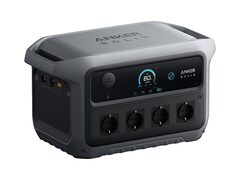
The Anker Solix C300X DC (299 EUR) delivers 272.9 Wh out of a rated 288, an excellent 94.8% efficiency, for 1,096 EUR per kWh, the worst ratio in the entire Anker range. The Bluetti EB3A (249 EUR) delivers only 225 Wh out of 268 (84%), for 1,107 EUR per kWh, the worst ratio in the entire Bluetti range. Each brand's weakest model lands at almost the same cost per kilowatt-hour, 11 EUR apart, despite an eleven-point efficiency gap in the Anker's favour.
This entry-level face-off sums up the whole picture: at this price point, Anker Solix's technical edge does not even come with a premium, it is thrown in for free.
Around 1,000 Wh: Bluetti holds its ground on price
The Anker Solix C1000 (1,024 Wh, 800.56 EUR) delivers 920 Wh (89.8%) and scores 4.4 out of 5, for 870 EUR per kWh. The Bluetti Elite 100 V2 (1,024 Wh, 699 EUR) delivers 910 Wh (88.9%) for 4.1, or 768 EUR per kWh, 102 EUR less for just 10 Wh less delivered and a 0.3 point efficiency shortfall. On this segment, as in our previous duels around 1,000 Wh, it is the brand cheaper on average that regains the edge on raw price.
The score gap (4.4 against 4.1), however, remains the widest of our three duels at this capacity level, driven in particular by the Anker's connectivity and build quality.
Around 2,050 Wh: Bluetti delivers more, Anker stays cheaper
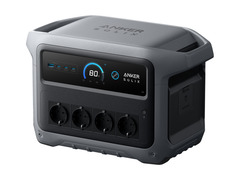
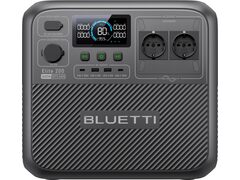
The Anker Solix C2000 Gen 2 (2,048 Wh, 1,199.99 EUR) delivers 1,850 Wh (90.3%) for 649 EUR per kWh, and scores 4.4 out of 5. The Bluetti Elite 200 V2 (2,074 Wh, 1,299 EUR) delivers 1,910 Wh (92.1%), 60 Wh more and the best measured efficiency in the entire Bluetti range, for 680 EUR per kWh and a score of 4.2.
This is the closest-fought of the three duels: the Bluetti delivers more energy and posts better efficiency, but the Anker stays cheaper per kilowatt-hour and slightly higher rated. Neither station clearly wins across the board.
Efficiency: Anker Solix slightly ahead, at little cost
Across the models whose delivered energy we measured, Anker Solix averages 89.9% efficiency against 88.2% for Bluetti, a modest 1.7 point gap.
The spread, however, tilts clearly toward Bluetti: its five models range from 84% (EB3A) to 92.1% (Elite 200 V2), an 8.1 point amplitude. The five Anker Solix range from 83.3% (Solix C300) to 94.8% (Solix C300X DC), an 11.5 point range, the widest in this whole comparison. Curiously, the brand with the higher average efficiency also carries the wider spread: Anker Solix holds both the best AND the worst individual result of this duel.
Once again, the conclusion holds: efficiency depends above all on the specific model, not the logo on the front panel.
What the extreme cases reveal
Beyond the averages, the extremes of our database tell each brand's strategy.
The best score in this duel goes to Anker Solix, with three models tied at the top (Solix C300, C1000 and C2000 Gen 2, all at 4.4 out of 5). Bluetti peaks at 4.2 with the AC180 and the Elite 200 V2, a ceiling three Anker Solix models already clear.
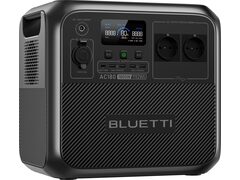
The best energy-to-price ratio between the two brands, however, still belongs to Bluetti: its AC180 (552 EUR per kWh) ranks eighth across all brands in our full database of thirty-six models, while the best Anker Solix ratio, the Solix C2000 Gen 2 (649 EUR per kWh), ranks only sixteenth. Anker Solix wins on quality, Bluetti remains this duel's benchmark for pure value.
Longevity. Bluetti rates up to 6,000 cycles on its Elite 200 V2, against a 4,000-cycle ceiling at Anker Solix. On warranty, Anker Solix runs from 3 to 5 years (the 3-year exception being the Solix C300X DC), Bluetti from 2 to 5 years (the 2-year exception being the EB3A). On this specific point, the quality hierarchy flips: Bluetti holds the edge.
Format. Neither Anker Solix nor Bluetti offers, in our sample, anything equivalent to the Jackery Explorer 100 Plus under 100 Wh: both brands position their entry point above 250 Wh, a segment they leave to others.
The match in one table
| Criterion | Anker Solix | Bluetti |
|---|---|---|
| Stations tested | 5 | 5 |
| Average score | 4.30 / 5 | 4.12 / 5 |
| Measured efficiency | 89.9% | 88.2% |
| Cost per kWh delivered (1,000 Wh and up) | 773 EUR | 711 EUR |
| Rated cycles | 3,000 to 4,000 | 2,500 to 6,000 |
| Warranty | 3 to 5 years | 2 to 5 years |
| Best score achieved | 4.4 (Solix C300, C1000, C2000 Gen 2) | 4.2 (AC180 and Elite 200 V2) |
| Best cost per kWh | 649 EUR (Solix C2000 Gen 2) | 552 EUR (AC180) |
| Strength | Connectivity, build quality, recharging, quietness | Rated cycles, pure value for money |
| Weakness | Slightly higher price, cycles capped at 4,000 | Noise, sustained power behind |
These averages aggregate our individual tests: every model mentioned has its own detailed review, with the full set of measurements. You will find them all in our complete product reviews, filterable by device type.
Verdict: which one for you?
This duel brings together two things no other in our matrix has combined: a brand that wins almost everything, and a minimal premium for it.
Choose Anker Solix in the vast majority of cases: better score on five of six criteria, better build quality, richer connectivity, noticeably quieter operation, for barely 8% more per kilowatt-hour than a Bluetti. It is the safer choice if you would rather not compare model by model.
Choose Bluetti if your budget is tight around 1,000 Wh, where its Elite 100 V2 costs 102 EUR less than the Anker equivalent for a minor performance difference, or if you are specifically after the AC180, the best energy-to-price ratio of the two brands and one of the best in our entire catalogue. It is also worth considering if rated cycle endurance matters more than day-to-day comfort.
This duel very nearly closes the loop on our four-brand matrix: only EcoFlow against Anker Solix remains to be published. You will find all these measurements model by model in our power station selection, taken according to our test methodology.