Four brands dominate: why these two?
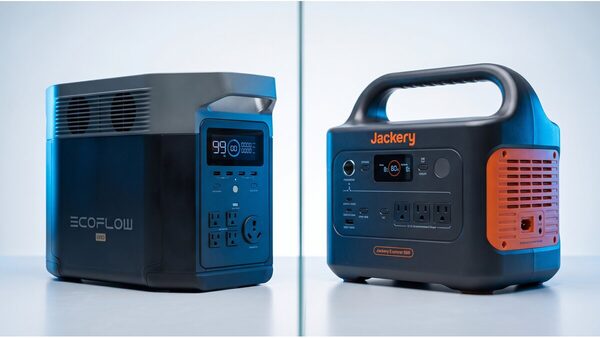
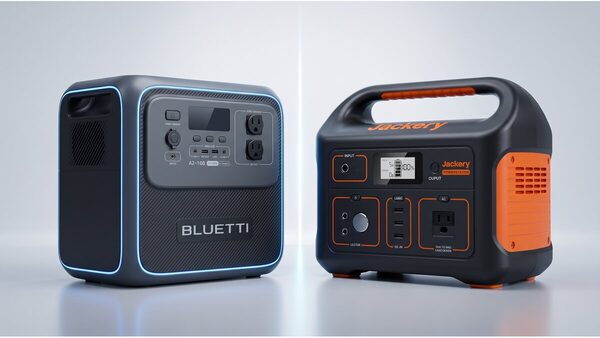
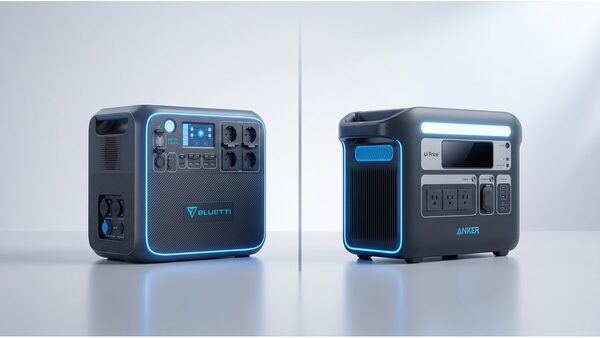
The European portable power station market is held by four brands, not two: Jackery, which pioneered the category in 2016 and claims more than seven million units sold, EcoFlow and Bluetti, which followed with the broadest ranges, and Anker Solix, a brand created in 2023 that continues the PowerHouse range launched back in 2016 by a consumer electronics heavyweight.
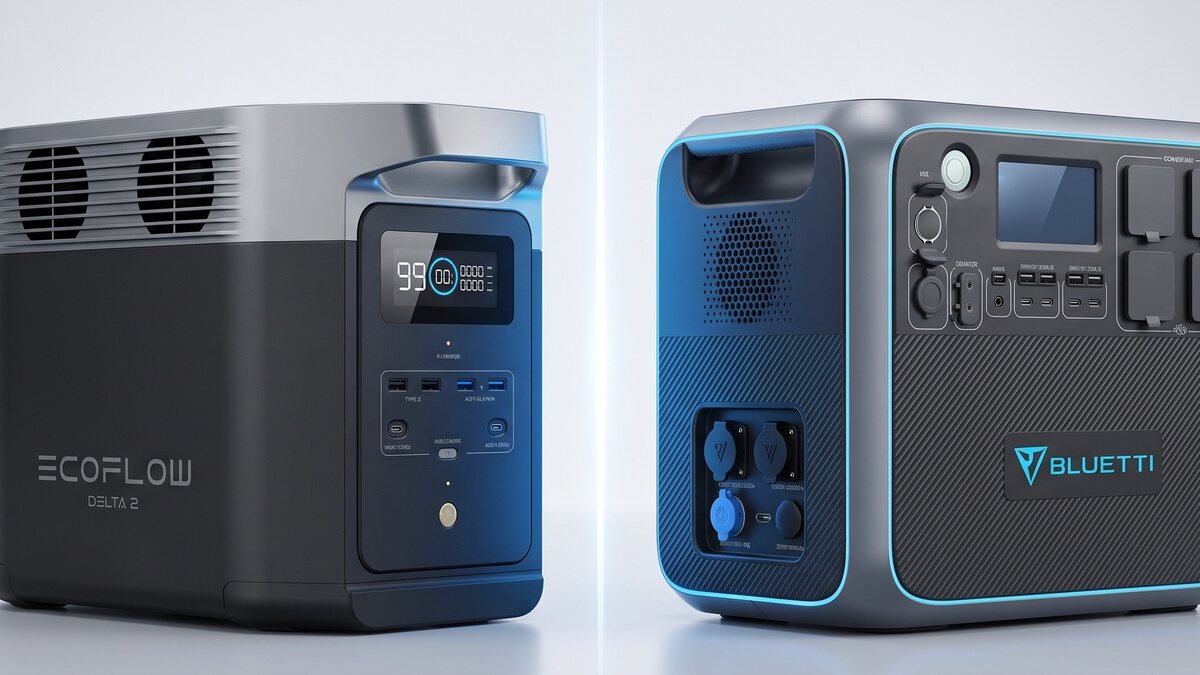
If we pit EcoFlow against Bluetti here, it is because no other pair is this hard to separate: the same LiFePO4 cells, the same fast charging, the same app control, and catalogues that answer each other model for model. On paper, the spec sheets look alike to the point of being interchangeable.
To settle the question with something other than marketing claims, we rely on our own measurements. We tested 22 power stations from these two brands, 17 EcoFlow and 5 Bluetti, scoring each one on six weighted criteria and, above all, measuring the energy actually available at the output. That last figure is the one that counts: a 2,000 Wh station that delivers only 1,750 Wh will not get you through the same evening as one that returns 1,900 Wh.
This duel is part of our complete matrix of the four major power station brands: all six possible match-ups between EcoFlow, Bluetti, Jackery and Anker Solix are published, including EcoFlow against Jackery, Bluetti against Jackery and EcoFlow against Anker Solix.
Price and efficiency: a perfect tie
This is the most surprising result of the comparison, and it sweeps away the received idea that one brand is clearly cheaper than the other.
On measured efficiency, meaning the share of the stored energy that actually reaches your devices, the two brands are level: 87.9% for EcoFlow, 88.2% for Bluetti. A gap of 0.3 point, well inside the spread between models from a single brand.
On the real cost of energy, the verdict is even clearer. Dividing the price by the kilowatt-hour actually delivered, and limiting the comparison to models of 1,000 Wh and above so as to compare like with like, we get €712 per kWh for EcoFlow against €711 for Bluetti. One euro apart. At equivalent capacity, the two brands sell energy at exactly the same price.
Beware of reading the overall averages too quickly: include the small models and Bluetti looks cheaper (€790 against €846 per kWh). That is only an effect of catalogue composition, EcoFlow having many compact stations under test, which are more expensive per kilowatt-hour by nature. On the segments that genuinely overlap, the tie is complete.
| Brand | Stations tested | Average score | Cost per kWh delivered |
|---|---|---|---|
| Jackery | 7 | 4.11 | €565 |
| Bluetti | 5 | 4.12 | €711 |
| EcoFlow | 17 | 4.28 | €712 |
| Anker Solix | 5 | 4.30 | €773 |
Placed alongside the four major brands on the market, EcoFlow and Bluetti sit on exactly the same price tier, within one euro of each other, with a clear score advantage for EcoFlow. Jackery remains the cheapest per kilowatt-hour, Anker Solix the highest rated and the most expensive.
What our 22 tests say
If price and efficiency do not separate the two brands, our six scoring criteria do draw a clear hierarchy.
| Scoring criterion | EcoFlow | Bluetti | Gap |
|---|---|---|---|
| Capacity and efficiency (25%) | 4.29 | 4.32 | -0.03 |
| Sustained power (25%) | 4.14 | 3.98 | +0.16 |
| Charging (15%) | 4.36 | 4.20 | +0.16 |
| Connectivity and control (15%) | 4.29 | 4.08 | +0.21 |
| Build quality and endurance (12%) | 4.41 | 3.94 | +0.47 |
| Noise (8%) | 4.35 | 3.87 | +0.48 |
| Overall score | 4.28 | 4.12 | +0.16 |
Two lessons. First, Bluetti comes out ahead on the heaviest criterion in the scale, capacity and efficiency (4.32 against 4.29), which confirms the measurements in the previous section. Second, EcoFlow takes back the advantage on all the others, with two markedly wider gaps: build quality (+0.47) and noise (+0.48).
That last point deserves a pause. A power station often serves indoors, at night, as a backup or for working from home. The noise level of the fan then becomes a major comfort criterion, and this is where EcoFlow looks after its recent models best. Conversely, that criterion weighs only 8% in our scale: it is not enough to overturn a match.
Four head-to-heads at equal capacity
Brand averages remain theoretical: you buy a model. Here are four direct face-offs, at comparable capacity, drawn from our tests.
Around 1,000 Wh: advantage EcoFlow
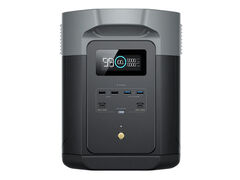
The EcoFlow Delta 2 (1,024 Wh, €599) delivers 930 Wh, or 90.8% efficiency, and earns 4.4 out of 5. The Bluetti Elite 100 V2 (1,024 Wh, €699) delivers 910 Wh (88.9%) and obtains 4.1. EcoFlow is €100 cheaper for slightly more usable energy. Bluetti claws back two concrete details: 11.5 kg against 12 kg, and a full recharge in 70 minutes against 80.
The best value in this comparison: the Bluetti AC180
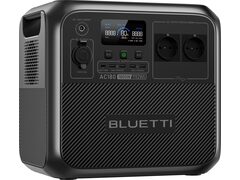
The Bluetti AC180 (1,152 Wh, €569) delivers 1,030 Wh, which works out at €552 per usable kWh, the best ratio in our whole comparison. Facing it, the EcoFlow Delta 3 Classic (1,024 Wh, €549) posts a better efficiency (92.8% against 89.4%) for €578 per kWh. Both obtain 4.2. A draw on the score, advantage Bluetti on the amount of energy carried for the price.
2,048 Wh: the most spectacular gap
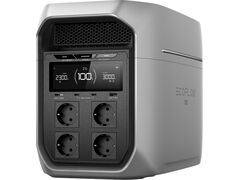
Here is the most telling duel of the comparison. The EcoFlow Delta 2 Max and the Bluetti AC200L claim the same capacity (2,048 Wh) and deliver exactly the same measured energy: 1,780 Wh, or 86.9% efficiency for both. But the first costs €949 and the second €1,499, a €550 gap for an identical energy service (€533 per kWh against €842). The AC200L keeps one argument, its output power, but the price gap is hard to justify.
The premium pair at €1,299: settled on weight
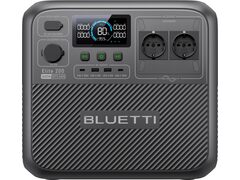
At a strictly identical price, the EcoFlow Delta 3 Max (2,048 Wh, 1,900 Wh delivered, 92.8%, scored 4.3) faces the Bluetti Elite 200 V2 (2,074 Wh, 1,910 Wh delivered, 92.1%, scored 4.2). Cost per kWh: €684 against €680. Impossible to separate them on energy. The real criterion becomes weight: 20.3 kg against 24.2 kg, nearly 4 kg apart, decisive if the station has to move often.
Durability: cycles, warranty and the European framework
A power station is written off over years: the claimed longevity counts as much as day-one performance. Both brands use LiFePO4, the most enduring chemistry on the consumer market, but their commitments differ.
On the models tested, EcoFlow claims 3,000 to 6,500 cycles depending on the range, against 2,500 to 6,000 at Bluetti. The top of the bracket is comparable, but the floor is higher at EcoFlow: even on its least enduring model, the brand guarantees more cycles. Same logic on the manufacturer warranty: 3 to 5 years at EcoFlow, 2 to 5 years at Bluetti. Here again the best models are level, but EcoFlow's entry-level range protects you better.
This point is gaining importance with the European battery regulation, which is progressively tightening the requirements on durability, information and recyclability for batteries placed on the Union market. A high cycle count and a long warranty are no longer merely commercial arguments: they are becoming objective purchase criteria for a product meant to last a decade.
The extremes of our test database
Beyond the averages, the edge cases say a lot about a brand.
The best score of our comparison goes to EcoFlow, with the Delta 3 Max Plus and its 4.6 out of 5, carried by a measured efficiency of 94.7%. The absolute efficiency record is EcoFlow's as well: the Delta Pro 3 delivers 3,999 Wh out of the 4,096 claimed, that is 97.6%, a remarkable figure for this type of device.
But EcoFlow also posts the worst efficiency in the database: the older River 2 Max tops out at 73.6%, nearly 14 points below the brand average. A useful reminder that inside a single catalogue, generations are not equal.
At Bluetti, the lowest score is that of the EB3A (3.8 out of 5), an older compact model whose measured efficiency of 84.0% and noise level no longer stand comparison with recent compacts. None of the five Bluetti units tested, on the other hand, drops below 84% efficiency, which speaks to honourable consistency.
The match in one table
| Criterion | EcoFlow | Bluetti |
|---|---|---|
| Stations tested | 17 | 5 |
| Average score | 4.28 / 5 | 4.12 / 5 |
| Measured efficiency | 87.9% | 88.2% |
| Cost per usable kWh (from 1,000 Wh) | €712 | €711 |
| Claimed cycles | 3,000 to 6,500 | 2,500 to 6,000 |
| Warranty | 3 to 5 years | 2 to 5 years |
| Best score obtained | 4.6 (Delta 3 Max Plus) | 4.3 (AC200L) |
| Best cost per kWh | €533 (Delta 2 Max) | €552 (AC180) |
| Strength | Build quality, quiet running, charging | Energy carried for the price |
| Weakness | Gaps between generations | Noise and finish lagging behind |
These averages aggregate our individual tests: every model mentioned has its own detailed review, with the full set of measurements. You will find them all in our complete product reviews, filterable by device type.
Verdict: which one for you?
The match is far tighter than the catalogues would have you believe. On what matters most, the energy actually available and its price, the two brands are level. The choice is therefore made on use.
Choose EcoFlow if the station is to live indoors: home working, household backup, bedroom. Quiet running and build quality are its two clearest advantages in our measurements, and the brand offers the widest range, from the backpack model to the 4 kWh station. It is also the safer choice at entry level, where its warranty and its minimum cycle count are higher.
Choose Bluetti if you are after a large capacity on a contained budget, and noise matters little to you: garage, workshop, worksite, camping. The AC180 remains the best energy-to-price ratio we have measured, across both brands in this duel.
In every case, compare on the watt-hour delivered, not on the claimed capacity. Our duel between the Delta 2 Max and the AC200L shows it well: two stations can deliver exactly the same energy with €550 between them. You will find these measurements on every model in our power station selection, taken according to our test methodology.