
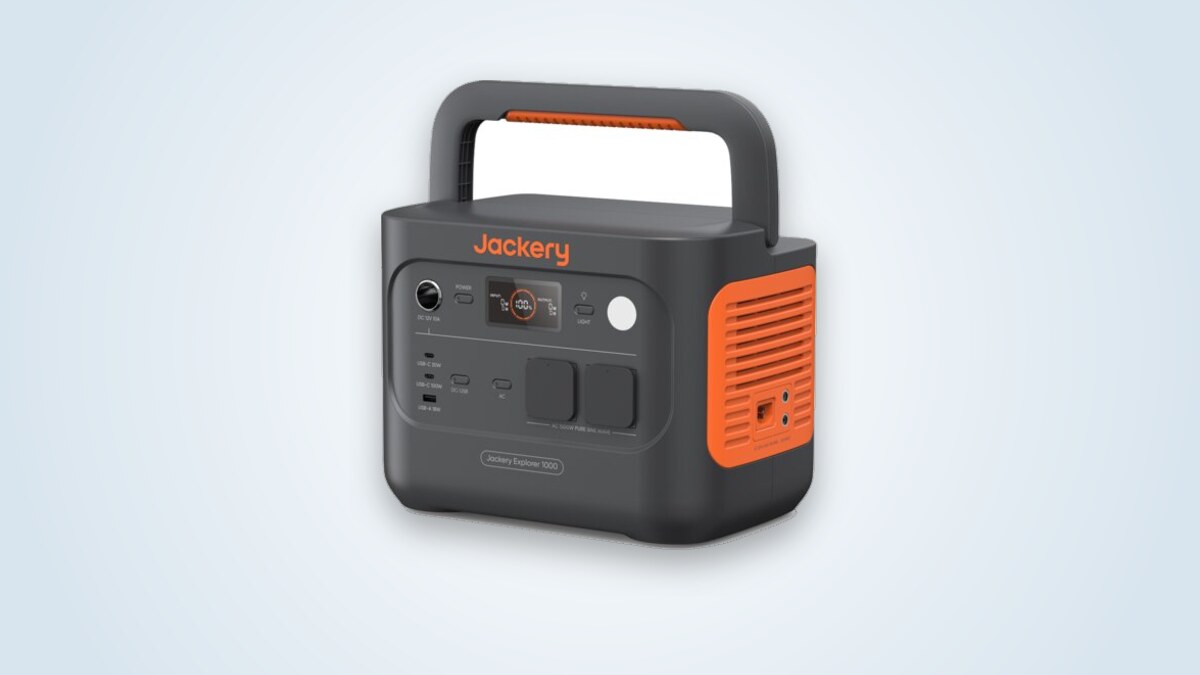
What the 1070 Wh are really worth
The 1070 Wh printed on the case is a cell capacity, measured in direct current. It is not what comes out of the sockets. Between the pack and the appliance sits an inverter that takes its cut, and that cut is never won back.
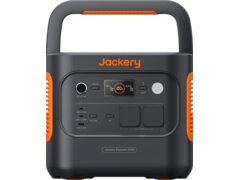
On this Explorer 1000 v2, the energy actually available comes to 943 Wh, or 88 % of the figure claimed. The 127 Wh gap is nothing unusual: it matches what the conversion costs, plus the reserve the system keeps at the bottom of the range.
Those 88 % put the Jackery in the middle of its category, no better and no worse. The 1 kWh stations return between 84 and 91 % of their nominal capacity at a 230 V socket. It therefore sits in the middle of that range.
Where do the 127 Wh missing between the capacity claimed and the energy recovered go? Almost entirely into the conversion. The pack works in direct current; a 230 V socket demands alternating current, at a stable frequency and with a clean waveform. The electronics that build that wave dissipate part of the energy as heat, which the fan gives away. On top of that comes a bottom reserve the system never releases: emptying lithium cells completely cuts their life short, and every serious manufacturer keeps a few per cent in hand.
One practical consequence follows. If the appliance to be powered accepts USB-C, it is better plugged in there than into the 230 V socket through its original charger. That avoids two successive conversions, the inverter first and then the mains adapter, and recovers appreciably more energy from the same pack. On a laptop powered all day long, the difference runs into tens of watt hours.
Where the missing 127 Wh go
Between the 1070 Wh printed on the case and the 943 Wh that come out of the sockets, 127 Wh disappear. They are neither stolen nor miscounted: they are consumed by the journey.
The pack works in direct current. A 230 V socket demands alternating current, at a stable frequency and with a clean waveform. The electronics that build that wave dissipate part of the energy as heat, which the fan gives away as soon as the power climbs. On top of that comes a bottom reserve the system never releases: emptying lithium cells completely cuts their life short, and every serious manufacturer keeps a few per cent in hand.
This mechanism has a second consequence, less widely understood. The inverter draws a roughly fixed amount of power as soon as it is switched on, whatever is asked of it. Running a 5 W night light through a whole night therefore costs proportionally far more than boiling water: in the first case the electronics take their toll for twelve hours for 60 Wh of useful energy; in the second, for three minutes for the same amount.
Hence a simple rule, valid across the whole category: this station is made for clear-cut and relatively short loads, not for watching over small appliances for days on end. For that last use, the USB-C outputs bypass the inverter and change the equation completely.
The flaw that disqualifies it, and how to avoid it
This station has two DC charging inputs, in the DC8020 format. One takes a solar panel, the other the car lighter cable. Each accepts up to 60 V, and 400 W on the solar side.
The two DC inputs are not isolated from each other. The voltage present on one ends up on the other. In concrete terms: plugging a solar panel into one and the car lighter cable into the other amounts to applying up to 60 V to the 12 V circuit of the vehicle. That is five times the voltage that circuit is designed for.
The most awkward part is not the flaw itself, it is the silence around it. The manual describes solar charging, describes car lighter charging, explicitly allows solar and mains to be combined, and nowhere forbids the dangerous combination. The unit carries no marking at that point. A user who sees two inputs and two available sources has no reason to be wary.
This configuration is nothing exotic. It is exactly that of a motorhome parked at a rest area: panel unfolded on the roof, station plugged into the 12 V socket of the vehicle to top it up. The flaw therefore lands precisely on the use this station is sold for.
Among eight stations of the same size, six keep their two DC inputs isolated from each other. Two do not, this one and one other, for that same reason. It is therefore not a constraint of the format, it is a design choice the competition does not make.
The exact reach of the complaint has to be measured, without exaggerating it or playing it down. The flaw concerns neither the battery, nor the inverter, nor the safety of the unit itself: nothing points to a risk of fire, overheating or pack failure, and the station behaves perfectly in every other use. What is at stake is what can happen to the vehicle plugged in at the other end of the cable. The potential damage sits with the third party, not in the station.
It is worth measuring, too, what this flaw does not say about the rest of the machine. Handling, features and equipment are all of a good standard, and one of those three comes close to excellent. It is a single point, disqualifying by nature, that tips everything over. In other words: this is not a poor product with one more flaw, it is a very good product that a single flaw costs everything.
A last word on what followed. More than a year after this point became known, no recall or buy-back campaign has been launched on this model, which is still sold normally. The flaw has therefore not been treated as an imminent danger, which fits its nature: it only shows up in one precise combination, and anyone who knows about it will never be exposed to it.
Fifty minutes, 1400 W, and a mode for the night
Charging is where this Jackery is at its most convincing. Three modes coexist, and the choice is made in the app.
In emergency mode, a full charge takes about fifty minutes. In standard mode, the station draws 1400 W from the mains. In quiet mode it settles for 260 W and spreads the charge over the night, which is exactly what you want in a van or under a tent.
The one-to-five ratio between the fast mode and the quiet mode is wider than on most rivals, and it is a genuine quality in use: you no longer have to choose between charging and sleeping.
Two reservations. Emergency mode leans hard on the fan, and pays for it in noise. And neither the car lighter cable nor the solar cable is supplied: both mobile charging methods assume an extra purchase, on a product sold at 999 € at the manufacturer price.
That absence deserves a pause, because it is counter-intuitive. The station is sold for mobility, its central argument is weight, and most of its marketing shows outdoor scenes. Yet the two ways of charging it away from a socket, the sun and the vehicle, each call for an accessory missing from the box. A buyer unpacking the parcel on a Friday evening before setting off finds that it can only be charged from the mains.
A word on charging strategy, which is not obvious. A LiFePO4 battery does not suffer from being left half full, unlike lead acid; it does, however, appreciate not spending its life at 100 %. On a station stored between two weekends, the gentlest routine is to leave it around 60 %, then fill it the day before departure, in quiet mode if there is no rush. Setting the input power in the app makes that discipline easy to keep.
47 dB running, 30 dB when asked politely
In operation, the fan settles around 47 dB. On quiet charging it drops to about 30 dB, a level that blends into the background of a still room.
These two figures describe what the unit actually does, not what the brochure promises, which is why they are higher than the number usually put forward for this model. A 1 kWh station shifting 1400 W of conversion heat cannot stay inaudible, whoever builds it.
What counts more than the peak is how long it lasts. The 47 dB only last as long as a fast charge or a heavy demand. On a moderate discharge, typically a few tens of watts for lighting and a computer, the fan stays idle and the unit is forgotten.
Neither figure comes with a measuring distance, which rules out comparing them term for term with the values quoted elsewhere, almost always given at one metre. The same fan can read 47 or 37 dB depending on whether the metre is held at 30 cm or at one metre. So hold on to the gap between the two modes, which is real and significant, rather than to the absolute value.
In practice, in a camper van, the only awkward moment is the fast charge. It is dealt with by setting the slow charge and starting it before going to bed: at 260 W the charge spreads over part of the night and the noise drops below the level that wakes people.
10.8 kg: the least spectacular argument and the most useful
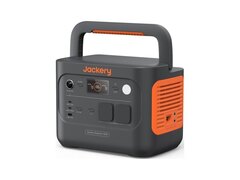
On paper, 10.8 kg is nothing to dream about. In practice, it is the lightest station of its capacity, and the gap with its direct competition is measured in kilos, not grams. The 1 kWh models routinely go past 12 kg, and some approach 15.
Two to four kilos is the difference between an object you lift out of the boot without thinking and an object you hesitate to move. On a product whose whole point rests on its mobility, that is a front-rank criterion, widely underestimated at the moment of purchase and rediscovered on the first weekend.
The usable density put forward here, 87 Wh per kilo if you stick to the 943 Wh genuinely available, remains one of the best on the market for LiFePO4 chemistry. That chemistry is heavier than conventional lithium-ion at equal capacity, but it takes 4,000 cycles instead of a few hundred.
As a backup: twenty milliseconds, and what that covers
The station can work as a UPS: plugged in between the mains and an appliance, it takes over in around twenty milliseconds during an outage.
That figure is enough for a desktop computer, a router, a monitor, an alarm system or an aquarium. It is not enough for everything: some sensitive equipment, notably servers with redundant power supplies and medical devices, requires a switchover under ten milliseconds. For those uses, an online UPS is needed, not a portable station.
With 943 Wh available, a router and a laptop, about fifty watts, last around fifteen hours. A domestic fridge, whose compressor only runs part of the time, gets through a whole night without difficulty.
400 W of solar, two inputs, a single controller
The solar input accepts 400 W, split across the two DC8020 connectors, in an 11 to 60 V range. A single MPPT controller handles the lot.
That architecture has a practical consequence worth knowing before ordering panels: with a single controller, two panels of different orientation or exposure drag each other down. The yield lines up with the one that is worse exposed. Two identical panels, laid out together, are always preferable to two scattered panels.
Each input takes one 100 or 200 W panel directly. Plugging two 100 W panels into a single input calls for a coupling connector, sold separately. And, as we have seen, the second input must never take the car lighter cable while the first is receiving solar.
How long for a full charge in the sun? The 400 W quoted is a peak figure, obtained with panels perpendicular to the sun, under a clear sky and at moderate temperature. In real conditions, over a summer day and with panels laid flat, you recover more like 55 to 70 % of that value over time. So with 400 W of panels, count on four to six hours of good sun for a full charge, and a good deal more in the shoulder seasons.
The 11 to 60 V input range deserves attention when choosing panels. It rules out small 5 V USB panels, which simply will not start the charge, and it caps at 60 V, which forbids putting more than two panels of standard voltage in series. Rigid roof modules, often quoted at 36 V open circuit, can therefore be wired two at a time at most.
The app convinces, the screen much less
Control runs over Bluetooth up close and Wi-Fi at a distance. The app is one of the best executed parts of the product: it shows incoming and outgoing power, the state of charge, and above all it sets the charging speed. It is where you switch between emergency mode, standard mode and quiet mode.
That setting is not a gimmick. It governs the noise, the heat given off and, over time, the ageing of the pack: a battery charged gently lasts longer than a battery routinely stuffed at full power. Entrusting that parameter to a well-made app is a better choice than freezing it in the hardware.
The built-in screen, on the other hand, disappoints. It is small, and its contrast copes badly with direct light, exactly the situation in which a portable station is used. It gives the essentials, watts in, watts out and percentage remaining, but you often have to get close to read it. On that point, several rivals do markedly better with wider and brighter displays.
A light is built into the case. It is the kind of addition you look down on in the shop and use every evening at camp.
Cycles, warranty, and what to expect from them
The chemistry chosen is lithium iron phosphate, quoted for 4,000 cycles before dropping to 70 % of the initial capacity. The manufacturer warranty runs for five years.
Those 4,000 cycles deserve translating. At one full cycle a week, already heavy use for a private owner, the quoted limit is only reached after seventy-five years. Put another way, in that use it is not the number of cycles that will decide the end of the unit life, but the calendar ageing of the cells and the availability of parts. The figure only becomes the limiting factor for daily use, in a camper van lived in year-round or as a permanent solar top-up: about eleven years in that case.
The charging range is the real point of vigilance with this chemistry, and it is not specific to this model. Below 0 °C, the battery refuses to charge, without anything being broken: it is a protection. Lithium iron phosphate degrades very quickly if it is charged at freezing point, and the system prefers to block. In concrete terms, a station left in a boot over winter will have to be brought inside and warmed up before it accepts any current at all. Discharging, on the other hand, remains possible down to -10 °C.
No recurring production defect stands out on this model, and no recall campaign has been launched since it came to market. The only documented complaint remains the charging inputs, which is a matter of design and not of manufacture.
Against the other 1 kWh stations
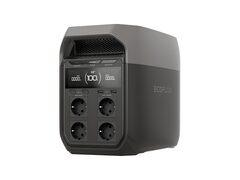
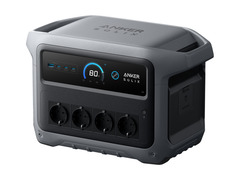
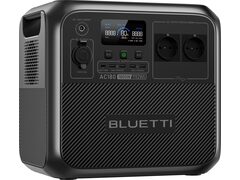
The portable kilowatt hour market is the most contested of the category. At comparable prices, the differences no longer lie in capacity, which is equivalent everywhere, but in four points: efficiency, weight, the number of sockets and expandability.
| Criterion | Explorer 1000 v2 | The 1 kWh competition |
|---|---|---|
| Energy delivered | 943 Wh out of 1070 | 860 to 930 Wh depending on the model |
| Weight | 10.8 kg | 12 to 15 kg |
| 230 V sockets | 2 | 3 to 4 most often |
| Battery expansion | None | Common, up to 5 kWh |
| Quoted cycles | 4,000 at 70 % | 3,000 to 4,000 depending on the chemistry |
The trade-off is therefore clear. This Jackery wins on efficiency and on weight, two criteria that count in mobility. It loses on connectivity and on expandability, two criteria that count in domestic or semi-fixed use.
The complete absence of expansion deserves a word. On a station in this class, being able to add a battery later is what saves you from buying the whole thing again the day your needs grow. Here, capacity is fixed for life. It is a deliberate choice in the service of lightness, but it is a choice that boxes you in.
Who it suits, and who it does not
It suits anyone who carries their station often and asks it to give back the maximum of the energy stored: van trips, outdoor shoots, weekends under canvas, light home backup. On that ground, its 10.8 kg and its 943 usable Wh put it ahead of just about everything sold at the same price.
It does not suit anyone who wants to run several 230 V appliances at once, anyone planning to grow their capacity later, or anyone counting on combining solar charging and vehicle charging without thinking about it. That last point is not a matter of preference, it is a precaution to respect.
Then there is the price. Listed at 999 € at the manufacturer price, it is in practice negotiated well below that. It is at that level of price, and not at the official one, that it becomes recommendable.