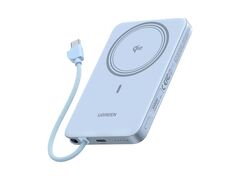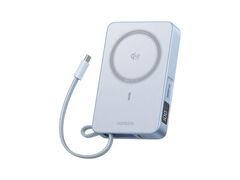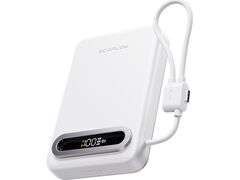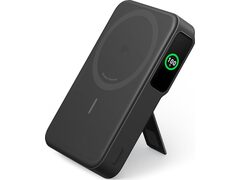
What the 10,000 mAh is really worth: 39.2 Wh on the label, 31 to 34 Wh delivered
The 10,000 mAh figure says little on its own. Here the pack pairs two 5,000 mAh ATL lithium-ion cells in series: 5Ah at 7.84V (3.92V per cell), or 39.2 Wh on the label. The advertised 10,000 mAh is that same pack counted at 3.92V per cell. The 37 Wh seen on other 10,000 mAh power banks comes from a 3.7V convention; here the real cell voltage is higher, and so is the nominal energy. The manufacturer also states a capacity of 6,250 mAh at 5V, or 31.25 Wh: that is the label figure at the USB output, more cautious than reality.
Discharged at 5V, the pack delivers about 34 Wh over a little more than two hours, or 87% of the nominal energy. Through the Qi2 wireless coil it supplies about 31 Wh, averaging 14.9W for over two hours, or 79%. The eight points between the two routes belong to the wireless link, which loses energy as heat between the power bank's coil and the phone's. On recharge, it takes about 43.5 Wh to fill it: a full cycle, charge then discharge at 5V, therefore returns about 78% of the energy put in.
That energy shows up on a phone. The recharge score adds up the battery percentages a power bank supplies wirelessly to a flat iPhone 16 Pro until it is empty: here 100%, then 100%, then 8%, or 208%. It is the best result in the 10,000 mAh class, level with the liquid-cooled MagFlow Pro and ahead of the Anker MagGo 2 Pro (199%) and a 15W EcoFlow Rapid (190%); the class average sits around 165%. On an iPhone 16 Pro Max, which has a bigger battery, you get about 1.25 charges wirelessly and 1.75 by cable. Ugreen quotes 1.6 charges of an iPhone 17 Pro Max: a little over one and a half, not two.
Qi2 15W: the power is held, the speed depends on temperature
The MagFlow Air's wireless side is a certified 15W Qi2 with N52 magnets, for iPhone 12 and newer. The advertised power is really delivered: about 15W at the coil (14.1V, 1.06A), 14.9W on average over more than two hours of discharge, with no negotiated power limit. It will not go higher: Qi2.2 at 25W needs a different power bank, which Ugreen sells under another model number.
What this means on an iPhone depends on the thermal state of the phone and the room. In 30 minutes, charging supplies 21 to 45% of battery depending on temperature, with about a third as the usual figure; in a temperate room, a flat iPhone 17 Pro fills up in 1 hour 45 minutes to 1 hour 50 minutes. In strong heat, the same exercise stretches a lot: 0 to 50% in 1 hour 54 minutes in the middle of a heatwave, against 28 minutes by cable.
| Phone and range | Built-in cable | Qi2 wireless |
|---|---|---|
| iPhone 17 Pro, 0 to 50% | 28 min | 1 h 54 min (heatwave) |
| iPhone 16, 25 to 80% | 41 min | 1 h 45 min |
Heat explains the gap. The wireless route returns 79% of the nominal energy against 87% by wired 5V, and the difference is lost as heat, trapped between a 13.9 mm aluminium body and the back of the phone. Depending on location and duration, the surface of the power bank runs from 34 °C at steady state to 38 °C at the coil, 40 °C after 30 minutes charging an iPhone and 44 °C at the peak; the phone sits around 37.5 °C. Thermal protection then cuts power, which stretches the charge. The 21 to 45% spread in 30 minutes is therefore not a manufacturing flaw: it is the signature of a very thin body with no room to shed heat.
Two things improve the result: a thin or MagSafe-compatible case, which does not separate the coils, and a phone that is not already hot. On an Android phone without Qi2, charging falls to 5 to 7.5W with no magnetic grip: the MagFlow Air only makes sense wirelessly for an iPhone or a Qi2-certified Android.
The 30W cable: the real fast route, with a thermal limit
The built-in braided cable and the USB-C port each advertise 30W in both directions. In practice, output reaches about 28W, in steps of 5, 9, 12 and 15V, with no 20V step. On an iPhone 17 Pro, charging from 0 to 50% takes 28 minutes. On an iPhone 16, 25 to 80% takes 41 minutes at up to 19W, the phone's limit; on a Galaxy S24+, 31 minutes at up to 27W. The cable is therefore the real fast route, and wireless a comfort extra.
The lack of a 20V step rules out laptops that require it: they are only served at reduced power, if they accept the charge at all. A ThinkPad in sleep, drawing a little over 24W, is powered for 90 minutes until the power bank is empty, and gains a little over 50% of its own battery: enough to bail a laptop out, not to run it continuously.
At continuous maximum power, thermal protection steps in. On a discharge at 15V and 2A, or 30W, the output holds for about 30 minutes, then the power bank drops itself to 5V; if 15V is requested again, the current settles around 1.33A, or roughly 20W. A phone, which stops drawing 30W well before that, never sees it; a laptop or a console that is powered for a long time does. A 13.9 mm body simply has nowhere to shed 30W over a long run.
On input, the power bank accepts 30W, peaking at about 28W, and recharges in 1 hour 50 minutes to 2 hours 10 minutes with a 30W charger: it needs about 43.5 Wh over 1 hour 57 minutes, with power tapering at the end. The case stays around 38 °C during this recharge. No charger is included in the box, only the power bank and its manual.
Three outputs, one 15W budget
Ugreen advertises three devices at once: one on the wireless pad, one on the built-in cable, one on the USB-C port. That is accurate, but the power is shared. A single device gets 30W (cable or port) or 15W (wireless). As soon as two outputs are in use, the total falls to 15W: 10W on the cable and 5W wirelessly, or 7.5W on each of the two USB-C ports. With all three outputs, the two USB-C ports share 10W (5V, 2A) and wireless keeps 5W.
Two behaviours complete the picture. As soon as wired charging starts, wireless charging is switched off by default: you have to press the button to bring it back, and it then drops to 5 to 7.5W while a device is charging on a port. As for the advertised pass-through charging, it works but the input is throttled: when the power bank powers a phone, it only takes in 13W (phone on wireless) or 17W (phone on cable) instead of about 28W, which roughly doubles its recharge time.
The built-in cable and the lanyard: handy, short, permanent
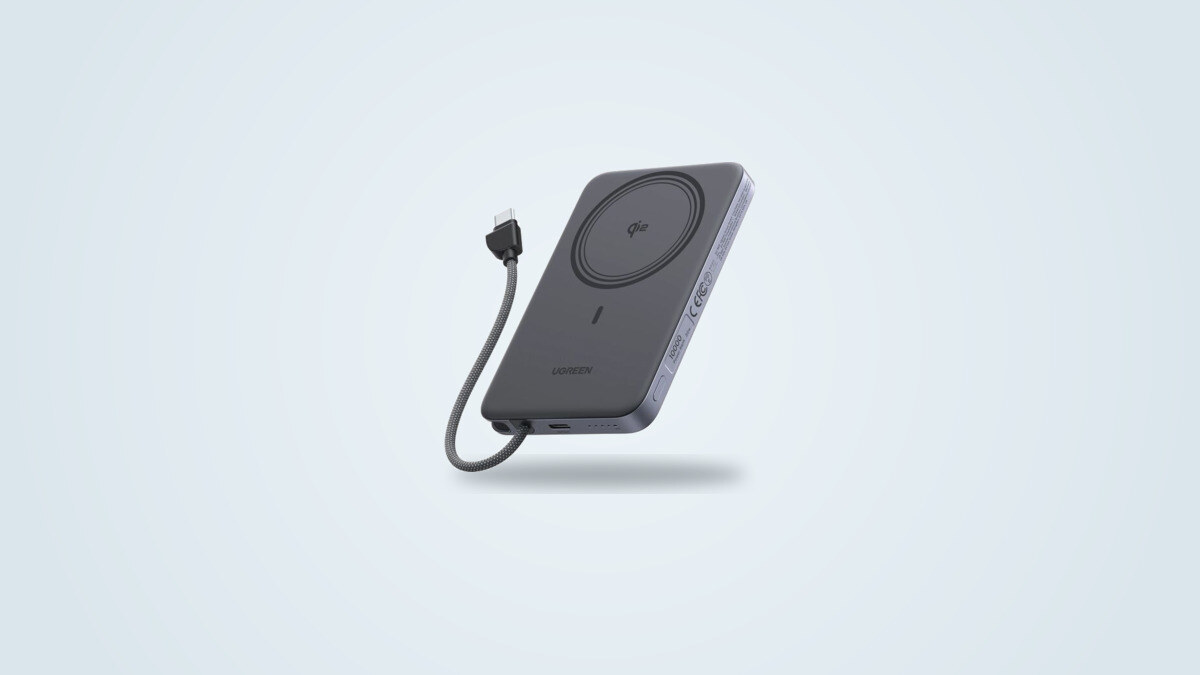
The 18.5 cm braided USB-C cable leaves one corner of the body and clips into a notch in the same corner: it then forms a loop that works as a lanyard or a handle, and Ugreen advertises more than 10,000 bends. It replaces the cable you always forget, and it also recharges the power bank. A second USB-C port takes another cable, for example a Lightning cable for an iPhone 14 or older, which the USB-C plug of the built-in cable cannot charge.
Its limits come from the same design. At 18.5 cm, it is enough to link the power bank sitting against a phone, not to keep the power bank in a pocket while the phone is in hand, nor to reach a distant socket. It can be neither removed nor replaced: if it gets damaged, the power bank loses its cable and only the USB-C port remains. The plug is thick and firm, enough to make you hesitate to pull on it, and it gets in the way under some rugged cases.
The product came out in April 2026: no recurring cable failure is known to date, but the track record is only six months. On a power bank of this format, a fixed cable is the most likely wear point, well before the cells.
13.9 mm and 213 g: the thinnest 10,000 mAh magnetic power bank in the catalogue
The MagFlow Air is 111.5 × 69.8 × 13.9 mm and weighs 213 g. Among the 10,000 mAh magnetic power banks in the catalogue, none is thinner: the EcoFlow Rapid Mag is 15.95 mm, the Baseus PicoGo 16 mm, the Anker MagGo 2 Pro 17.8 mm, the Anker MagGo 10K 19.8 mm and the Ugreen MagFlow 10000mAh 21 mm. Only the Baseus is lighter (198 g); the same brand's MagFlow 10000mAh weighs 41 g more (254 g).
That thinness has a cost in use. On a standard-size iPhone, the body overhangs slightly below the phone; the proportions are better on a longer Max model. And 213 g is the weight of a phone: the pair exceeds 400 g with a Pro Max iPhone, which you feel in the hand during a call or a video. In a jeans or jacket pocket, however, the power bank slips in without distorting the garment, and that is what it is asked to do.
Which MagFlow Air to choose: 10,000 mAh, 5,000 mAh or Qi2.2
The MagFlow Air name covers several models that should not be confused. The one on this page is the 10,000 mAh Qi2 15W, model PB570, sold in Space Gray (75982), Lunar White (75983) and Starlight Blue (65839).
| Criterion | MagFlow Air 10000 (PB570, this review) | MagFlow Air 5000 (PB580) | MagFlow 10000mAh (25W) |
|---|---|---|---|
| Capacity | 10,000 mAh (39.2 Wh) | 5,000 mAh (19.6 Wh) | 10,000 mAh |
| Wireless | Qi2 15W | Qi2 15W | Qi2 25W |
| Wired output | 30W | 20W | 30W |
| Thickness | 13.9 mm | 8.6 mm | 21 mm |
| Weight | 213 g | 127 g | 254 g |
| Built-in cable | Yes, 18.5 cm | No, separate cable | Yes |
The 5,000 mAh version drops to 8.6 mm and 127 g, but it offers half the energy and no built-in cable: it is a choice of extreme thinness, not a smaller 10,000 mAh. A Qi2.2 25W version of this format exists under another model number, at a higher price: it is not covered by this review. The liquid-cooled MagFlow Pro is yet another product. To avoid a mistake, look for PB570 or one of the three colour codes.
Build, safety and reliability: a good record, a short track record
The body combines an aluminium alloy back and frame with a soft-coated magnetic face that does not scratch the phone. The pack relies on high-density ATL cells; Ugreen advertises 13 layers of protection and a thermal regulation system called Thermal Guard. The magnets are N52 grade: the hold stays firm in a pocket or a bag, including when you pull the phone out. A thin or MagSafe-compatible case preserves that grip; a thick case moves the coils apart and slows charging.
On safety, the 39.2 Wh stays under the 100 Wh limit allowed in an aircraft cabin: the power bank travels in hand luggage, never in the hold. No recall or incident is known for this model. The warranty is two years.
The record is therefore good, with a reserve of caution rather than a flaw: the product dates from April 2026, and the endurance of both the cells and the fixed cable is not yet established by use. The point to watch is the fixed cable, with its thick plug.
Against the other 10,000 mAh magnetic power banks
The closest rivals are the other 10,000 mAh magnetic power banks in the catalogue. The MagFlow Air wins on thinness and delivered energy, and gives way on wireless speed.
| Criterion | MagFlow Air | Ugreen MagFlow 10000 | EcoFlow Rapid Mag | Anker MagGo 10K | Baseus PicoGo AM52 |
|---|---|---|---|---|---|
| Wireless | Qi2 15W | Qi2 25W | Qi2.2 25W | Qi2 15W | Qi2.2 25W |
| Built-in cable | Yes, 30W | Yes, 30W | Yes, 36W | No | Yes, 45W |
| Thickness | 13.9 mm | 21 mm | 15.95 mm | 19.8 mm | 16 mm |
| Weight | 213 g | 254 g | 230 g | 250 g | 198 g |
Against the same brand's MagFlow 10000mAh, the Air gives up 10W of wireless but gains 7.1 mm and 41 g. Against the EcoFlow Rapid Mag, it is 2 mm thinner and 17 g lighter, but stays at 15W wireless instead of 25W and has no stand. Against the Anker MagGo 10K, it keeps the same 15W, with 5.9 mm and 37 g less, and above all a built-in cable that the Anker lacks; the Anker's score is 170%. Against the Baseus PicoGo AM52 (182%), the Baseus charges faster wirelessly (on a compatible phone) and by cable, but it is 2.1 mm thicker and the Air delivers more energy.
At catalogue prices on 9 October 2026, the MagFlow Air (£46.99) costs about £8 less than the MagFlow 10000mAh (£54.72): you gain in thinness and runtime what you lose in wireless speed.
Who it suits, who it does not
It suits anyone with an iPhone 12 or newer, preferably a Max model, who wants a power bank to forget in a pocket, with no cable to carry and a real energy reserve: up to two full charges of an iPhone 16 Pro. The 30W cable covers emergencies, the pad covers comfort top-ups on a commute or in front of a screen. It also suits anyone travelling light, since 39.2 Wh goes into the cabin without formalities.
It does not suit anyone who wants the fastest wireless charging (that takes a Qi2.2 25W model), anyone who regularly charges several devices at once (15W shared), anyone who wants to power a laptop that needs 20V or work for long at 30W, or anyone who wants a long or replaceable cable.