
Pro Max, Pro, Pro Max AC: three products under one name
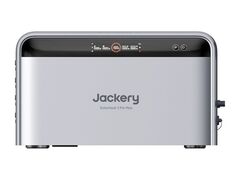
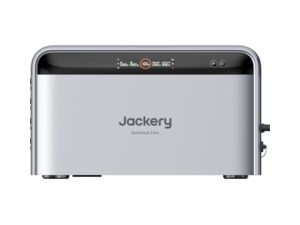
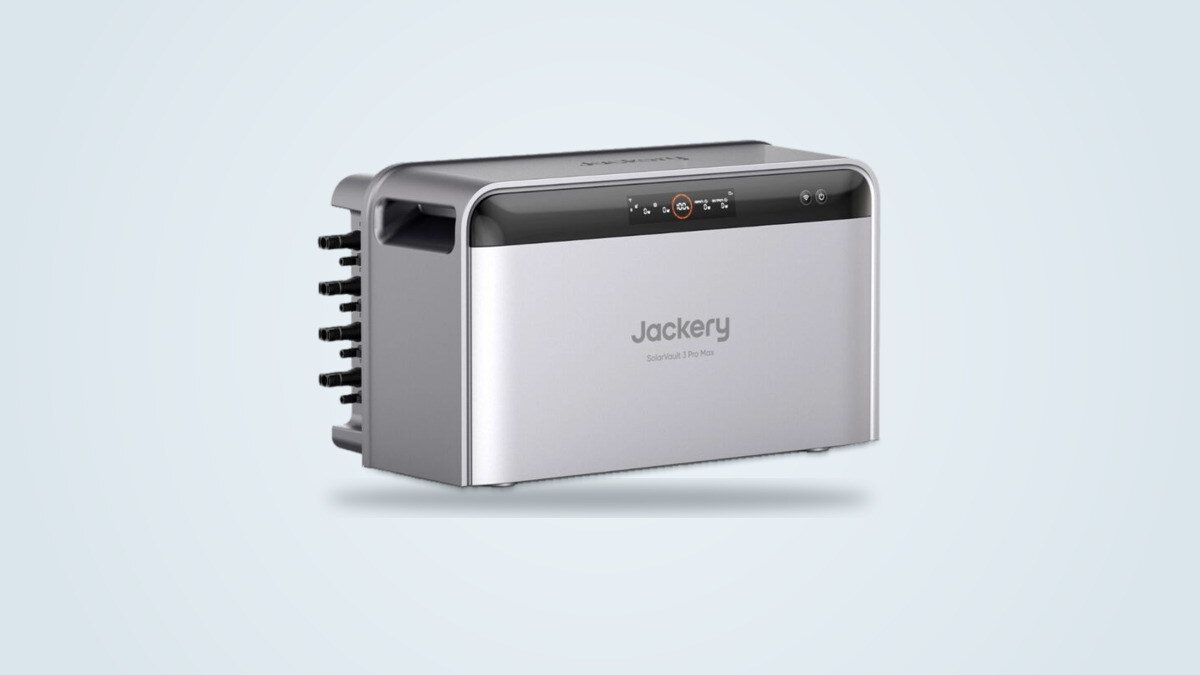
The SolarVault 3 Pro Max (model JS3-2500PMA-GY) is the top hybrid version of Jackery's SolarVault 3 range, launched in March 2026: a 2520 Wh LiFePO4 battery, a bidirectional inverter and four MPPT trackers combined in a 26.5 kg IP65 casing. Two neighbouring products carry an almost identical name without being the same thing: the SolarVault 3 Pro (JS3-2500PA-GY), whose AC output tops out at 1200 W, and the Pro Max AC (JS3-2500PMB-GY), which keeps the 2500 W output but drops the solar inputs so that it connects behind an existing installation.
| Criterion | SolarVault 3 Pro Max | SolarVault 3 Pro |
|---|---|---|
| Model number | JS3-2500PMA-GY | JS3-2500PA-GY |
| Maximum AC output | 2500 W | 1200 W |
| Grid bypass | 3680 W | 2300 W |
| Off-grid backup | 1600 W alone, 2500 W with an additional battery | 1200 W |
| Direct solar input | 4000 W, 4 MPPT | 4000 W, 4 MPPT |
| Weight | 26.5 kg | 25.5 kg |
Charging directly from the panels is the only hardware difference between the Pro Max and the Pro Max AC: the Pro Max makes sense for anyone wiring panels without a microinverter, the Pro Max AC for anyone who already has an installation. The figures below hold for the hybrid version; where one comes from the AC version, whose power electronics are identical, the variant is stated.
The 2500 W: a promise to read with its conditions
The 2500 W figure heads the Pro Max's spec sheet, but it covers several distinct power levels depending on the port and the configuration. Through an ordinary socket the unit exports 800 W: that is the factory setting, in line with the limit commonly accepted for balcony kits in Europe. The app then offers only two grid-output steps, 800 W or 2500 W, with nothing in between. Moving to 2500 W requires a dedicated circuit and a fixed connection (plug cut off, junction box), so a qualified electrician and, depending on the country, a different notification procedure.
The second condition is less well known: the base battery on its own does not exceed 1800 W charging or 1600 W discharging through the AC socket. The full 2500 W, charging or discharging, requires at least one BP2500 additional battery, which makes the first expansion a power decision as much as a capacity one. The 3680 W (16 A) bypass passes grid current to a load plugged into the backup socket without touching the battery: that is what lets it feed a tumble dryer while leaving the cells at rest. Jackery's UK pages quote 2990 W for the same function.
Efficiency and standby: 84% at 800 W, and an idle draw to watch
On a full cycle, charging from 10 to 100% then discharging from 100 to 10%, at 800 W in both directions, the round-trip efficiency of the SolarVault 3 Pro Max comes to 84.4% on average over four cycles, from 83.8 to 84.8% between one cycle and the next. The AC version, whose power electronics are identical, reaches 84.7% under the same conditions. That is a respectable level for the category, one notch below the best hybrids, which exceed 87%.
That figure holds for sustained operation. When the battery supplies only a few hundred watts, as in overnight self-consumption, overall efficiency falls back to between 75 and 80%. The mechanism is the same as in every inverter: fixed losses (electronics, battery management, communication) weigh proportionally more as the power being transferred shrinks. Direct charging through the MPPT inputs skips one conversion and should improve the figure, but no reliable value exists for that mode today.
The idle draw comes on top. While an energy plan is active, in self-consumption for example, the unit draws in the region of 30 to 35 W. It drops to about 2.2 W in standby, which the unit enters on its own after ten minutes without solar input or a running plan (this automatic standby can be switched off in the app). At 30 W continuously, the loss reaches 0.72 kWh a day, 29% of the nominal capacity, and close to 263 kWh over a year: a cost to keep in mind before stacking up small cycles, especially as the usable energy of a daily cycle does not exceed 2.3 kWh.
Capacity and expansion: 2.52 kWh to start, 15.12 kWh per tower
The base battery stores 2520 Wh (41.6 V, 60.6 Ah) in LiFePO4. The energy actually usable depends on the reserve held by the battery management system: with the 90% depth of discharge used for the lifespan rating, it reaches 2.27 kWh at best, and a more cautious 2.1 kWh (83% of nominal) remains plausible. It is better to reason on that 2.1 to 2.3 kWh range than on the 2.52 kWh printed on the label.
Each BP2500 module adds 2520 Wh, weighs 21 kg (485 × 210 × 230 mm) and stacks without a cable under the main unit: up to five modules, or 15.12 kWh for a tower of about 131.5 kg. Expansion also affects power: total charging power, panels and mains combined, rises from 1800 W for the unit alone to 3600 W with one expansion and 4500 W from two. The manufacturer also announces coupling three towers, up to 45.36 kWh, but that function is presented as "coming soon" and is not available today. A base and castors are offered as options for standing and moving the assembly.
Solar input: four MPPT trackers, 4000 W direct and 2500 W more through the mains
Along with output power, this is what puts the Pro Max at the top of its category. The four MPPT trackers are independent: each accepts up to 1000 W between 16 and 60 V, with 28 A of input current and 32 A of short-circuit current, for 4000 W in total. Two panels facing east and two facing west, or one partly shaded panel, therefore do not penalise one another. The MC4 connectors are staggered in pairs to stay accessible, and a release tool is supplied.
The 60 V limit governs the wiring: two panels of 400 W or more connected in series exceed that voltage, whereas a parallel arrangement stays within range as long as the total current does not exceed 28 A, with a Y cable sold separately. AC coupling adds to this: an existing microinverter plugs into the backup socket and feeds up to 2500 W into the battery, with at least one expansion, for up to 6500 W of combined input.
In practice, those 4000 W exceed what a simplified balcony kit can accept: the value lies in orientation flexibility and a slight oversizing that helps in the morning, in the evening and under cloud, not in raw peak power.
Control: a polished app, automation still young
The Jackery app offers four modes: self-consumption (the default), custom, tariff and AI. A colour screen on the front shows the state of charge, the incoming and outgoing power and the active mode without opening the app; the unit can also be set over Bluetooth without Wi-Fi, and connects over Ethernet. Supported meters include Jackery's own (single-phase, three-phase, D0 readers and a TIC module for Linky), the Shelly Pro 3EM and Pro EM-50, the Everhome EcoTracker, the HomeWizard P1 and the Homey Energy Dongle, plus Shelly smart plugs for tracking individual appliances.
Regulation is precise when the meter is fast: over a six-hour night, the AC version draws 24 Wh and exports 32 Wh in total, and rises only to 57 and 58 Wh when a boiling-water tap imposes regular 1600 W peaks lasting about ten seconds. Reaction time is counted in seconds rather than fractions of a second.
The reservations concern the automation. Tariff mode lets you set neither a minimum price gap nor a reference efficiency, so the unit may discharge for gaps that do not cover the losses. Custom schedules repeat every day, with no distinction between days of the week. AI mode, which learns over several weeks, makes decisions that are sometimes hard to follow, such as a full charge during expensive hours. App data refreshes slowly over Wi-Fi, 2.4 GHz reception is weak in a garage or basement, and the update to version 1.1 failed over Wi-Fi before going through an Ethernet cable; the firmware went from version 1.0 to 1.5 in under six months.
On integration, Jackery publishes an official Home Assistant integration that reads data over local MQTT. Commissioning, enabling MQTT and pairing a meter nevertheless go through the app and a Jackery account, and the manufacturer publishes no complete description of the MQTT interface. Once pairing is done, the exchange with a meter on the same local network runs directly.
Off-grid backup: real, but not an office UPS
The backup socket switches to the battery in under 20 ms during an outage and delivers 1600 W with the unit alone, 2500 W with at least one additional battery. The manufacturer states that it is not an uninterruptible power supply, because the changeover is not instantaneous, and advises against plugging in servers or workstations.
Only appliances plugged into that socket are backed up: the home does not switch over by itself. At 1600 W, the base battery lasts a little over an hour. Off grid, discharge is no longer possible below 10% charge, and the socket switches itself off after 12 hours under 25 W of output (the delay can be set to 2, 8, 12 or 24 hours, or disabled). The discharge limit is set in the app, which allows a reserve to be kept for outages, and Bluetooth can wake the unit from standby when the grid drops.
Build quality, heat and safety
The casing is rated IP65 and operates from -20 to 55 °C, with automatic battery preheating below 0 °C; the unit works best between 15 and 30 °C. With no fan, passive cooling relies on a finned heatsink on the rear face: noise stays below 30 dB, the only sound being the click of the relays at each change of mode.
Heat is the point to watch. The rear face rises to around 65 °C after two hours of charging at 2500 W. On the AC version, which has the same electronics, it stays at 37 °C at 800 W and reaches 48 °C at 1800 W. The manufacturer asks for 30 cm of clearance on each side and reduces output when the temperature climbs: installing it in a closed cabinet or in direct sun is to be avoided.
LiFePO4 chemistry is markedly more thermally stable than NMC. The unit monitors the temperature of the MC4 connectors and the mains socket, fits a pressure-relief valve on each battery and an aerosol fire-suppression module that triggers on severe overheating. That module is no extinguisher for a battery in thermal runaway: it replaces neither a clear location nor a smoke detector above the unit. A CB safety certificate (standard IEC 62040-1:2017, 17 March 2026) covers the Pro Max and the Pro Max AC.
The stated endurance is 6000 cycles at 90% depth of discharge down to 70% remaining capacity, or about sixteen years at one cycle a day, with a 10-year warranty. Launched in March 2026, the product has no track record on the scale of those figures yet, but no recall or safety defect has been identified to date.
Installation and compliance in the UK: what the battery changes
Setting up takes ten minutes to an hour: the unit on its base or fixed to the wall with the brackets supplied, an earthed socket for the mains cable, the panels on the MC4 connectors, then commissioning through the app over Bluetooth before connecting to 2.4 GHz Wi-Fi or Ethernet. At 26.5 kg for the unit (131.5 kg for a tower of five expansions), moving it is a two-person job, with 30 cm of clearance on each side.
In Great Britain, Jackery requires the SolarVault 3 to be hardwired to the distribution board by a registered electrician and says it is not a plug-in socket product; the installer notifies the distribution network operator under G98 within 28 days, G98 covering power up to 3.68 kW. The plug-in solar rules that took effect on 27 August 2026 cover generation-only devices rated up to 800 W AC and exclude any device designed to import electricity in order to store it for later use, so a battery inverter like this one falls outside them. The 800 W factory setting is described by Jackery as UK grid compliant; anything higher needs a professional installer and permission under local rules. Jackery's UK page presents the range as an upcoming launch with an early-access sign-up, so availability and installer lead times need checking before any purchase is planned.
Against the direct competition
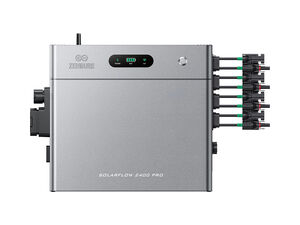
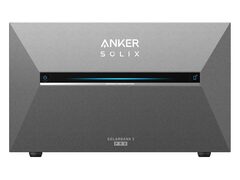
Three references help place the Pro Max: its little brother, the SolarVault 3 Pro, the Zendure SolarFlow 2400 Pro, also a hybrid, and the Anker Solix Solarbank 3 E2700 Pro, closer on capacity.
| Criterion | SolarVault 3 Pro Max | SolarVault 3 Pro | SolarFlow 2400 Pro | Solarbank 3 E2700 Pro |
|---|---|---|---|---|
| Base capacity | 2520 Wh | 2520 Wh | 2400 Wh | 2688 Wh |
| Maximum AC output | 2500 W | 1200 W | 2400 W | 1200 W (800 W default export) |
| Direct solar input | 4000 W (4 MPPT) + 2500 W through AC coupling | 4000 W (4 MPPT) | 3000 W (4 MPPT) + 1800 W through AC coupling | 3600 W (4 MPPT) |
| Expandable to | 15.12 kWh | 15.12 kWh | 16.8 kWh | about 16 kWh |
| Weight | 26.5 kg | 25.5 kg | 27.8 kg | 29.2 kg |
The Pro Max is the only one of the four to combine 2500 W of output, 4000 W of direct input and 2500 W of backup. The Zendure SolarFlow 2400 Pro outdoes it on round-trip efficiency (87 to 90%) and on tariff tools, at the cost of a narrower direct input. The Anker Solarbank 3 E2700 Pro offers 168 Wh more at base, similar efficiency and a more established ecosystem, but tops out at 1200 W. The 3 Pro, finally, shares almost everything with the Pro Max except the power and the backup: if the horizon stays at 800 W of export, it is enough.
Who the SolarVault 3 Pro Max is for, and where it is sold
It suits households that consume a lot in the evening, connect three or four panels facing different directions, or want to keep the door open to an expansion up to 15 kWh: with its 3680 W bypass and its 2500 W backup, it is a home appliance more than a balcony accessory. It suits less well anyone with only one or two panels aiming at 800 W of export, where the 3 Pro is enough, or anyone who demands operation without an app or an account, uninterrupted backup for computer equipment, or fine-grained tariff arbitrage.