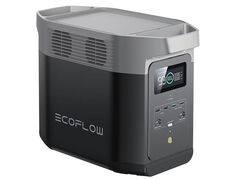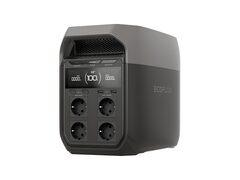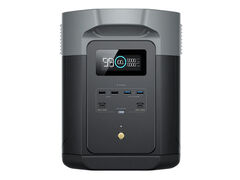

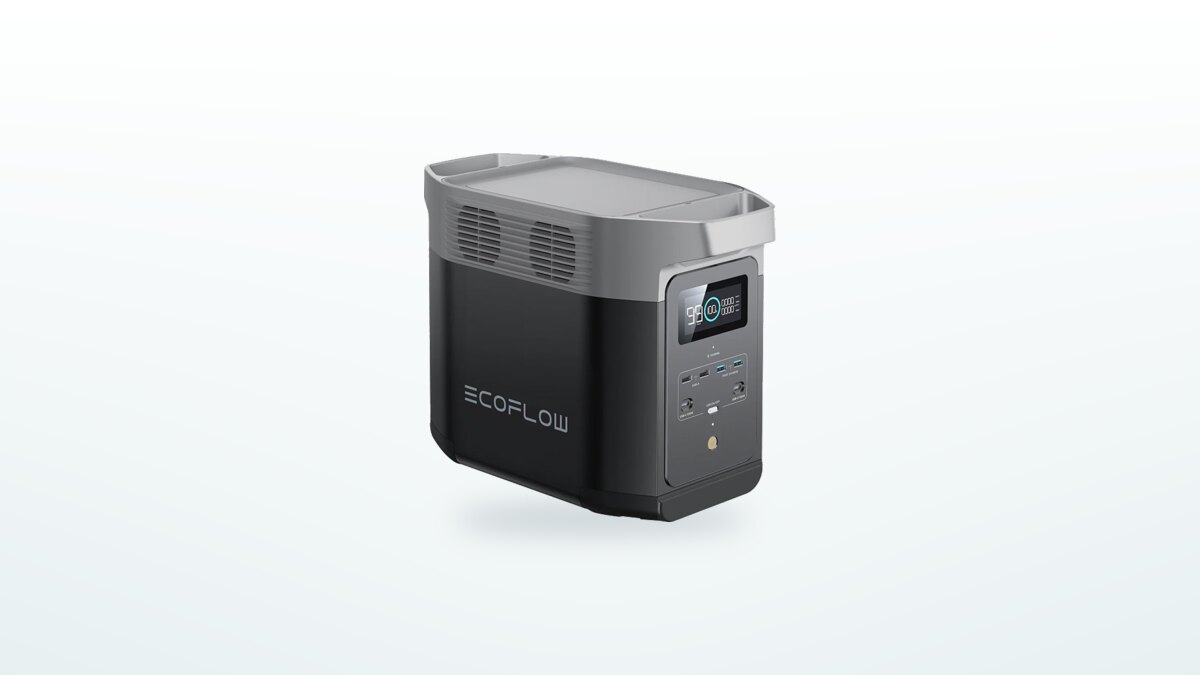
From 745 to 930 Wh: what the connected load changes
The 1024 Wh printed on the case is a cell capacity. What the station gives back depends on what you ask of it, and the gap here is documented with rare precision: depending on the power drawn, you recover between 745 and 930 Wh. Nearly 200 Wh of difference on the same machine, purely according to what is plugged in.
That progression is not random. The inverter that produces the 230 V draws a roughly fixed amount of power whenever it is on, whatever the demand. On a 900 W load, that self-consumption disappears into the total and you recover 91 % of the capacity. On a 15 W night light, the inverter runs for dozens of hours for almost nothing, and the yield collapses to 73 %.
The practical consequence is counter-intuitive: the Delta 2 is more efficient when worked hard. Running a kettle for a few minutes costs proportionally less stored energy than leaving a small charger plugged in all night.
The 50-minute recharge, and what it leaves out
This is the station's founding argument, and it holds. EcoFlow quotes 80 % of charge in 50 minutes from an ordinary socket, and the 51 minutes observed leave no room for argument. For a 1024 Wh station that is remarkable, and it remains its best feature four years on.
The wording still deserves a pause. EcoFlow advertises the 80 %, not the full charge, and there is a very concrete reason for that.
A full charge takes 87 minutes. In other words, the last fifth of the battery demands 36 minutes, some 70 % of the time the first four fifths required. This is not a design flaw but a property of every lithium battery: beyond roughly 80 %, charging switches to constant voltage and the current tapers off to protect the cells.
Two practical lessons follow. First, the 50-minute claim is not misleading, merely partial: if you have an hour, you leave with 80 % and that is already a lot. Second, always chasing 100 % wastes a great deal of time for little energy, and works the battery in its least favourable band.
Input power can also be set in the app, up to 1200 W. Lowering it lengthens the charge but spares the battery and quietens the fan, which is far from trivial on this station.
Backup: what EcoFlow actually writes in its manual
The Delta 2 is heavily sold as a home UPS. It does have the function: connected to the mains, it passes grid power through to its sockets and switches to battery during an outage. The official figure is under 30 milliseconds.
Far less relayed is the warning attached to that function in the manufacturer's own documentation. EcoFlow does not call it a UPS but an emergency power supply, states that it is a basic function that does not support zero-millisecond switching, and explicitly recommends not connecting any device requiring instantaneous switchover, naming servers and workstations. The manufacturer also disclaims responsibility for any data loss.
The manual adds a rarely read recommendation: in backup mode, it is better to connect a single device at a time rather than several, to avoid triggering overload protection.
None of this removes the value of the function, which remains genuinely useful. It simply places the product: the Delta 2 protects domestic comfort, not an IT infrastructure. The following generation, at identical capacity, brings that delay down to under 10 ms.
X-Boost: 2400 W, and its condition
X-Boost lets the station run an appliance hungrier than its rated output by slightly lowering the voltage it supplies. On the Delta 2 it raises the admissible power from 1800 to 2400 W, with 2700 W of surge to absorb start-ups.
Its implementation is simpler than on the following generation, and that counts in its favour: X-Boost is enabled by default and engages automatically as soon as demand exceeds the rated output. No fiddling, no phone to fetch. It can be disabled in the app if needed.
Two limits still apply:
- It becomes unavailable when the AC output runs during a recharge, that is in bypass mode. A station plugged into the wall while powering a hungry appliance will not get the boost.
- It is unsuitable for appliances with strict voltage requirements. Instruments with voltage protection may refuse to work. It is designed for heating appliances, kettles, space heaters, hotplates, where a slightly lower voltage changes nothing.
A useful note for anyone comparing spec sheets: some listings quote 2200 W for this station. The official figure in the European manual is 2400 W.
Delta 2 or Delta 3: the real decision
This is the question every buyer asks, and rightly so: both stations advertise the same capacity and the same power. Here is what actually separates them.
| Criterion | Delta 2 | Delta 3 |
|---|---|---|
| Observed price | 570 to 600 € | 650 to 750 € |
| Capacity | 1024 Wh | 1024 Wh |
| Power | 1800 W, 2700 W surge | 1800 W, 3600 W surge |
| X-Boost | 2400 W, on by default | 2400 W, off by default |
| Cycles | 3000 | 4000 |
| Backup switchover | 30 ms | 10 ms |
| Mains charging | 80 % in 51 min | 100 % in 56 min |
| Maximum expansion | 3040 Wh | 5120 Wh |
| Weight | 12 kg | 12.5 kg |
The Delta 3 wins on three measurable points: a third more cycles, a switchover three times faster, and a 3600 W surge that copes better with motor start-ups. It also charges fully in 56 minutes, where the Delta 2 needs 87 for the same result.
The Delta 2 keeps two concrete advantages: it costs 80 to 150 € less, and its X-Boost works with no configuration. On everything else, capacity, rated power, solar input, connectivity, the two are very close.
The decision therefore comes down to something simple. If the station is to watch over sensitive equipment or work daily for years, the Delta 3's 4000 cycles and 10 ms earn their premium. For occasional use, camping, vans, the odd outage, the Delta 2 does exactly the same job for considerably less, and that is precisely why it remains the best seller.
The 3 kWh expansion, and its rule
Capacity rises to 2048 Wh with a Delta 2 add-on battery, or to 3040 Wh with the larger Delta Max battery. Connection is by a single cable, with no other modification.
One important rule governs this: the station accepts only one add-on battery. You cannot stack several to scale up gradually, so the total depends entirely on the model chosen at the outset.
The manual adds three precautions worth respecting, since they concern high-current connectors:
- Switch off both the station and the battery before connecting them.
- Check that the add-on battery icon appears on both screens before use.
- Never connect or disconnect the battery during charging or discharging. The station must be switched off first.
It is a genuine advantage over non-expandable stations at the same price, provided you know that the add-on battery costs about as much as the station itself.
Noise, the main criticism
If one complaint comes up consistently about this station, it is this one. During fast charging, the Delta 2's fan is clearly audible, at a level of around sixty decibels, comparable to a desktop computer under load. Since no measuring distance is stated in the available readings, that figure gives an order of magnitude rather than a rigorous comparison.
The logic is direct: it is the power passing through the electronics that makes the noise. A Delta 2 quietly running a router and some lighting is silent. The same one swallowing 1200 W to fill in fifty minutes is not.
One word finally on standby, a frequent source of confusion: the screen goes dark after five minutes of inactivity, and the station shuts down completely after two hours with no load. That delay is adjustable in the app. It is good for self-discharge, but worth knowing if you are relying on it to power something that draws almost nothing continuously.
Solar: 500 W, and a cable to budget for
The solar input accepts 500 W at most, over an 11 to 60 V range at 15 A, through an MPPT controller. For a 1024 Wh battery that is well sized: two to three hours of good sun are enough for a substantial charge, which makes it genuinely usable for seasonal off-grid living.
Two practical points are worth knowing before ordering.
The voltage constraint is strict. Panels connect in series, and the total open-circuit voltage of the array must stay below 60 V or the unit may be damaged. That is the check to make before any connection, particularly if you are reusing existing panels rather than portable modules.
Charging from a vehicle's cigarette lighter socket is also possible, on 12 V as well as 24 V. It stays slow, but keeps the charge topped up while driving.
The maintenance routine nobody follows
Here is the most useful information for the unit's lifespan, and the least read. The manufacturer publishes a precise storage routine, and ignoring it damages the battery far more surely than using it.
| Situation | Guidance |
|---|---|
| Ideal temperature | 20 to 30 °C |
| Avoid for long periods | above 45 °C or below -10 °C |
| Before storing | charge to about 60 % |
| Every 3 months | run down to 30 % then back up to 60 % |
The third point is the crucial one: a battery stored for a long time at a low charge loses capacity irreversibly. The Delta 2 limits the damage by putting its cells into hibernation, but that is no substitute for maintenance. The quarterly cycle asked for, down to 30 % then back to 60 %, takes an evening twice a year if you group it.
This matters particularly for the most common use of this kind of station: a reserve bought for power cuts, put in a cupboard and forgotten. That is exactly the scenario in which a lithium battery ages worst.
Its LFP chemistry is rated for 3000 cycles before dropping to 80 % of its original capacity, roughly ten years at one full cycle a week. The manufacturer warranty runs five years.
Against the kilowatt-hour competition
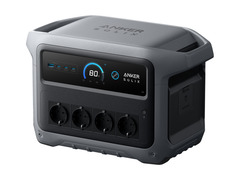
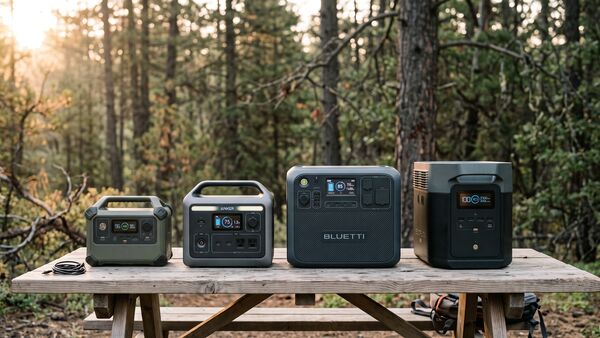
The portable kilowatt-hour is the most contested segment on the market. Here is where the Delta 2 stands against its most compared rivals, at prices observed in mid-August 2026.
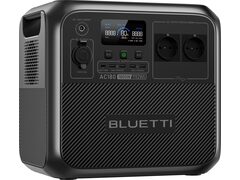
| Criterion | EcoFlow Delta 2 | Anker Solix C1000 | Bluetti AC180 |
|---|---|---|---|
| Observed price | 570 to 600 € | ≈ 800 € | ≈ 800 € |
| Capacity | 1024 Wh | 1024 Wh | 1152 Wh |
| Power | 1800 W | 1800 W | 1800 W |
| Expandable | yes, 3040 Wh | depends on generation | no |
| 230 V sockets | 4 | 4 | 2 |
| Weight | 12 kg | ≈ 13 kg | 16.4 kg |
The Delta 2's decisive argument is its price. At equivalent capacity and power it costs 100 to 200 € less than its direct rivals, while offering the expandability the Bluetti lacks and weighing markedly less.
What it gives up is measured: the Bluetti offers 128 Wh more capacity, and the more recent rivals quote faster backup switchovers. Neither gap justifies two hundred euros for everyday use.
Its real competition is elsewhere. It comes from its own successor, the Delta 3, which for 80 to 150 € more brings 4000 cycles and a 10 ms switchover. That is the only comparison that genuinely calls for thought.
Who it suits, and who it does not
Four years after launch, the Delta 2 still tops the charts, and that is no accident. It does everything competently, hides no vice, and its price has fallen where its qualities have not.
It suits very well camping, vans and campers, where its 12 kg, four sockets and 80 % recharge in fifty minutes at a serviced stop do exactly the expected job. It suits home working and the mobile office, where its two 100 W USB-C ports and several hours of reserve cover a full day. It suits home backup against everyday outages: router, lighting, fridge, television. It suits the occasional building site, its 2700 W surge absorbing the start-up of common power tools. And it suits anyone who wants the most capacity per euro in this class, which remains its strongest argument.
It suits poorly protecting a server, a NAS or a desktop computer without a battery: its 30 ms switchover is explicitly advised against by the manufacturer for those uses. It suits poorly daily stationary use over years, where the following generation's 4000 cycles come into their own. It suits poorly an environment where silence is essential during charging, unless the input power is capped. And it suits poorly anyone permanently running very small loads, since that is the regime where it returns only 73 % of its capacity.
What remains is a solid, fast, light and expandable machine, sold today at a price it did not deserve to fall to. For the majority of uses, it is still the most rational choice in the segment.