
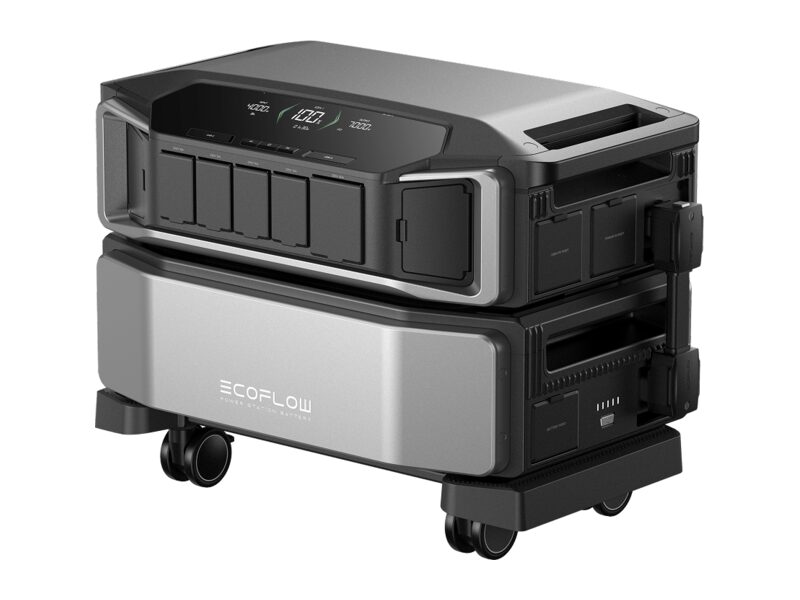
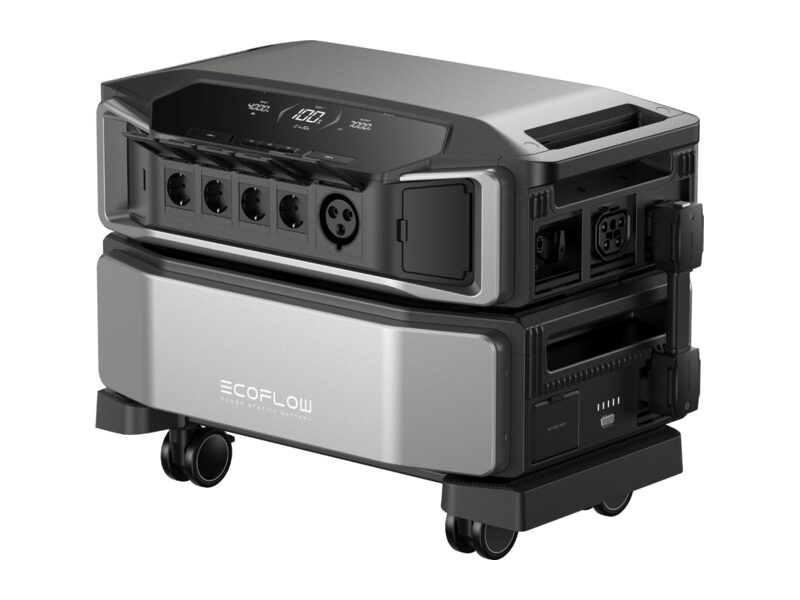
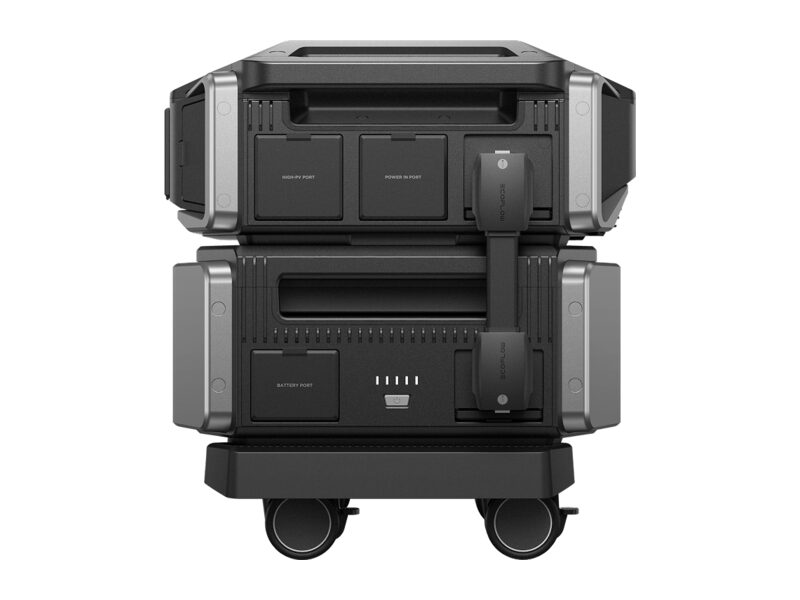
EcoFlow Delta Pro Ultra
(7 reviews)
EcoFlow's modular home system: 6 to 30 kWh per inverter (up to 90 kWh), 7200 W and an online UPS to back up an entire house.
- Capacity: 6144 Wh per battery (expandable to 30 kWh)
- Inverter: 7200 W (up to 21.6 kW in triple)
- UPS: Online, switchover under 20 ms
- Solar: Up to 5600 W (dual MPPT)
- Modular home system up to 90 kWh
Detailed overview: EcoFlow Delta Pro Ultra 6144Wh home system
The EcoFlow Delta Pro Ultra is the brand's most ambitious residential energy system: instead of a single-block station, it is a modular architecture that combines inverters and batteries to fit the needs of a whole home. The base module brings together a 7200 W inverter and a 6144 Wh LiFePO4 battery, already ample to back up a household's essential circuits.
Its strength is expandability. Each inverter drives up to 5 batteries, i.e. 30 kWh, and up to 3 inverters can be combined to reach 90 kWh of storage and 21.6 kW of power, enough to cover several days of autonomy for a complete home, including heating and large appliances. You therefore scale the installation gradually, adding batteries over time.
On the power-security side, the Delta Pro Ultra integrates a UPS (online inverter) that switches to battery in under 20 ms during an outage: sensitive devices (computers, server, medical fridge) never shut down. Under 2000 W, it runs at 0 dB, completely silent. Recharging is done through five methods (mains up to 7200 W, solar up to 5600 W via two MPPT, car socket, generator, EV charger), and the whole system is finely controlled from the EcoFlow app (Wi-Fi and Bluetooth).
Important point: to connect the Delta Pro Ultra to the home's electrical panel, EcoFlow offers a manual transfer switch whose installation must be carried out by a certified electrician, at the buyer's expense. It is therefore an infrastructure investment, matching its capabilities, protected by a 5-year warranty and LiFePO4 cells rated for over 4000 cycles.
Full specifications
Detailed characteristics (EAN: 4895251660082)
Battery and capacity
| Rated capacity?Total stored energy in watt-hours. The higher the figure, the longer the runtime. | 6144 Wh |
|---|---|
| Delivered energy, measured?Energy that actually leaves the battery and reaches the devices. Always below the stored energy, as conversion costs heat. Taken from our in-depth review. | 6020 Wh |
| Max capacity (with extensions)?Total capacity reachable by adding extra batteries. | 30720 Wh |
| Expandable capacity?Whether capacity can be increased with add-on batteries. | Yes |
| Removable battery?The main battery can be removed or replaced by the user. | Yes |
| Battery chemistry?LiFePO4 (LFP) lasts far longer and is safer than NMC. | LFP (LiFePO4) |
| Charge cycles?Number of full charges before capacity drops to the stated threshold. | 3500 cycles (80 %) |
AC output
| Continuous AC power?Power the unit can sustain continuously on its 230 V outlets. | 6900 W |
|---|---|
| Surge power?Brief peak tolerated when starting motor or compressor devices. | 14400 W |
| Inverter type?A pure sine wave is essential for sensitive electronics and motors. | Pure sine wave |
| AC voltage / frequency?Voltage and frequency of the AC output (230 V / 50 Hz in Europe). | 230 V / 50 Hz |
| Number of 230 V AC outlets?Number of mains outlets available on the unit. | 5 |
| RV / TT-30 outlet?Dedicated 30 A outlet for North-American style RVs. | No |
Recharging
| Max AC charging power?Maximum power drawn from a wall socket; higher means faster charging. | 7200 W |
|---|---|
| AC charge 0-80%?Stated time to go from 0 to 80% on mains power. | 60 min |
| Max solar input?Maximum solar power accepted at the input (PV panels). | 5600 W |
| Accepted solar voltage?Panel voltage range compatible with the solar input. | 30 to 150 V |
| Max solar current?Maximum current accepted on the solar input. | 20 A |
| MPPT controllers?Number of independent MPPT solar inputs (yield optimisation). | 2 |
| Vehicle charging (12/24 V)?Can be charged from a vehicle's cigarette-lighter socket. | Yes |
| Pass-through charging?The unit can power devices while charging (pass-through). | Yes |
Ports and connectors
| USB-C ports?Number of USB-C ports and the fastest port's power (laptops, phones). | 2 × 100 W |
|---|---|
| USB-A ports?Number of USB-A ports and maximum power (small devices). | 2 × 18 W |
| 12 V output (car socket)?12 V cigarette-lighter output and its power (coolers, pumps…). | No |
| Other DC outputs?Additional DC connectors (Anderson, DC5521, XT60…). | Anderson |
Portability
| Weight?Net weight of the unit, battery included. | 82.4 kg |
|---|---|
| Dimensions (L × W × H)?Overall size of the unit in millimetres. | 605 × 270 × 950 mm |
| Form factor?Portable (hand-carried), transportable (heavy), or wheeled. | Transportable |
| Wheels?Built-in wheels for moving the unit. | No |
| Telescopic handle?Retractable handle like a wheeled suitcase. | No |
Safety and environment
| Certifications?Standards and approvals obtained (CE, RoHS, UN38.3, UL…). | CE, RoHS, UN38.3 |
|---|---|
| Discharge temperature?Temperature range in which the unit can deliver power. | -20 to 45 °C |
| Charge temperature?Temperature range in which the unit can be recharged. | 0 to 45 °C |
| Ingress protection (IP)?Resistance to dust and water (e.g. IP54). | IP20 |
Backup / UPS
| UPS / EPS mode?Automatic switch to battery on a mains outage (backup). | Yes |
|---|---|
| Switchover time (rated)?Delay before switching to battery; under 20 ms suits a PC or router. | 20 ms |
Noise and thermal
| Noise level (rated)?Manufacturer-stated noise; a quiet room is around 30 dB. | 30 dB(A) |
|---|---|
| Quiet mode?Setting that limits fan noise, often by capping charge power. | Yes |
| Self-heating battery?Battery pre-heating to allow charging in cold weather. | No |
Display and connectivity
| Display?Type of screen showing power, runtime and alerts. | LCD |
|---|---|
| Bluetooth?Bluetooth link for nearby control. | Yes |
| Wi-Fi?Wi-Fi connection for remote control and monitoring. | Yes |
| Mobile app?iOS / Android app to control the unit. | Yes |
| Local control (no cloud)?Control possible over Bluetooth without an account or internet. | Yes |
| Solar connector?Connector type of the solar input (XT60, Anderson, MC4…). | XT60i |
Availability and warranty
| Market launch?Date the model first became available on the European market. Useful to place its generation: technology moves fast in this segment, and a device several years old may be at the end of its commercial life. | July 2025 |
|---|---|
| Warranty?Length of the manufacturer's warranty. | 5 years |
User manual / Instructions for use
⚡ How long will this power station run a device?
With 6,144 Wh, the EcoFlow Delta Pro Ultra external battery runs a fridge (50 W) for ~104h or an LED TV (90 W) for ~58h.
| Home | Runtime |
|---|---|
| American fridge (150 W) | ~35h |
| Dehumidifier (300 W) | ~17h |
| Washing machine (500 W) | ~10h |
| Air fryer (1500 W) | ~3h30 |
| Outdoor & workshop | Runtime |
|---|---|
| LED lighting (10 W) | ~522h |
| RV fridge (60 W) | ~87h |
| E-scooter (charging) (100 W) | ~52h |
| Pressure washer (1400 W) | ~3h45 |
Rough estimate: real consumption varies, and very power-hungry appliances (heating elements) must stay below the output power.
What is this power station best for?
-
Home & Power cuts Ideal
The Delta Pro Ultra is designed first and foremost as a whole-home backup system. A base module (one inverter + one battery) already delivers 6144 Wh and 7200 W, enough to run the fridge, router, lighting, heating pump, several outlets and even a heavy appliance at once for hours, without worrying about load shedding. Paired with the manual transfer switch (installed by a certified electrician), it switches to battery in under 20 ms during an outage: with its online UPS, your sensitive devices never shut down. Above all, it is expandable: up to 5 batteries per inverter (30 kWh) and up to 3 inverters for 90 kWh and 21.6 kW, meaning whole days of autonomy for a complete home. LiFePO4 cells (4000 cycles, over 10 years), X-Cooling and a 5-year warranty make it an energy-infrastructure investment, not a mere portable accessory.
-
Off-grid & Solar Ideal
For an off-grid home or heavy solar self-consumption, the Delta Pro Ultra is a top-tier domestic storage core. Each inverter accepts up to 5600 W of solar input (two MPPT controllers, 30 to 150 V), and the system recharges through five methods (mains, solar, car socket, generator, EV charger). With capacity expandable from 6 to 30 kWh per inverter, it stores a large daytime PV output to cover evening and night in near-total self-consumption. Its 7200 W inverter powers a whole house (induction hob, pump, AC, tools), and smart management through the EcoFlow app optimises charge, discharge and priorities. For a truly off-grid site, you stack batteries and panels up to the target autonomy, without a generator or noise.
-
Remote work Suitable
For a home office or a small business where the slightest outage is costly, the Delta Pro Ultra secures the entire setup and much more: workstations, server, NAS, printers, lighting and air conditioning stay powered without interruption thanks to the online UPS (switchover under 20 ms). Its 6144 Wh, expandable to 30 kWh, last hours or even days, and its silent operation (0 dB under 2000 W) preserves the calm of a workspace. Its 100 W USB-C ports and 230 V outlets cover all equipment, and app control lets you monitor consumption remotely. It is overkill for a simple desk, but for an activity that cannot stop, peace of mind is total.
-
Job site & Tools Suitable
On an off-grid worksite or an isolated operation, the Delta Pro Ultra delivers near-industrial power: 7200 W per inverter (21.6 kW with three), enough to run a saw, compressor, light welder, cement mixer or several machines in parallel, where a classic portable station stalls. Its 6 to 30 kWh cover full days, and its solar recharge up to 5600 W tops it up on site in the sun, without a generator's noise or fuel. Heavy (67 kg for the base module) and built to stay in a fixed spot, it acts as a mobile power panel for a demanding site. For light nomadic use, a more compact Delta station remains better suited.
Our team's recommendations based on the model's capacity, output power and weight.
Compatible solar panels
A selection of photovoltaic panels that suit this station's solar input (up to 150V / 5600W), best match first.


Comparison
From 4299 pounds for the base module, the EcoFlow Delta Pro Ultra does not compare to portable stations but to modular residential backup and self-consumption systems. Here is how it stands against three references in its category: the EcoFlow Delta Pro 3 (the top of the expandable portable range), the Anker SOLIX F3800 and the Bluetti EP760 system.
| Criterion | EcoFlow Delta Pro Ultra | EcoFlow Delta Pro 3 | Anker SOLIX F3800 | Bluetti EP760 |
|---|---|---|---|---|
| Base capacity | 6144 Wh | 4096 Wh | 3840 Wh | Inverter only (+ B500) |
| Max capacity | 90 kWh (3 inverters) | 12 kWh | 26.9 kWh | 19.8 kWh |
| Power | 7200 W (21.6 kW in triple) | 4000 W | 6000 W | 7600 W |
| Max solar | 5600 W | 2600 W | 2400 W | 4500 W |
| Observed price | ≈ £4299 | ≈ £2799 | ≈ £3419 | ≈ £4019 |
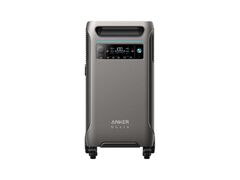
In short, the Delta Pro Ultra clearly aims above classic expandable stations: higher base capacity and power, a record 5600 W solar input and expandability to 90 kWh that places it among true home systems. Versus the Delta Pro 3 (excellent but capped at 12 kWh), it targets anyone wanting to back up a whole house or aim for autonomy. Against competing systems like the Anker F3800 or Bluetti EP760, it offers the highest power per inverter and the best expansion headroom. Its price and its installation (transfer switch by an electrician) reserve it for a real energy project, not nomadic use.
Related video
Video: EcoFlow DELTA PRO Ultra Review - Is It WORTH It? - Published on 09/06/2025
Our tester's review: Christophe Delpuech
The Delta Pro Ultra changes category: it is no longer a portable station but a brick of domestic energy infrastructure, and it must be judged as such. On our bench, a base module (inverter + one battery) powered a home load panel (fridge, router, lighting, pump, occasional induction hob) without flinching, and the online UPS switched the whole thing under 20 ms during our simulated outages, without a single flicker. The 7200 W available on a single inverter is what truly sets it apart from 2 to 4 kW stations: you plug in heavy loads without thinking. Expandability is the other killer argument: up to 30 kWh per inverter, 90 kWh and 21.6 kW with three inverters, you size it to a home's real needs. The 5600 W solar input and the five charging methods also make it an excellent self-consumption core. Two common-sense caveats: the price (from 4299 pounds for the base module) and the installation, since the transfer switch requires a certified electrician and incurs costs. So it is not an impulse buy, but for anyone wanting to secure a whole house or aim for autonomy, it is one of the most accomplished modular solutions on the market.
In-depth review EcoFlow Delta Pro Ultra: Our Full Review 4.2/5 Read our full review → Capacity and efficiency 4.6 Delivered power 4.3 Recharging 3.7 Ports and control 4.1 Build and endurance 4.2 Noise 3.6Frequently asked questions: EcoFlow Delta Pro Ultra 6144Wh home system
Yes, that is its purpose. A base module (7200 W inverter + 6144 Wh battery) already backs up essential circuits, and the system expands to 3 inverters and 90 kWh, i.e. 21.6 kW of power, enough to cover a complete home for several days. Connection to the panel is done via a transfer switch installed by a certified electrician.
Each inverter drives up to 5 batteries of 6144 Wh, i.e. 30 kWh. By combining up to 3 inverters, you reach 90 kWh of storage. Batteries are added gradually, according to needs and budget.
Yes. Its online UPS switches to battery in under 20 ms, with no perceptible interruption: computers, server, fridge or medical equipment never shut down. Under 2000 W, it also runs at 0 dB, completely silent.
To connect it to the home's electrical panel via the manual transfer switch, yes: EcoFlow requires installation by a certified electrician, at the buyer's expense. In standalone use (plugging devices directly into its outlets), it works without any special installation.
Need help choosing?
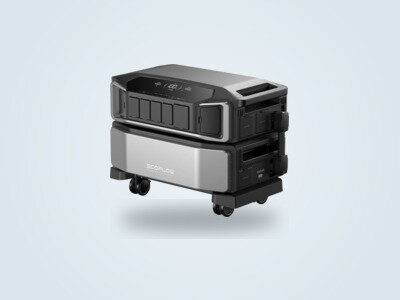
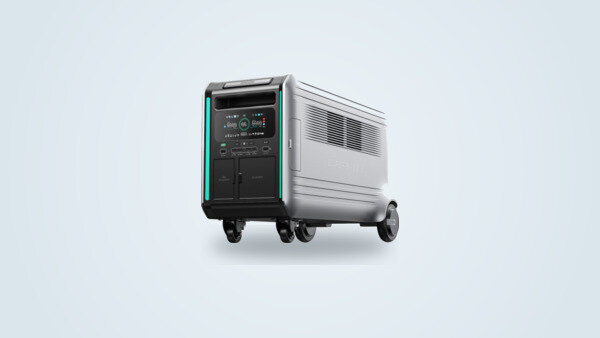
Other products in the "Very high-capacity & expandable" category
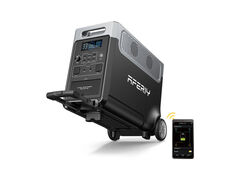
Aferiy P310
See price (8)
With 3840 Wh expandable to 11520 Wh, 3600 W (7200 W peak) and a 7 year warranty, the Aferiy P310 aims for accessible high end power.
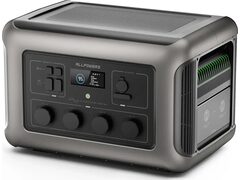
Allpowers R3500 V2
See price (4)
2880Wh and 3500W (7000W peak): the powerful station that recharges fully in one and a half hours, protects your devices during outages and doubles its capacity in parallel.
Allpowers R4000
See price (5)
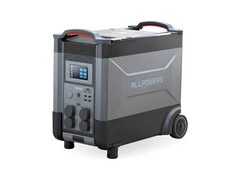
3456Wh and 3600W in a wheeled format: the big station that backs up the whole home, recharges to 100% in one hour and is controlled by voice.
Anker SOLIX F3800
See price (11)
3840Wh, 6000W and up to 26.9kWh per unit with BP3800 batteries (53.8kWh combined): the Anker power station built to back up an entire home.
Published on 24/07/2026, updated on 01/10/2026