Two batteries under one name: what you're actually buying
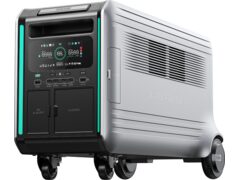
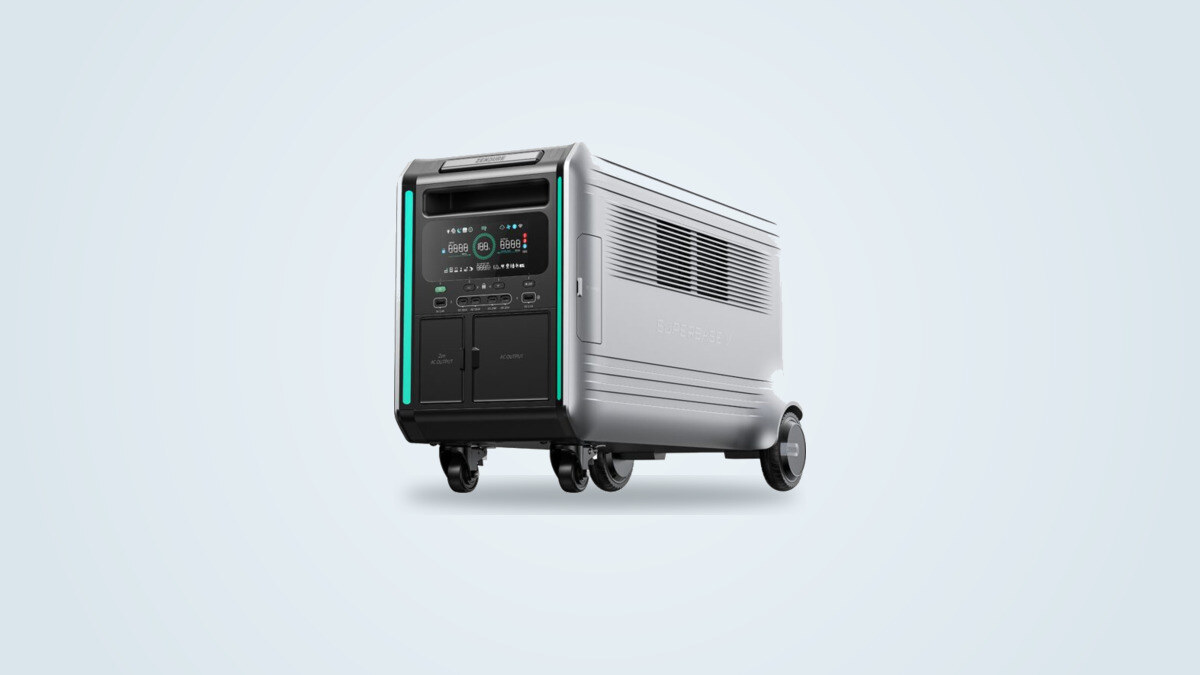
The SuperBase V's product sheet presents two batteries under a single name, and the difference is nothing like a simple colour choice. The V4600 version carries a conventional LiFePO4 battery rated at 4608 Wh. The V6400 version houses a battery marketed as semi-solid-state, denser, with a capacity of 6438 Wh inside the same outer shell. These are the two figures that come up everywhere the product is mentioned, and they cover two genuinely distinct cell packs.
Across the five markets where this site links to this product (France, Germany, Italy, Spain, the United States), the exact reference listed on every one of those pages is consistently the V4600, the LiFePO4 version. That is not a minor detail: it is the version that gets the least airtime in the brand's own marketing, where the semi-solid-state battery dominates the conversation, yet it is the one that actually lands in the cart at checkout.
| Version | V4600 (the one sold here) | V6400 |
|---|---|---|
| Capacity | 4608 Wh | 6438 Wh |
| Chemistry | LiFePO4 (LFP) | Semi-solid-state, 228 Wh/kg |
| Rated cycles | 6000+ | 3000+ |
| Base unit weight | 55 kg | 59 kg |
Pricing has also moved a great deal since launch: the very first units sold through crowdfunding in late 2022 cost over 3,800 US dollars for the base unit alone, and up to 7,000 US dollars with a first satellite battery. Prices in effect today, including on this page, sit well below those original figures, with frequent promotions that sometimes more than double the gap with the launch price. The rest of this review covers the version actually reachable through the links on this page, the V4600, flagging every time a figure comes specifically from the other version.
The semi-solid-state promise, and why it doesn't apply to this version
Almost all of the marketing buzz around the SuperBase V rests on its semi-solid-state battery, presented as a world first for a station of this power level. The real principle behind the name: an electrolyte that is half liquid, half held within a solid membrane, versus a fully liquid electrolyte in a conventional lithium cell. The claimed gain is an energy density around 42% higher than a comparable LiFePO4 cell, rated at 228 Wh/kg. That gain is what lets the V6400 pack 40% more capacity (6438 versus 4608 Wh) for only 7% more weight on the base unit (59 versus 55 kg).
That density gain comes with a trade-off the product's marketing does not highlight: the manufacturer's technical documentation rates the semi-solid-state battery of the V6400 at a 3000-cycle lifespan, against 6000 for the LiFePO4 version of the V4600 sold on this page. The version presented as the more technologically advanced one is therefore, on this specific measure, half as durable as the more conventional LFP version. Neither figure is false on its own, but the two rarely sit in the same sentence.
For anyone buying the V4600, this trade-off is beside the point: its battery remains a standard LiFePO4 cell, with the endurance and safety profile already well established for that chemistry, without the density gain or the cycle penalty of the other version. The rest of this review covers that trade-off, not the one facing the V6400.
Power and real-world loads
The SuperBase V is rated at 3800 W continuous, identical on both versions since the inverter and power electronics are shared between the V4600 and the V6400: only the battery changes. Peak power reaches 5000 W on a single unit, and two units paired in parallel combine their continuous output to reach 7600 W, a useful setup for backing up a more demanding panel without going through the satellite-battery expansion system.
On real-world loads, an electric kettle drawing over 2200 W causes no trouble, a resistive load that is normally considered a tough test for an inverter because of its startup inrush current. No independent source has pushed the unit to its full 3800 W continuous rating over an extended period: strictly speaking, the margin between this test and the maximum rated power remains not fully verified, even though nothing in the available material suggests any early limitation.
The dual-voltage output deserves a mention: the station delivers 120 V and 230/240 V simultaneously depending on which outlet is used, a rare versatility that directly matters to owners of imported appliances or mixed installations. The RV-oriented outlet, a NEMA TT-30 on the North American version, adds to an already generous set of AC outputs: the European version offers four 230 V outlets and four 12.6 V outputs, alongside the six 100 W USB-C ports and two 18 W USB-A ports already listed on the spec sheet.
On the North American version, one of the AC outlets (NEMA 6-20, 240 V 16 A) remains impractical in everyday use: the format is properly documented, but few off-the-shelf cables connect to it directly. The protective flaps on the AC outlets also open with an annoying amount of resistance. These are real, if minor, friction points on an appliance of this scale, but worth flagging for anyone planning to plug in large appliances regularly.
Recharging: one of the few promises kept to the letter
With an AC input reaching up to 3600 W, the SuperBase V is rated for a full 0 to 100% recharge in around 120 minutes. That figure holds up in practice with only a minimal gap: the measured time for a full charge on AC power also lands close to two hours, which is not so common at this price point, where the gap between promise and reality often exceeds 50%.
On the solar side, input reaches up to 3000 W over a wide voltage range (12 to 150 V), handled by a single MPPT tracker. Under clear skies with a properly sized panel array, a full charge takes around two and a half hours, an order of magnitude consistent with the AC figure. Battery switchover during an AC outage stays under 13 milliseconds, comfortably enough for nearly all home electronics, computers and networking gear included.
What these three figures have in common: none shows a notable gap between the claim and the measurement, which sets the SuperBase V apart from several direct rivals where a fast-charging promise turns out to be markedly slower once checked under real conditions.
Real efficiency: a cautious estimate, not a direct measurement
Measured against its rated capacity, the V6400 version delivers between 5.58 and 5.77 kWh of usable energy out of the 6.43 kWh on board, depending on the charge and discharge session considered, an efficiency of between 87 and 90%. That is a solid result for a station of this power level, though it falls short of the best efficiency figures at this price point, which sometimes exceed 95% near maximum power.
No independent measurement specific to the V4600 has been found to date: its LiFePO4 battery differs from that of the V6400, which rules out directly transposing the figure. The inverter, charger and conversion electronics are shared between the two versions, however, so a similar efficiency, in the 87 to 90% range, is a reasonable assumption rather than an established fact. Applied to the V4600's rated 4608 Wh, that would correspond to a genuinely usable capacity of roughly 4000 to 4150 Wh. That is the value used in this review's rating block, with this explicit caveat: it is estimated by transposition, not measured directly on this specific version.
This blind spot illustrates a broader limit of the material available on this product: independent checks almost all cover the V6400 version, the more spectacular one to showcase, leaving the version actually sold on this site noticeably less documented than its identical outer shell might suggest.
Expandability: how far the system really goes
The SuperBase V's real selling point is not its starting capacity, fairly modest next to some direct rivals, but its expansion path. Each base unit accepts up to four satellite batteries of 4608 Wh each (model B4600, the same LiFePO4 chemistry as the base unit), taking a single station to 23040 Wh. Two base units paired together, each with its four satellites, reach 46080 Wh, enough to cover a home's power use for several days.
Each satellite is controlled and charged independently (its own XT90 input, 12 to 150 V), measures roughly 69 x 28.5 x 27.4 cm, and sells, promotions included, for around 2000 euros, notably less than a full base unit since it carries neither an inverter nor a control screen. It is this architecture, more than the starting capacity, that justifies treating the SuperBase V as an expandable home storage system rather than just a big portable battery.
Noise: the most consistent reservation
Noise level is the most consistently flagged reservation on this station. At rest or under light load, the level drops to around 40 dB, a background hum that is still perceptible but unobtrusive. As soon as the power draw increases, particularly during a full-power AC recharge (3600 W), the level climbs to between 55 and 70 dB, a range considered disruptive for working nearby in an enclosed room.
This sensitivity to noise comes down to the product's own architecture: a 3800 W inverter paired with a 3600 W AC charger generates substantial heat, which the fans need to clear quickly to protect the electronics and the battery. The trade-off is nothing unusual for a station of this power level, but it leaves the SuperBase V trailing the best references in the segment, which manage to stay quiet up to a noticeably higher power draw before their fans kick in hard.
App, control and a few software rough edges
Remote control runs through a mobile app over WiFi (2.4 GHz only, the 5 GHz band is not supported) and Bluetooth for initial pairing. The app tracks charge level and consumption, lets you schedule recharge windows, and offers an automated mode that prioritises solar power whenever it is available.
Several software rough edges have marked the product across updates: a charge-level display that is sometimes inconsistent with the battery's actual state, an unprompted fan restart with no additional load on the unit, and, on the very first units shipped, voice-assistant integration (Alexa, Google Assistant) that did not work correctly. Firmware updates have been frequent since launch, which points to active ongoing support, even though it also means a unit fresh off the production line may not behave exactly like one that has been updated for several months.
None of these software quirks calls into question the station's basic electrical operation: they affect the comfort of remote monitoring, not the delivery of power itself, which keeps working independently of the app if a connection issue occurs.
A crowdfunded birth, and the traces it left behind
The SuperBase V was not born as a standard mass-retail product: it was first funded through a crowdfunding campaign in late 2022, then extended on a second platform while the first units were being shipped. That launch route carries a well-known downside: delays to the original delivery schedule were announced mid-campaign, and the period that followed saw phone support that was hard to reach, with support tickets left unanswered for a long time for some early buyers.
On the hardware side, at least one satellite battery unit arrived fully discharged, preventing it from being put into service right away, and one station unit went through an unexplained full charge-then-discharge cycle, with no diagnosis established despite correctly configured charge and discharge thresholds. These cases do not appear to be widespread given the overall material available, which leans positive on the unit's mechanical build quality, but they are worth mentioning for a product at this price point.
On warranty terms, the SuperBase V carries a 3-year base warranty, extendable to 5 years by registering the device in the manufacturer's app, a duration that sits at the high end of the power station market. The brand remains active in 2026, with several newer product lines launched since, but no recent independent data confirms whether the support friction seen at this specific model's launch has since eased.
Against direct competitors
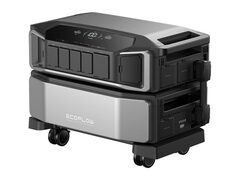
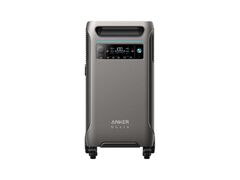
The market for expandable home systems already has well-established references. Against the EcoFlow Delta Pro Ultra, the SuperBase V starts with a more modest base capacity (4608 versus 6144 Wh) and a lower expansion ceiling (46 versus 90 kWh), but it keeps its recharge promise to the letter where the measured gap on its rival reaches nearly double the stated time. Against the Anker Solix F3800, the continuous power gap narrows (3800 versus 6000 W), and the SuperBase V keeps the edge on expansion ceiling per unit (46 versus 26.9 kWh).
| Criterion | SuperBase V4600 | Market benchmark |
|---|---|---|
| Rated vs. measured recharge | 120 min rated, ~120 min measured | A frequent gap among direct rivals |
| Maximum expansion | 46 kWh, 2 units | 26.9 to 90 kWh depending on the rival |
| Warranty | 5 years (3 years + 2 years on registration) | At the high end of the segment |
The sharpest difference, then, is not a power or capacity figure, but the consistency between claim and measurement on recharging, set against a lingering reservation on noise and on the relative youth of the distribution and support network, two areas where the segment's established references, longer on this market, have had more time to build confidence.
Who the SuperBase V4600 is really for
The SuperBase V4600 is aimed first at a well-thought-out home storage project: a desire for an expandable residential backup system, an off-grid solar installation sized over several years, or a remote site where the ability to add satellites as budget allows matters more than the starting capacity. Its 55 kg, motorised wheels and telescopic handle make it movable around a house or garage, but it is not built for everyday nomadic use: it is an appliance that gets installed, not one that travels.
For a more occasional backup need, a handful of sensitive devices to protect through an outage, a far more compact and cheaper station is more than enough. For a full residential project targeting several dozen kWh, the expansion-ceiling gap against the segment's most established references deserves to be weighed carefully. Between these two uses, the SuperBase V4600 sits in a credible spot: it keeps its power and recharge promises, it genuinely expands as advertised, and its reservations, noise chief among them, are documented rather than hidden. The name on the box highlights a technology this specific version does not carry, but that is not necessarily bad news for anyone who wants a proven LiFePO4 chemistry above all else.