
A station built for North America, not for Europe
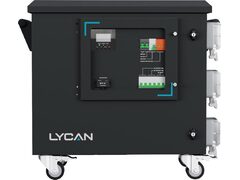
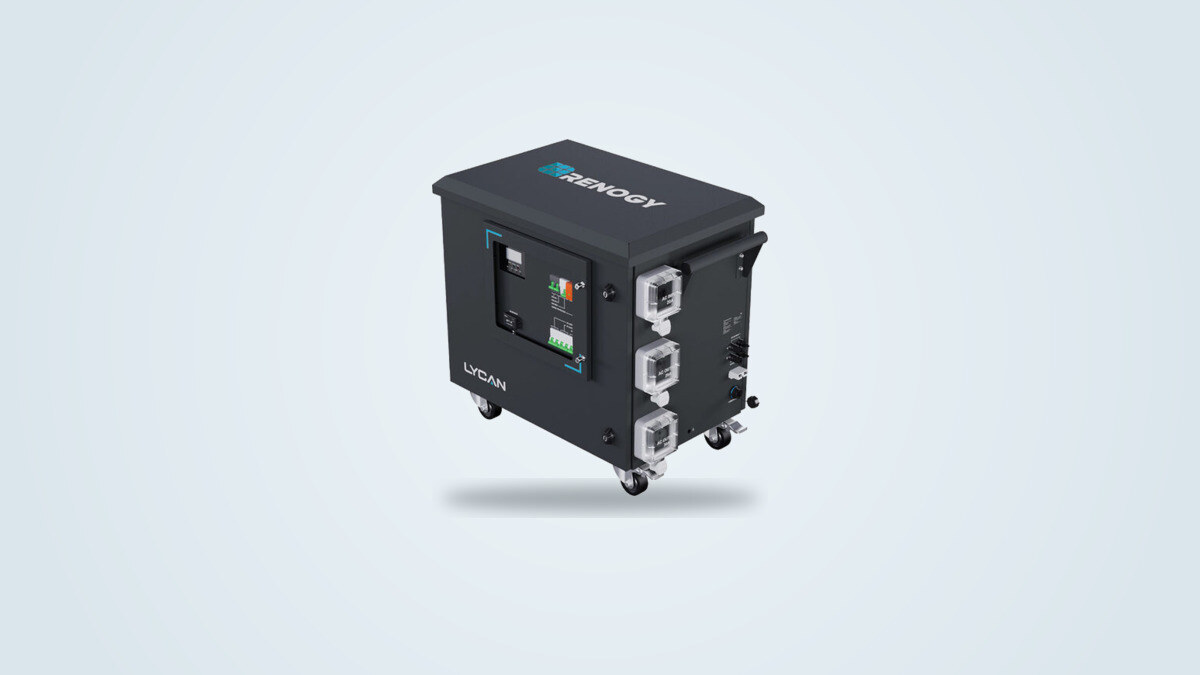
The Renogy Lycan 5000 Power Box is not a portable station like the other products in this comparison: it is an all-in-one residential backup system, battery, inverter and MPPT solar charge controller combined in a single wheeled cabinet, designed to take over from the grid during an outage or to run a home off-grid. Launched in 2023 by Renogy, a brand well established in the North American solar and RV market, it carries the model reference RPB4835OA-48LFPA12S.
The first thing worth checking before anything else is where it is actually sold. Every usable source found for this review, specialty retailers, technical forums, official documentation, is written in English and hosted on North American domains. No independent coverage in German, Japanese or French turned up, and that silence is not a research failure but a market reality: the Lycan 5000 is designed and sold for the American 120V, 60Hz grid, and has never had any real distribution in Europe.
What the 4,800Wh actually deliver
The base of the Lycan 5000 is a 4,800Wh LiFePO4 battery at 48V (51.2V nominal), made up of two internal 50Ah blocks. The manufacturer rates it for 4,500 cycles before dropping to 80% of original capacity, a lifespan that, at one cycle a day, works out to roughly a decade of use before reaching that threshold.
No independent measurement of the actual capacity delivered at the AC output (the exact percentage of the 4,800Wh nominal rating that is actually recoverable) was found for this model: it is a far less covered product among general test labs than equivalent EcoFlow, Anker or Jackery references. The only real-world data point available is one specific case: under a sustained load of about 2,200W, well below its 3,500W ceiling, the unit powered an installation for just over two hours before shutting down, without faltering over that time. That figure confirms healthy behaviour under sustained load, but it is not enough on its own to calculate a reliable delivered-capacity percentage: without a full-discharge measurement, this review does not publish a real-world Wh figure rather than estimate one.
The one-hour charge: real, but under two conditions
The headline marketing claim is a 0 to 80% charge in one hour. That figure is real, but comes with a condition rarely spelled out: it requires stacking mains AND solar input at the same time, both at their maximum power, that is 2,400W through a dedicated 20A outlet plus a good share of the 4,400W available from solar. Few buyers have both resources available at full strength from day one.
On mains power alone, with the 20A/120V input available (2,400W maximum), a full charge is closer to 2.5 hours. A properly sized solar array under a clear sky, on the other hand, can complete a full charge in under 90 minutes without ever touching the mains, a rare speed for a battery this size. Combining both sources, a full charge takes just over 1 hour 15 minutes.
The dual MPPT input (two separate circuits, up to 100A of combined solar charge current) accepts a minimum of three 12V panels or two 24V panels wired in series, leaving real headroom to size an array around whatever is available.
The backup (UPS) function: automatic switchover confirmed, full panel backup is separate
Left permanently connected to mains power, the Lycan 5000 provides an automatic UPS function on its own outlets: when the power cuts out, the switch to battery happens on its own, with no action needed. A real-world outage test confirmed this works: desktop computers, monitors and TVs plugged directly into the unit rode out the outage without a single restart. The only visible sign of the transfer was a brief dip in light output while the switch took place; no switchover time in milliseconds has been published or independently measured.
This automatic continuity only covers equipment plugged directly into the unit's two outlets. Backing up a full breaker panel works differently: Renogy sells a MANUAL transfer switch as an accessory, compatible with generic switches already on the market (the same type used for a backup generator), to be fitted by a licensed electrician to meet local safety codes. Unlike some rival systems that require a costly proprietary distribution panel for the same job, the Lycan relies here on standard installation hardware, a genuine plus for the installation budget. The trade-off is that the switchover is no longer automatic at whole-house scale: during an outage, a manual action is still needed at that switch.
Outlets: only two, read differently depending on the market
The Lycan 5000 offers only two AC outlets: one general-purpose 20A outlet and one 30A RV-style outlet, with no other AC port, no USB, no 12V output and no 240V compatibility. For a system marketed as a complete residential backup solution, that is a thin outlet count next to modular rivals that pack far more outputs onto their power unit.
For a North American buyer, the choice makes sense: the two outlets cover the product's two main scenarios, plugging in a handful of large appliances directly or backing up an RV, and a transfer switch takes over once wider coverage is needed. It is not the most generous outlet count in its class, but it is consistent with the intended use.
For a buyer on the five other markets this site covers, the picture changes entirely: both outlets put out 120V at 60Hz, a voltage and frequency that match no European domestic standard. Plugging a standard European appliance into either outlet will not power it properly: at best it simply refuses to start, at worst it can be damaged. Using the Lycan 5000 on these markets therefore requires an external voltage converter rated for several kilowatts, a piece of equipment that is heavy, expensive and rarely already owned by a household, adding fully to both the budget and the footprint of the installation. This is not a manufacturing flaw, the design does exactly what its home market needs, but it is a real functional limitation with no simple fix.
Screen and app: the weak point of day-to-day monitoring
The built-in screen shows real-time watts and amps, useful for tracking a charge in progress, but it gives neither a battery percentage nor an estimate of time left until full or empty, an odd gap on a device whose whole job is knowing how much runtime is left in reserve.
The companion mobile app (paired over Bluetooth through the supplied BT-2 module) does not fully close that gap: it displays amp-hours rather than watt-hours, a less directly useful unit for estimating residential runtime, and the remaining-runtime estimate only appears once the inverter is already under load, not during idle or charging. The Bluetooth connection itself is described as adequate for basic monitoring, but less dependable once you move beyond the basics.
On day-to-day control, the package remains functional for the product's core job, watching a charge, triggering a switchover, but a buyer used to the far more polished apps of some rivals will need to lower expectations on fine-grained charge-state visibility.
Build quality, IP55, and a warranty worth reading closely
On the mechanical side, the Lycan 5000 inspires confidence: a galvanised steel enclosure treated against corrosion, connections and cable entries protected by weatherproof glands, a confirmed IP55 rating, and a dedicated grounding lug for lightning protection. Its discharge operating range runs from 14 °F (-10 °C) to 122 °F (50 °C). The design is modular, with several components (the communication module, internal boards) replaceable independently rather than forcing a full return of the unit for a partial fault. No official safety recall has been recorded for this model, and no widespread structural problem has been identified, a notable point for an inverter of this power.
The warranty, however, deserves a closer look. The marketing around a 5-year coverage in fact applies only to the battery, and even then on a prorated basis (a partial, declining allowance as the unit ages, not a full free replacement). The rest of the unit sits on a much shorter scale.
| Component | Length | Basis |
|---|---|---|
| Battery | 5 years | Prorated |
| Enclosure | 3 years | Materials and workmanship |
| Breakers and protection devices | 1.5 years | Materials and workmanship |
| Inverter/charger, BT-2 module, cables | 1 year | Materials and workmanship |
In practice, it is the inverter, the part under the heaviest electronic load and the most expensive to replace out of warranty, that carries the shortest coverage on the entire unit. That is not highlighted in the product's general marketing, but it is what the published warranty terms show.
Stackable to 19.2kWh: real expandability, at a real cost
The Lycan 5000's central selling point is its expandability: up to six additional batteries, each rated at 2.4kWh, connect in series over a network cable to the two internal blocks, taking total capacity up to 19,200Wh without changing the inverter or the main cabinet.
That growth comes at a real price: each expansion battery is itself a substantial purchase: around $1,700 apiece on the North American market, notably more than the going rate for a Renogy 48V/50Ah battery of seemingly very similar specifications sold for other uses. Renogy's own position is that only its batteries certified for the Lycan should be used, warning that mixing in another reference could damage the system, a warning that some experienced users have publicly questioned without ever fully taking it apart point by point. Absent an independent test settling the question, caution suggests following the manufacturer's line: if there really is an incompatibility, the risk falls on a battery pack worth several thousand dollars.
That reservation aside, the expansion mechanism itself is confirmed and coherent: growing in 2.4kWh steps lets total capacity be matched to actual need without reinvesting in a second inverter, a real advantage over rivals that force a full new unit purchase past a certain point. The base unit alone is priced above $5,000 on the North American market, before any accessory or expansion.
Up against the EcoFlow Delta Pro and the Bluetti AC500
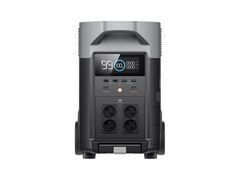
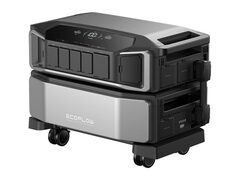
In the category of all-in-one residential backup systems, rather than simple portable stations, two direct rivals come up most often for comparison: the EcoFlow Delta Pro and the Bluetti AC500 paired with a B300S battery.
| Criterion | Renogy Lycan 5000 | EcoFlow Delta Pro | Bluetti AC500 + B300S |
|---|---|---|---|
| Base capacity | 4800Wh | 3600Wh | 5120Wh |
| Continuous power | 3500W | 3600W | 5000W |
| Architecture | All-in-one (inverter + battery + MPPT) | All-in-one | Modular (power unit separate from batteries) |
| Full panel backup | Generic manual transfer switch | Proprietary distribution panel | Proprietary distribution panel |
The Lycan 5000 stands out with a higher base capacity and solar input than the Delta Pro, and with a residential installation path that relies on generic electrician's hardware rather than a branded box to buy on top. The Bluetti AC500 offers higher power and capacity in its full configuration, at the cost of a modular system to assemble rather than one delivered ready to place as a single unit.
The most defining difference, though, has nothing to do with these numbers: it is availability. The Delta Pro and the AC500 have, at least in the past, been sold on the European market; the Lycan 5000 remains an almost exclusively North American proposition.
Who the Lycan 5000 is really for
The Renogy Lycan 5000 targets a specific buyer: a North American household that wants a genuine residential backup system delivered as a single unit, without having to assemble a separate inverter and batteries, and that values a very generous solar input to recharge without ever touching the mains. For that buyer, the unit delivers on its main technical promises: confirmed power under sustained load, a reliable automatic switchover on its own outlets, real expandability up to 19.2kWh, and a full-panel backup path that relies on standard rather than proprietary hardware.
It suits less well anyone looking for a portable station to take along day to day: at 120kg, moving it beyond flat ground means partly disassembling it or getting several people involved. It also suits less well anyone expecting close day-to-day visibility of charge state, since the screen and app remain basic on that specific point.
For a reader in France, Germany, Italy, Spain or the UK, the question barely applies in the same terms: beyond the difficulty of even obtaining the unit, its two 120V outlets do not put out a voltage that local appliances can use directly. A station designed for the European grid, even at the cost of some of the Lycan 5000's capacity or solar input, will serve these markets far more directly.