
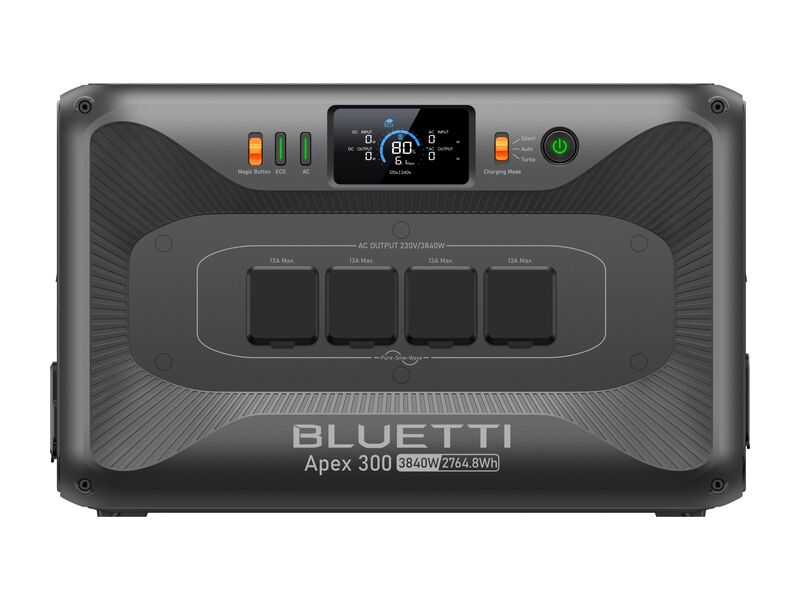
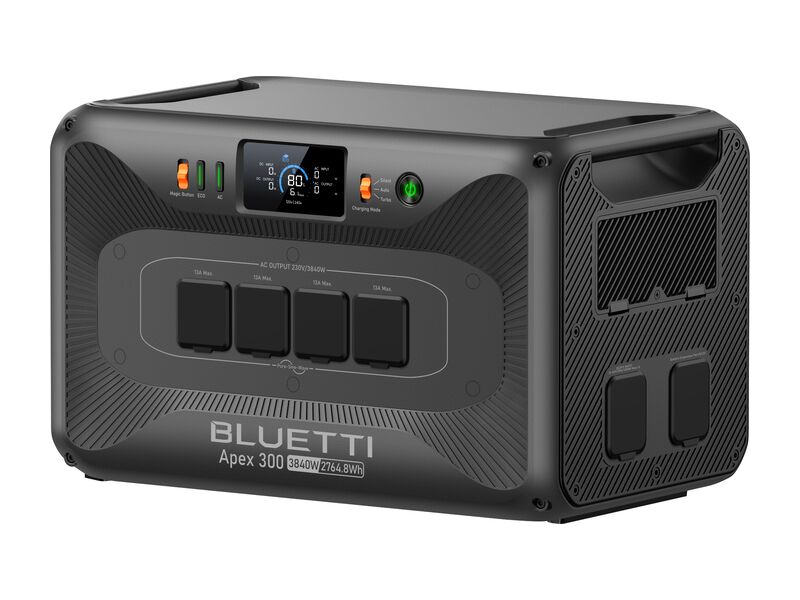
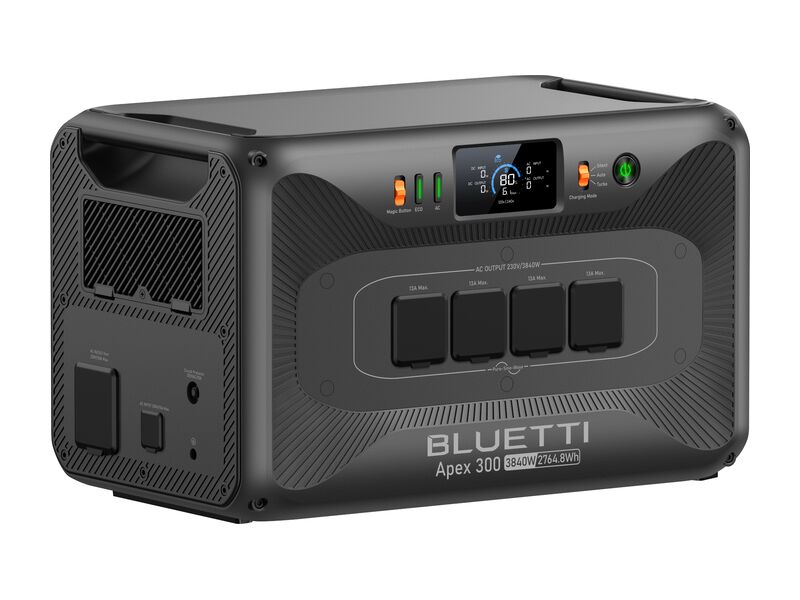
Bluetti Apex 300
(9 reviews)
Bluetti's modular home backup station: a 3840 W core, batteries added as your needs grow, and a UPS that switches over to battery in just 20 ms.
Characteristics
- Capacity: 2764.8 Wh (LiFePO4), up to 19.4 kWh per unit
- Power: 3840 W continuous, 7680 W peak (resistive loads)
- Recharge: Up to 3840 W on the mains (Turbo), 2400 W solar
- Size: 38 kg, 52.5 x 32.7 x 32 cm, IP20
- Modular up to 58 kWh, 20 ms UPS
Detailed overview: Bluetti Apex 300 - photo 2
The Bluetti Apex 300 is not just another portable station: it is the core of a home backup system that grows with your needs. The base unit packs a 2764.8 Wh LiFePO4 battery (51.2 V, 54 Ah), rated for more than 6,000 cycles before dropping to 80% of its capacity, and a pure sine wave inverter delivering 3840 W across four 230 V mains sockets (13 A each on the UK model). Power Lifting mode, off by default, allows up to 7680 W for purely resistive loads such as a kettle or a space heater.
Expandability is its real selling point. One unit accepts up to six B300K batteries (2764.8 Wh each), which makes 19.4 kWh, or 5120 Wh B500K modules. With the Hub A1 parallel box, two or three Apex 300 units combine for 7680 W or 11,520 W and up to 58 kWh with B300K batteries, and Bluetti quotes up to 100 kWh with B500K modules. You buy the base, then add modules as the budget allows.
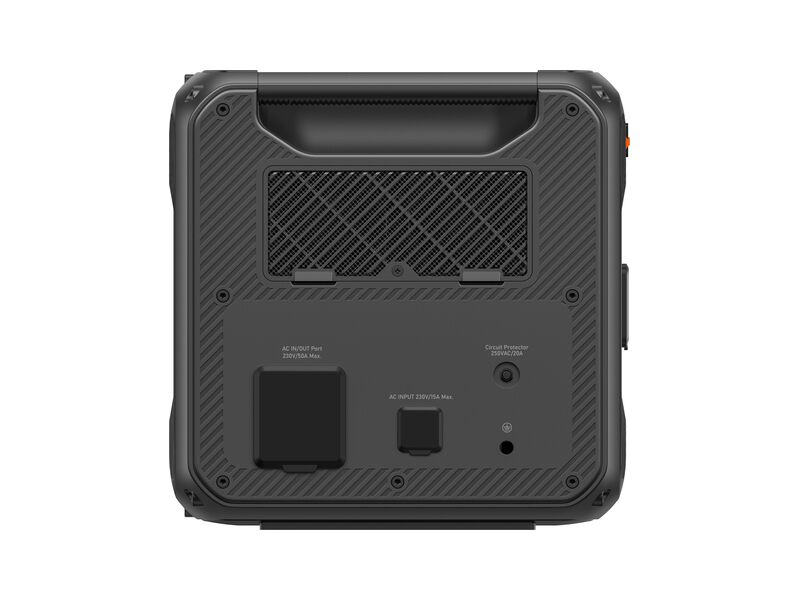
Recharging is fast for this capacity. On the mains, Turbo mode accepts up to 3840 W (80% in about 45 minutes according to Bluetti), against 1440 W in the gentler Standard mode and 500 W in Silent mode. The solar input offers two XT60 connectors of 1200 W each (12-60 V, 20 A), or 2400 W with no extra accessory. A car cigarette-lighter socket (96 W at 12 V) or the optional Charger 1 alternator charger complete the picture.
During a power cut, the switchover to battery takes 20 ms on the sockets designed for UPS mode, enough to protect a router, a broadband hub or a NAS. Bluetti is clear, however, that it is no substitute for a high-performance UPS for servers or critical workstations. The app (Bluetooth and Wi-Fi) manages backup, off-peak and solar self-consumption modes, and idle consumption stays around 20 W.
A few limits are worth knowing. The unit has no USB, no 12 V and no Anderson outputs: these come from the Hub D1, sold separately. It weighs 38 kg without wheels (a trolley is available as an option), and its IP20 rating limits it to sheltered use, from -20 °C to 40 °C when discharging and from 0 °C to 40 °C when charging. The budget also climbs once you add batteries, hubs and cables. The announced warranty is 5 years.
Full specifications
Detailed characteristics
Battery and capacity
| Rated capacity?Total stored energy in watt-hours. The higher the figure, the longer the runtime. | 2764.8 Wh |
|---|---|
| Max capacity (with extensions)?Total capacity reachable by adding extra batteries. | 19353.6 Wh |
| Expandable capacity?Whether capacity can be increased with add-on batteries. | Yes |
| Removable battery?The main battery can be removed or replaced by the user. | No |
| Battery chemistry?LiFePO4 (LFP) lasts far longer and is safer than NMC. | LFP (LiFePO4) |
| Charge cycles?Number of full charges before capacity drops to the stated threshold. | 6000 cycles (80 %) |
| Pack nominal voltage?Internal battery voltage; higher voltage helps deliver high power. | 51.2 V |
AC output
| Continuous AC power?Power the unit can sustain continuously on its 230 V outlets. | 3840 W |
|---|---|
| Surge power?Brief peak tolerated when starting motor or compressor devices. | 7680 W |
| Boost-mode power?Extended power via a proprietary mode (X-Boost, AmpUp…) by lowering voltage. | 7680 W |
| Inverter type?A pure sine wave is essential for sensitive electronics and motors. | Pure sine wave |
| AC voltage / frequency?Voltage and frequency of the AC output (230 V / 50 Hz in Europe). | 230 V / 50 Hz |
| Number of 230 V AC outlets?Number of mains outlets available on the unit. | 4 |
| RV / TT-30 outlet?Dedicated 30 A outlet for North-American style RVs. | No |
Recharging
| Max AC charging power?Maximum power drawn from a wall socket; higher means faster charging. | 3840 W |
|---|---|
| AC charge 0-80%?Stated time to go from 0 to 80% on mains power. | 45 min |
| Max solar input?Maximum solar power accepted at the input (PV panels). | 2400 W |
| Accepted solar voltage?Panel voltage range compatible with the solar input. | 12 to 60 V |
| Max solar current?Maximum current accepted on the solar input. | 20 A |
| Vehicle charging (12/24 V)?Can be charged from a vehicle's cigarette-lighter socket. | Yes |
| Pass-through charging?The unit can power devices while charging (pass-through). | Yes |
Ports and connectors
| 12 V output (car socket)?12 V cigarette-lighter output and its power (coolers, pumps…). | No |
|---|
Portability
| Weight?Net weight of the unit, battery included. | 38 kg |
|---|---|
| Dimensions (L × W × H)?Overall size of the unit in millimetres. | 525 × 327 × 320 mm |
| Form factor?Portable (hand-carried), transportable (heavy), or wheeled. | Transportable |
| Wheels?Built-in wheels for moving the unit. | No |
| Telescopic handle?Retractable handle like a wheeled suitcase. | No |
Safety and environment
| Certifications?Standards and approvals obtained (CE, RoHS, UN38.3, UL…). | MIL-STD-810G |
|---|---|
| Discharge temperature?Temperature range in which the unit can deliver power. | -20 to 40 °C |
| Charge temperature?Temperature range in which the unit can be recharged. | 0 to 40 °C |
| Ingress protection (IP)?Resistance to dust and water (e.g. IP54). | IP20 |
Backup / UPS
| UPS / EPS mode?Automatic switch to battery on a mains outage (backup). | Yes |
|---|---|
| Switchover time (rated)?Delay before switching to battery; under 20 ms suits a PC or router. | 20 ms |
Noise and thermal
| Quiet mode?Setting that limits fan noise, often by capping charge power. | Yes |
|---|
Display and connectivity
| Display?Type of screen showing power, runtime and alerts. | LCD |
|---|---|
| Bluetooth?Bluetooth link for nearby control. | Yes |
| Wi-Fi?Wi-Fi connection for remote control and monitoring. | Yes |
| Mobile app?iOS / Android app to control the unit. | Yes |
| Solar connector?Connector type of the solar input (XT60, Anderson, MC4…). | XT60 |
Availability and warranty
| Market launch?Date the model first became available on the European market. Useful to place its generation: technology moves fast in this segment, and a device several years old may be at the end of its commercial life. | August 2025 |
|---|---|
| Warranty?Length of the manufacturer's warranty. | 5 years |
User manual / Instructions for use (PDF)
⚡ How long will this power station run a device?
With 2,765 Wh, the Bluetti Apex 300 external battery runs a fridge (50 W) for ~47h or an LED TV (90 W) for ~26h.
| Home | Runtime |
|---|---|
| Fan (45 W) | ~52h |
| Washing machine (500 W) | ~4h40 |
| Portable AC (1000 W) | ~2h20 |
| Kettle (1800 W) | ~1h20 |
| Outdoor & workshop | Runtime |
|---|---|
| CPAP machine (40 W) | ~59h |
| RV fridge (60 W) | ~39h |
| E-bike (charging) (150 W) | ~16h |
| Oxygen concentrator (300 W) | ~7h50 |
Rough estimate: real consumption varies, and very power-hungry appliances (heating elements) must stay below the output power.
What is this power station best for?
-
Home & Power cuts Ideal
With 2764.8 Wh, 3840 W continuous and a UPS that switches over in 20 ms, the Apex 300 is first and foremost designed for power cuts at home. Plugged into a wall socket, it feeds your devices directly and takes over on battery the moment the mains drops: fridge, freezer, router, lighting, a computer and several small appliances keep running together for many hours. Its four 230 V sockets (13 A each on the UK model) spread the loads, and Power Lifting mode allows up to 7680 W for a purely resistive kettle or space heater. Its decisive advantage is that it can grow step by step: each B300K battery adds 2764.8 Wh, up to 19.4 kWh per unit and 58 kWh with three units linked by the Hub A1, enough to aim for several days of autonomy. The app schedules backup mode and the other energy modes. One limit to keep in mind: the UPS suits routers and computers, not critical servers.
-
Off-grid & Solar Ideal
With two XT60 solar inputs of 1200 W each (12-60 V, 20 A), or 2400 W with no accessory, the Apex 300 connects straight to an array of panels and recovers a large part of its charge in one sunny day: Bluetti quotes 80% in 55 minutes under ideal conditions. To go beyond that ceiling, the optional SolarX 4K accessory lifts the solar input to 4000 W. The LiFePO4 battery, rated for more than 6,000 cycles to 80%, and the low idle draw (about 20 W) suit an isolated site, a workshop or a second home. The app's self-consumption and off-peak modes also help a grid-connected house shift its consumption. With B300K or B500K batteries and up to three units, capacity climbs towards 58 kWh, and Bluetti even quotes 100 kWh. Size it carefully: panels, modules and cables add up to a substantial budget.
-
Motorhome & Van life Suitable
In a motorhome or converted van, the Apex 300 handles an induction hob, fridge, lighting and device charging for several days, with 2764.8 Wh and 3840 W. Its 2400 W solar input and the optional Charger 1 alternator charger let you recharge while driving. But the unit has no 12 V output and no USB: the Hub D1 is essential to power the on-board equipment continuously. At 38 kg and without wheels, it is installed permanently in a locker rather than carried around, and its four mains sockets are enough as long as you do not stack several heavy loads.
-
Health & CPAP Suitable
For a breathing-assistance device such as a CPAP, which draws a few dozen watts, 2764.8 Wh means several nights of autonomy, and the 20 ms switchover on the UPS sockets prevents the device from stopping during a power cut. The stable LiFePO4 chemistry and app monitoring are reassuring for prolonged backup use. The Apex 300 is not a medical device, however: for a vital dependency, validate the choice with your healthcare provider, keep a second energy source, and do not let ECO mode cut a low load (Bluetti advises turning it off below 60 W).
-
Remote work Suitable
For remote working, the Apex 300 protects computer, screens, router and NAS: with an office draw of 150 to 300 W, the station lasts a full day, and the 20 ms switchover generally avoids losing a session during a brief cut. Its idle consumption of about 20 W stays reasonable for a unit plugged in permanently. Bluetti makes clear, however, that it is not a high-performance UPS for servers or critical workstations: equipment that tolerates no interruption is better protected by a dedicated UPS placed downstream. The fans become audible above about 2000 W, which does not happen with office use.
-
Job site & Tools Backup only
As an emergency source on a small worksite, its 3840 W powers a drill, grinder or circular saw through four 230 V sockets. But 38 kg without wheels, an IP20 rating (not waterproof, keep it dry) and 12 V outputs reserved for the Hub D1 make it less suited than a lighter, more rugged station for daily outdoor work.
Our team's recommendations based on the model's capacity, output power and weight.
Compatible solar panels
A selection of photovoltaic panels that suit this station's solar input (up to 60V / 2400W), best match first.


Comparison
At around £1,600, the Bluetti Apex 300 sits against the modular home backup stations, on searches such as "Apex 300 vs EcoFlow Delta Pro 3" or "Apex 300 vs Anker SOLIX F3800". Here is how it stacks up against three references from our catalogue: the EcoFlow Delta Pro 3, the Anker SOLIX F3800 and the Bluetti Elite 400.
| Criterion | Bluetti Apex 300 | EcoFlow Delta Pro 3 | Anker SOLIX F3800 | Bluetti Elite 400 |
|---|---|---|---|---|
| Capacity (base) | 2765 Wh | 4096 Wh | 3840 Wh | 3840 Wh |
| Continuous power | 3840 W (7680 W resistive peak) | 4000 W | 6000 W | 2600 W |
| Max expansion (1 unit) | 19.4 kWh | 12.3 kWh | 26.9 kWh | Not expandable |
| UPS switchover | 20 ms | 10 ms | 30 ms | 15 ms |
| Battery chemistry | LFP (LiFePO4) | LFP (LiFePO4) | LFP (LiFePO4) | LFP (LiFePO4) |
| Weight | 38 kg | ≈ 51.5 kg | ≈ 60 kg | 39 kg |
| Price observed | ≈ £1,599 | ≈ £2,599 | ≈ £3,163 | ≈ £1,599 |
In short, the Apex 300 offers the best modular compromise in this comparison: expansion to 19.4 kWh per unit (58 kWh with three), a weight of 38 kg that is well below its expandable rivals, and a starting price far lower than the Delta Pro 3 or the SOLIX F3800. Those two win on base capacity and, for the SOLIX F3800, on continuous power (6000 W), while the Elite 400 offers more capacity at a similar price with built-in DC outputs, but with no expansion possible.
Related video
Video: BLUETTI FINALLY Got It Right! BLUETTI Apex 300 - Published on 18/10/2025
Our tester's review: Christophe Delpuech
What strikes you first about the Apex 300 is that it is designed as a system, not as a big battery. You put it in the garage or utility room, plug it into a wall socket and it becomes the home's backup inverter: 3840 W available, a 20 ms switchover on the UPS sockets, nothing to reconfigure. Turbo recharging is impressive for 2.7 kWh, and the idle draw of around 20 W stays contained; tests published by the specialist press put efficiency close to 88%. The downside is real: 38 kg that takes two people to move, no wheels, fans that become audible above 2000 W or in Turbo charging, and no USB or 12 V output without the Hub D1 you have to add. The budget climbs fast once you stack batteries, hubs and cables. For a household that wants to start small and grow, it remains the most coherent in its category; for pure nomadic use, an Elite will be simpler.
Frequently asked questions: Bluetti Apex 300 - photo 2
One unit accepts up to six B300K batteries of 2764.8 Wh, or 19.4 kWh. With the Hub A1, up to three Apex 300 units run in parallel for 11,520 W and 58 kWh with B300K batteries; Bluetti quotes 100 kWh with 5120 Wh B500K modules.
No, the unit only offers its four 230 V mains sockets. The USB-A, 100 W USB-C, cigarette-lighter and Anderson ports come from the Hub D1, an accessory sold separately.
Bluetti quotes 80% in about 45 minutes in Turbo mode, up to 3840 W, and 1440 W in Standard mode. On solar, the 2400 W input (2 x 1200 W) gives 80% in 55 minutes under ideal conditions.
Yes, it switches to battery in 20 ms when devices are plugged into the sockets designed for UPS mode, enough for a router, a computer or a NAS. Bluetti advises against it for servers and workstations that need a high-performance UPS.
It is rated IP20: no waterproofing, so keep it away from water. It discharges from -20 °C to 40 °C and charges from 0 °C to 40 °C; charging stops below 0 °C.
Need help choosing?
Other products in the "Very high-capacity & expandable" category
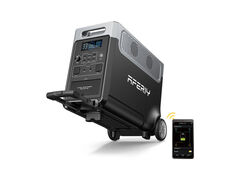
Aferiy P310
See price (8)
With 3840 Wh expandable to 11520 Wh, 3600 W (7200 W peak) and a 7 year warranty, the Aferiy P310 aims for accessible high end power.
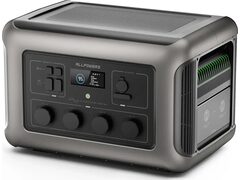
Allpowers R3500 V2
See price (4)
2880Wh and 3500W (7000W peak): the powerful station that recharges fully in one and a half hours, protects your devices during outages and doubles its capacity in parallel.
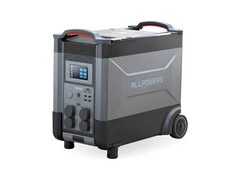
Allpowers R4000
See price (5)
3456Wh and 3600W in a wheeled format: the big station that backs up the whole home, recharges to 100% in one hour and is controlled by voice.
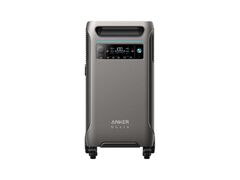
Anker SOLIX F3800
See price (11)
3840Wh, 6000W and up to 26.9kWh per unit with BP3800 batteries (53.8kWh combined): the Anker power station built to back up an entire home.
Published on 08/10/2026