
What the rated 2,764.8Wh is really worth
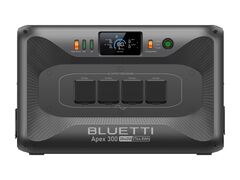
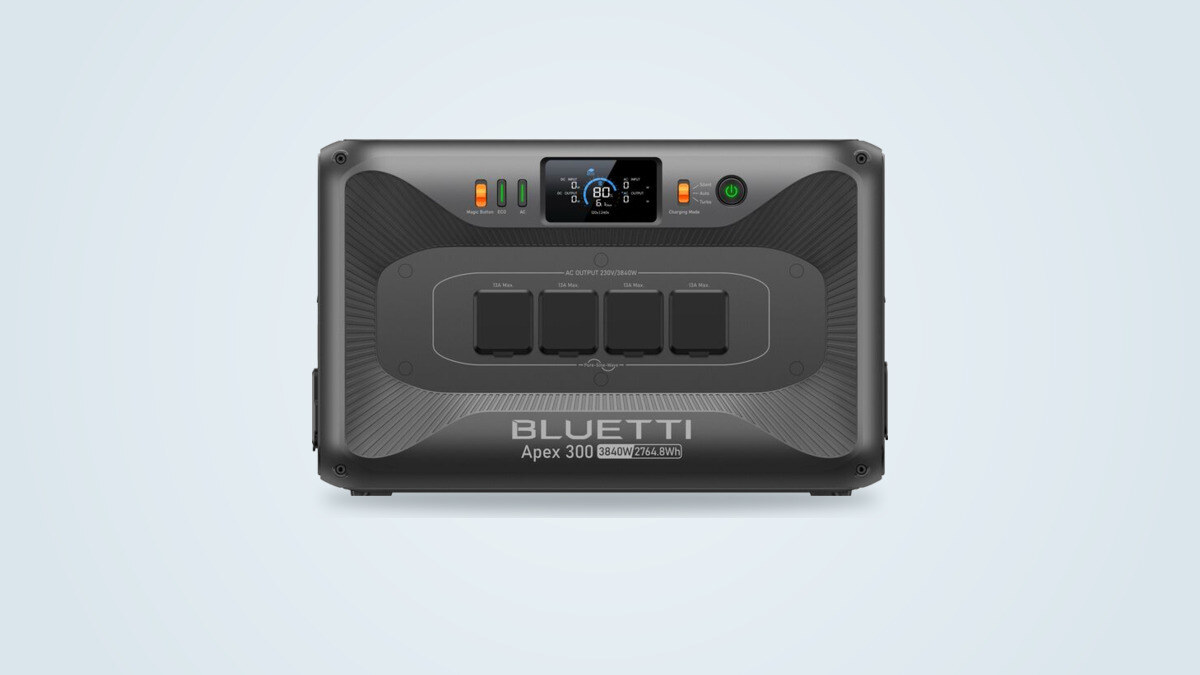
Bluetti rates the Apex 300 at 2,764.8Wh (LiFePO4 cells, 51.2V and 54Ah). What reaches the outlets depends on the power drawn: from 2,290Wh under a dehumidifier load on the 120V version to 2,580Wh at 2,000W on the 230V version, or 83 to 93% of the nominal figure. In between, a full discharge into a resistive load delivers about 2,440Wh (88%), and a discharge at 3.8kW about 2,550Wh (92%).
The gap has a simple cause: the inverter and the electronics use around 20W all the time, whatever is plugged in. At 2,000W, those 20W are 1% of the energy delivered; at 150W, more than 10%. The manufacturer builds this into its own runtime formula: capacity, multiplied by 95% depth of discharge and by an inverter efficiency above 90%, divided by the load plus 20W.
In home backup, most loads (fridge, router, lighting, computer) stay under 300W, so you land towards the bottom of the range, around 2,300 to 2,450Wh of usable energy. A space heater or a kettle sits nearer the top. Set against the energy that is really available, the £1,599 base unit works out at about £655 per kWh delivered, against £578 per nominal kWh.
The 20W standby draw and round-trip efficiency
With the unit on, the inverter active and nothing plugged in, its own consumption is around 20W. That is 480Wh a day, or 17% of the capacity, and about 14kWh a month. A full battery runs flat in about five and a half days without powering anything (2,626Wh usable at 95% depth of discharge, divided by 20W).
ECO mode limits this drift. On by default, it switches the AC output off after 4 hours below 10W of load. The manufacturer nonetheless advises switching it off for devices under 60W and for loads that must never be interrupted, such as lighting or a fridge.
A full cycle is less efficient than a discharge on its own. Filling the battery from empty takes 3.35kWh from the mains in Turbo mode (3.39kWh in Standard), and the discharge delivers 2.58kWh at best: about 76% of the energy drawn, because that figure includes the charger, the battery management and the 5% of capacity the unit never empties.
The Silent charging mode is not the most economical. It starts at around 500W, drops to 200W at about 20% charge and, over the first third of the battery, more than 1.7kWh is drawn from the mains, an efficiency close to 50%. For a charge quieter than Turbo, Standard mode gives a much better balance.
With off-peak scheduling or self-consumption, these losses add up: about a quarter of the stored energy disappears over the cycle, and 480Wh a day comes on top if the unit stays on. The financial case for tariff arbitrage has to be worked out with both losses, not just the price per kWh.
3,840W held, 7,680W with conditions
The unit is rated for 3,840W continuous, shared across four 230V sockets of 13A on the UK model (16A on the European one). It holds that figure: discharging at 3.8kW, it delivers 2,550Wh before stopping, at 92% efficiency, with no cut-out or throttling along the way. Two fan heaters of 1.8kW and 2kW plugged in together (3.3kW) pass without difficulty, and neither a kettle, a vacuum cleaner nor an electric hob has managed to trip it.
The 7,680W figure comes from Power Lifting mode, which is off by default. It only applies to purely resistive loads (kettle, heater, hair dryer) rated between 3,840 and 7,680W, and the manual states that the power the appliance actually draws stays below its rated value: the unit lowers the voltage to stay within its limits rather than supplying more energy. In one specific case, a 4.3kW load held for the whole boil of a kettle, while a 4.8kW load cut the output within 7 seconds.
| Load applied | Power | Result |
|---|---|---|
| Full discharge at full power | 3.8kW | 2,550Wh delivered, no cut-out before the battery ran flat |
| Two fan heaters (1.8kW and 2kW) | 3.3kW | Held without difficulty |
| Power Lifting: heater, air fryer and kettle | 4.3kW | Held for the whole boil |
| Power Lifting: two heaters and a kettle | 4.8kW | Output cut after 7 seconds |
| Claimed peak, purely resistive loads | 7,680W | A ceiling setting: the appliance's real power stays below its rated value |
For a motor or a compressor (pump, air conditioner, power tool), Power Lifting does not apply: the manual warns that such devices can start at 2 to 4 times their rated power and overload the inverter, without quoting any surge above 3,840W. By way of example, a 1,500W motor that starts at three times its rated power draws 4,500W, beyond what the unit accepts.
In parallel, two units linked by the Hub A1 raise the power to 7,680W, three to 11,520W. Plugged into the mains, the unit takes from the wall what its input allows, 2,300W on the standard socket, and draws the rest from the battery: at a 3,840W load, about 1,500W is missing.
Charging and solar: the claimed 45 minutes come with a condition
The manufacturer claims 80% in 45 minutes. That is correct, but only with 3,840W of input, which the standard wall socket cannot supply: its input is limited to 2,300W (10A at 230V). The three modes on the front panel give, on a 230V socket, 508W in Silent, 1,442W in Standard and 2,330W in Turbo at peak, in line with the manufacturer's ceilings of 500, 1,440 and 2,300W.
| Charging route | Maximum power | Time |
|---|---|---|
| Silent mode, wall socket | 500W | More than 5.5 hours at best, far longer in practice |
| Standard mode, wall socket | 1,440W | About 2 hours for a full charge |
| Turbo mode, wall socket | 2,300W | About 95 minutes for a full charge |
| Turbo mode via the Hub A1 (P050A input, 230V 50A) | 3,840W | 80% in 45 minutes between 15 and 25 °C |
| Mains and solar combined | 3,840W | Combined ceiling (6,240W with one or more B300K) |
| Cigarette lighter (cable supplied) | 96W at 12V, 192W at 24V | Nearly 29 hours at 12V |
| Charger 1 on the alternator (optional) | 560W | About 5 hours |
Connecting the unit to the Hub A1 through the P050A input calls for a dedicated circuit: the manual requires a 50A single-pole 230V protective device that complies with European standards. The Hub A1 pack costs £629 for two units, and wiring into a consumer unit is a job for an electrician. Without it, the simplest way past 2,300W is to combine mains and solar, within the 3,840W limit.
On the solar side, two XT60 inputs each accept 12 to 60V and 20A, or 1,200W nominal per input and 2,400W in total. That ceiling stays theoretical: 1,200W would need a panel string at 60V at its maximum power point, whereas 60V is the maximum open-circuit voltage, and a string typically works at around 80% of its open-circuit voltage, which brings 20A down to about 1,000W per input. Below 30V, the current is also limited to 8.2A in the app's standard setting; the advanced mode keeps that limit only below 16V.
To make use of a roof array, the SolarX 4K controller (£549) accepts up to 4,000W, on top of the XT60 inputs.
No USB or 12V outlet: the Hub D1 becomes mandatory
The front panel has only four 230V sockets, protected by rubber covers. No USB, no 12V, no Anderson: those outputs go through the Hub D1, a £249 box that plugs into the expansion port. It adds two 100W USB-C ports, two USB-A ports, two cigarette-lighter sockets, two DC5521 sockets and a 50A Anderson connector (12V at 50A or 24V at 25A), within a combined limit of 700W: beyond that, the hub goes into protection.
For home backup (fridge, router, computer), the four AC sockets are enough. For a motorhome or a van, the Hub D1 is essential: without it, the unit cannot feed the on-board 12V equipment.
The four sockets are controlled as a block: the AC button on the front and the app switch the whole AC output on or off. The app (Bluetooth and Wi-Fi) shows the state of the inputs and outputs, the UPS, off-peak and self-consumption modes, and the firmware updates, which the manual recommends installing before first use. The Magic button can be programmed to trigger a function of your choice, such as Power Lifting or the child lock. Once switched off, the unit cannot be switched back on remotely.
Modularity: the real bill for a system
Expansion is the central argument. The manual allows up to six B300K batteries of 2,764.8Wh per unit, or 19.4kWh in total with the unit itself, and the manufacturer also sells 5,120Wh B500K batteries. With the Hub A1, two units and twelve B300K give 7,680W and 38.7kWh, three units and eighteen B300K give 11,520W and 58kWh; with B500K batteries, the quoted ceiling approaches 100kWh.
| Item | Role | Price | Price per nominal kWh |
|---|---|---|---|
| Apex 300 (2,764.8Wh) | Base unit, four AC sockets | £1,599 | £578 |
| B300K battery (2,764.8Wh) | 2,764.8Wh expansion, about 30kg | £1,149 | £416 |
| B500K battery (5,120Wh) | 5,120Wh expansion | £2,099 | £410 |
| Hub D1 | USB, 12V and Anderson outputs | £249 | - |
| Hub A1 (pack for two units) | Paralleling and 3,840W charging | £629 | - |
| SolarX 4K | Solar controller up to 4,000W | £549 | - |
| Charger 1 | Alternator charging, 560W | £199 | - |
On the price per nominal kWh, expansion beats the base unit: £578 per kWh for the unit, £416 for a B300K and £410 for a B500K. An 8.3kWh system with solar (unit, two B300K, Hub D1 and SolarX 4K) therefore reaches £4,695 at list price, almost three times the entry price.
A few assembly rules: all units must be switched off before a battery is connected, the manual recommends wall-mounting stacks of two or more B300K with metal brackets, and advises against mixing B300 and B300S batteries. Each B300K weighs about 30kg: a unit with three B300K exceeds 125kg.
UPS, backup and wiring: what the manual allows
Plugged into the mains, the unit powers devices directly and switches to battery within 20ms when the supply drops, provided they are connected to the sockets intended for UPS mode (set in the app). That is short enough for a router, a broadband hub or a desktop computer; it is not a UPS for servers or workstations that need high-performance protection, which the manual expressly rules out.
When the battery has run flat, the unit remembers the state of its outputs and restores them automatically when the mains returns. If the charge falls to 0%, the unit must be switched off and charged for at least 30 minutes before being restarted.
| Constant load | Minimum runtime |
|---|---|
| 40W | 39.4 hours |
| 100W | 19.7 hours |
| 250W | 8.8 hours |
| 300W | 7.4 hours |
| 2,000W | 1.2 hours |
| 3,840W | 0.6 hours, or 37 minutes |
These runtimes are floors: they assume 90% inverter efficiency, 95% depth of discharge and the 20W standby draw. The 2,550 to 2,580Wh delivered under heavy load exceed that floor by 8 to 10%.
Wiring the unit into the house for automatic backup goes through the P050A input, the Hub A1 and 50A protection. That job belongs to an electrician: it is not a plug-in connection, and flexible leads remain the simplest way to back up a few appliances.
Three versions, not one product: 230V, 13A and 120/240V
The Apex 300 comes in market-specific versions, with separate references for Europe, the United Kingdom and the United States. Delivered-capacity figures carry over from one version to another; power and charging figures do not. Each column below applies to its own version.
| Feature | Europe (230V) | United Kingdom (230V) | United States (120/240V) |
|---|---|---|---|
| Front sockets | 4 sockets of 16A | 4 sockets of 13A | 4 NEMA 5-20R sockets (20A), one TT-30R and one 14-50R |
| Voltage selector | No | No | Yes, 120V or 240V |
| Standard mains input | 2,300W (10A) | 2,300W (10A) | 1,800W at most (15A, 120V) |
| 3,840W charging | Hub A1 on the P050A input | Hub A1 on the P050A input | Optional TT-30P or L14-50P cable to the P050A |
| UPS changeover | 20ms | 20ms | 0ms or 20ms depending on the setup |
In the UK, the 13A version is the one sold. The American version, with its six outlets and 120/240V selector, answers other uses (caravan, electric range, well pump, vehicle charging point). The weight (38kg), the dimensions (52.5 x 32.7 x 32cm), the 2,764.8Wh capacity and the IP20 rating are the same from one version to the next.
Weight, build quality and warranty
At 38kg, with two side handles and no wheels (a folding trolley is sold as an option), the Apex 300 is put down once. Its IP20 rating limits it to a dry, sheltered room. It discharges from -20 to 40 °C but only recharges between 0 and 40 °C: an unheated garage in winter can therefore interrupt charging. If it has dropped to 0%, the manual asks you to keep it between 5 and 35 °C for 6 hours before recharging.
Bluetti quotes automotive-grade LiFePO4 cells, 6,000 cycles to 80% of capacity and a 5-year warranty. The construction is dense: rubber covers on the sockets, a removable dust filter, active cooling. No safety recall specific to the Apex 300 has been found to date, on a product on sale for less than fifteen months: the track record is still short.
The fans are audible during Turbo charging and under heavy load, and the top of the unit warms up during fast charging; Silent mode limits charging to about 500W to stay discreet. No decibel figure is published with a usable protocol: the noise axis is therefore not scored.
The warranty runs from the date of purchase and is limited to the country of purchase: a unit shipped abroad is no longer covered. The five years apply to the unit itself: accessories such as cables and chargers are covered for 12 months. The warranty requires proof of purchase from an authorised seller and excludes unauthorised modifications or repairs. In case of failure, the manufacturer repairs or replaces with an equivalent unit, possibly refurbished, delivered within 7 working days after the faulty unit reaches its warehouse; the replacement takes over the remaining warranty, or 30 days if that is longer. The claim goes through a written exchange with support, with the invoice and order number.
For long-term storage: charge to between 40 and 60%, switch off, unplug all cables, store between -10 and 40 °C (below 35 °C beyond a month) and run a full cycle every three months. The manual recommends recharging from the mains, or from solar with at least 100W of input.
Against the Elite 400, Delta Pro 3 and SOLIX F3800
At the same price (£1,599), the Elite 400 offers 3,840Wh, built-in USB and 12V outputs and wheels, but only 2,600W, two 230V sockets and no expansion. The Apex 300 turns the equation around: less energy to start with (2,765Wh), more power (3,840W), four sockets, expansion up to 19.4kWh and 6,000 rated cycles against 3,000.
| Criterion | Bluetti Apex 300 | Bluetti Elite 400 | EcoFlow Delta Pro 3 | Anker SOLIX F3800 |
|---|---|---|---|---|
| Base capacity | 2,765Wh | 3,840Wh | 4,096Wh | 3,840Wh |
| Continuous power | 3,840W | 2,600W | 4,000W | 6,000W |
| Maximum expansion (one unit) | 19.4kWh | Not expandable | 12.3kWh | 26.9kWh |
| AC sockets | 4 | 2 | 5 | 5 |
| Built-in USB-C | None (Hub D1) | 2 x 100W | 2 x 100W | 3 x 100W |
| Wheels | No | Yes | Yes | Yes |
| Weight | 38kg | 39kg | 51.5kg | 60kg |
| UPS changeover | 20ms | 15ms | 10ms | 30ms |
| Rated cycles to 80% | 6,000 | 3,000 | 4,000 | 3,000 |
| Indicative list price | £1,599 | £1,599 | £2,599 | £3,163 |
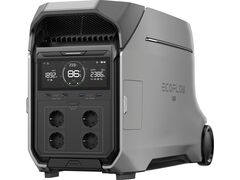
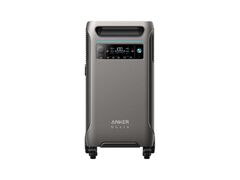
The Delta Pro 3 (4,096Wh, 4,000W, expandable to 12.3kWh) has all its outputs built in, switches over in 10ms and shows a higher discharge efficiency, but costs about 60% more (£2,599) and weighs 51.5kg against 38kg. The SOLIX F3800 (3,840Wh, 6,000W, expandable to 26.9kWh) beats it on power and on expansion, at the cost of 60kg and about £3,163.
On expansion, the Apex 300 sits between the two: 19.4kWh per unit, against 12.3kWh for the Delta Pro 3 and 26.9kWh for the SOLIX F3800. Its own argument is an entry price below both rivals for 3,840W and 6,000 rated cycles, with the drawback of a system that needs accessories to be complete.
Who is the Apex 300 really for?
The Apex 300 is aimed first at home backup that grows in steps: four sockets, 3,840W, a 20ms changeover and the option to add capacity when the budget allows. It also suits an off-grid site or a second home fed by solar panels, provided you plan for the SolarX 4K to make use of a roof array, and a motorhome or converted van where it stays installed permanently, with the Hub D1 and an alternator charger.
It is a poor fit for anyone who wants to move it often (38kg, no wheels), who counts on the 45-minute recharge without installing the Hub A1, who wants USB and 12V outputs without an accessory, or who has to protect servers or a critical workstation, for which the manufacturer advises against the unit.
At £1,599, the base unit stays accessible for 3,840W of power; the real bill depends on the modules, the hub and the solar. Before buying: list the appliances to back up and what they draw, choose between flexible leads and a connection to the consumer unit, and price the complete system rather than the unit alone.