Petrol & dual-fuel generators

Petrol & dual-fuel generators

No product matches these criteria.

Our selection

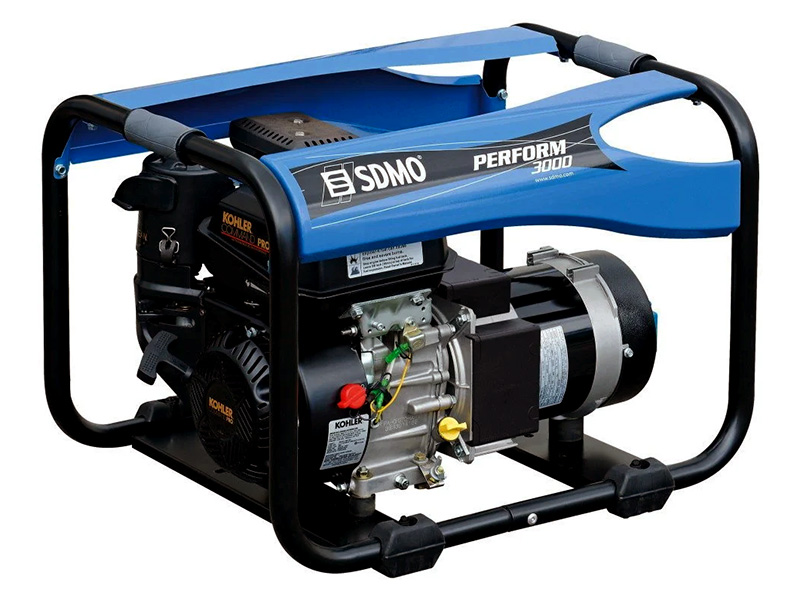
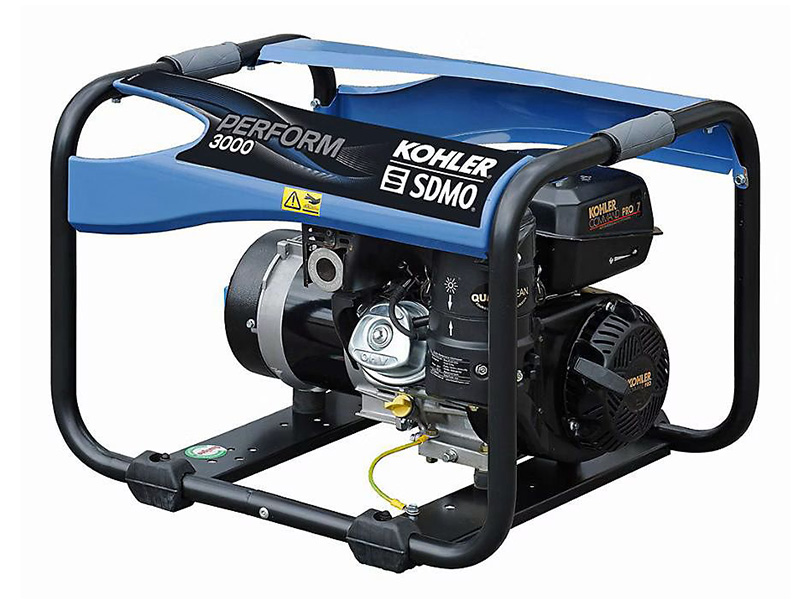
SDMO Perform 3000 Petrol Generator

634.79€ (2)

A Kohler engine, a frame built to take knocks and manufacturing in Brittany: the petrol generator that aims at service life rather than the spec sheet.

  • Output: 2,800 W max, 230 V single-phase
  • Engine: Kohler CH270, 208 cc, petrol
  • Sockets: 2 x 230 V 10/16 A with breaker
  • Runtime: 3.2 h at 75 %, 4.1 L tank
  • A real Kohler engine and French support
The Perform 3000 comes from a manufacturer that has been building generators in Brest since 1966, and it shows in the engineering choices. Rather than an entry-level engine, SDMO fits a 208 cc Kohler CH270, paired with a four-stage Quad Clean air filter that genuinely protects the engine on a dusty site. Output peaks at 2,800 watts single-phase 230 volts, delivered through two 10/16 A sockets each protected by its own breaker. The 4.1 litre tank gives 3.2 hours of runtime at three-quarter load. The tubular frame with anti-shock panels and the 45 kilo weight make it a generator two people carry without thinking about it.
On paper the Perform 3000 impresses nobody: 2,800 watts, no electric start, no screen, no inverter. You can find generators claiming more for half the price. The logic appears once you look at what is inside. The engine is a Kohler CH270, a professional reference found on hire fleet machines, not an anonymous generic block. The Quad Clean air filter, with its four stages of filtration, is not a marketing line: on a dusty site or by a roadside, it is what separates an engine that lasts five years from one that clogs up in a season. SDMO has manufactured in Brest since 1966 and offers a three-year warranty, with a spare parts network genuinely accessible in France, which is far from true of every brand in this segment. In use, pull-cord starting takes no particular effort thanks to the summer/winter setting, and the two 230 volt sockets are individually protected by breakers. The tubular frame with anti-shock panels survives transport in a tipper without a handle snapping off. Three limits to know about. The 4.1 litre tank is small: 3.2 hours at three-quarter load means a jerry can as soon as you work a full day. The noise level, 96 decibels of guaranteed acoustic power, remains that of an open-frame generator: this is not a camping appliance. Finally, it is not an inverter, so no clean power for fragile electronics. For tools, a pump, lighting or a site post, on the other hand, it is a purchase that pays for itself over time.
View product page

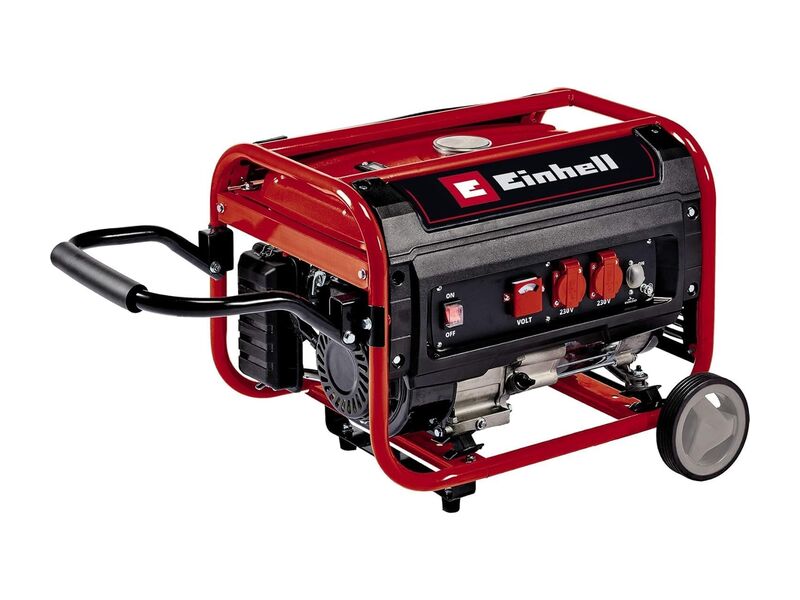
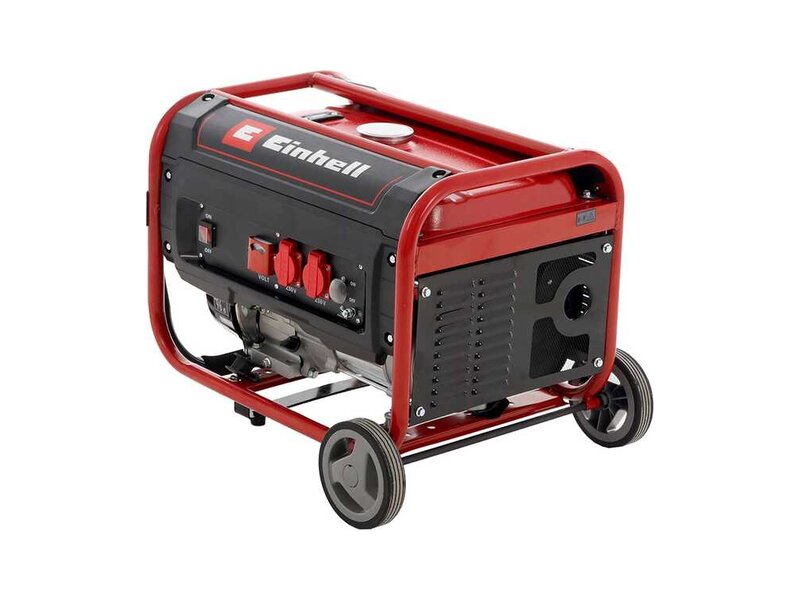
Einhell TC-PG 35/E5

See price and availability (22)

A rugged 3100W petrol generator with a large 15L tank and an AVR voltage regulator, designed for the worksite and backup power.

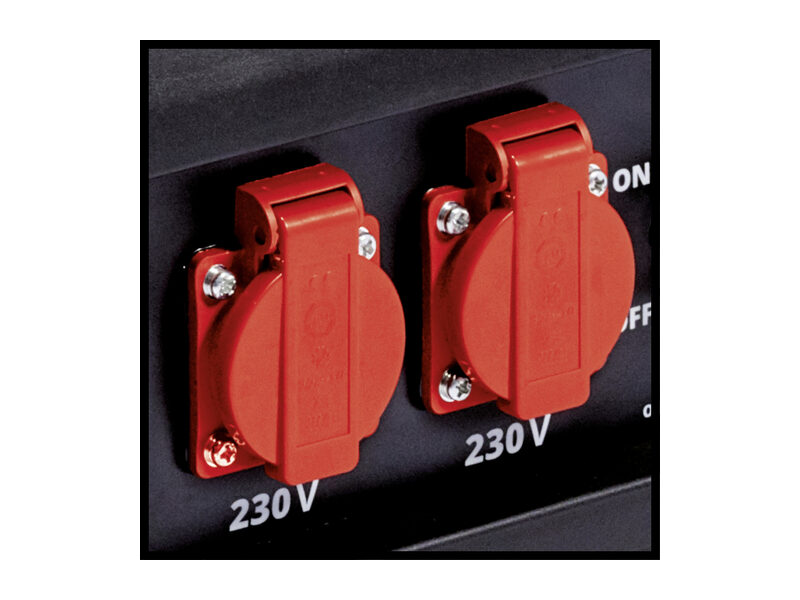
  • Power: 3100 W max (2600 W rated)
  • Engine: 4-stroke petrol, low emissions
  • Outputs: 2 x 230V sockets, AVR regulator
  • Large 15L tank and rugged wheeled frame
The Einhell TC-PG 35/E5 is a conventional 3100W petrol generator (2600W rated), mounted on a tubular frame with wheels and handles for easy moving. Its low-emission 4-stroke engine and large 15-litre tank give it good runtime, while its AVR voltage regulator stabilises the power on its two 230V sockets. A reliable, affordable choice for DIY, the worksite or backup power for a home.
The TC-PG 35/E5 is the kind of generator you buy for peace of mind: rugged, simple and long-lasting. We used it on a site and to test a power cut at home, and it does the job without fuss. Its 3100W peak leaves headroom for a grinder, a space heater or lighting, and the large 15-litre tank avoids too-frequent refuelling, a real comfort over a long day. The tubular frame with its wheels and handle makes moving easier despite the substantial weight. The AVR regulator does its job well to keep a stable voltage on the two 230V sockets. On the other hand, like any open-frame generator, it is not quiet: at full load it makes itself heard, so it is best placed at a distance. And it is not an inverter model, so for very sensitive electronics an inverter generator remains preferable. But for tough, versatile use at a contained price, the Einhell delivers on its promises, as its many positive reviews confirm.
View product page

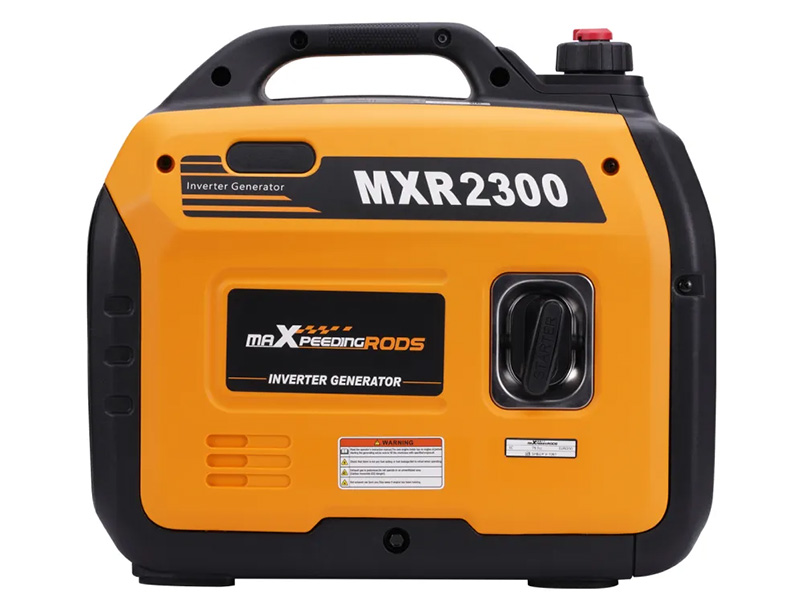
maXpeedingrods MXR2300 Inverter 2300W

See price and availability (16)

1800 watts continuous, a pure sine wave and 58 decibels in economy mode: the generator that powers a motorhome without waking the neighbours.

  • Output: 1800 W continuous, 2300 W peak
  • Power quality: Pure sine wave, THD ≤ 3 %
  • Runtime: 11 h at 25 % load, ECO mode
  • Noise: 58 dB at 7 m in ECO mode, 18 kg
  • Pure sine and 58 dB, safe for electronics
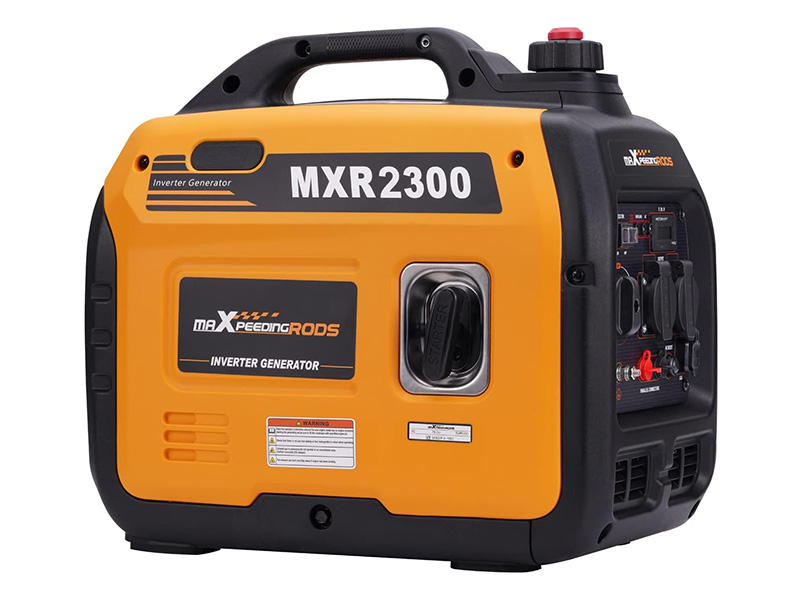
The MXR2300 is an inverter generator, and that changes everything compared with entry-level models: instead of a raw voltage tied to engine speed, it produces a pure sine wave, clean enough for a laptop, a television or a power station. It delivers 1800 watts continuously and absorbs 2300 watts when an appliance starts up. ECO mode matches engine speed to the load, which brings noise down to 58 decibels at seven metres and stretches runtime to eleven hours at quarter load. At 18 kilos with a built-in handle, it stays a two-handed carry.
The MXR2300 sits in the segment compact inverter generators fight over, and it defends a simple argument there: power per pound. For around 370 euros you get 1800 continuous watts of pure sine wave, where equivalent Japanese references often ask double. Power quality is not a marketing detail: with quoted distortion below 3 %, you can plug in a laptop, a television or even recharge a power station without worrying about the supply. A conventional generator without an inverter rules those uses out. ECO mode is the other pleasant surprise: by matching engine speed to the actual load, it drops to 58 decibels measured at seven metres, the level of a conversation, and makes the tank last eleven hours at quarter load. On a campsite or an organised bivouac, that is the difference between a tolerable generator and one you dare not start. The reservations come with what a petrol generator is: 18 kilos to carry, fuel to store, servicing to keep up, and an absolute ban on running it in an enclosed space. This is also a brand that plays volume rather than after-sales network, worth comparing with an Einhell or a Honda if parts availability matters to you. For occasional backup or leisure use, the 4.4 rating across more than 700 reviews reflects a product that delivers what it promises.
View product page

Einhell TC-PG 25/1/E5

390.10€ (10)

Twelve and a half hours on one tank: the small petrol generator that carries a whole night of outage without a refill, and without breaking the bank.

  • Power: 2100 W continuous (2400 W peak)
  • Runtime: 12.5 h at 2/3 load, 15 L tank
  • Outputs: 2 x 230 V sockets, voltmeter, AVR
  • Weight: 36.8 kg, tubular frame
  • A 15-litre tank on a 2100 W generator
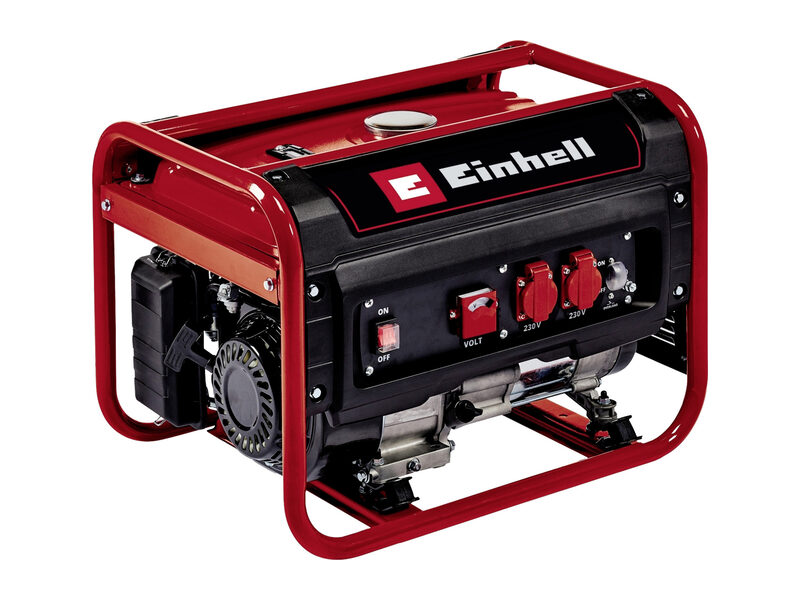
The TC-PG 25/1/E5 is Einhell's entry-level petrol generator, built for backup use and light site work. Its four-stroke engine delivers 2100 watts continuously and 2400 watts at peak across two 230 volt sockets, with a voltmeter to watch the output and AVR regulation to steady it. The 15-litre tank, unusually large for this power class, gives up to 12.5 hours of running at two-thirds load. Tubular frame, recoil start, 36.8 kilos.
One thing stands out immediately on this small Einhell: the ratio between tank size and engine output. Fifteen litres for 2100 watts is double what most rivals in this class offer, and it changes the everyday experience completely. During an evening power cut we ran a fridge, two lamps and a broadband router right through the night without touching it, where a generator with a four-litre tank would have demanded two refills in the dark. The claimed 12.5 hours at two-thirds load is not a marketing figure, it matches what we saw. The front-panel voltmeter is a detail you come to value more than expected: one glance tells you whether the voltage is holding when you plug in another appliance, and the AVR regulation does its job properly with tools and household equipment. The recoil starter needs a firm pull when cold, nothing more. Two honest reservations. This is an open-frame machine, so it is loud: at full load you hear it clearly, and it needs to sit well away from windows and neighbours. And its 36.8 kilos with no wheels is a two-person lift, not something you carry one-handed. For household backup or an off-grid cabin, it remains a very sound buy.
View product page

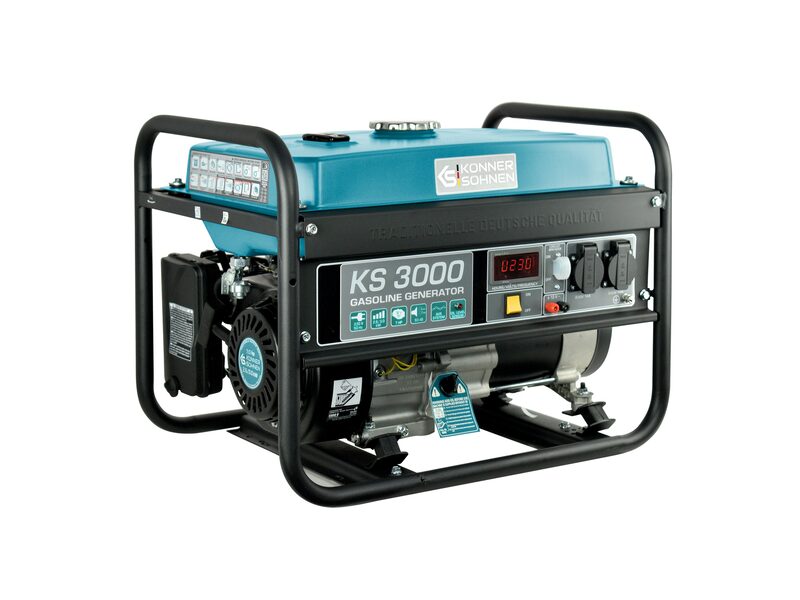
Könner & Söhnen KS 3000

499.00€ (2)

Fifteen hours on one tank, and only 68 decibels at seven metres: the site generator that almost lets you forget it is running.

  • Power: 3 kW peak, 2.6 kW continuous
  • Engine: KS 210, 208 cc, 7 hp, 15 L tank
  • Runtime: 15 h at 50% load
  • Outputs: 2 x 230 V Schuko + 12 V, LED display, AVR
  • 68 dB(A) at 7 m and a 100% copper alternator
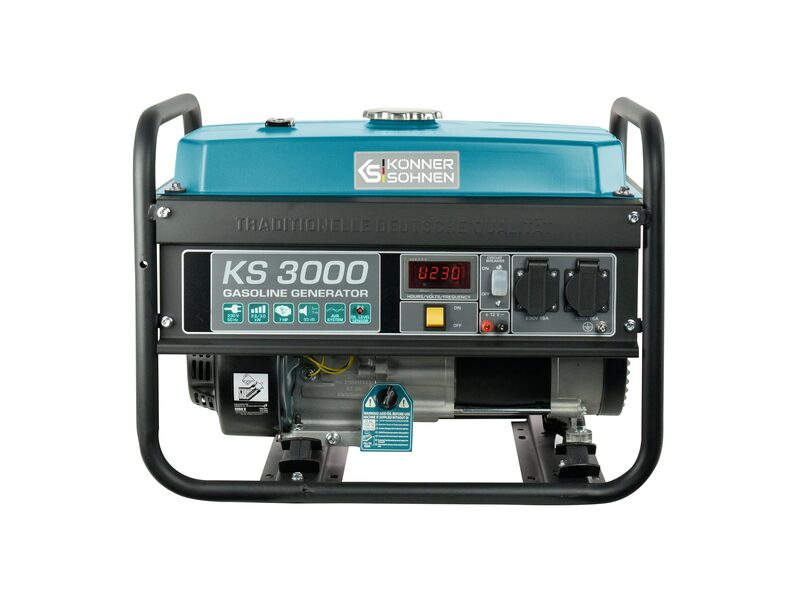
The Könner & Söhnen KS 3000 is an open-frame petrol generator built for household backup and light site work. Its in-house KS 210 engine, 208 cc and 7 hp, delivers 3 kW peak and 2.6 kW in steady operation across two 230 V Schuko sockets and a 12 V output. The 15 litre tank runs fifteen hours at half load, a record in this class, and noise drops to 68 dB(A) measured at seven metres. The alternator is wound in 100% copper, AVR regulation is standard, and an LED display shows voltage, frequency and an hour counter.
Two figures stand out on this spec sheet, and they belong together. The first is runtime: fifteen hours at half load, a day and a night without touching the fuel cap. A 15 litre tank for 2.6 kW in steady operation is a very favourable ratio, where many rivals of the same rating make do with 4 to 6 litres and demand refuelling every three hours. The second is noise: 68 dB(A) measured at seven metres, a figure you would associate with a sound-insulated set rather than an open tubular frame. Take care not to confuse that 68 dB(A) with the 93 dB LWA also quoted: the first is what you hear from a distance, the second a standardised sound-power level that only compares with itself. The rest is solid work rather than spectacle. The 100% copper alternator winding is a genuine quality marker in this segment, where copper-clad aluminium is common and ages less gracefully. AVR regulation stabilises the voltage, the LED display shows voltage, frequency and an hour counter, and a fuel gauge saves you guessing. The low-oil cut-out stops the engine before damage occurs. Two limits to know. The 41.5 kg is a two-person lift, and the wheel kit is not supplied as standard, you have to add the KS 3 KIT. And AVR is not an inverter: for a laptop or fragile electronics, an inverter set remains the safer bet. For tools and household backup, though, this is a very good buy at 499 euros.
View product page

Mecafer MF3800

(2)

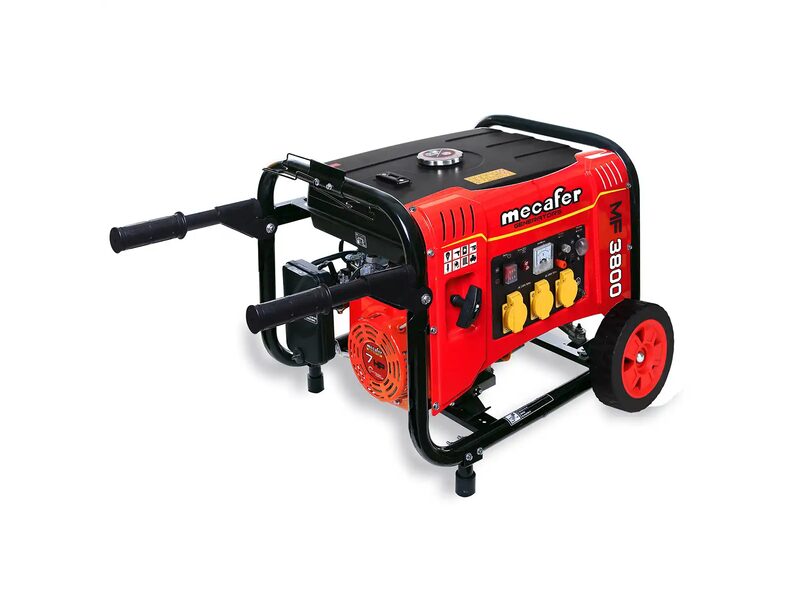
A fifteen litre tank, three sockets and two big wheels: the site generator that runs all day without you touching it.

  • Power: 3500 W peak, 3000 W continuous
  • Engine: 7 hp four-stroke petrol, 15 L tank
  • Runtime: Up to 10 h at 75% load
  • Outputs: 3 x 230 V sockets + 12 V DC, AVR regulation
  • 15 L tank, wheels and folding handles
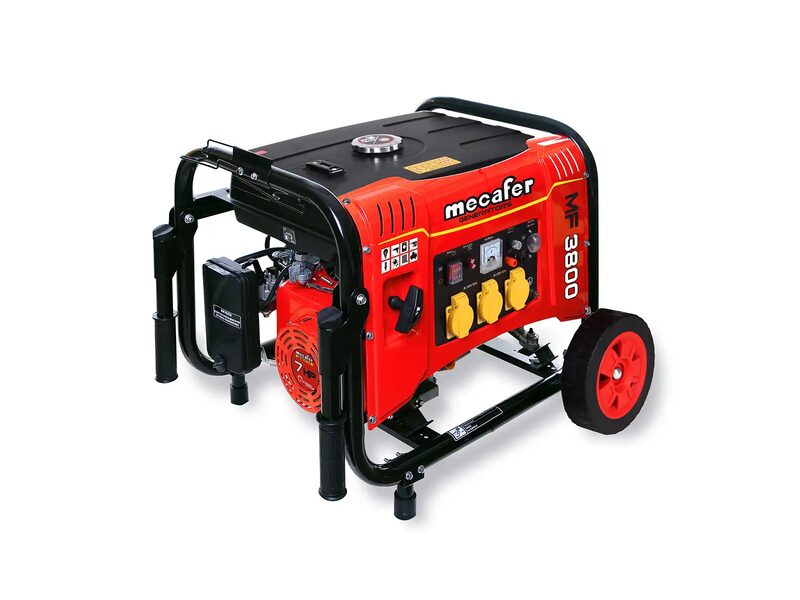
The Mecafer MF3800 is an open-frame site generator, built to run tools where there is no mains supply. Its 7 hp four-stroke petrol engine delivers 3500 W peak and 3000 W in steady operation, spread over three 230 V sockets and a 12 V DC output. The 15 litre tank gives up to 10 hours of runtime at 75% load, a rare figure at this price. AVR regulation stabilises the voltage, the large wheels and folding handles let one person move it over soft ground, and Mecafer commits to 10 years of spare-parts availability.
The MF3800 makes no attempt to charm: it is a site generator, open tubular frame, exposed engine, two big wheels and two handles you fold down to pull it along like a wheelbarrow. That choice has one direct consequence on noise, a quoted 96 dB(A) sound power, and another on use: you put it far away, run an extension lead, and you do not set it down on a campsite pitch. In exchange you get three things no sound-insulated set at the same price offers. First, power: 3000 W in steady operation runs a cement mixer, a circular saw or a compressor, where small inverter sets top out at 1800 or 2000 W. Second, runtime: 15 litres for a quoted 10 hours at 75% load is a full working day without refuelling, when most portable rivals manage four to five hours. Third, equipment: three 230 V sockets let three work stations run at once with no multi-way adapter. Two points call for nuance. The first is weight, 49.2 kg dry: the wheels save you on flat ground, less so on stairs or into the back of a van. The second is the nature of the current: AVR regulation stabilises voltage, but it is not an inverter. For a tool, a floodlight or a pump it is perfect; for a laptop or fragile electronics, an inverter set is the safer choice. That aside, this is one of the soundest power-to-runtime-to-price ratios in the segment.
View product page

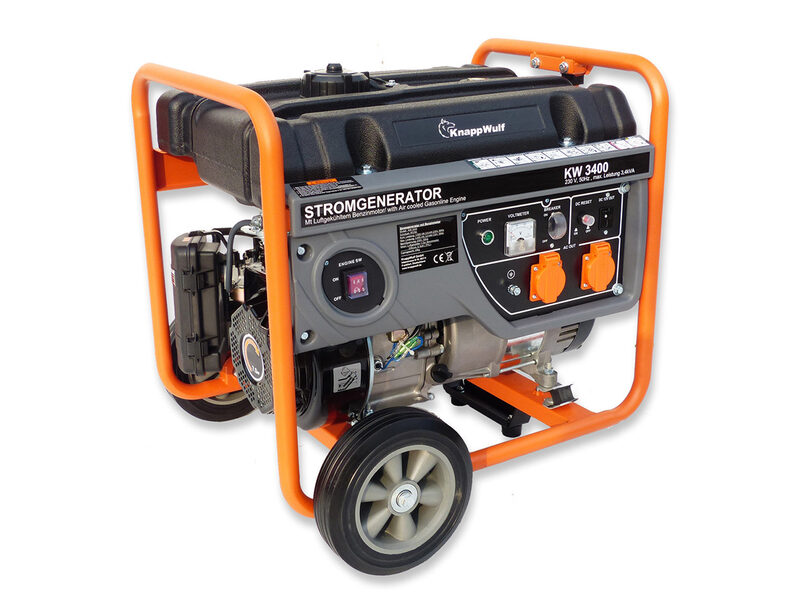
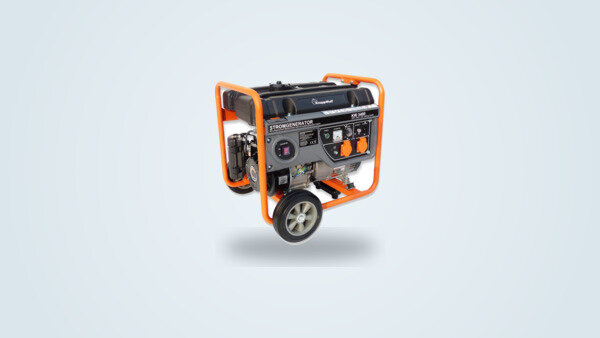
KnappWulf KW3400

539.00€ 289.00€

Eleven to twelve hours on one tank, an analogue voltmeter and two solid wheels: the no-frills site generator, under 300 euros.

  • Power: 3.4 kVA peak (3 kW), 3.1 kVA continuous (2.6 kW)
  • Engine: Single-cylinder four-stroke 208 cc, air-cooled
  • Runtime: 11 to 12 h on one 15 litre tank
  • Outputs: 2 x 230 V sockets + 12 V (7 A), voltmeter, AVR
  • Solid wheels on bearings and a 15 L tank
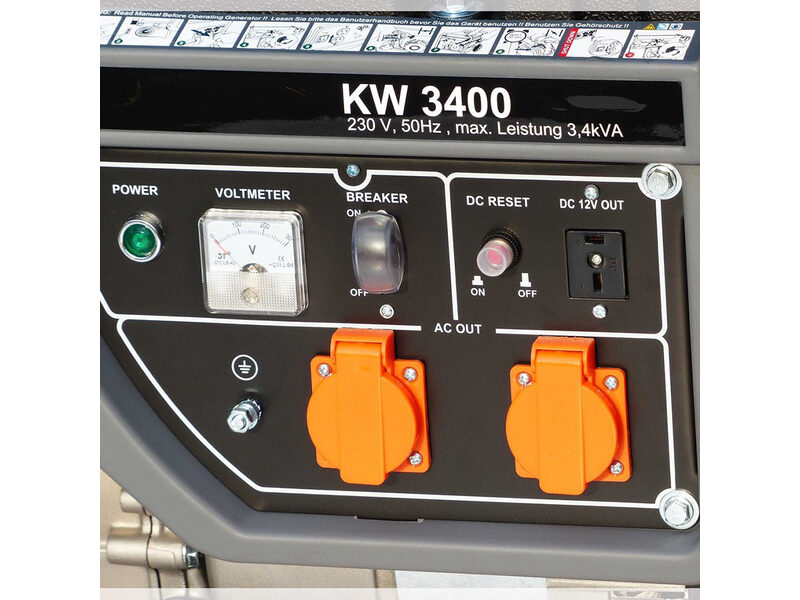
The KnappWulf KW3400 is an open-frame petrol generator sold direct by this German manufacturer based in Frankfurt. Its 208 cc air-cooled single-cylinder four-stroke engine is quoted at 3.4 kVA peak, or 3 kW, for 3.1 kVA in steady operation, or 2.6 kW at 230 V. Two 230 V sockets and a 12 V output rated 7 A make up the panel, with an analogue voltmeter, a 13 A engine circuit breaker and electronic AVR regulation. The 15 litre tank gives eleven to twelve hours of runtime, and the 47 kg rolls on two solid wheels mounted on ball bearings.
The KW3400 is an object without marketing. Orange tubular frame, exposed engine, an analogue voltmeter rather than a screen, two sockets and a start switch: everything the spec sheet promises is visible at a glance, and nothing more. At under 300 euros direct from the maker, that is exactly what you want from a backup generator. Its strengths are concrete. The 15 litre tank gives a quoted eleven to twelve hours of runtime, covering a working day or a night-time outage without a second thought. The wheels are solid and mounted on ball bearings, a detail that matters when dragging 47 kg over rough ground, where many rivals make do with plastic wheels on a bare axle. The 13 A engine breaker and the low-oil cut-out cover the essentials on protection, and electronic AVR regulation stabilises the voltage for power tools. Two honest reservations. First, noise: 96 dB LWA and 76 dB(A) measured at four metres are frank open-frame figures, so install it well away from windows. Second, starting, manual only on this version: the automatic decompressor helps, but a 208 cc engine still calls for a firm pull. KnappWulf offers a KW3400E with electric start and battery for those who prefer a button. Finally, the brand has limited distribution outside Germany, which complicates after-sales support elsewhere in Europe.
View product page

EcoFlow Smart Generator (Dual Fuel)

See price and availability

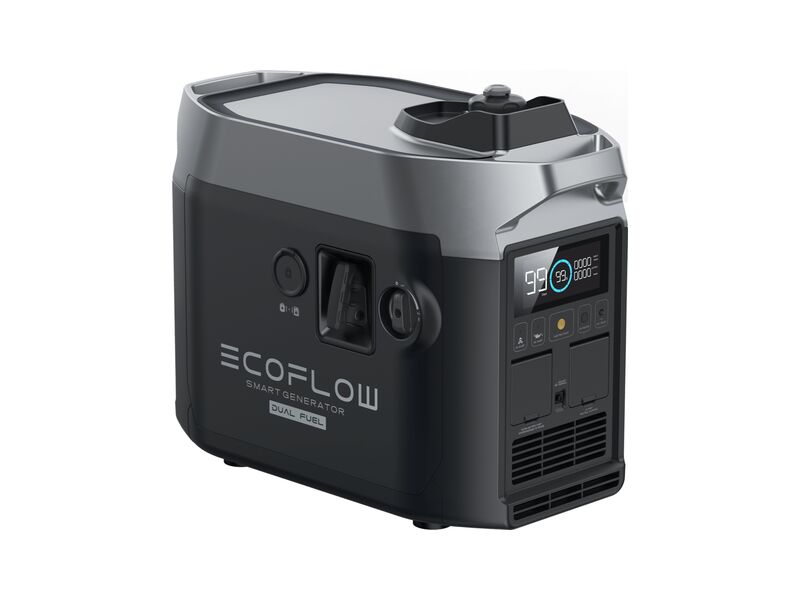
Gasoline or LPG, up to 20 kWh of runtime and automatic start: the smart generator that recharges your EcoFlow station on its own when solar is not enough.

  • Fuel: Gasoline or LPG (dual fuel)
  • Runtime: 5.4 kWh gasoline / up to 20 kWh LPG
  • Power: Up to 1800 W (1600 W on LPG)
  • Smart: Auto start, app, -40% fuel
  • Auto-recharges the Delta, gas or LPG
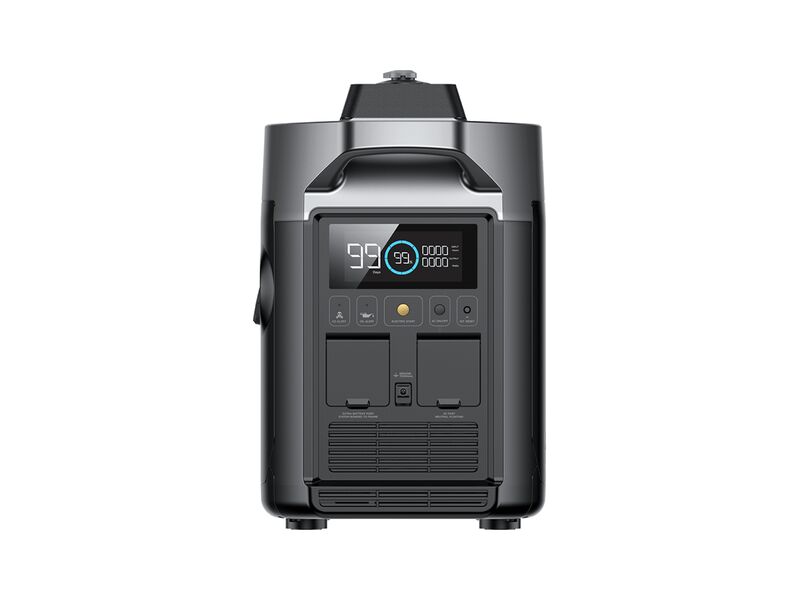
The EcoFlow Smart Generator (Dual Fuel) is an inverter generator designed to complement Delta power stations. It runs on gasoline (4 L tank, around 5.4 kWh) or LPG (up to 20 kWh and 12.5 h of runtime), and delivers up to 1800 W. Its key asset: paired with a Delta station, it starts and stops automatically based on battery level and saves up to 40% fuel. App control, a carbon monoxide detector and contained 56 dB operation make it a self-sufficient backup solution, ideal when the sun is missing.
We paired this dual-fuel generator with a Delta station to test the scenario that really matters for it: long-duration autonomy when solar is no longer enough. That is where it makes full sense. Connected to the station, it starts on its own when the battery drops below a threshold, recharges, then stops, without you having to monitor anything, a life-changing convenience on extended camping trips or during multi-day outages. The dual fuel is a real plus: gasoline for quick backup, LPG for long duration (up to 20 kWh and around a dozen hours), with cleaner combustion and easy bottle storage as a bonus. App control lets you track the level and start recharging remotely, and the CO detector is reassuring. On noise, 56 dB at seven metres is reasonable for a generator, without being silent. Two caveats: the 1800 W power destines it to recharge a station rather than directly power large appliances, and you have to accept the fuel logistics. But as a smart complement to an EcoFlow station, it does exactly what you expect of it.
View product page

← Back to Generators