2600 W continuous, 3100 W for two minutes: what the advertised power really covers
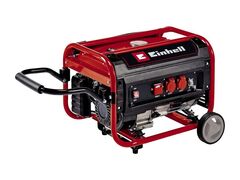
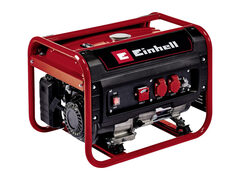
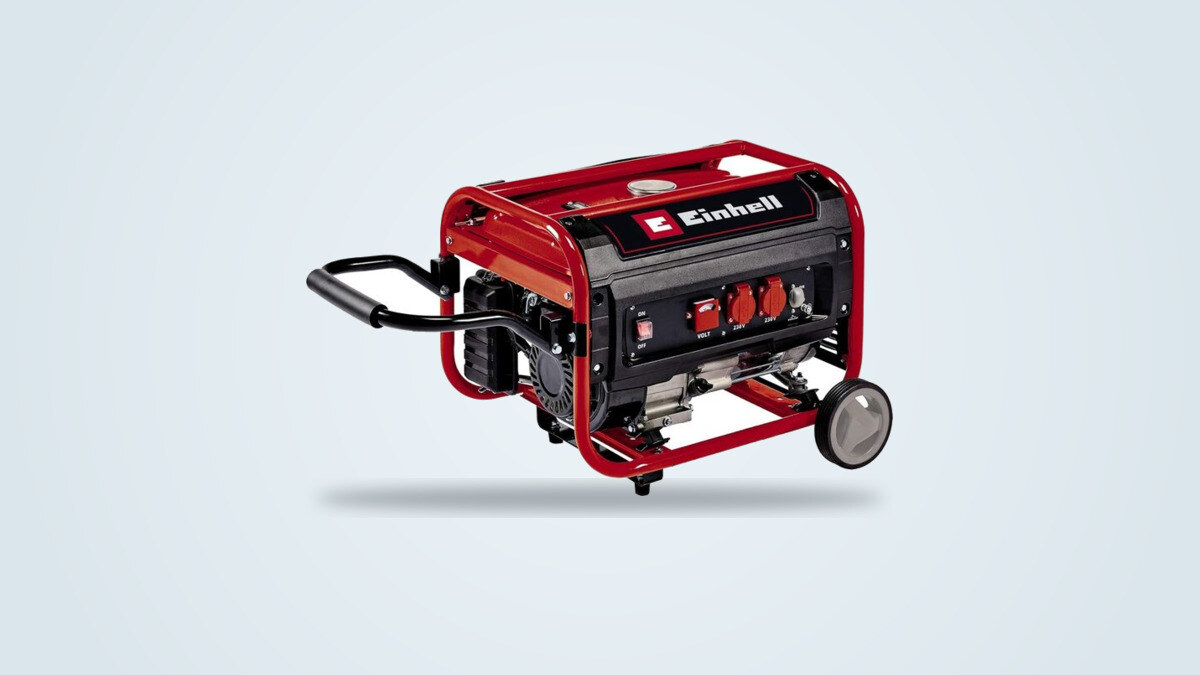
The TC-PG 35/E5 is a conventional (brushed, non-inverter) petrol generator mounted on a wheeled tubular frame. Its official technical data sheet distinguishes three power tiers on its two 230V outlets, a nuance most retail listings leave out: a continuous rated power P(S1) of 2600 W, a maximum power P(S2) of 2800 W held for five minutes, and a peak of 3100 W sustained for only two minutes. The 3100 W figure used in the product name and most retailer listings therefore covers only a very brief surge, typically useful for starting an electric motor.
The AVR (automatic voltage regulation) keeps output voltage stable across both outlets whatever the load within this range, with a rated current of 11.3 A. That is a genuine advantage for running power tools or lighting without a voltage sag when a motor starts: the AVR regulates the amplitude of the current, not its waveform (see below).
15-litre tank, 1.4 L/h at reduced load: a runtime figure worth qualifying
The 15-litre tank is gravity-fed and paired with a level gauge. According to the manufacturer's own figures, consumption reaches 1.4 L/h at reduced load (two-thirds of continuous power, around 1730 W), for a stated runtime of 10.7 hours on a full tank. That is a genuinely good runtime, but it is measured at reduced load, not at the 2600 W continuous rating: pushed harder, any petrol engine burns more fuel, and real runtime drops accordingly, a mechanism retail listings rarely spell out.
The crankcase takes around 0.6 L of oil, with an automatic cut-out if the level runs low: a useful safeguard, since a petrol engine gives no other warning before running dry.
96 dB(A) guaranteed sound power: the real friction point
The guaranteed sound power level of the TC-PG 35/E5 reaches 96 dB(A) (measurement uncertainty of 2.07 dB(A)), the value declared under the noise-emission rules for outdoor power equipment. Unlike a plain sound-pressure reading, which varies with distance and surroundings, guaranteed sound power is a standardised figure that allows two products to be compared directly, wherever each was actually measured. At the operator's position, the official sound pressure level is 74.1 dB(A).
For context: the only other generator reviewed on this site so far, the Honda EU10i, an inverter model with half the power, has a guaranteed sound power of 87 dB(A). The 9 dB(A) gap between the two corresponds to roughly eight times the radiated acoustic energy, a difference very clearly audible to the ear. This is not a flaw specific to the TC-PG 35/E5: it is the direct consequence of an open frame and a conventional engine, cheaper and more powerful than an enclosed inverter design, but mechanically noisier.
| Criterion | Einhell TC-PG 35/E5 | Honda EU10i |
|---|---|---|
| Guaranteed sound power (LWA) | 96 dB(A) | 87 dB(A) |
| Architecture | Conventional, open frame | Inverter, enclosed |
| Continuous power | 2600 W | 900 W |
In practice, this noise level rules out camping use or running it right next to homes, particularly in the evening. It remains acceptable on a daytime worksite or for occasional backup power, provided the unit is placed well away from occupied rooms.
The AVR regulator stabilises voltage, not the waveform
The AVR acts on voltage amplitude: it keeps output close to 230 V regardless of load, within the available power range. It does not, however, act on the shape of the waveform itself. A conventional generator like the TC-PG 35/E5 produces alternating current straight from the alternator, with total harmonic distortion generally higher than an inverter generator, which electronically reconstructs a smoothed sine wave. No distortion figure is published for this exact model, a common gap on conventional generators in this price bracket: with no verifiable number, it is best treated as a point of caution rather than left unmentioned.
In practice, this is not an issue for power tools, lighting or a space heater, which cope well with the variations of conventional current. Caution still applies to very sensitive electronics (high-end laptops, professional audio or photo equipment): an inverter generator remains the safer choice for that kind of use, something the manufacturer itself recommends across its whole conventional range.
Recoil starting and everyday reliability
Starting is by manual recoil only, with no electric starter or battery to maintain: a choice that keeps the unit simple and removes one more electronic component to age over time. An overload circuit breaker protects the 230V outlets, and an automatic low-oil cut-out stops the engine before it can be damaged.
In cold weather, a slightly rich carburettor setting can mean several pulls before the engine catches, a pattern that recurs for this exact model. That is not a fault, just a carburation setting that can be corrected. Outside of that specific case, starting hot or cold under normal conditions is generally trouble-free. The manufacturer's warranty runs for two years.
42 kg on wheels: portability built for rolling, not carrying
The TC-PG 35/E5 weighs around 42 kg. Its tubular frame includes two large wheels and a carry handle, designed to roll the unit around a worksite or between storage and where it is needed, not to be lifted and carried. The IP23M protection rating (protected against solid objects larger than 12 mm and against water spray up to 60° from vertical) allows for reasonable outdoor use, without tolerating direct, prolonged exposure to rain.
Loading it alone into a car boot is more awkward than with a small hand-carried inverter unit of 13 to 15 kg: it is best rolled right up to the vehicle and lifted with a second pair of hands if needed.
Build quality and the Classic range: entry-level ruggedness, not a continuous-duty professional tool
Einhell is a German consumer tools manufacturer based in Landau an der Isar, Bavaria, active in this market since the 1960s. The TC-PG 35/E5 belongs to its "Classic" range, positioned by the manufacturer itself for occasional rather than continuous, intensive professional use, as opposed to its higher-tier ranges. Design stays German; manufacturing is spread across several production sites worldwide under head-office oversight.
The standard manufacturer warranty runs for two years. Overall feedback on this widely distributed model shows no recurring structural fault or recall signal: the real friction points concentrate on noise and, occasionally, the cold-start behaviour already covered, not on early mechanical failure.
Against the competition: other petrol generators and the inverter alternative
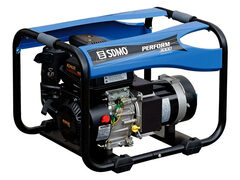
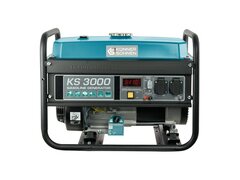
Within the catalogue itself, two conventional petrol generators sit in a similar position: the Konner & Sohnen KS 3000 and the SDMO Perform 3000, both in a comparable power and price bracket. Choosing between these models comes down mostly to brand reputation, spare-parts availability and local after-sales support: the differences in power and tank size are secondary next to the far larger gap that separates any conventional generator from an inverter one.
The Honda EU10i, the only inverter generator reviewed on this site so far, illustrates that gap well: noticeably quieter (87 versus 96 dB(A) guaranteed sound power) and lighter (13 versus 42 kg), it delivers in return only a third of the TC-PG 35/E5's continuous power (900 versus 2600 W), at a considerably higher price for the power on offer. The choice therefore comes down to intended use: power and runtime at a contained price for the TC-PG 35/E5, quiet operation and portability for an inverter generator.
Worksite work and home power cuts: where it fits best
The TC-PG 35/E5 suits two specific uses well: running power tools on a worksite (an angle grinder, a drill, a small welder, lighting) and providing backup power for a home during an outage, for a space heater, a fridge or lighting. In both cases, noise is manageable through distance and a fairly limited runtime, and the 2600 W continuous rating comfortably covers most one-off needs of this kind.
It suits camping or wild-camping trips far less well, where the noise quickly becomes a problem for both the user and any neighbours, and it is a poor fit for backup power that would need to run for hours on end right next to occupied rooms in the evening or overnight.
Who the TC-PG 35/E5 suits, and who should skip it
It suits anyone after high continuous power and a good tank runtime at a contained price, for a worksite or the occasional home backup during a power cut, who can live with the noise of an open-frame generator.
It does not suit anyone who needs quiet running (camping, night-time use near homes), an inverter generator for very sensitive electronics, or a light unit to hand-carry rather than roll.