A French jobsite generator, pure petrol despite the sub-category it sits in
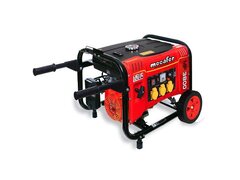
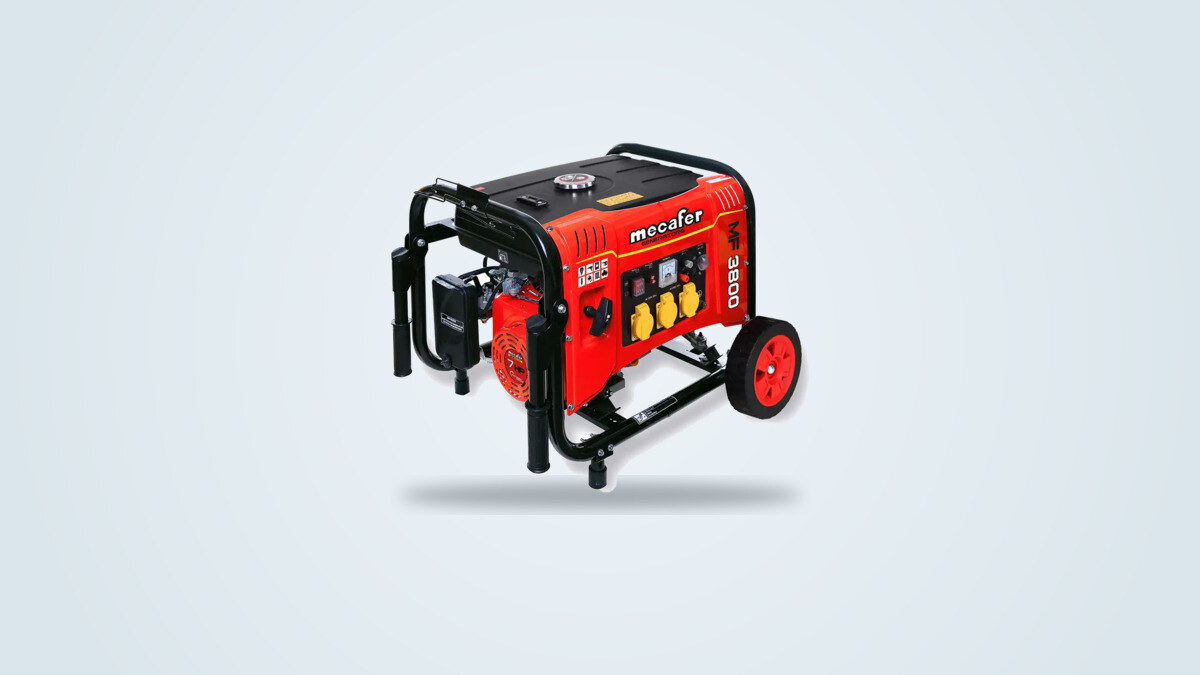
The Mecafer MF3800 is an open-frame petrol generator: exposed engine, two large wheels, and two folding handles you lower to pull it along like a wheelbarrow. Mecafer is a French brand founded in 1976 in Tours, now based in Valence, historically a compressed-air compressor specialist and part of the Thermador group since 2015. The engine block carries the reference DJ170F, a 208 cc four-stroke single-cylinder unit rated at 7 hp maximum and 6.5 hp continuous at 3600 rpm, figures drawn from the manufacturer's own technical manual.
One clarification worth making up front: the MF3800 runs on petrol only (regular unleaded or E10). No dual-fuel version is sold under this same name, unlike other models in this sub-category that offer a petrol-only version and a petrol/LPG version under a very similar label. The MF3800 targets jobsite and home-backup use: running power tools off the grid, on a plot of land, a house under renovation, or stepping in during a prolonged outage.
3000 W continuous, 3500 W peak: the highest power in the comparison
The MF3800's retail spec sheet states 3500 W maximum power (LTP) and 3000 W continuous power (COP). Both figures match exactly in the manufacturer's official technical manual, which expresses them as 3.5 kW/15 A peak and 3.0 kW/13 A continuous at 230V: a cross-check across two independent Mecafer documents, a step beyond what most retail spec sheets alone offer.
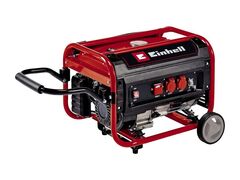
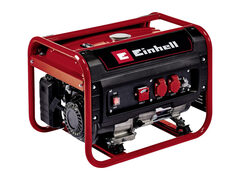
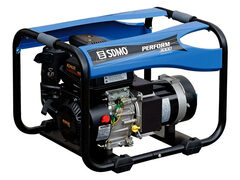
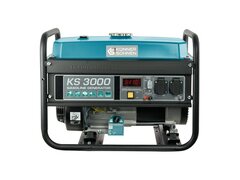
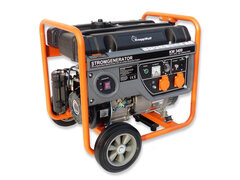
With 3000 W available continuously, the MF3800 becomes the most powerful of the six petrol and dual-fuel generators already reviewed on this site, ahead of the tied 2600 W of the Konner & Sohnen KS 3000, the Einhell TC-PG 35 and the KnappWulf KW3400, the 2400 W of the SDMO Perform 3000, and the 2100 W of the Einhell TC-PG 25/1/E5. In practice, that margin covers a cement mixer, a jobsite circular saw and a floodlight running at once, or several work stations sharing its three 230V outlets without having to pick between two tools.
15 litres, 10 hours at 75% load: the most energy-efficient tank in the comparison
The MF3800's tank holds 15 litres, a common size in this sub-category. What is less common is the load level Mecafer uses to state its runtime: 10 hours at 75% load, around 2250 W drawn continuously, per the product's retail spec sheet. The manufacturer's official technical manual gives a specific fuel consumption of 413 grams of petrol per kilowatt-hour produced at that same 75% load, and states a slightly longer runtime, 11 hours, for the same full tank. That minor gap between two Mecafer documents is not a red flag by itself, but it is worth flagging: the more conservative figure, 10 hours, is the safer one to reason from.
Taken on its own, this hours-based ranking puts the MF3800 behind: it runs for less time on a full tank than the Konner & Sohnen KS 3000, the Einhell TC-PG 25/1/E5, the KnappWulf KW3400, or even the Einhell TC-PG 35. But that ranking is not comparing like with like: each of those four other generators is rated by its manufacturer at a noticeably lighter load (50 to 67% of its own continuous power), a more forgiving condition that mechanically stretches the stated runtime. The MF3800, by contrast, is rated at 75% load, or 2250 W, a tougher regime. Simply multiplying the stated hours by the power actually drawn at that load gives the total energy a full tank delivers, the figure that is genuinely comparable:
| Generator | Stated runtime | Power at that load | Energy per tank |
|---|---|---|---|
| Mecafer MF3800 | 10 h at 75% | 2250 W | 22.5 kWh |
| Konner & Sohnen KS 3000 | 15 h at 50% | 1300 W | 19.5 kWh |
| Einhell TC-PG 35 | 10.7 h at 2/3 | 1733 W | 18.5 kWh |
| Einhell TC-PG 25/1/E5 | 12.5 h at 2/3 | 1400 W | 17.5 kWh |
Even using Mecafer's more conservative figure (10 hours, not the technical manual's 11), the MF3800 delivers more energy per tank than the three other 15-litre-tank generators already reviewed on this site, despite being rated at the toughest load of the four. The SDMO Perform 3000 and the KnappWulf KW3400 fall outside this comparison: the first because its 4.1-litre tank is not comparable, the second because its own review notes that the load level behind its 11-to-12-hour figure is not specified by the manufacturer.
96 dB(A) guaranteed sound power: among the loudest in the comparison
Guaranteed sound power (LWA) is the standardised rating manufacturers publish for outdoor power equipment: unlike a plain sound-pressure reading, which changes with distance and surroundings, it lets two products be compared directly no matter where each was actually measured. The MF3800 carries a guaranteed sound power of 96 dB(A), a figure confirmed identically on the retail spec sheet and on the manufacturer's technical manual.
| Criterion | Mecafer MF3800 | Konner & Sohnen KS 3000 | Einhell TC-PG 35 | Einhell TC-PG 25/1/E5 | SDMO Perform 3000 | KnappWulf KW3400 |
|---|---|---|---|---|---|---|
| Guaranteed sound power (LWA) | 96 dB(A) | 93 dB | 96 dB | 96 dB | 96 dB | 96 dB |
| Manufacturer's secondary reading | 79.8 dB(A) at 1 m | 68 dB(A) at 7 m | 74.1 dB(A) at operator position | 73.1 dB(A) at operator position | 67 dB(A) at 7 m | 76 dB(A) at 4 m |
On this standardised measure, the MF3800 ties with four of the five other generators in the comparison, and only the Konner & Sohnen KS 3000 does better, at 93 dB. The 79.8 dB(A) secondary reading Mecafer publishes is not directly comparable to the other figures in the table: it is taken at just 1 metre, a much shorter distance than the 4 to 7 metres used by the other manufacturers, which mechanically makes it look higher. It does offer one useful, purely educational takeaway: the 16.2 dB(A) gap between that reading and the guaranteed sound power illustrates the difference between the two measures on its own, one describing the total acoustic energy radiated by the source, the other what you actually hear at a specific spot. In practice, this noise level rules out camping or use near homes in the evening, but sits within the norm for a daytime open-frame jobsite generator.
AVR regulation and recoil starting: what the stated reliability does, and does not, cover
The MF3800 is regulated by an AVR (Automatic Voltage Regulation) system that keeps output voltage close to 230V regardless of load, within its 3000 W ceiling. As with the five other petrol and dual-fuel generators already reviewed on this site, this regulation acts on voltage amplitude, not on the waveform: the MF3800 is a conventional generator, not an inverter one, and its alternator produces current straight off the spinning engine. No harmonic distortion figure is published for this model, a gap common to every conventional generator in this price range.
Starting is by manual recoil only, with electronic TCI ignition. No electric-start version is listed for this model, unlike the Konner & Sohnen KS 3000, which offers a KS 3000E variant. An automatic warning shuts the engine down if the oil level runs low, and a circuit breaker protects the three 230V outlets against overloads. No information available lets us confirm or rule out a specific cold-start issue on this exact model, unlike the Einhell TC-PG 35, whose slightly rich carburetor setting is documented.
An official 2022 recall: electric shock risk if the voltmeter cracked
The MF3800 (reference 450138, the same EAN code as the product linked from this review) was the subject of an official recall registered on November 18, 2022, on France's government consumer-safety recall platform. The stated reason was an electric-shock risk if the unit's voltmeter cracked and was touched while the generator was running. The recall covers units sold new between April 15 and November 18, 2022, identified by several specific manufacturing lot numbers.
No other Mecafer recall appears on the same government platform to date: this is an isolated, documented event, not a repeated pattern for the brand. It nonetheless remains the only safety recall identified among the six petrol and dual-fuel generators already reviewed on this site, which is reason enough for extra care when buying an older secondhand unit: confirming the metal guard is fitted to the voltmeter before use is a simple, free precaution.
Mecafer, the Thermador group, and ten years of spare parts: a build-quality picture worth nuancing
Mecafer is a French brand founded in 1976, now part of the Thermador group since 2015, a French equipment-distribution group. The brand remains best known for its compressed-air compressors, with generators a more recent addition to its lineup. The MF3800's engine block, the 208 cc DJ170F, is a generic single-cylinder design widely used across entry- and mid-range generators: it is not a recognised third-party engine brand like the Kohler unit in the SDMO Perform 3000, but nothing in this research points to a specific flaw tied to this block either.
On strictly commercial terms, Mecafer offers a two-year warranty, matching the Konner & Sohnen KS 3000, the Einhell TC-PG 35 and the Einhell TC-PG 25/1/E5, though short of the SDMO Perform 3000's three years. The ten-year spare-parts commitment, on the other hand, has no equivalent among the five other generators already reviewed on this site: a genuine plus for a machine whose useful life runs well past its commercial warranty.
This build-quality picture still has to be read alongside the 2022 safety recall covered above: it is the only one of the six petrol and dual-fuel generators in this comparison carrying an official recall. The MF3800's build-quality score sits clearly below the 4.0-to-4.3 range recorded by the five other reviews already published in this sub-category, none of which report any recall or known safety defect.
49.2 kg on wheels: the heaviest in the comparison, but wheel-equipped from the factory
The MF3800 weighs 49.2 kg net, in a 605 x 470 x 495 mm footprint, making it the heaviest of the six petrol and dual-fuel generators already reviewed on this site, ahead of the KnappWulf KW3400 (47 kg), the SDMO Perform 3000 (45 kg), the Einhell TC-PG 35 (42 kg), the Konner & Sohnen KS 3000 (41.5 kg) and the Einhell TC-PG 25/1/E5 (36.8 kg).
In exchange, the tubular frame includes two large wheels and two folding handles as standard, equipment the Konner & Sohnen KS 3000, the Einhell TC-PG 25/1/E5 and the SDMO Perform 3000 do not ship with (an optional kit for the first, no wheel option at all for the other two). Only the Einhell TC-PG 35 and the KnappWulf KW3400 share this advantage. On flat or soft ground, the wheels let one person move the unit like a wheelbarrow; loading it into a car boot or up a flight of stairs, on the other hand, takes two people, a bit more so than with the lighter generators in this comparison.
Against the five other petrol and dual-fuel generators already reviewed on this site
The MF3800 holds an unusual position in this sub-category: the most powerful continuously, the best at turning a full tank into usable energy at an equal load, but also the heaviest and the only one with a documented safety recall. The table below sums up the real differences between the six.
| Criterion | Mecafer MF3800 | Einhell TC-PG 35 | Einhell TC-PG 25/1/E5 | SDMO Perform 3000 | Konner & Sohnen KS 3000 | KnappWulf KW3400 |
|---|---|---|---|---|---|---|
| Continuous power | 3000 W | 2600 W | 2100 W | 2400 W | 2600 W | 2600 W |
| Peak power | 3500 W | 3100 W | 2400 W | 2800 W | 3000 W | 3000 W |
| Tank | 15 L | 15 L | 15 L | 4.1 L | 15 L | 15 L |
| Guaranteed sound power | 96 dB(A) | 96 dB | 96 dB | 96 dB | 93 dB | 96 dB |
| Weight | 49.2 kg | 42 kg | 36.8 kg | 45 kg | 41.5 kg | 47 kg |
| Wheels as standard | Yes | Yes | No | No | No (kit optional) | Yes, ball-bearing |
| Commercial warranty | 2 years | 2 years | 2 years | 3 years | 2 years | Not identified |
| Documented safety recall | Yes (2022, fixed) | No | No | No | No | No |
| Observed price | ≈ £390 | ≈ £293 | ≈ £303 | ≈ £560 | ≈ £364 | ≈ £247 |
The MF3800 wins on power and on energy delivered per tank at an equal load (see above), and it shares the standard-wheels advantage with the Einhell TC-PG 35 and the KnappWulf KW3400. It loses out on weight, where it becomes the heaviest of the group, and above all on its track record: it is the only one of the six with a documented safety recall, even a fixed one. On a tight budget, the Einhell TC-PG 25/1/E5 or the KnappWulf KW3400 cost less; for an engine with a professional-grade reputation, the SDMO Perform 3000 keeps the edge despite its tiny tank.
Who the MF3800 suits, and who should skip it
It suits anyone after the highest continuous power and the best energy yield per tank in this sub-category, for a multi-station jobsite or demanding home backup power, who can live with the noise of an open-frame generator and its 49.2 kg bulk.
It does not suit anyone after quiet running (camping, nighttime use near homes: the Konner & Sohnen KS 3000 does better here), an inverter generator for sensitive electronics, the lightest unit in the category, or anyone who would rather avoid any recall history, even a resolved one.