
Genuine inverter technology, at a price well below Japanese references
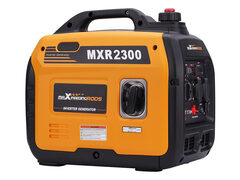
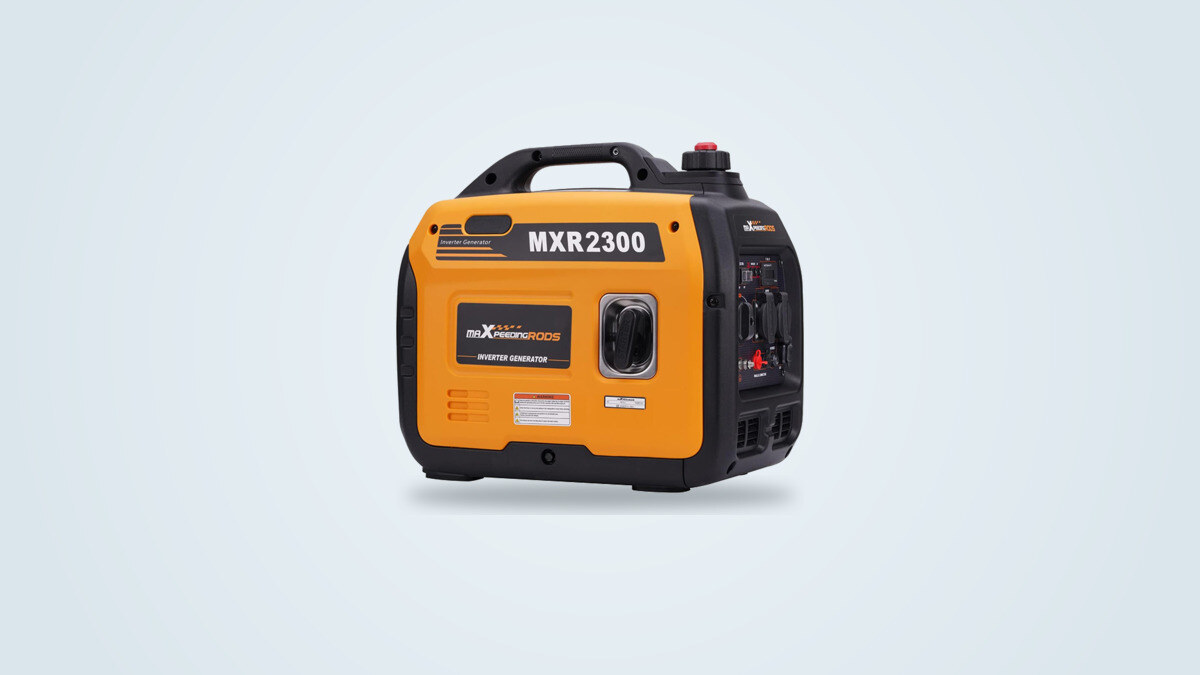
The MXR2300 works on the inverter principle: instead of a raw voltage tied to engine speed, the onboard electronics rebuild a clean sine wave, which allows a laptop, a television or a power station to be powered without risk to these devices. A conventional generator without an inverter is not recommended for these uses, a difference of principle rather than a marketing claim.
At comparable output, the price gap with an established Japanese reference stays clear, on the order of three to five times depending on the sales channel. This is the central argument for this product, and it is a real one.
Claimed noise and runtime: manufacturer figures, copied without verification
The 58 dB at 7 metres in ECO mode at 25 % load, the 11-hour runtime at that same level, and the 6.5 hours at half load are the figures published by the manufacturer. They come back identically on almost every French-language comparison site consulted, including those with the word "test" in their title. None of these sites describes its own measurement protocol (calibrated sound metre, verified distance, ambient conditions), and one of them explicitly acknowledges reusing the figures supplied by the manufacturer. This is therefore a widely circulated manufacturer figure, not an independent measurement.
Two separate signals suggest a real noise level higher than claimed
Two elements, of a different nature, point in the same direction without amounting to formal proof. The first is a figure of 62 dB put forward by a comparison site, with no described protocol: a 4 dB gap from the manufacturer's claim, to be treated as a simple cautionary signal rather than a reliable counter-measurement. The second comes from an extended ten-day use in a motorhome at 2000 metres altitude, where the unit is described as two to three times noisier than an equivalent Japanese reference generator in terms of quietness, while staying acceptable below 500 W of load.
Neither element replaces a calibrated sound-metre measurement, and the second remains a single case. But both point in the same direction on a matter the manufacturer alone claims, which justifies clearly qualifying the claimed 58 dB rather than repeating it as-is.
MXR2300 or MXR2350: a different trade-off, not a simple successor
The MXR2300 coexists with the MXR2350, newer and lighter (15 kg against 18 kg), but with a noticeably smaller tank (2.4 L against 4 L), and therefore less runtime at equal load. This is not a direct replacement but a different trade-off between weight and runtime: worth checking precisely before buying, since the two references are close in name. Regional variants (US, CA, EU) and a version with a digital display also exist within the same 2300 W range.
Cold and high-altitude starting: a documented real-world use
An extended ten-day use in a motorhome at 2000 metres altitude, with oil suited to low temperatures, showed no starting difficulty down to around -14 °C, with instant starts throughout the period. This point is reassuring about cold-weather operation, a frequent use for this type of unit for winter backup or in the mountains, even though a single case does not replace a repeated cold-testing protocol.
An isolated restart failure signal, not to be generalised
One failure case exists for this specific model: a unit that ran normally during its first outings later refuses to restart. This type of failure (unable to start after an initially correct run) is a known failure mode for small combustion engines, generally linked to ignition or the carburettor, though it is not possible to know whether this is an isolated case or the start of a trend for this model. No other comparable and detailed report was found for this specific model, which calls for caution in both directions: neither downplaying the signal nor generalising it from a single case.
No automatic carbon monoxide detection confirmed
A brand first known for automotive parts, a separate division for generators
maXpeedingrods is primarily known as a seller of automotive and engine parts (tie rods, suspension kits), a segment where quality criticism exists (non-conforming fasteners, poorly machined parts). This activity is unrelated to the manufacturing of generators, a separate product line. It would nonetheless be inaccurate to fully ignore this brand context when assessing the overall confidence to place in the manufacturer, particularly regarding after-sales service, which can take several months to reach a return or a refund.
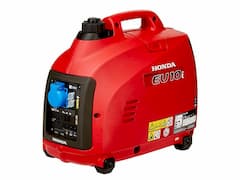
Against the Honda EU10i, a trade-off between price and certainty
The Honda EU10i remains the best-documented reference in its category on this site.
| Criterion | maXpeedingrods MXR2300 | Honda EU10i |
|---|---|---|
| Continuous power | 1800 W | 900 W |
| Noise at 7 m, reduced load | 58 dB claimed, likely higher in practice | 52 dB, consistent with official data |
| Weight | 18 kg | 13 kg |
| Price seen | ≈ 369 € | 999 to 1279 € |
The MXR2300 offers double the continuous power for roughly a third of the price, a real argument for a tight budget or occasional use. The Honda keeps the advantage on quietness at reduced load and on the depth of documentation available: its reputation for longevity rests on real cases exceeding several thousand hours, whereas the MXR2300 has no comparable track record to date. The choice largely comes down to a trade-off between a noticeably lower price and a higher level of certainty over time.
Who it suits, and who it does not
It suits anyone looking for genuine inverter technology on a limited budget, for occasional camping use, occasional backup power or light jobsite work, and who accepts a real noise level probably a little above the claimed 58 dB.
It does not suit anyone who camps regularly right next to noise-sensitive neighbours and wants the quietest option in the category, nor anyone who needs a proven multi-year reliability track record before investing, a figure that simply does not yet exist for this model.