
Why aim for 100 W and above?
For years, a power bank existed to rescue a phone at the end of the day. 18 W was plenty and nobody asked questions. Since USB-C started powering laptops too, the maths changed: a 14-inch MacBook Pro asks for 96 W to charge at its rated speed, a Windows ultrabook needs 65 W to 100 W, a handheld console around 45 W.
Below 100 W a power bank will still charge a laptop, but slowly, and often more slowly than the machine drains itself if you keep working. That is the whole difference between “compatible” and “at full speed”. Above 100 W you enter the Extended Power Range (EPR) introduced by USB Power Delivery 3.1: voltage can climb to 48 V and a single port can carry up to 240 W.
European rules have accelerated the shift: since 28 April 2026, laptops sold in the European Union must also feature a USB-C charging port, following phones and tablets in December 2024. We cover that timeline in our piece on the EU USB-C mandate.
How we picked these models
The fast-charging market is drowning in marketing numbers. A pack advertised at 145 W may well cap out at 65 W on its main port, the 145 W figure only appearing when three outputs run at once. So we ignored that kind of claim and applied five criteria:
- Power on a single port: that is what sets laptop charging speed, not the combined total.
- Real capacity in watt-hours (Wh), the only figure that compares honestly across models.
- How fast the pack itself recharges: a 90 Wh reserve that takes five hours to refill is a false friend.
- Air travel compliance: every model here stays under 100 Wh, so it flies in the cabin with no paperwork.
- Useful hardware: built-in cable, display, port count, cell quality.
The result: five packs, from €60 to €180, that actually keep their promises. All of them sit in our power banks section.
1. Best power per euro: Ugreen Nexode 20000 145 W
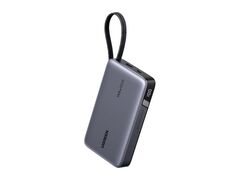
This is the one we recommend most often, by a wide margin. For around sixty euros the Ugreen Nexode 20000 145 W packs 20,000 mAh (72 Wh) and, more importantly, a built-in 100 W USB-C cable. That detail matters: no cable left on the bedside table, no doubt about its rating, and 100 W available instantly for an ultrabook.
Alongside it, a second USB-C port reaches 45 W and a USB-A rounds things off, for 145 W shared across three devices. The pack itself takes 80 W in, which refills it completely in an hour and a half: plug it in over lunch and it leaves full.
Its limits are honest ones: 72 Wh of reserve is one full MacBook Air charge and not much more, and it never exceeds 100 W per port. For the vast majority of mobile professional use, that is plenty.
2. The all-rounder: Anker Prime 20000 (200 W)
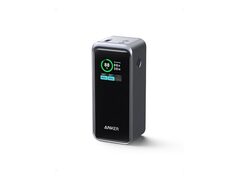
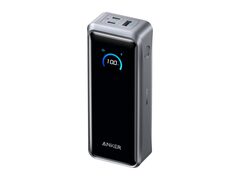
Same capacity as the Ugreen (72 Wh), but electronics in another league: the Anker Prime 20000 delivers 100 W on each of its two USB-C ports at the same time, for 200 W total with the USB-A. In practice it charges two laptops at full speed simultaneously, which is still rare in this size.
It also takes 100 W in and refills in 1 h 15. Its small display shows live wattage, remaining charge and estimated time, which helps enormously: you can see straight away if a cable is throttling charging to 60 W.
Budget around €115: the premium over the Ugreen makes sense if you charge several power-hungry devices at once, or if the display and companion app appeal to you.
3. The endurance pick: EcoFlow Rapid Pro 27K
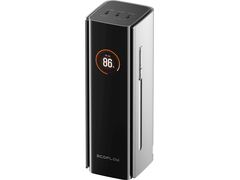
At 27,650 mAh, or 99.54 Wh, the EcoFlow Rapid Pro 27K deliberately grazes the 100 Wh regulatory ceiling allowed in the cabin without prior airline approval. It is the most energy you can legally carry in a backpack, and EcoFlow built its pitch around it.
It delivers 140 W on a single USB-C port thanks to PD 3.1, and 300 W in total across four USB-C ports. A 140 W cable is built into the case, the LCD reports state of charge, and the EcoFlow app allows finer monitoring.
This is the pack for remote workers stacking long flights or full days away from an outlet: two complete ultrabook charges, or one laptop charge plus a week of phone. Predictably, it is heavy and costs around €165.
4. The long-life choice: Aferiy Nano100 (LiFePO4)
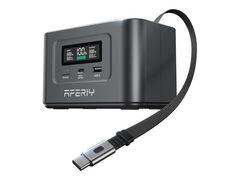
Here is the genuine oddity of this line-up. Where every other model uses conventional lithium-ion cells, the Aferiy Nano100 runs LiFePO4 chemistry, the same as power stations: over 2,000 charge cycles claimed, against 500 to 800 for an ordinary power bank.
In plain terms, where a classic pack starts fading after two or three years of daily use, this one is designed to last a decade. LiFePO4 is also markedly more thermally stable, a point we unpack in our feature on Li-ion versus LiFePO4.
Power is not sacrificed: 99 Wh (31,000 mAh), two USB-C ports at 100 W, 145 W total, a retractable built-in USB-C cable and a full recharge in an hour and a half. The trade-off shows on the scales, LiFePO4 being less energy-dense than lithium-ion. At a little over €90, it is the rational buy-once choice.
5. The most powerful: Anker Prime 26250 (300 W)
The flagship of the category. The Anker Prime 26250 combines 99.75 Wh of reserve (right at the flight ceiling again) with 140 W on one USB-C port, for 300 W combined. It charges a 16-inch MacBook Pro at full speed, something no 100 W pack can do.
Its real party trick is the input: it accepts 250 W while recharging and recovers 50 % of its capacity in 13 minutes. On a trade show floor, between two meetings, that speed is worth real money. The colour display and Anker app complete a very polished package.
At €180 it targets people genuinely working on the move all day. For occasional use, the €60 Ugreen does the same job more slowly.
The comparison at a glance
| Model | Capacity | Single port | Total | Recharge | Price |
|---|---|---|---|---|---|
| Ugreen Nexode 20000 145 W | 72 Wh | 100 W | 145 W | 80 W (1 h 30) | ≈ €60 |
| Anker Prime 20000 | 72 Wh | 100 W (x2) | 200 W | 100 W (1 h 15) | ≈ €115 |
| EcoFlow Rapid Pro 27K | 99.5 Wh | 140 W | 300 W | 140 W | ≈ €165 |
| Aferiy Nano100 | 99 Wh (LiFePO4) | 100 W | 145 W | 100 W (1 h 30) | ≈ €92 |
| Anker Prime 26250 | 99.75 Wh | 140 W | 300 W | 250 W (50 % in 13 min) | ≈ €180 |
One reading rule: the “single port” column is the one that matters for a laptop, while the “total” column only means something if you really plug in three or four devices together.
Fast charging: what to check before you buy
The cable matters as much as the pack
This is the number one cause of disappointment. Beyond 60 W, a USB-C cable must carry an identification chip (an “e-marked” cable) that declares its current rating. For 100 W you need a 5 A rated cable; for 140 W and above, a cable rated 240 W / EPR. A charging cord bundled with a phone will never exceed 60 W, even plugged into a 300 W pack. The built-in cable models in this round-up neatly sidestep the problem.
Read watt-hours, not mAh
Two packs both advertised at 20,000 mAh can store different amounts of energy depending on their cell voltage. Only watt-hours (Wh) allow an honest comparison, and Wh is also the unit airlines use. We devoted a full feature to the gap between the printed figure and the energy actually delivered: the real capacity of a power bank.
Heat, the quiet referee of fast charging
Charging fast means shedding heat. A rise of a few degrees is normal near the end of a charge; beyond roughly 10 °C (18 °F) of increase under moderate charging, the protection electronics or the cells have a problem. Every pack here deliberately throttles its output as it warms up: seeing 140 W drop to 90 W after twenty minutes is not a fault, it is the BMS protecting the cells.
The 100 Wh flight ceiling
A power bank always travels in the cabin, never in checked luggage, and needs no approval up to 100 Wh. That is exactly why the highest-capacity models on the market stop at 99.x Wh. The full rules, including the new in-flight usage restrictions, are in our guide to power banks on a plane.
Verdict: which one should you buy?
If you charge an ultrabook and a phone on the move, the Ugreen Nexode 20000 145 W covers the need for about sixty euros, cable included. If two of you share one pack, the Anker Prime 20000 and its two simultaneous 100 W ports is the answer.
For long days without an outlet, the EcoFlow Rapid Pro 27K carries the maximum energy you may legally transport. The Aferiy Nano100 suits anyone who would rather buy once for a decade, thanks to its LiFePO4 chemistry. And the Anker Prime 26250 remains the only one pairing 140 W out with 250 W in, for genuinely intensive use.
Still unsure about capacity or ports? Our guide on how to choose a power bank starts from scratch. And if weight matters more than power, head to our round-up of the best power banks for travel. Finally, do not forget the mains charger that goes with it, otherwise fast recharging stays theoretical: everything is in the chargers section.