The golden rule: it all comes down to watt-hours
If you only remember one thing, make it this: what allows a battery on board (or not) is not its size or its number of mAh, but its energy expressed in watt-hours (Wh). That is the value airlines and security agents look at.
The good news is that the vast majority of consumer power banks pass without trouble. You just need to know the thresholds and how to work out the Wh of your gear. That is exactly what this guide is for.
The three thresholds to know
International regulation, harmonised by the IATA, distinguishes three cases:
- Up to 100 Wh: allowed in the cabin, no special paperwork, in a reasonable quantity for personal use. This covers almost every consumer power bank.
- From 100 to 160 Wh: allowed, but with the airline's prior approval, and generally limited to two spare batteries per passenger.
- Above 160 Wh: banned on board passenger aircraft, in the cabin and in the hold alike.
Cabin yes, hold never
Second absolute rule: a power bank and, more broadly, any spare lithium battery, always travels in the cabin, never in the hold. The reason is simple: if a cell fails, an incident spotted in the cabin can be dealt with immediately, which would be impossible in the hold.
Your power bank, your spare camera batteries, your backup e-bike battery: it all stays with you, in your hand luggage. Also remember to protect the terminals (in their packaging or a pouch) to prevent any short circuit with metal objects.
How to work out your battery's Wh
The easiest way is to read the Wh value directly on the battery's label: serious manufacturers print it. If only the capacity in mAh is shown, the calculation is easy: Wh = (mAh × voltage) ÷ 1000, with a voltage of 3.7 V for most lithium batteries.
| Advertised capacity | Energy (at 3.7 V) | On a plane |
|---|---|---|
| 5,000 mAh | ~18.5 Wh | Cabin, no paperwork |
| 10,000 mAh | ~37 Wh | Cabin, no paperwork |
| 20,000 mAh | ~74 Wh | Cabin, no paperwork |
| 27,000 mAh | ~100 Wh | Cabin (lower limit) |
| 50,000 mAh | ~185 Wh | Banned (exceeds 160 Wh) |
Practical cases
- Laptop, tablet, smartphone: built-in battery, no problem, in the cabin with you.
- Power bank: cabin only, within the 100 Wh limit without paperwork.
- Spare batteries (camera, drone): cabin, terminals protected.
- Electronic cigarette / vape: cabin only, never in the hold, and no using it on board.
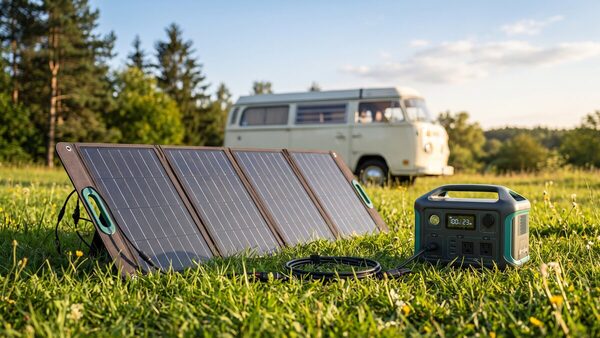
- Power station: too powerful for a plane, it stays on the ground.
Our tips for stress-free travel
A few simple reflexes to avoid a nasty surprise at the checkpoint:
- Choose a battery whose capacity is legible on the casing (ideally with the Wh value).
- Stay under 100 Wh to depend on no approval: a 20,000 mAh is the ideal compromise to travel light and long.
- If in doubt about a borderline model, contact your airline before departure: it always has the final say.
Want to travel well equipped? Discover our selection of travel power banks, and our comparison of the best power banks for travel.