
Why a lead-acid, AGM or gel battery struggles so much in winter
A starter battery (flooded lead-acid, AGM or gel) loses a large part of its usable power as soon as the thermometer drops below 0 °C: the internal chemical reactions slow down, and the capacity actually delivered can fall by 30 to 50% in cold weather. At the same time, electrical demand rises (heating, rear window defroster, wipers), and a string of short trips never gives the alternator enough time to replace what the starter motor just used.
The result: a battery that coped fine all summer weakens progressively through winter, until the morning it no longer delivers enough current to turn the starter. Our in-depth piece on why battery range drops in cold weather covers the chemistry; this guide focuses on the simplest fix: a maintenance charger plugged in regularly through the cold season.
Maintenance charger, basic charger or jump starter: do not mix them up
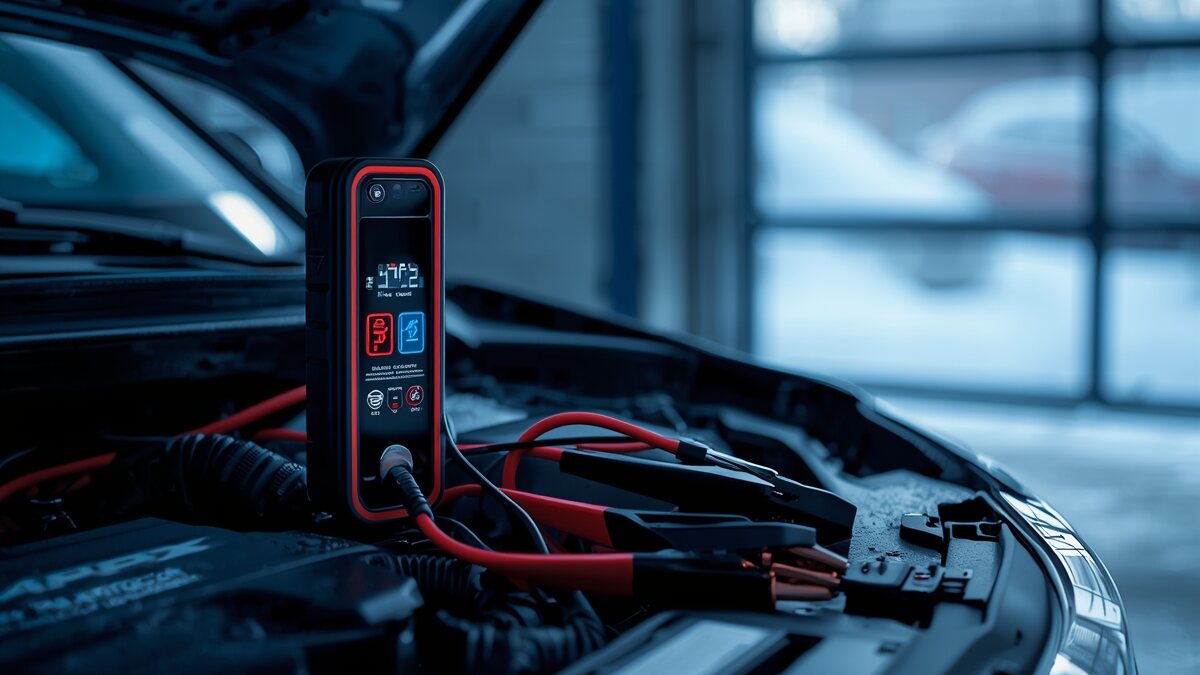
Three devices look alike on a shelf but do very different jobs. A jump starter is a portable battery that delivers a very high current for a few seconds to start an engine in an emergency: it does not actually recharge the battery, it only compensates for a momentary lack of power. We cover that need in our guide to the best jump starters, a different job from the one covered here.
A maintenance charger (often called a battery maintainer, or trickle charger) is something else entirely: left plugged in regularly or permanently, it recharges the battery slowly, then switches to a float stage to offset self-discharge, without ever overcharging it. That is the right tool for winter care: a car, motorcycle or RV used rarely, a classic vehicle in storage, or simply a battery you want to keep in top shape until spring.
A basic charger, without smart regulation or automatic cut-off, delivers a constant current until you unplug it yourself: left connected by mistake for days, it can overcharge and damage the battery. All four models in our selection below are smart chargers with automatic cut-off, designed to stay connected unattended all winter.
What to look for in a winter battery charger
Before comparing specific models, here is what really matters on a charger meant for winter maintenance:
- Chemistry compatibility: flooded lead-acid, AGM, gel, EFB... and, increasingly on newer vehicles or replacement batteries, LiFePO4 starter batteries. A charger built for lead-acid only can damage a lithium battery, and conversely undercharge an AGM.
- Charge current matched to capacity: a rough rule is not to exceed about a tenth of the capacity in amp-hours (a 60 Ah battery copes well with 4 to 6 A), but a much lower current (0.8 to 2 A) is more than enough for simple winter maintenance.
- A desulfation function: an occasional higher-voltage pulse that can break down lead sulfate crystals built up on a battery left undercharged too long.
- Protections: reverse-polarity and short-circuit protection, and ideally IP65 sealing if the charger lives in an unheated garage or outdoor shed.
- A genuine winter or automatic maintenance mode: the charger should stay connected for weeks unattended, cutting off or switching to float charge on its own.
| Model | Current | Compatible chemistries | Profile |
|---|---|---|---|
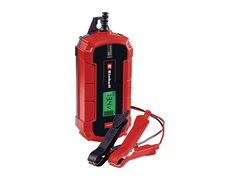
| Einhell CE-BC 4 M | 4 A | Lead-acid, gel, AGM | Budget, IP65 sealed |
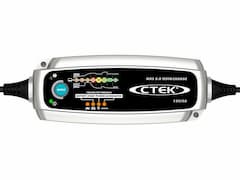
| CTEK MXS 5.0 | 5 A, 8 stages | Lead-acid, AGM, gel (no lithium) | Long-standing multi-stage reference with reconditioning |
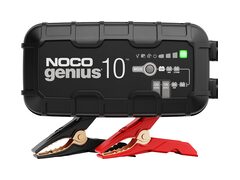
| NOCO GENIUS10 | 10 A, 9 modes | Lead-acid, AGM, gel, EFB, LiFePO4 | High-end, large batteries up to 230 Ah |
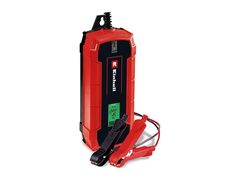
| Einhell CE-BC 5 M LiFePO4 | 5 A, auto-detect | LiFePO4, gel, AGM, lead-acid | Affordable lithium option |
Our picks: 4 chargers that cover every winter need
The simple, budget option: Einhell CE-BC 4 M
Under 40 euros for a smart, IP65-sealed charger compatible with lead-acid, gel and AGM, with an LCD screen and a genuine winter mode: the Einhell CE-BC 4 M does the job without fuss for a car, motorcycle or ride-on mower put away for winter. At 4 A, it suits common batteries without forcing anything, and can stay connected unattended all season.
The long-standing reference: CTEK MXS 5.0
It is the charger many mechanics have recommended for years. The CTEK MXS 5.0 delivers 5 A over 8 stages, with a reconditioning mode that can revive a stratified battery after too long a winter without a charge. Its 5-year warranty is reassuring, though, like the whole MXS line, it does not charge lithium batteries at all: lead-acid, AGM and gel only.
The high-end, multi-chemistry option: NOCO GENIUS10
With 10 A and 9 modes (charge, maintain, desulfate, Force mode for deeply discharged batteries), the NOCO GENIUS10 targets larger batteries (up to 230 Ah) in a 4x4, RV or van. Its compatibility also covers LiFePO4, a real plus if the vehicle's starter battery has been upgraded from lead-acid to lithium.
Affordable lithium: Einhell CE-BC 5 M LiFePO4
For a tight budget but a starter battery already upgraded to LiFePO4, the Einhell CE-BC 5 M LiFePO4 automatically detects the chemistry of the connected battery (lithium, gel, AGM or lead-acid) and adjusts its charge accordingly, for around 55 euros. A rare find at that price.
Safety: always charge in a ventilated space
Charging a lead-acid battery releases hydrogen through electrolysis of the water in the electrolyte, a process that intensifies toward the end of the charge. Mixed with ambient air, this hydrogen can form an explosive atmosphere: the UK's Health and Safety Executive covers this directly in its guidance on using batteries safely (source), which recommends charging batteries in a dedicated, well-ventilated area and keeping sources of ignition well away.
At the scale of a home garage the risk is far smaller than in an industrial charging room, but the basic precautions stay the same: charge in a ventilated space rather than inside a closed car boot, keep any flame or spark (cigarettes, grinders, welding) away from the charging area, and never cover the charger or the battery while it is working. Sealed gel and AGM batteries release far less gas than flooded lead-acid ones, but caution still applies to both.
How to use a maintenance charger well this winter
A few simple habits make winter trouble-free:
- Recharge before the first hard freeze, not after the first breakdown: a battery that starts winter fully charged copes far better with the cold-weather power loss.
- Connect the charger as soon as the vehicle sits idle for more than a week or two, or if it only does repeated short winter trips: the alternator simply does not have time to replace what starting and the electrics used.
- Follow the correct clamp order: positive (+) first, negative (-) second onto a metal earth point away from the battery, as detailed in our full guide to charging and disconnecting a car battery.
- Check the charger's light or display after a few hours: an “error” or “fault” mode usually points to a battery too degraded to simply recharge, rather than a faulty charger.
- Never charge a frozen battery: if ice is visible on the case or terminals, let it return to room temperature before connecting the charger.