
The essentials before you decide
Before comparing dozens of models, know that the right choice comes down to four criteria, roughly in this order. If you only remember one thing from this guide, make it this:
- Capacity (in mAh / Wh): how many times do you want to recharge your devices?
- Power (in watts): how fast, and for which devices (phone, tablet, laptop)?
- Connectivity: USB-C, number of ports, wireless or MagSafe charging?
- Quality & safety: reliable brand, quality cells, airline-friendly?
We break down each of these points below, with the numbers that actually matter.
Capacity: what mAh figures are really worth
Capacity is the headline number: 5,000, 10,000, 20,000 mAh. The mAh (milliamp-hour) measures how much charge the internal cells store. But be careful: you never get 100 % of that figure back.
Why? Because a power bank's cells run at 3.7 V, while your devices charge at 5 V (or more). That conversion, plus heat and the internal electronics, causes losses. In practice, count on 60 to 70 % of the advertised capacity actually delivered to your devices, an order of magnitude confirmed by the reference work of Battery University.
In other words, a 20,000 mAh power bank delivers around 13,000 mAh to your devices. That is normal: every serious manufacturer is in the same boat, and a model claiming 100 % efficiency would simply be too good to be true.
Which capacity for which use?
More capacity means more runtime, but also more weight and a higher price. The smart move is not to chase the biggest number, but to start from your real-world use.
| Capacity | Rough weight | Ideal for | Phone recharges* |
|---|---|---|---|
| 5,000 mAh | ~100 g | Backup, pocket, a light day | ~1 |
| 10,000 mAh | ~200 g | Everyday use, a weekend | ~1.5 to 2 |
| 20,000 mAh | ~350 g | Travel, several devices | ~3 to 4 |
| 27,000 mAh and up (≈100 Wh) | ~500 g and up | Heavy needs, laptop, airline ceiling | ~4 to 6 |
* Estimate for a smartphone of about 4,500 mAh, conversion losses included.
For a precise need, no need to guess: our selection of power banks shows the estimated number of charges for each model, and a built-in calculator does the maths for your device. And if the goal is to recharge far from any outlet, take a look at solar panels and batteries.
Charging power: no more endless waiting
Two power banks of the same capacity can charge at very different speeds. It is the power, expressed in watts (W), that makes the difference, especially when you are in a hurry.
- For a smartphone: 18 to 30 W is plenty for fast charging. The standards to look for are USB Power Delivery (USB-C PD) and Quick Charge (QC).
- For a tablet: aim for 30 to 45 W.
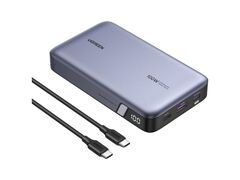
- For a laptop: you need the real thing: 60 W minimum, ideally 100 W in USB-C PD. Below that, the laptop charges slowly, or even keeps draining if you use it at the same time.
Good news: since late 2024, the European Union requires the USB-C port on almost all portable electronics. A power bank with a good USB-C PD port is therefore both a universal and a future-proof choice.
Ports, USB-C, MagSafe: everyday convenience
Beyond the big numbers, a few details genuinely make life easier in use:
- The number of ports: two or three outputs let you charge a phone, earbuds and a watch at the same time.
- The built-in cable: some power banks carry their own USB-C cable, so there is nothing left to forget.
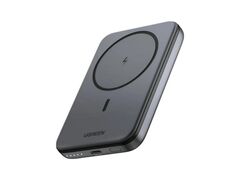
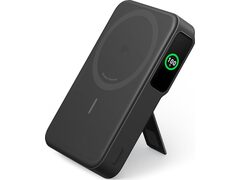
- Wireless and MagSafe charging: simply place your iPhone (or a Qi-compatible phone) on the bank. Magnetic / MagSafe models clip onto the back of the phone: perfect on the move. In return, wireless charging stays a little less efficient than a cable.
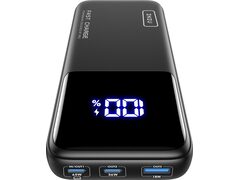
- The screen or LEDs: a percentage display is far more precise than four little LEDs left to guesswork.
- Passthrough charging: handy, it lets you recharge the bank and a plugged-in device at the same time.
Power banks on a plane: the rule to know
This is THE question before every trip. The answer comes down to one value: watt-hours (Wh).
- Up to 100 Wh (about 27,000 mAh): allowed in the cabin, no paperwork, on virtually every airline.
- From 100 to 160 Wh: allowed with the airline's approval, usually limited to two spare batteries.
- Above 160 Wh: banned on board.
Two golden rules: a power bank always travels in the cabin, never in the hold, and its capacity must be legible on the label. When in doubt, check the IATA guidance and your airline, which always has the final say.
Brand, cells and lifespan: the price of reliability
A power bank is electronics that store energy: build quality is never a detail. In ten years of testing and selling these products, we have seen the gap between a good and a bad power bank come down to three things:
- The cells: serious models use quality Li-ion (or Li-Po) cells, sometimes LiFePO4 on newer models, a more durable chemistry.
- The protection circuit (BMS): it guards against overcharge, overheating and short circuits. It is your real safety guarantee.
- Lifespan: a good battery keeps most of its capacity after 500 full charge cycles, often far more.
That is why we favour proven brands such as Anker, Ugreen or EcoFlow: solid warranties (often 18 to 24 months) and real support. Paying a few euros more for a reliable brand often saves you from a battery that swells or loses half its capacity within a year.
Recap: our method in 5 points
- Start from the use, not the number: everyday backup does not have the same needs as a world tour.
- Aim for the right capacity: 10,000 mAh for daily use, 20,000 mAh to travel light, 27,000 mAh (≈100 Wh) for a laptop or several devices.
- Do not overlook power: USB-C PD, 20-30 W for a phone, 100 W for a laptop.
- Pick the right connectors: USB-C everywhere, MagSafe if you have a recent iPhone.
- Bet on a reliable brand and check airline compatibility (≤ 100 Wh).
To move from theory to practice, here are a few models we recommend, chosen to cover most needs, from the pocket mini to the powerful laptop-charger.