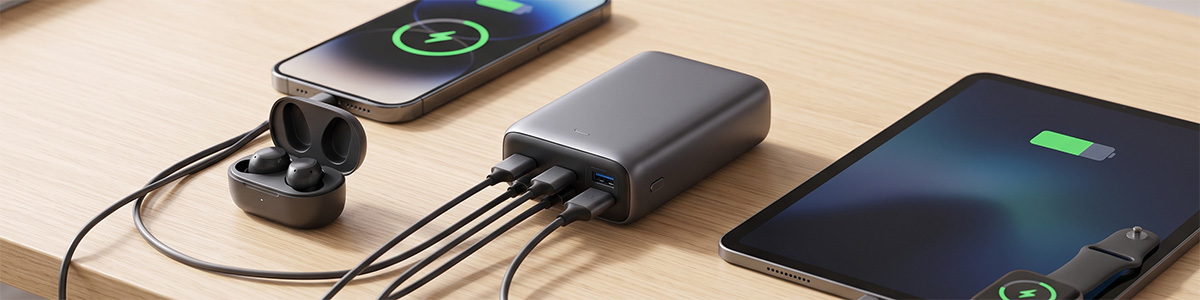
The power bank you need, based on what you recharge.
A power bank proudly displays its milliamp-hours (mAh), but that figure is misleading: a 10,000 mAh power bank does not recharge a 5,000 mAh smartphone twice. Between voltage conversion and losses, you actually recover 60 to 70 % of the stated capacity. This tool works out the truly useful capacity you need and points you to the right model.
Our method
- You choose your devices (smartphone, tablet, handheld console, laptop) and the number of recharges you want.
- We start from the real battery capacity of each device, not a marketing figure, and apply a 72 % efficiency reflecting real losses.
- We derive the minimum capacity to carry, then recommend the power banks in our catalogue that deliver it, also taking charging power (USB-C Power Delivery) into account for demanding devices such as laptops.
Why it matters
Choosing on mAh alone often leads to a battery that is too small (frustrating) or too heavy (pointless to carry). By thinking in real recharges, you carry exactly what you need: a slim battery to top up a phone around town, or a large capacity for a long multi-device trip.
The results are estimates: efficiency varies with the cable, temperature and the state of the batteries. They are still far more reliable than a raw mAh reading. Every recommended model has a detailed page, and for high capacities, remember to check airline compliance, which our dedicated tool works out in an instant.
Beyond capacity
Capacity is not the only criterion. Charging power decides the speed: a plain 10 W takes hours where USB-C Power Delivery (20, 45, 100 W) recharges a phone halfway in thirty minutes and even powers a laptop. So check the ports’ output as much as the milliamp-hours.
Form factor matters too: a flat pocket battery does not replace a large backpack capacity, and vice versa. Look at the number of ports for charging several devices at once, the presence of passthrough (charging the battery and a device at the same time) and, for train or plane, cabin compliance. Since late 2024, USB-C has become standard in Europe: a single cable is now enough to recharge almost everything.
Travellers and homebodies alike, we have used these batteries daily for over ten years: we know what really matters in the field. Trust the result for capacity, then refine according to your own priorities (weight, charging speed, number of ports) using the detailed pages of each model we recommend to you.
To recharge iPhone 16 3x, you need about 58 Wh, i.e. a power bank of at least 15,500 mAh. In our catalogue, Xiaomi Redmi 20000mAh does the job.
Estimate with a real 72% efficiency (conversion and cable losses). A power bank rated in mAh at 3.7 V delivers in practice about 60 to 70% of its stated capacity.