
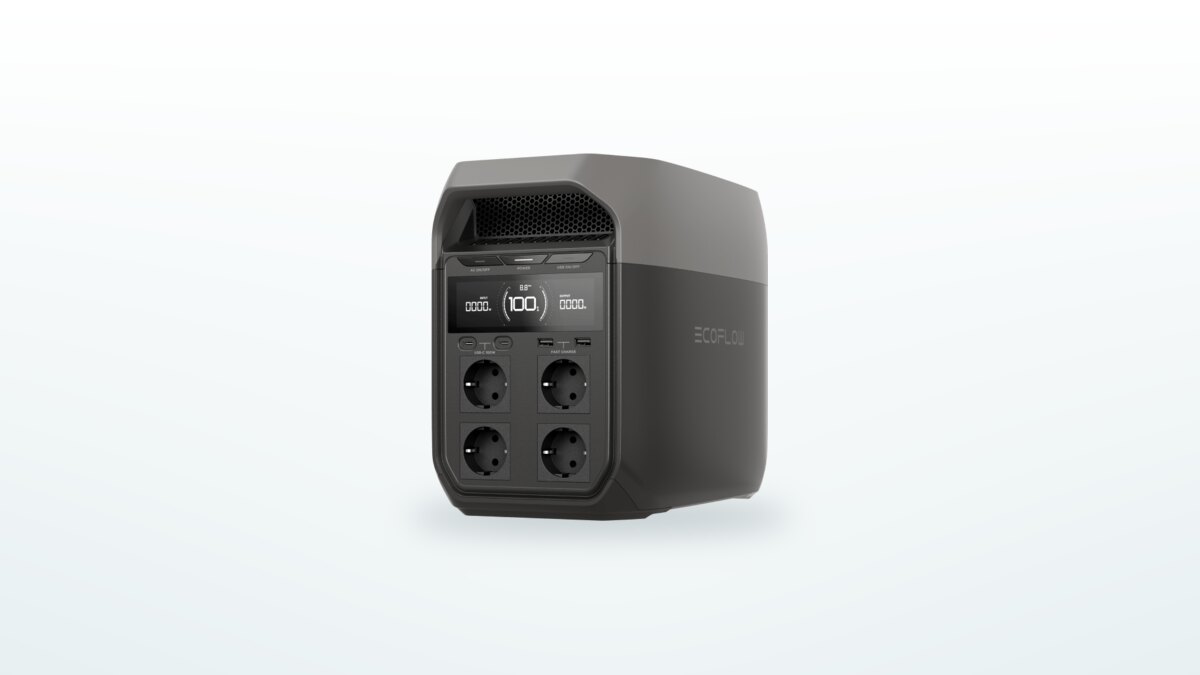
What the 1024 Wh are really worth
The 1024 Wh printed on the case is a cell capacity, measured in direct current at 51.2 V. It is not what comes out of the sockets. Between the pack and the appliance sits electronics that take their cut, and that cut varies enormously depending on which output you use.
This is the most widely misunderstood point in this product category, and the most useful one to grasp before buying. On one and the same machine, the amount of energy recovered shifts by about 35 Wh depending on the socket chosen.
The explanation is mechanical. Turning a 51.2 V direct-current pack into 230 V alternating current requires an inverter, and that inverter draws a roughly fixed amount of power whenever it is switched on, regardless of what is asked of it. The 12 V output needs only a step-down converter, which is far simpler. USB-C is more direct still.
That fixed overhead also explains a puzzling spread: depending on conditions, the same 1024 Wh platform delivers between 840 and 950 Wh on mains voltage. This is not sloppiness. An inverter taking its toll for twelve hours to run a small lamp costs proportionally far more than the same inverter working for one hour on a hotplate. At identical capacity, a low draw over a long period is the worst possible case.
What a full charge really costs
The full question is not only what comes out, but what had to go in. Over a complete cycle, expect roughly 1175 Wh drawn from the grid to recover 950 Wh, which puts round-trip efficiency at around 78 to 81 %. A quarter of the energy paid for never comes back out.
That is an honest figure for a portable station, and it has no consequence in mobile use: you fill it at home, you empty it over a weekend, the loss goes unnoticed. It becomes a real penalty in permanent stationary use, home storage in particular, where that quarter is paid on every single cycle.
On top of that comes a self-consumption of roughly 15 W when the station is switched on with its output active but nothing plugged in. That sounds trivial. Over twenty-four hours it amounts to nearly 360 Wh, more than a third of the pack evaporating with nothing done. A Delta 3 left permanently switched on empties itself in three days. The habit to build is to disable unused outputs, and the station itself when it is not in service.
The 56 minutes, and on what condition
This is the most heavily promoted argument, and also the one that holds up best. The official promise is explicit about its condition: a full charge in 56 minutes assumes the maximum input is available, that is 1500 W. This is not an unreachable laboratory figure, it is simply the fastest mode.
In practice the input does show up: absorbed power peaks around 1460 to 1470 W, very close to the quoted 1500 W. Observed times, on the other hand, range from 51 minutes to 1 hr 15 min. The reason is not chance: charge speed is set in the app, and a station configured for gentle charging, or sitting in its constant-voltage tail, logically takes longer. Set to maximum, it even beats the manufacturer's own figure.
One method deserves a warning. Charging from a vehicle cigarette lighter socket tops out around 59 W, which means more than twenty-four hours for a full charge. In a motorhome or a van this is not a charging solution, it is at best a trickle top-up while driving. To genuinely recharge on the move you need the alternator charger, a separately sold accessory that reaches 800 W.
X-Boost: 2400 W in Europe, not 2600
X-Boost is the technology that lets the station run an appliance hungrier than its rated output, by slightly lowering the voltage it sends. The figure of 2600 W circulates everywhere in connection with it. It is accurate, but it applies to the US model.
The power obtained depends directly on the local mains voltage, and the manufacturer publishes the breakdown itself:
| Output voltage | Market | Rated power | With X-Boost |
|---|---|---|---|
| 100 V | Japan | 1500 W | 2000 W |
| 110 V | Various | 1500 W | 2500 W |
| 120 V | United States, Canada | 1800 W | 2600 W |
| 220 V | China, Korea | 1800 W | 2200 W |
| 230 V | United Kingdom and Europe | 1800 W | 2400 W |
In Europe the real ceiling is therefore 2400 W. The gap with the 2600 W quoted elsewhere is not enormous, but it is enough to sink a purchase calculated too finely from the American spec sheet.
Three conditions of use, considerably more restrictive than that figure, are almost never mentioned:
- X-Boost is off by default. It has to be enabled in the EcoFlow app, which means pairing the station with a phone first.
- It becomes unavailable as soon as the station is plugged into the mains, that is while charging and in bypass mode. You cannot rely on it for a power-hungry appliance left permanently connected.
- It is unsuitable for appliances with voltage protection, precision instruments included, which may shut down on undervoltage. It is designed for resistive loads: kettles, water heaters, electric blankets, small tools.
The 5 kWh expansion, and what it really costs
"Expandable from 1 to 5 kWh" is the argument that justifies this version existing at all alongside the Classic, which cannot be expanded whatsoever. The promise is technically accurate. Its translation into euros deserves to be spelled out.
The Delta 3 has only one add-on battery port. You cannot stack several 1024 Wh batteries to scale up gradually. The total depends entirely on the single unit you connect, and the arithmetic is unforgiving: 5120 Wh is 1024 Wh plus 4096 Wh, which is the capacity of the DELTA Pro 3 battery.
| Add-on battery | Its capacity | Its price | Total capacity | Total cost |
|---|---|---|---|---|
| None | - | - | 1024 Wh | 749 € |
| DELTA 2 | 1024 Wh | 499 € | 2048 Wh | 1248 € |
| DELTA 3 | 1024 Wh | 509 € | 2048 Wh | 1258 € |
| DELTA 2 Max | 2046 Wh | 799 € | 3070 Wh | 1548 € |
| DELTA Pro 3 | 4096 Wh | 2299 € | 5120 Wh | 3048 € |
In other words: the only route to the 5 kWh printed on the box costs 2299 €, three times the price of the station itself. The pair comes to more than 3000 €, a budget at which you are no longer comparing portable stations but fixed installations.
With the battery a buyer would naturally choose, the DELTA 3 unit at around 509 €, you double the capacity and stop at 2048 Wh. That is a very good compromise, and probably the only realistic expansion scenario. You simply need to know it is not what "up to 5 kWh" promises.
As a backup: ten milliseconds, and three traps
Switching to battery during an outage takes under 10 ms, a delay no computer or router will notice. This is a genuine UPS function and it works. Three reservations are worth knowing before building a home backup around it.
The first trap is the most insidious, and the manufacturer documents it twice, once in its own safety instructions. The station's AC output switches off automatically after a certain period of inactivity. A fridge or an air conditioner, however, does not draw continuously: it stops between compressor cycles. The station can read those pauses as inactivity and cut power to an appliance you believed was protected.
The second trap is a wiring condition. To act as a UPS, the station must stay connected to the grid with the appliances plugged into its own sockets. In that configuration it must draw more power from the grid than it supplies, otherwise it cannot keep its battery topped up and stops performing its backup role. It is therefore unsuitable for permanently covering a load close to its 1800 W ceiling.
The third is the idle consumption mentioned earlier. A backup station spends most of its life doing nothing, and that is precisely the regime where those 15 W weigh most. Permanently connected to the grid it tops itself up as it goes and the issue is minor; a Delta 3 kept charged "just in case" in a cupboard, however, must be switched off, or it will be flat by the time it is needed.
One last detail relevant to computing use: the station does not present itself to the operating system as a standard UPS. A server or a computer will therefore receive no clean shutdown signal when the battery runs low, unless the manufacturer's app is used.
The quiet running, and at what power
Discretion is one of the most consistently praised aspects of this range, and the manufacturer makes an argument of it. Here too, the headline figure comes with a condition that is rarely repeated.
| Power delivered | Quoted noise level |
|---|---|
| 600 W | under 30 dB |
| 1200 W | under 40 dB |
The commonly quoted 30 dB therefore corresponds to a 600 W load, a third of the rated output. Doubling the demand adds around ten decibels which, on a logarithmic scale, corresponds to a perceived sound roughly twice as loud. No measuring distance is stated, which rules out any serious comparison with a competitor.
In practice the fan stays discreet in everyday use and the station can spend a night in an occupied room without causing a nuisance. You should simply expect to hear it clearly during a full-power recharge or under heavy load, the two moments when the electronics have the most heat to shed.
Solar: 500 W and a single controller
This is where this version differs most clearly from its bigger sibling, and not in its favour. The solar input accepts 500 W at most, through a single MPPT controller, over a voltage range of 11 to 60 V. The Plus version, for 100 € more, accepts twice that.
Two technical constraints govern the connection, and respecting them avoids damaging the unit: the total open-circuit voltage of the array must stay below 60 V, and the short-circuit current below 15 A. In practice that comfortably accommodates two portable 200 to 220 W panels in parallel, but rules out series strings of conventional roof panels, whose voltage climbs past the limit very quickly.
At full solar power the manufacturer quotes a full charge in 130 minutes, which is consistent with a 500 W input. That is respectable, but twice as slow as on the Plus version, a gap that is paid for every single day in real runtime when you live off the sun.
Classic, Delta 3 or Plus: the real decision
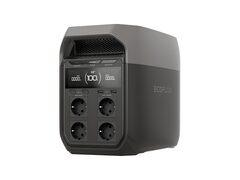
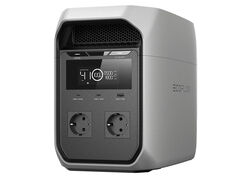
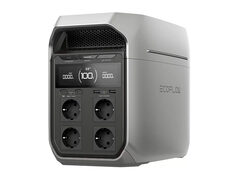
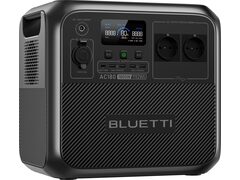
Three stations share 1024 Wh, the Delta 3 name and an almost identical silhouette. This is the main source of buying mistakes across the range, all the more so as all three often sit on the same page. Here is what actually separates them.
| Criterion | Delta 3 Classic | Delta 3 | Delta 3 Plus |
|---|---|---|---|
| Manufacturer price | 599 € | 749 € | 849 € |
| Capacity | 1024 Wh | 1024 Wh | 1024 Wh |
| AC output | 1800 W | 1800 W | 1800 W |
| 230 V sockets | 2 | 4 | 4 |
| 12 V output | no | yes | yes |
| USB-C | 1 × 100 W and 1 × 30 W | 2 × 100 W | 2 × 140 W |
| Mains input | 1400 W | 1500 W | 1500 W |
| Solar input | 500 W | 500 W | 1000 W |
| Expandable | no | yes | yes |
| Weight | 12.1 kg | 12.5 kg | 12.5 kg |
Against the Classic, the 150 € gap is largely justified. You are not merely paying for the expansion port: you double the number of mains sockets, you gain the entire 12 V output, which the Classic lacks, and the second USB-C port goes from 30 to 100 W. For a motorhome or a van, where 12 V is precisely the most efficient output, the Classic is ruled out from the start.
Against the Plus, however, the case is far weaker. The two models have exactly the same weight, the same dimensions, the same capacity, the same power and the same expandability. For 100 € more, the Plus version doubles the solar input and takes the USB-C ports to 140 W, enough to charge a laptop at full speed. The moment a solar panel enters the plan, that gap is the best-spent money in the whole range.
The argument gets stronger in the shops than at list price. Street prices in mid-August 2026 sit well below the manufacturer's figures, around 650 € for this Delta 3 and 690 € for the Plus version. The real gap then narrows to about 40 €, a trifling sum against a doubled solar input. Only one thing still justifies taking the standard version at that price: being certain you will never connect a panel.
Who it suits, and who it does not
The Delta 3 is a good machine, solid and fast, whose main flaw is being badly positioned within its own range. Once the promises are cut down to their real size, it recommends itself without reservation in several cases and is clearly to be avoided in others.
It suits home backup against outages, where its sub-10 ms switchover and four sockets cover router, computer, lighting and fridge, provided the timeout is set. It suits mobile use in a van or motorhome, thanks to its 12 V output and its express recharge at a service stop. It suits a building site or a workshop with no mains, where its 1800 W and 3600 W surge absorb tool start-up currents. It suits an office or a film shoot, where the two 100 W USB-C ports and the relative quiet make the difference.
It suits poorly a solar project, where the Plus version offers twice the input for 100 € more. It suits poorly permanent home storage, because of the quarter of the energy lost on every cycle and the 15 W idle draw. It suits poorly anyone aiming from the outset at several days of autonomy, since the route to 5 kWh costs 2299 € and a higher-capacity station would be more rational. And it suits poorly anyone who needs 2600 W from X-Boost: on a European grid, that figure does not exist.
One point should not be overlooked at the moment of purchase: the five-year warranty put forward actually consists of three years of standard cover, plus two further years granted once the product is registered in the app. It takes a few minutes, but it is not automatic, and forgetting costs two years of cover.