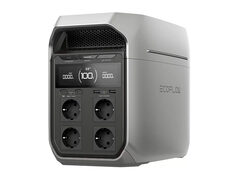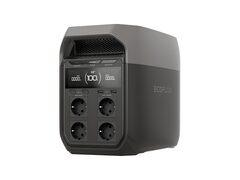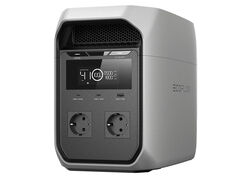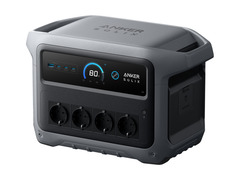

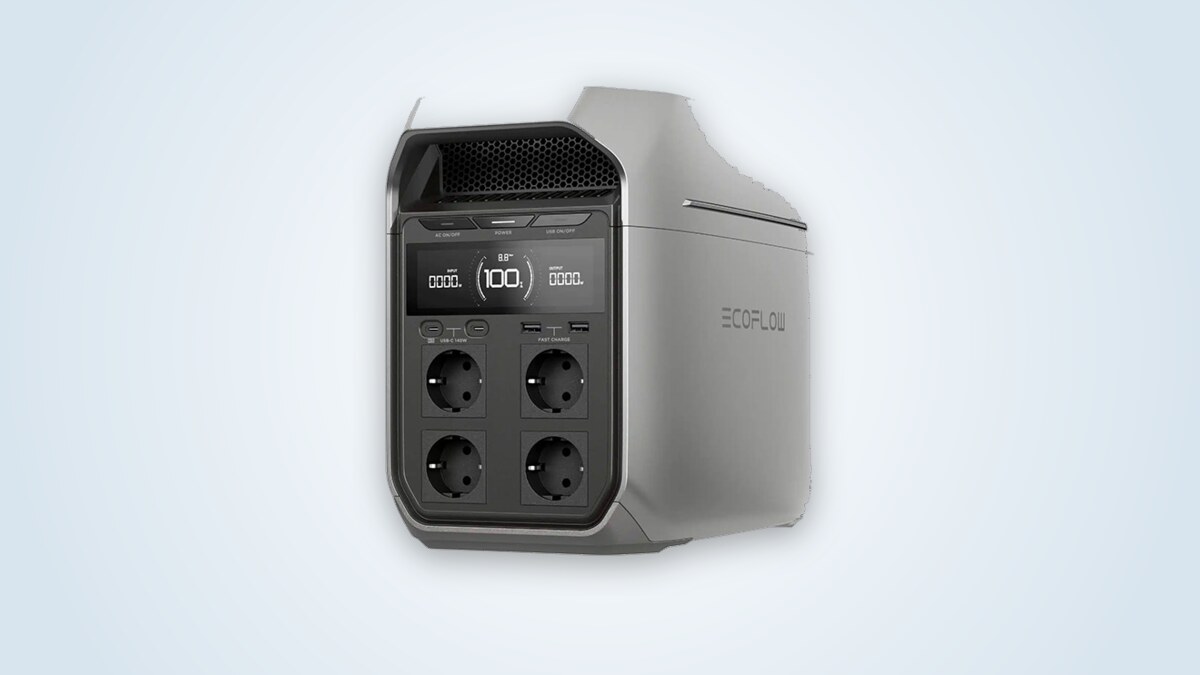
It returns no more energy than the Delta 3
This is the starting point, and it defuses half the sales pitch straight away. The Plus carries the same 1024 Wh pack as the Delta 3 and the same 1800 W inverter. Through a 230 V socket it therefore gives back exactly as much: 860 Wh. On the 12 V output, 895 Wh. Paying a hundred pounds more does not buy one extra minute of runtime.
The third value belongs to the Plus alone, and it is the only one on the output side that justifies the difference in price: 937 Wh from a USB-C port, or 91 % of the claimed capacity. That figure is out of reach for the Delta 3, whose USB-C ports stop at 100 W where those of the Plus climb to 140.
The ranking is explained by the architecture. The pack works at 51.2 volts. USB-C starts from that direct voltage and transforms it very little. The 12 V output has to come down much lower. The 230 V socket has to build a complete sine wave, and that is by far the most costly operation. The more the inverter is avoided, the more energy comes back.
A rating plate that does not cheat
This deserves saying, because it is rare. The pack is quoted at 51.2 volts and 20 amp hours. The product comes to exactly 1024.0 Wh, at 3.2 volts per cell, which is the true average discharge voltage of lithium iron phosphate.
Compare that with pocket power banks, where the milliamp hours displayed are multiplied by an assumed cell voltage to produce a flattering watt hour figure. Here the arithmetic is right and checkable. That is no detail: it is the first sign that a manufacturer is not counting on the confusion of its buyer.
The flip side is overall efficiency. Refilling the pack draws between 1175 and 1180 Wh at the metre to give back 860 Wh at a socket. Efficiency from the wall to the socket therefore settles around 77 %, which is average for the category. On the USB-C output, where the inverter does no work, it climbs back appreciably.
What you really buy: two controllers, not one
Here is the real difference, and it comes down to one thing: the second controller. The solar input rises from 500 to 1000 W, split across two XT60i connectors each accepting 500 W between 11 and 60 volts.
The doubling of power is the argument on display. The second controller is the real argument, and nobody explains it. With a single controller, two panels of different orientation or exposure drag each other down: the whole lines up with the one that is worse exposed. A panel in the shade of a branch penalises the one in full sun.
One reservation, and it is a large one: no figure exists for the real solar charging of this unit. The 1000 W is a peak value, obtained with panels perpendicular to the sun under a clear sky. In everyday conditions, with panels laid flat, you commonly recover 55 to 70 % of the installed power. The gain from the second controller is mechanically certain; its size in figures is not.
Fifty-one minutes, and the figure holds
Mains charging is the field where the unit keeps its promises without reservation. A full charge takes 51 minutes, with an input power peaking at 1460 W.
Two honest qualifications. The 1500 W claimed is never reached: the maximum stops at 1460 W, and in practice the time ranges from 51 minutes to 1 h 15 depending on the speed setting chosen in the app. And in cold weather the protection electronics throttle the input far lower, around 1000 W, until the cells warm up.
Charging also slows at the end of the cycle, which is normal and desirable with this chemistry: the last few per cent fill gently to spare the cells.
X-Boost: 2400 W, and three conditions nobody writes down
The feature is put forward everywhere, its conditions nowhere. It deserves a pause, because it is useful and because it is not available when you would imagine.
The value first. On 230 V, X-Boost lifts the admissible power to 2400 W. The 2200 W often quoted is the value at 220 V, and the 2600 W the value at 120 V, so the figure for the American model. On the French grid, 2400 W is the only correct number.
The three conditions next.
That last condition deserves weighing. A station left permanently plugged in to take over during an outage never has X-Boost available while the grid is present. At the precise moment the power drops, the switchover runs on the inverter alone, capped at 1800 W. The feature that promises 2400 W is missing from the very scenario where it would be most expected.
Finally, X-Boost works by lowering the output voltage. It suits resistive appliances, a portable heater, a hotplate, a kettle. It does not suit equipment protected against voltage, which cuts out on undervoltage.
On backup: eight milliseconds, and four reservations
The switchover comes to a little over 8 milliseconds, under the 10 ms claimed. That is a good result on this point.
But four points should temper the enthusiasm before entrusting a server to this machine.
The idle draw. With the 230 V output switched on and nothing being powered, the unit takes around 15 W. Against 860 Wh available, that empties the pack in two to three days. A station left in reserve, unplugged, does not last the week.
No standardised UPS protocol. There is indeed a link over USB-C, but it calls for a dedicated piece of software installed on the protected machine. A storage server will not recognise the station as a UPS simply because it has been plugged in.
No protection against surges. The unit protects against an outage, not against a lightning strike or a disturbance on the grid. That is not the same function, and a surge-protected power strip is still needed.
X-Boost unavailable, as seen above. On backup, the limit is 1800 W, never 2400.
The most annoying flaw is a counting flaw
It is neither a breakdown nor a loss of capacity, but the effect is the same for the user, and it is spectacular.
Under a modest load, the screen can announce four and a half hours of runtime left while the cut-off comes after forty minutes. After a full cycle from 100 % down to zero and back to 100 %, the estimate, under the same conditions, finds five hours again.
The capacity had therefore not disappeared: it is the estimate that had drifted. Lithium iron phosphate chemistry has a very flat voltage curve over most of its range, which makes the state of charge hard to deduce from voltage alone. Without a full cycle from time to time, the gauge loses its bearings.
The trap is twofold in permanent UPS use, since you cannot go down to zero without cutting off the protected equipment. That is precisely the use where a wrong estimate costs the most.
The 5 kWh exist, by a single route, and it is the dearest
The promise is displayed everywhere: expandable up to 5 kWh. It is true. It is also far narrower than the phrase suggests.
The station has only one expansion port. One extra battery, not two. With the 1024 Wh Delta 3 battery, the one the manufacturer puts forward and the one a buyer naturally takes, you reach 2048 Wh. Not 5120.
The 5120 Wh come from one combination only: a 4096 Wh Delta Pro 3 battery, heavier, dearer, and needing an adapter sold separately. It is arithmetic, 1024 plus 4096.
The ranking is counter-intuitive and worth knowing before ordering. The cheapest route per kilowatt hour added is the Delta 2 Max battery, around 390 €. The route that leads to the 5 kWh claimed is the dearest, around 600 €. In other words, the configuration the advertising puts forward is the least profitable of the three.
One last figure completes the demonstration: adding the station and the Delta Pro 3 battery together costs more than buying a Delta Pro 3 on its own, which does offer 1024 Wh less but more than double the output power. Anyone genuinely aiming at 5 kWh should not start from this machine.
Note finally that the extra battery does not recharge on its own: it has no input of its own and depends entirely on the station.
Noise: what the spec sheet will not tell you
Better to write it plainly: no usable acoustic figure exists for this machine. Not one sound level that comes with the distance it was taken at. The manufacturer quotes under 30 dB at 600 W and under 40 dB at 1200 W, but never says at what distance, which leaves those figures incomparable with anything at all.
That gap is information in itself, and the acoustic behaviour seems to vary from one unit to another: some stay quiet at idle, while on others the fans run constantly as soon as the 230 V output is switched on, even with no appliance plugged in, where the spec sheet announces a trigger from 600 W.
The hypothesis that reconciles the two behaviours is a badly set fan control law: a permanent base speed as soon as the inverter comes on, with no clear ramp under heavy load. It would explain both continuous noise at idle and the high temperatures at the air outlet under load. That hypothesis remains plausible, but it is not proven.
Practical conclusion: if silence is a deciding criterion for you, this machine cannot be recommended on that point, for want of reliable data, and not because it would be noisy.
1800 W held, and a peak far more modest than claimed
The 1800 W continuous are held without faltering. Under a load of more than 1500 W, the runtime reaches thirty-two minutes straight, through to the normal shutdown on an empty battery, with no drop in power and no untimely cut-off. On that point, the unit does what it says.
Peak power, on the other hand, does not follow the sales talk. The spec sheet announces 3600 W. In fact the unit accepts around 2600 W for one minute, and cuts out immediately beyond. The gap is considerable, and it counts: it is precisely the peak that decides whether a fridge compressor or a pump motor will start.
For ordinary domestic use, computers, lighting, a router, a television, small kitchen appliances, the 1800 W are amply enough and the question of the peak never arises. It arises as soon as a motor enters the equation.
Cycles, warranty, and a clause you need to have read
The chemistry is lithium iron phosphate, rated for 4,000 cycles before dropping to 80 % of the initial capacity. The warranty runs for five years and, a detail that matters, with no registration requirement: several neighbouring models in the same range offer three years only, extended to five after signing up.
One clause in the manual deserves to be known before buying, though, because it aims precisely at the use many people intend for this kind of unit: the warranty does not cover a product that has been neither charged nor discharged for more than six months. For a station bought as an emergency reserve, and therefore meant to sleep, the constraint is real. It also chimes with the recalibration advice: one full cycle twice a year settles both problems at once.
Two faults deserve mentioning. A repeated clicking from the inverter as soon as the 230 V output is switched on, present on a replacement unit as well, which makes it a trait of the series rather than an accident. And a fan control whose trigger point does not match what the spec sheet announces.
No official recall targets this range. The manufacturer has had recalls on earlier generations, including for fire risk, but they concerned units using a different chemistry, lithium NMC, dropped here in favour of lithium iron phosphate, markedly more stable thermally.
Classic, Delta 3 or Plus: where the Plus really sits
Three machines share 1024 Wh and a similar silhouette. The choice turns neither on capacity nor on power, identical across all three.
| Criterion | Classic | Delta 3 | Delta 3 Plus |
|---|---|---|---|
| 230 V sockets | 2 | 4 | 4 |
| 12 V output | no | yes | yes |
| USB-C | 100 W and 30 W | 2 × 100 W | 2 × 140 W |
| Solar input | 500 W, 1 controller | 500 W, 1 controller | 1000 W, 2 controllers |
| Expandable | no | yes | yes |
| Energy returned on 230 V | identical | 860 Wh | 860 Wh |
Against the Classic, the gap is amply justified: two more sockets, the 12 V output the Classic does without, and the possibility of expanding. For a van, where 12 V is precisely the most efficient output, the Classic is ruled out from the start.
Against the Delta 3, the choice comes down to one question: will there be solar? If yes, the second controller and the extra 500 W justify the difference without discussion. If not, all that remains is the USB-C ports at 140 W, useful to anyone carrying a hungry laptop, incidental otherwise.
Who it suits, and who it does not
It suits anyone installing solar, in a van, a shed or a second home, and particularly anyone who will lay out several panels of different orientations. It also suits anyone who lives on USB-C, where it returns 937 Wh and charges a laptop at full speed.
It does not suit anyone looking for a reserve to leave sleeping: 15 W of idle draw empty it in two to three days. Nor anyone who wants a UPS in the strict sense, for want of a standardised protocol and of protection against surges. Nor anyone genuinely aiming at 5 kWh, for whom the sums point elsewhere. Nor anyone who will never install a panel: the plain Delta 3 then does the same job for less.
A word on price, because it holds a surprise. The list price is 999 €, and the manufacturer store regularly runs 849 €. Yet the machine can be found at around 690 to 750 € at resellers. The official promotion is therefore, at the time of writing, dearer than the market. Worth checking before ordering, and worth setting against a point of after-sales service: bought from the manufacturer, a warranty return is covered; bought elsewhere, shipping costs stay with you.