
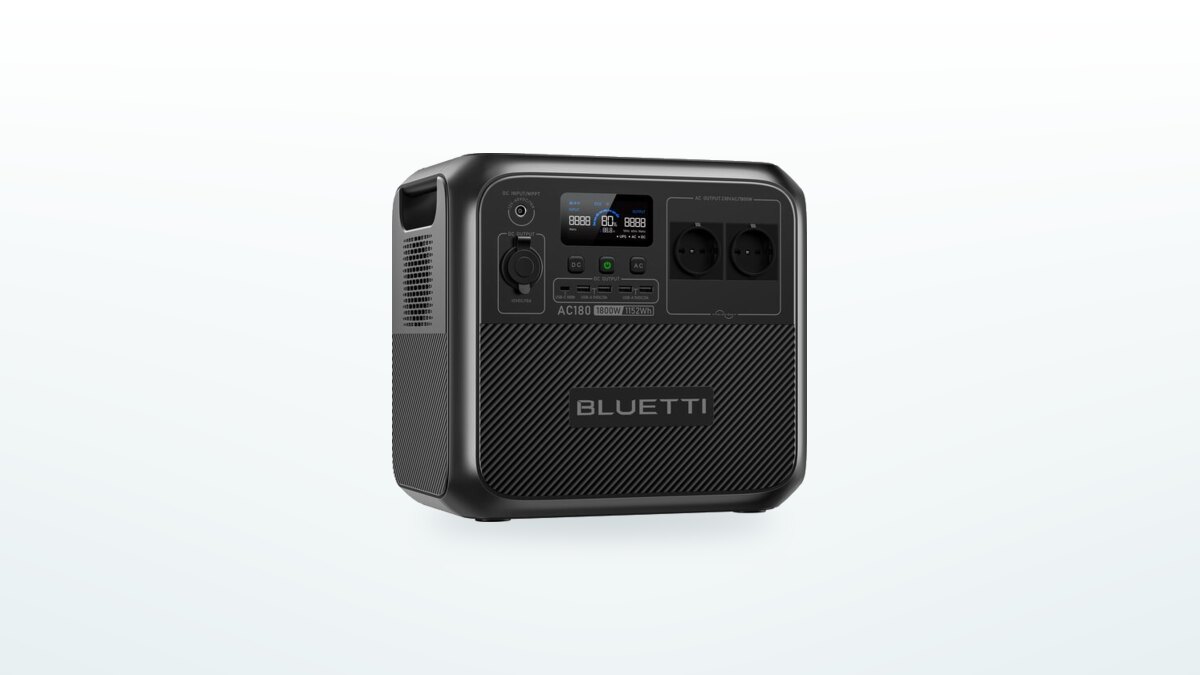
992 to 1030 Wh delivered, from a maker that under-promises
On this point the AC180 is the exception. Every power station on this market claims a cell capacity higher than what it returns, and the gap only shows up in use. Here the opposite happens: the machine delivers more than Bluetti promises.
The maker publishes its own runtime formula, which is unusual, and it is deliberately conservative: capacity multiplied by 90 % depth of discharge, then by an inverter efficiency it states as "above 85 %". Applied to 1152 Wh, that gives 881 usable Wh. Actual delivered capacity falls between 992 and 1030 Wh.
The practical consequence is a pleasant one: the runtimes estimated by the app and the documentation are floors, not best cases. Where most makers quote the most favourable scenario, Bluetti quotes the least favourable, and the machine beats its own promises.
One caveat remains, and it applies to every station of this type. The maker declares self-consumption of around 15 W, and honestly folds it into its formula for small loads: running a 40 W fridge actually draws 55. On a low, sustained draw that fixed overhead weighs heavily; on a 600 W appliance it becomes negligible.
Two sockets in Europe, four elsewhere
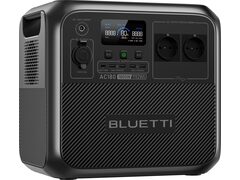
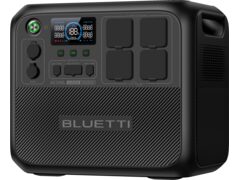
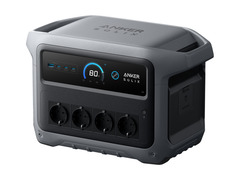
Here lies the biggest gap to know about before buying. The maker's manual is explicit: the AC180 has four mains sockets, but only two on the European version.
| European version | 2 sockets |
|---|---|
| Other markets | 4 sockets |
| Total output | 1800 W, identical everywhere |
| Surge | 2700 W, identical everywhere |
The four-socket front panel therefore belongs to a different unit from the one sold in Europe. For a 1152 Wh, 1800 W station, two sockets is thin, and a power strip becomes necessary as soon as you want to run a fridge, a light and a computer at the same time. It is not a deal-breaker, but it is worth planning for, all the more so since the strip adds losses of its own.
Output power, on the other hand, does not vary by market: 1800 W continuous and 2700 W surge everywhere, through a pure sine wave inverter.
Power Lifting: 2700 W, and three conditions
Power Lifting is Bluetti's name for its power-boost function. It allows the station to run an appliance drawing more than the nominal 1800 W by lowering the voltage supplied, and raises the ceiling to 2700 W.
Three conditions govern the function, and none of them is highlighted at the point of sale:
- It is off by default. You have to enable it in the station's settings menu, by holding the AC button for two seconds, or from the app.
- It applies only to purely resistive loads, and the maker cites heaters and clothes irons, meaning appliances built solely from heating elements. A motor, a compressor or a piece of electronics will not benefit.
- It becomes unavailable during mains charging. When the station is plugged into the wall, grid power bypasses the inverter and feeds the sockets directly: the boost no longer exists.
That last limit is the most counter-intuitive. An AC180 left permanently plugged in, which is precisely the home-use configuration, will never exceed its 1800 W.
Backup: 20 ms, and the setting that cancels it
Switchover to battery in the event of an outage is stated at 20 milliseconds or less, placing the AC180 between the EcoFlow Delta 2 and its successor. That is enough for a router, a television or a fridge, and not enough for a server. The maker puts it plainly in its specification table: test the function before use to avoid any risk of data loss.
The genuinely important point, though, lies elsewhere, buried in the manual. The AC180 offers a mode called Grid Enhancement, off by default, which lets the station cope with voltage fluctuations and waveform distortion from an unstable mains source. Useful on a generator or a poor-quality grid.
It is a classic design trap: two useful functions, mutually exclusive, with nothing on screen to say so. If you are counting on the AC180 to protect a workstation, check that this mode has stayed off.
One last note, purely regulatory but with practical consequences: the AC180 is classed as a category C2 device. The maker warns that in residential areas it may cause radio interference, and that it then falls to the user to take remedial measures. Worth keeping in mind if you install it near an aerial or a radio set.
Heat, and the two limits it triggers
Two thermal limits appear in the specification table and never in the marketing copy, and they bear precisely on summer use.
| Situation | Range | Consequence |
|---|---|---|
| Discharging | -20 to 40 °C | full power up to 35 °C |
| Discharging in high heat | 35 to 40 °C | 1500 W instead of 1800 W |
| Charging | 0 to 40 °C | impossible below 0 °C |
| Charging at full speed | 10 to 30 °C | 1440 W guaranteed in this range only |
| Storage | -20 to 40 °C | ideally between 10 and 30 °C |
The first limit is the more troublesome. Between 35 and 40 °C, output falls from 1800 to 1500 W. And 35 °C is an ordinary summer day in a van, a vehicle parked in the sun, a conservatory or a building site. The maker notes that on a full battery the station may briefly exceed 1500 W in that range, but risks tripping its thermal protection if it does.
The second is quieter. The 1440 W input that gives the AC180 its fast-charging reputation is guaranteed only between 10 and 30 °C. Outside that window, charging slows with nothing to announce it.
Neither limit is a manufacturing flaw: both are normal lithium chemistry protections. They simply deserve to be known, because they kick in exactly when the station is working hardest.
Three charging modes, and the right default
The AC180 recharges in four ways: mains, solar, car socket and generator. From the mains it accepts up to 1440 W, which is what underpins the claim of 80 % in 45 minutes.
What the spec sheet does not say is that this speed depends on a setting. The station offers three charging modes, and the fastest is not the one it ships with:
- Turbo, enabled in the app, to fill the station in the shortest possible time.
- Standard, the default mode, which the maker itself describes as gentler on the battery.
- Silent, which charges at low power for quiet running and better longevity.
In other words, an AC180 straight out of the box does not charge at its maximum speed, and that is deliberate. It is a fairly sound design choice, but worth knowing if you time your recharge expecting the advertised 45 minutes.
Silent mode answers the station's main weak point directly: its cooling is clearly audible under fast charging and heavy load alike. Switching to Silent lengthens the recharge but makes the station discreet, which matters in a van or a bedroom.
The ports, and the figures to read twice
The AC180 fields a generous set of outputs, two details of which deserve a careful reading.
| Output | Detail |
|---|---|
| 230 V sockets | 2, pure sine wave, 1800 W in total |
| USB-C | 1 port, up to 100 W |
| USB-A | 4 ports, but 30 W in total |
| Car socket | 12 V / 10 A |
| Wireless charging pad | 15 W, on the top surface |
The first catch concerns the USB-A ports. There are four, but they are organised as two 15 W channels, 30 W in total. Plugging two devices into the same channel therefore makes them share 15 W. That is not enough to charge four phones at a decent rate, and it pays to spread the load across both channels.
The second concerns USB-C. The port does reach 100 W, but the spec sheet notes that the 20 V and 5 A mode requires a cable fitted with an E-Marker chip. An ordinary USB-C cable will cap out at 60 W. It is a common requirement, and rarely mentioned at the point of purchase.
One genuine bonus, on the other hand: the AC180 has a 15 W wireless charging pad on its top face, letting you set down a phone or a pair of earbuds without a cable. It is rare kit in this price bracket, and curiously absent from most product descriptions.
ECO mode, to configure before relying on it
The AC180 carries an ECO mode that automatically cuts the outputs when the station is drawing almost nothing. The principle is excellent, because it stops a station left switched on from draining itself through its 15 W of self-consumption.
The implementation is worth understanding, though, because it is configurable in detail:
| Output | Cut-off threshold | Delay |
|---|---|---|
| AC | 15 to 30 W | 1, 2, 3 or 4 hours |
| DC | 5 to 10 W | 1, 2, 3 or 4 hours |
The trap is the same as on rival stations: an intermittent appliance can be cut off during one of its pauses. A fridge whose compressor stops between cycles draws less than the threshold for several minutes at a time. With a short delay and a high threshold, the station can read that as inactivity.
The practical rule is simple: ECO mode on for portable use, where it saves precious energy, and ECO mode off as soon as the station is watching over something that must stay powered, be it a fridge, a freezer or medical equipment.
Maintenance, and the emergency procedure to know
Bluetti publishes more precise maintenance guidance than most, and one item amounts to an outright emergency procedure.
| Situation | Instruction |
|---|---|
| Unused for over 3 months | charge to between 40 and 60 % |
| Ideal storage temperature | 10 to 30 °C |
| Every 6 months | run a full cycle |
| Before storing | switch off and unplug every cable |
The emergency procedure covers the case where the battery falls to zero per cent, whether in use or at start-up. The maker then asks for three things in order: switch the station off at once, recharge it within 48 hours, and keep it between 5 and 35 °C for 24 hours before starting that charge. It adds that it accepts no liability for damage arising from failure to follow these instructions.
That is unusually explicit, and worth noting down somewhere: an LFP battery left at zero for weeks can fall below the recovery threshold, and no warranty covers that case.
Its chemistry is rated for 3500 cycles before dropping to 80 % of capacity, and the maker's warranty runs for five years.
Against the roughly 1 kWh stations
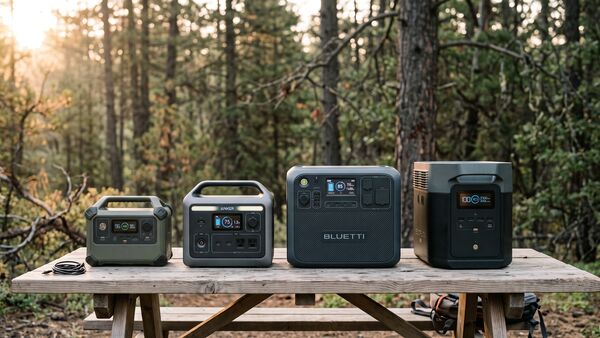
The AC180 has to be judged in the most contested segment of the market. Here is where it stands, at prices seen in mid-August 2026.
| Criterion | Bluetti AC180 | EcoFlow Delta 2 | Anker Solix C1000 |
|---|---|---|---|
| Street price | ≈ 800 € | 570 to 600 € | ≈ 800 € |
| Capacity | 1152 Wh | 1024 Wh | 1024 Wh |
| Output | 1800 W | 1800 W | 1800 W |
| 230 V sockets | 2 | 4 | 4 |
| Expandable | no | yes, 3040 Wh | depends on generation |
| Backup switchover | 20 ms | 30 ms | depends on generation |
| Cycles | 3500 | 3000 | 3000 |
| Weight | 16.4 kg | 12 kg | ≈ 13 kg |
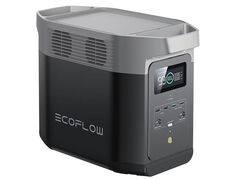
The AC180 wins on three counts: 128 Wh more capacity, 500 more cycles, and a switchover a third faster than the Delta 2. Its wireless charging pad and its measured delivered capacity, proportionally the best of the three, add to the tally.
It loses on three others, and they weigh heavily: two sockets instead of four, four extra kilos, and above all a 200 € gap with the Delta 2 for 128 Wh more. Per watt-hour, it is the poorest value of the trio.
The verdict therefore turns on which criterion matters most. For raw capacity and longevity, the AC180 holds its ground. For capacity per euro and for connectivity, the Delta 2 stays ahead.
Who it suits, and who it does not
The AC180 is a serious, well-documented machine, and unusually honest about its own performance. Its shortcomings are not hidden flaws but choices, only one of which is genuinely questionable in Europe.
It suits van and motorhome life well, where its 1152 Wh, its wireless charging pad and its Silent mode make a coherent package for living on board. It suits mobile remote work, where its 20 ms switchover protects a session and its 100 W USB-C feeds a laptop. It suits camping and boating, where its LFP chemistry and controllable behaviour are reassuring. And it suits anyone who wants the largest possible reserve without stepping up to 2 kWh stations, and anyone who appreciates a maker that claims less than it delivers.
It suits poorly anyone needing to run several appliances at once: two sockets for 1800 W means a power strip is compulsory. It suits poorly intensive summer use, with output cut to 1500 W above 35 °C. It suits poorly the protection of a server or a NAS, its 20 ms remaining an emergency switchover rather than an online UPS. It suits poorly anyone hoping to enlarge the reserve later, since it is not expandable. And it suits poorly a tight budget: the Delta 2 offers 90 % of its capacity for 200 € less.
What remains is a station you can buy with your eyes open. Its limits are all set down in black and white in its own documentation, which is far from universal, and its real capacity exceeds what its maker dares to promise. For a first high-capacity station, it is a defensible choice, provided you accept its two sockets and its price.