
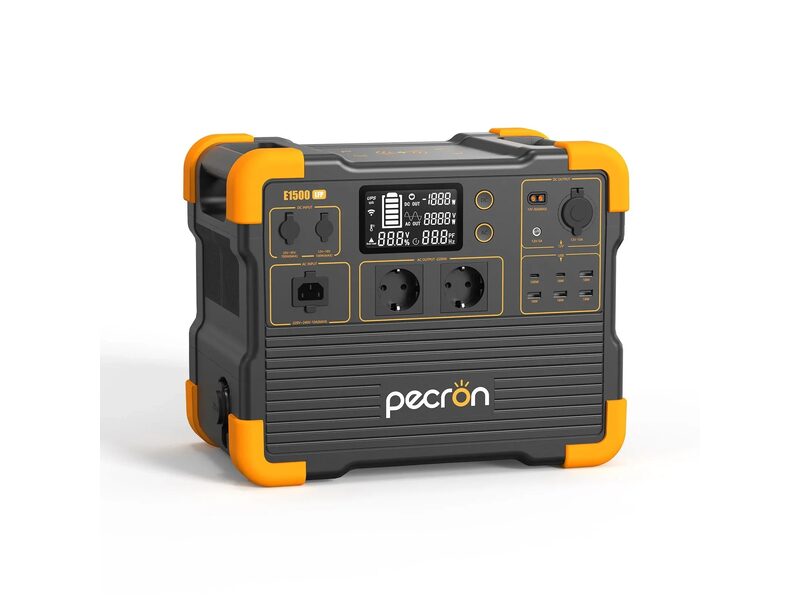
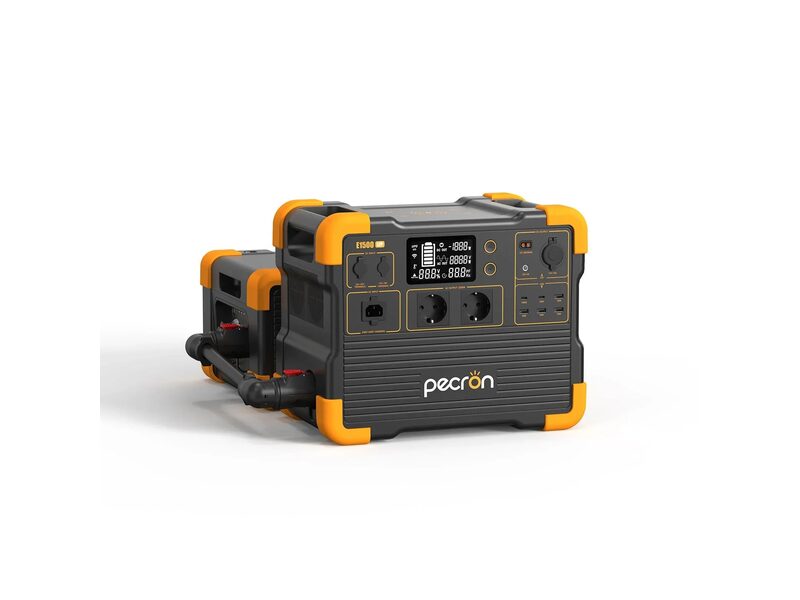
Pecron E1500LFP
(4 reviews)
Fifteen hundred and thirty-six watt-hours for £495, 80% charged in eighty minutes, and the option of moving up to 7,680 Wh later.
Characteristics
- Capacity: 1536 Wh of LiFePO4, expandable to 7,680 Wh
- Power: 2200 W continuous, 4400 W peak, pure sine wave
- Recharge: 1400 W from the mains, 80% in 80 minutes
- Outputs: 2 x 230 V, 4 USB-A, 2 USB-C (100 W), 12 in total
- 1536 Wh for £495 with a 20 ms UPS function
Detailed overview: Pecron 1536 Wh expandable power station
The Pecron E1500LFP sits in the most contested segment of the market: the versatile 1.5 kWh station, the one that serves equally as household backup, as a power source in a motorhome or on a building site. Pecron, a maker still thinly distributed in Europe, answers with a simple argument, a price clearly below that of established brands for comparable specifications.
The battery is a 1536 Wh LiFePO4 pack at 51.2 volts, quoted at more than 3,500 cycles before dropping to 80% of its initial capacity, roughly a decade at one cycle a day. The inverter delivers 2200 W continuous and 4400 W peak, on a pure sine wave, across two 230 V sockets. At that level a fridge, a kettle, an occasional induction hob or an angle grinder all pass without difficulty.
The output panel is generous: twelve in total, split into two 230 V sockets, a 30 A 12 V output, a cigarette-lighter socket, two 5 A 12 V outputs, four 18 W USB-A ports, a 100 W USB-C port, a second 18 W USB-C and a 15 W wireless charging pad set into the top of the casing. The UPS function switches to battery in under 20 milliseconds during an outage, a delay neither a computer nor a router notices.
Charging works four ways. From a wall socket the input accepts 1400 W and fills the battery to 80% in eighty minutes, to 100% in one hour forty-eight. From a generator, allow the same. On solar, the GX16 input with built-in MPPT controller accepts up to 700 W, meaning three and a half to four hours of charging in good conditions, against nine to ten hours with only 200 W of panels. Finally, a vehicle's 12 V or 18 V socket allows charging while driving.
The casing measures 337 x 238 x 301 mm for 18.2 kg, with two side handles; a trolley kit is sold separately by the maker. A screen shows charge level and power figures, and the Pecron app connects over Bluetooth. Finally, the station is expandable: one EP3000-48V battery takes it to 4,608 Wh, two take it to 7,680 Wh, which brings it close to very high-capacity stations without paying their entry price.
Full specifications
Detailed characteristics
Battery and capacity
| Rated capacity?Total stored energy in watt-hours. The higher the figure, the longer the runtime. | 1536 Wh |
|---|---|
| Delivered energy, measured?Energy that actually leaves the battery and reaches the devices. Always below the stored energy, as conversion costs heat. Taken from our in-depth review. | 1336 Wh |
| Max capacity (with extensions)?Total capacity reachable by adding extra batteries. | 7680 Wh |
| Expandable capacity?Whether capacity can be increased with add-on batteries. | Yes |
| Removable battery?The main battery can be removed or replaced by the user. | No |
| Battery chemistry?LiFePO4 (LFP) lasts far longer and is safer than NMC. | LFP (LiFePO4) |
| Charge cycles?Number of full charges before capacity drops to the stated threshold. | 3500 cycles (80 %) |
| Pack nominal voltage?Internal battery voltage; higher voltage helps deliver high power. | 51.2 V |
AC output
| Continuous AC power?Power the unit can sustain continuously on its 230 V outlets. | 2200 W |
|---|---|
| Surge power?Brief peak tolerated when starting motor or compressor devices. | 4400 W |
| Inverter type?A pure sine wave is essential for sensitive electronics and motors. | Pure sine wave |
| AC voltage / frequency?Voltage and frequency of the AC output (230 V / 50 Hz in Europe). | 230 V / 50 Hz |
| Number of 230 V AC outlets?Number of mains outlets available on the unit. | 2 |
| RV / TT-30 outlet?Dedicated 30 A outlet for North-American style RVs. | No |
Recharging
| Max AC charging power?Maximum power drawn from a wall socket; higher means faster charging. | 1400 W |
|---|---|
| AC charge 0-80%?Stated time to go from 0 to 80% on mains power. | 80 min |
| AC charge 0-100%?Stated time for a full charge on mains power. | 108 min |
| Max solar input?Maximum solar power accepted at the input (PV panels). | 700 W |
| Accepted solar voltage?Panel voltage range compatible with the solar input. | 32 to 95 V |
| Max solar current?Maximum current accepted on the solar input. | 15 A |
| MPPT controllers?Number of independent MPPT solar inputs (yield optimisation). | 1 |
| Vehicle charging (12/24 V)?Can be charged from a vehicle's cigarette-lighter socket. | Yes |
| Pass-through charging?The unit can power devices while charging (pass-through). | Yes |
Ports and connectors
| USB-C ports?Number of USB-C ports and the fastest port's power (laptops, phones). | 2 × 100 W |
|---|---|
| USB-A ports?Number of USB-A ports and maximum power (small devices). | 4 × 18 W |
| 12 V output (car socket)?12 V cigarette-lighter output and its power (coolers, pumps…). | Yes |
| Other DC outputs?Additional DC connectors (Anderson, DC5521, XT60…). | allume-cigare, XT60 |
Portability
| Weight?Net weight of the unit, battery included. | 18.2 kg |
|---|---|
| Dimensions (L × W × H)?Overall size of the unit in millimetres. | 337 × 238 × 301 mm |
| Form factor?Portable (hand-carried), transportable (heavy), or wheeled. | Transportable |
| Wheels?Built-in wheels for moving the unit. | No |
| Telescopic handle?Retractable handle like a wheeled suitcase. | No |
Safety and environment
| Discharge temperature?Temperature range in which the unit can deliver power. | -20 to 45 °C |
|---|---|
| Charge temperature?Temperature range in which the unit can be recharged. | 0 to 45 °C |
Backup / UPS
| UPS / EPS mode?Automatic switch to battery on a mains outage (backup). | Yes |
|---|---|
| Switchover time (rated)?Delay before switching to battery; under 20 ms suits a PC or router. | 20 ms |
Noise and thermal
| Quiet mode?Setting that limits fan noise, often by capping charge power. | No |
|---|---|
| Self-heating battery?Battery pre-heating to allow charging in cold weather. | No |
Display and connectivity
| Display?Type of screen showing power, runtime and alerts. | LCD |
|---|---|
| Bluetooth?Bluetooth link for nearby control. | Yes |
| Wi-Fi?Wi-Fi connection for remote control and monitoring. | No |
| Mobile app?iOS / Android app to control the unit. | Yes |
| Local control (no cloud)?Control possible over Bluetooth without an account or internet. | No |
| Solar connector?Connector type of the solar input (XT60, Anderson, MC4…). | GX16 |
Availability and warranty
| Market launch?Date the model first became available on the European market. Useful to place its generation: technology moves fast in this segment, and a device several years old may be at the end of its commercial life. | September 2023 |
|---|---|
| Warranty?Length of the manufacturer's warranty. | 3 years |
⚡ How long will this power station run a device?
With 1,536 Wh, the Pecron E1500LFP external battery runs a fridge (50 W) for ~26h or an LED TV (90 W) for ~15h.
| Home | Runtime |
|---|---|
| Mini fridge (45 W) | ~29h |
| Freezer (60 W) | ~22h |
| American fridge (150 W) | ~8h40 |
| Washing machine (500 W) | ~2h35 |
| Outdoor & workshop | Runtime |
|---|---|
| Wi-Fi router (15 W) | ~87h |
| Water pump (60 W) | ~22h |
| E-scooter (charging) (100 W) | ~13h |
| Angle grinder (900 W) | ~1h25 |
Rough estimate: real consumption varies, and very power-hungry appliances (heating elements) must stay below the output power.
What is this power station best for?
-
Home & Power cuts Ideal
This is the E1500LFP's natural playing field. Its 2200 W continuous and 4400 W peak cover most of a household during an outage: fridge, freezer, router, lighting, boiler and even a kettle now and then. The UPS function switches to battery in under 20 milliseconds, a delay short enough that a computer or a home server never restarts. Its 1536 Wh cover several hours on the essentials, and above all the station is expandable: one EP3000-48V battery takes it to 4,608 Wh, two take it to 7,680 Wh, enough for a full day. Charging to 80% in 80 minutes brings it back up between two outages.
-
Motorhome & Van life Ideal
In a motorhome or a van, the E1500LFP acts as a bolt-on electrical installation: its two 230 V sockets and 2200 W run the fridge, an occasional induction hob, the coffee machine and every device on charge, while its four USB-A ports, two USB-C ports including one at 100 W and its 15 W wireless charging pad cover the electronics. It recharges from the 12 V socket while you drive, from a service-area outlet in 1 h 48, or from the sun at up to 700 W. Its 18.2 kg stay carryable on two side handles, and the additional-battery expansion lets you travel longer without changing station.
-
Job site & Tools Ideal
On a site with no mains connection, the E1500LFP's 2200 W continuous run most power tools, drill, sander, jigsaw, angle grinder, and the 4400 W peak absorbs the starting surge of a motor-driven machine. The pure sine wave protects the electronics inside modern tools, and the complete absence of noise and fumes changes everything indoors or in a residential block, where a petrol generator is banned. Fast charging, 80% in 80 minutes, lets you refill from an available socket over lunch. For a full day at full tilt, plan on the expansion battery.
-
Remote work Suitable
For a home office, the E1500LFP acts as an oversized UPS: switching in under 20 ms protects the session from any brief outage, and its 1536 Wh last a full day on a computer, two monitors, the router and lighting. The 100 W USB-C port charges a laptop with no mains brick, and the Pecron app over Bluetooth tracks consumption remotely. Its 18.2 kg mean it will live under a desk rather than move every day, which is no drawback for this use.
-
Events & Market stalls Suitable
For a market stall, a car boot sale, an outdoor wedding or a club bar, the E1500LFP silently runs lighting, a PA system, a card terminal and a small fridge. Two 230 V sockets rarely suffice for a full stall, so you will need a multi-way adapter, but the 2200 W available leave plenty of headroom. The decisive advantage over a petrol generator remains the absence of noise, vibration and exhaust, often required by event regulations. For a full day with continuous refrigeration, the expansion battery becomes necessary.
-
Off-grid & Solar Suitable
In a light off-grid setup, a cabin, an isolated workshop or a tiny house, the E1500LFP serves as an affordable system core: it takes up to 700 W of panels through its GX16 input with built-in MPPT controller, recharges in three and a half to four hours in those conditions, and its LiFePO4 chemistry rated for 3,500 cycles to 80% withstands a daily cycle for a decade. Expansion to 7,680 Wh with two EP3000-48V batteries lets the installation grow gradually. Its limit for full autonomy remains the solar input, more modest than that of premium stations.
Our team's recommendations based on the model's capacity, output power and weight.
Compatible solar panels
A selection of photovoltaic panels that suit this station's solar input (up to 95V / 700W), best match first.


Comparison
Between £495 and £854, stations of 1.4 to 2 kWh separate on price per watt-hour, charging speed and warranty. Here is how the Pecron E1500LFP sits against three references from our catalogue.
| Criterion | Pecron E1500LFP | Growatt Infinity 1300 | Jackery Explorer 2000 v2 | Aferiy P210 |
|---|---|---|---|---|
| Capacity | 1536 Wh | 1382 Wh | 2042 Wh | 2048 Wh |
| Continuous power | 2200 W | 1800 W | 2200 W | 2400 W |
| Expandable | Yes, up to 7,680 Wh | No | No | No |
| Mains charging | 1400 W, 80% in 80 min | Not stated | Not stated | Not stated |
| Weight | 18.2 kg | 19.2 kg | 17.5 kg | 22 kg |
| Warranty | 3 years | 5 years | 5 years | 7 years |
| Observed price | ≈ £495 | ≈ £854 | ≈ £683 | ≈ £769 |
In short, the E1500LFP offers the best price per watt-hour in the table and is the only one that can grow through additional batteries, which makes it the rational pick if budget rules or if your needs are likely to increase. The Growatt Infinity 1300 costs £359 more for less capacity and is even a kilo heavier (19.2 kg against 18.2 kg): its appeal rests mainly on its 14 outputs. The Jackery Explorer 2000 v2 offers 500 Wh more and five years of warranty for £188 on top. The Aferiy P210 is the most powerful and the best covered, seven years, but also the heaviest. If warranty is your first criterion, look towards Jackery or Aferiy instead.
Related video
Video: PECRON E1500LFP 2200w UPS LiFePO4 Modular Solar Power Generator Review - Published on 11/09/2023
Our tester's review: Christophe Delpuech
Pecron is a maker you come across less often than EcoFlow or Jackery in Europe, and its strategy fits in one sentence: offer the same thing for considerably less. The E1500LFP illustrates it well. At £495 it delivers 1536 Wh and 2200 W, where most stations of equivalent output in our catalogue start around £700 to £850. On paper there is no obvious sacrifice: LiFePO4 chemistry rated for 3,500 cycles to 80% residual capacity, a pure sine wave inverter, a UPS function switching in under 20 milliseconds, a Bluetooth app. Two things deserve highlighting. Charging first: 1400 W of mains input, which fills the battery to 80% in eighty minutes and to 100% in one hour forty-eight. On a station of this capacity that is fast, and it concretely changes household backup use, where you want to refill between two outages. Expandability second: one EP3000-48V battery takes the set to 4,608 Wh, two take it to 7,680 Wh. Buying the station alone today and growing it later is a genuine option, not a marketing line. Three honest reservations. Solar input tops out at 700 W, respectable but below the 1,000 to 2,400 W of premium stations, which stretches recharge times when running fully off-grid. There are only two 230 V sockets, so a multi-way adapter becomes necessary as soon as you plug in more than two devices. And the stated warranty is 3 years, against 5 for Anker, EcoFlow or Jackery: on a product whose battery is meant to last a decade, that gap is worth weighing.
In-depth review Pecron E1500LFP: our full review 4.0/5 Read our full review → Capacity and efficiency 4.1 Delivered power 3.9 Recharging 4.0 Ports and control 4.1 Build and endurance 3.9 Noise not measuredFrequently asked questions: Pecron 1536 Wh expandable power station
One EP3000-48V expansion battery takes the set from 1536 to 4,608 Wh, and two take it to 7,680 Wh, five times the starting capacity. That is this station's main argument against its non-expandable rivals.
From a wall socket the input accepts 1400 W: 80% in eighty minutes and 100% in one hour forty-eight. On solar, allow three and a half to four hours with 600 W of panels, and nine to ten hours with only 200 W.
Yes. The UPS function switches to battery in under 20 milliseconds during an outage, far too short for a computer, a router or a home server to restart.
That is this station's main equipment limitation. The 2200 W available do allow more than two appliances, but you will need a multi-way adapter, which is perfectly safe as long as total power is respected.
Pecron quotes more than 3,500 cycles before capacity drops to 80% of its initial value, roughly a decade at one full cycle a day. The commercial warranty, however, is 3 years.
Need help choosing?

Other products in the "Versatile power stations" category
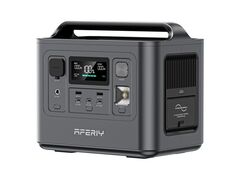
Aferiy P010
See price (5)
512Wh and 800W (1600W surge) in a 6.5kg footprint, backed by a 7-year manufacturer warranty: the Aferiy P010 bets on longevity as much as on compactness.
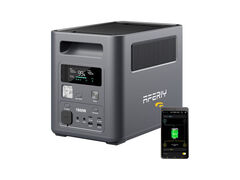
Aferiy P180
See price (12)
With 1024 Wh, 1800 W (up to 3600 W peak), a 90% recharge in 60 minutes and just 11.6 kg, the Aferiy P180 aims for lightweight versatility.
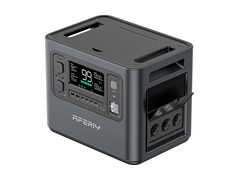
Aferiy P210
See price (7)
With 2048 Wh, 2400 W (up to 4800 W peak), a LiFePO4 battery and a 7-year warranty, the Aferiy P210 targets the best capacity-to-price ratio on the market.
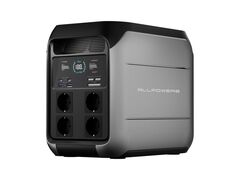
Allpowers P1800
£494.95 (6)
A 1 kWh LiFePO4 power station with plenty of punch, fast mains recharging and quiet running: a smart pick for campervans, camping trips and power cuts.
Published on 28/07/2026, updated on 14/08/2026