
What the claimed 1920 Wh are actually worth
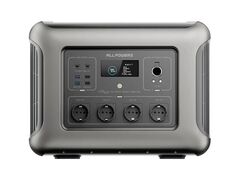
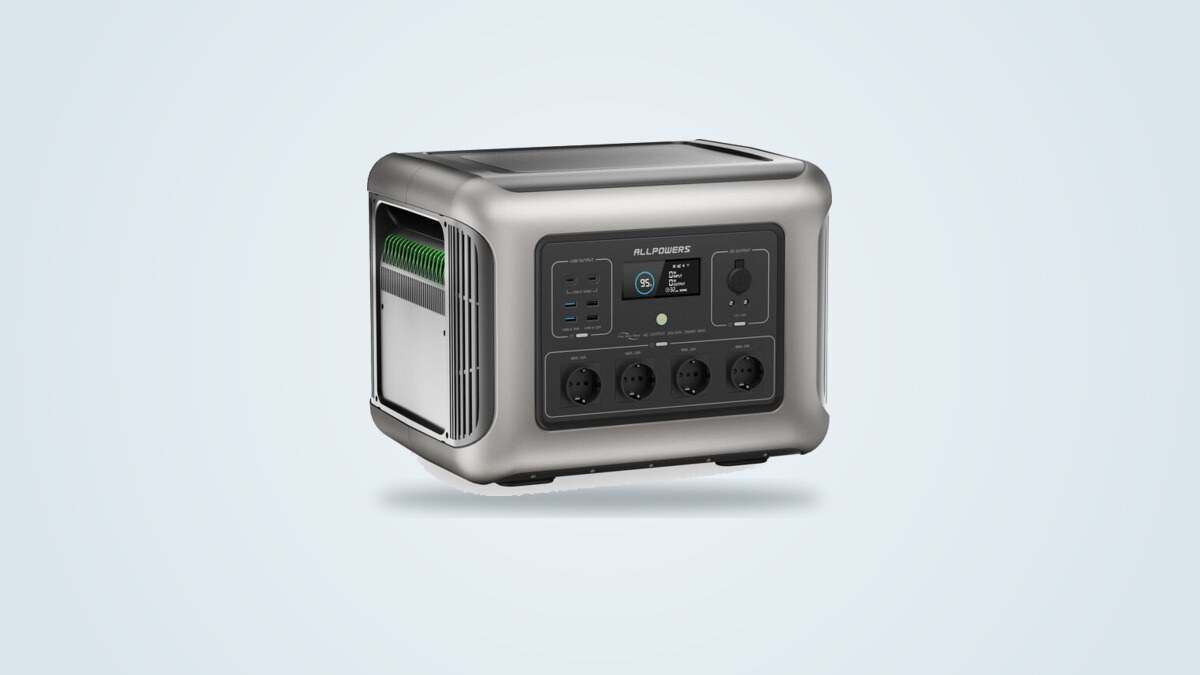
The Allpowers R2500 V2 lists 1920 Wh of LiFePO4 capacity on its spec sheet. That nominal figure says nothing about the energy actually available at the AC output once the inverter's conversion losses and the BMS safety margin are subtracted. Yet it's this real figure, not the one on the label, that determines how long a fridge or a laptop will actually run on a charge.
Under a steady, reasonable load of 300 W, a profile close to a fridge, a router, and a few lights running together, the station returns 1778 Wh, or 92.6% of the claim. Under a considerably heavier load, close to 1900 W, the return climbs to 1873 Wh, or 97%. This direction of change is less common than the opposite, which shows up on plenty of competing stations where efficiency drops as power draw rises.
The mechanism is still the same fixed conversion cost, just applied differently depending on how long the discharge lasts: at low power, the discharge stretches over many hours, and that fixed cost accumulates the whole time, eating a proportionally larger share of the total energy. At high power, the same fixed loss is spread over far less time and so weighs less in the final tally. In practice, for a low-power backup scenario (fridge, router, lighting), it's safer to plan around 92 to 93% of the rated capacity rather than the full 1920 Wh on the label.
The one-hour full charge promise, and its real condition
The Allpowers R2500 V2's spec sheet highlights a full charge in around one hour, a strong claim for a station of this capacity. That figure is real, but it rests on a condition rarely printed in the same font size: it requires stacking the AC input (1500 W maximum) and the solar input (1000 W maximum) at the same time, for 2500 W total input. Without solar panels connected, on AC alone, expect around 90 to 95 minutes for a full 100% charge, and around 50 to 60 minutes to reach 80%, a gap that comes from the usual slowdown of charging near the very top of the curve.
A second condition, even less visible in the marketing copy: reaching the lower end of that AC-only range requires manually turning on fast-charge mode in the Allpowers app. Without that step, the station charges at a more cautious default rate. It isn't deceptive, just a step an eager buyer can easily miss on first setup, before even opening the app.
The station offers five charging methods overall: AC, solar, a vehicle's 12 V socket while driving, a generator, and the combined AC-plus-solar mode mentioned above. On solar alone, with a panel array close to the 1000 W maximum and decent sun, expect around two hours for a full charge, a duration that naturally stretches with a smaller panel setup or less favourable weather.
Two power limits worth knowing before buying
This is the most important reserve in this review, and the least visible in the product's marketing. The Allpowers R2500 V2's UPS function switches to battery in under 15 milliseconds as soon as a power cut hits, fast enough that a computer, a home router, or a sensitive medical device won't even restart. That's a genuine strength, rare at this price point.
But once that switchover happens, maximum output is no longer 2500 W: it caps at 1500 W. The reason comes down to the standard rating of an ordinary household AC outlet, whose current is limited to 15 A, a threshold the unit itself respects even when it acts as the backup source plugged into such an outlet. That ceiling isn't an arbitrary limit set by the device, it's a direct consequence of the standard household circuit it's connected to in UPS mode.
For most backup scenarios (fridge, lighting, home router, computer, small electronics), 1500 W is more than enough and this ceiling is never noticed: the combined draw of those devices rarely exceeds 400 to 600 W at once. It becomes decisive, though, for anyone planning to run a big single load, an electric oven, a stovetop, or a powerful hair dryer, during an extended outage while counting on the 2500 W advertised elsewhere: that specific scenario simply doesn't work in UPS mode.
A second, independent limit is also worth knowing. The advertised 2500 W is a total spread across the station's four AC outlets, but each individual outlet stays amperage-limited. A single high-inrush appliance at startup, a drill, a welder, or a motorised power tool, plugged alone into one outlet, can trip the protection well below the total power the unit can actually deliver.
The fix is simple once the mechanism is understood: spread heavy loads across several different outlets rather than plugging everything into one spot through a power strip. This isn't strictly a manufacturing flaw, more a design trait common to many multi-outlet stations of this power class, where each output channel is protected independently. It's still worth anticipating before buying, especially for job-site or workshop use where high-inrush tools are common.
A good fit for sensitive, continuous electronics
Beyond classic home backup, the combination of a direct 12 V output, a pure sine-wave inverter, and a UPS function makes the Allpowers R2500 V2 particularly well suited to electronics sensitive to a continuous power supply, such as a CPAP machine used every night. Plugging such a device directly into the 12 V output rather than through its AC adapter avoids the extra conversion losses that adapter introduces, stretching the real runtime available.
As a rough illustration based on the real-world return established above: a device drawing around 350 Wh a night with a heated hose and a humidifier running would last roughly five to six nights on a full charge, and up to about ten nights with the humidifier off. That calculation is a projection based on the connected device's own draw, not a universal guarantee: actual consumption depends on the specific machine, its pressure setting, and the ambient temperature.
A generous 1000 W solar input, rare at this price, with one caveat
The Allpowers R2500 V2 accepts up to 1000 W of solar panels, across a wide voltage range of 12 to 150 V, with a built-in MPPT controller. That's a generous solar charging capacity for this price bracket, well above what several direct competitors of the same capacity offer: enough to fully recharge the station in a single good day of sun with a well-sized panel array, or to top up an AC charge to approach the one-hour figure discussed above.
The 12-to-150 V voltage range gives real installation freedom: several panels can be wired in series to reach a higher voltage without needing an extra converter, a setup that cuts line losses over a long cable, useful for a campervan roof install or a fixed setup far from the point of use.
One real caveat does exist around how consistent that solar charging is: cases of solar charging described as inconsistent exist on some units, without a precise, reproducible fault having been clearly identified so far. Before making the solar input the sole, primary charging source for an off-grid setup, it's worth testing it with your own equipment as soon as it arrives, rather than discovering a possible issue once far from any AC outlet.
Expandable with B1000 batteries, but not up to 4320 Wh on this version
The 1920 Wh capacity can grow with one or two B1000 expansion batteries, sold separately, each rated at 1152 Wh. With one, the total rises to around 3072 Wh. With two, it reaches around 4224 Wh, enough for a considerably longer home backup or to cover a wider daily load off-grid, without changing either the inverter or the connectivity of the main unit.
One point of caution on this exact figure: a value of 4320 Wh circulates widely online for an R2500 plus two B1000 batteries, but it actually belongs to the R2500 Plus, a neighbouring variant rated near 2016 Wh (2016 + 1152 + 1152 = 4320 Wh), not to this 1920 Wh V2. The gap between the two final figures stays modest, under 100 Wh, but it shows how closely the variants in this lineup resemble each other and get mixed up, including in the manufacturer's own marketing pages.
One more useful point to place this exact version: the Japanese market for this lineup appears to distribute mainly the 2016 Wh variant, not this 1920 Wh V2, a fact of local distribution worth knowing rather than a gap in availability. Both variants share the same electronic platform (inverter, UPS, app), only the battery capacity and the weight genuinely differ between them.
24.5 kg: the lightest in its Allpowers class, still a fixed installation
At 24.5 kg on the scale and dimensions of 45.6 x 36 x 34.6 cm, the Allpowers R2500 V2 is noticeably lighter than its close sibling the R2500 Plus, which weighs 29 kg for a barely higher 2016 Wh capacity. That's a notable 4.5 kg gap at nearly identical capacity, a difference that likely comes down to different cell or chassis choices between the two variants of the same lineup.
This remains a station built for a fixed spot, not for daily nomadic use: no wheels, no telescoping handle, only side handles for hand-carrying. Beyond a few metres, carrying it with two people is noticeably more comfortable than going solo. The footprint stays reasonably compact for the class though: its dimensions let it slide under a campervan bench or against a garage wall without much trouble, built for a setup that stays put rather than daily nomadic use.
Ports and app control: complete for its class
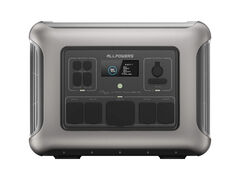
Output provision is complete for a station of this capacity: four pure sine-wave AC outlets, the waveform type most sensitive electronics prefer, two USB-C ports up to 100 W each, enough to fast-charge a laptop, four USB-A ports up to 18 W, and a 12 V/10 A cigarette-lighter-style output with a DC5525 connector. Enough to power around ten devices at once without a power strip.
Control runs through the Allpowers app, over Bluetooth for initial nearby pairing and over WiFi for remote monitoring once the station is on the home network: charge level, instantaneous input and output power, turning UPS mode or fast-charge mode on. That software layer remains a genuine advantage over direct competitors that skip it entirely, as the comparison below shows. It's also useful for keeping an eye on a backup or solar setup remotely without walking over to the station's screen.
Against the Vtoman Jump 2200 and the Pecron E1500LFP
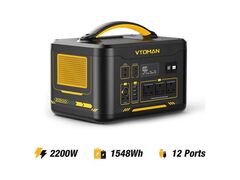
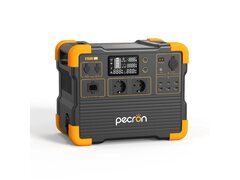
In its capacity class, the Allpowers R2500 V2 goes up against the Vtoman Jump 2200 and the Pecron E1500LFP in particular. On paper, it clearly wins on two specific points: a capacity of 1920 Wh against 1548 Wh and 1536 Wh for the other two, and above all a 1000 W solar input where the Vtoman caps at 400 W, more than twice as little. App control is also exclusive to the Allpowers in this comparison, with the Vtoman offering none according to its public spec sheet.
| Criterion | Allpowers R2500 V2 | Vtoman Jump 2200 | Pecron E1500LFP |
|---|---|---|---|
| Capacity | 1920 Wh | 1548 Wh | 1536 Wh |
| Continuous power | 2500 W | 2200 W | 1500 W |
| Max solar input | 1000 W | 400 W | not specified |
| App control | Yes | No | not specified |
| Weight | 24.5 kg | not specified | not specified |
The Vtoman keeps one argument the Allpowers lacks: a built-in vehicle jump-starter function, useful for anyone pairing their station with automotive or roadside use. Against the Pecron, less publicly documented on these specific criteria, the Allpowers clearly wins on advertised power, 2500 W against 1500 W, and on capacity. In both cases, the clearest gap remains solar charging: few direct competitors in this capacity class offer an input as generous as the Allpowers' 1000 W.
Reliability, warranty, and customer support
Allpowers advertises a 5-year warranty on this station, a selling point featured on most of its product pages. That figure follows the manufacturer's general policy, which sets a base coverage of 24 months across its range and ties the extension beyond that to registering the product on its official site after purchase. Without that step, a fault occurring after 24 months would only fall under the base warranty, not the 5 years pushed commercially. An external AC power block is also generally excluded from this type of warranty at this manufacturer.
On customer support itself, two concrete cases lean in the brand's favour: a defective unit replaced within a week through an online marketplace, and a free replacement granted several years after purchase, past the base warranty period, in exchange for covering only the shipping cost. This kind of responsiveness guarantees nothing for any individual future case, but it weighs positively in the brand's overall standing.
Who it's for, who it isn't
It's a good fit for anyone after a serious home backup reserve with genuine app monitoring, or for demanding campervan use able to run a compressor fridge, a portable cooktop, or a pressure washer. It also suits an off-grid solar setup thanks to its 1000 W input, as long as the daily heavy load stays reasonable (lighting, a fridge, electronics).
It isn't a good fit for anyone counting on the full 2500 W in UPS backup mode for one specific big appliance (an oven, a stovetop, a powerful hair dryer): that mode caps at 1500 W. It also doesn't suit anyone after a nomadic setup to move around daily, or anyone unwilling to check the warranty policy or the consistency of its solar charging beforehand.