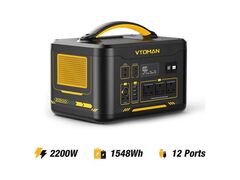
What the 1548Wh actually delivers
The advertised 1548Wh refers to the energy stored in the LiFePO4 cells, not what actually reaches a mains socket. Between the two sits the inverter, which takes its own cut.
Charging efficiency, on the mains-input side, sits at around 93%: that's the share of the energy drawn from the wall that actually ends up stored in the cells, before output losses even come into play.
The Jump 1500 expansion battery, sold separately, doubles the available capacity to 3096Wh without changing the output power or adding any extra ports: it only adds energy reserve. For extended home backup power or full-time motorhome living, that option genuinely changes the equation, where a non-expandable station forces a jump to a bigger, pricier unit the moment the starting capacity falls short.
2200W continuous: a promise that holds up under real combined loads
Plenty of power stations advertise a wattage they only reach on paper. That isn't the case here: a real combined load, mixing a kettle, a coffee maker and a hairdryer, drew 2234W continuously from the station without a single trip, and a 3250W surge was absorbed without cutting out.
That headroom comes from Vtoman's own V-BEYOND technology: rather than cutting out abruptly the moment a device draws more than the rated power, the inverter holds output steady and absorbs the overshoot up to a 4400W surge. In practice, that means an appliance with a strong start-up spike, such as a fridge compressor or a power tool, doesn't trigger an unwanted shutdown, unlike what happens on some stations with less headroom to spare.
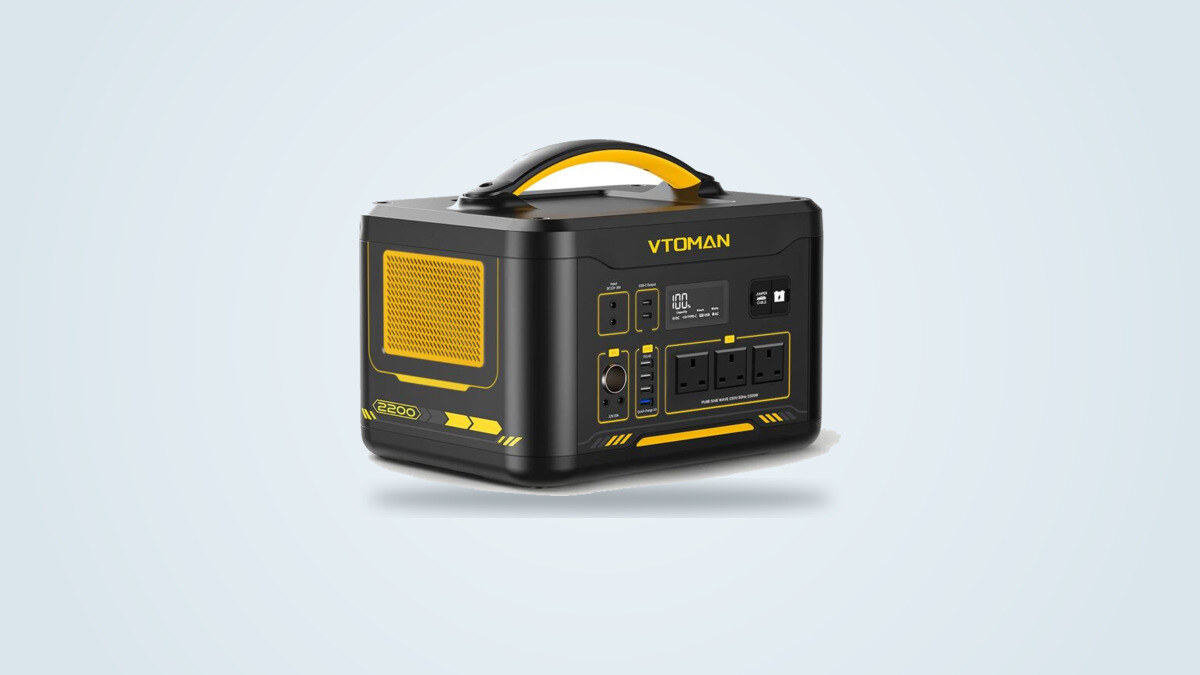
Three mains sockets on the output side, a pure sine wave and a 230V/50Hz supply round out the picture: enough to run several sensitive devices at once, from electronics to small kitchen appliances, without worry for their internal circuitry.
Mains charging: the 4-hour promise doesn't survive real-world use
The manufacturer advertises a full charge in 4 hours for a 400W mains input. In practice, the supplied charger doesn't deliver that figure: its real output caps at 328.5W, a gap that shows up directly on the clock.
| Protocol | Duration | Note |
|---|---|---|
| Full charge, supplied mains charger | over 5 hours | real charger output limited to 328.5W |
| Charge up to 80% | around 6h30 | different protocol, not directly comparable to the line above |
| Charging from a 12V car outlet | 6h30 to 13h | manufacturer's stated figure |
| Solar charging, 400W panels | 5 to 8 h | manufacturer's stated figure, depending on sunlight |
Pass-through charging is still available: the station keeps powering its outputs while it recharges, useful for home backup power or motorhome use where you don't want the fridge to lose power during a top-up. The two DC5521 input ports share the advertised 400W total, which in theory allows combining mains and solar input, but also explains why neither port alone ever delivers the full input power on its own.
The fan: silent at idle, genuinely loud under load
This is the most consistent point of friction. Cooling stays discreet as long as demand is light: charging a phone, LED lighting, small electronics. Once the load climbs, the picture changes sharply.
| Situation | Noise level |
|---|---|
| Light load (USB, lighting, small electronics) | near silent, fan off most of the time |
| Active mains charging, within the first few minutes | clearly audible indoors |
| Output above roughly 1000W, sustained | 60 to 70 dB at one metre, fan running flat out |
Two independent figures converge on that last line: one places the level well above 60 dB, the other puts it at 70 dB on average, both taken at one metre. The fan can kick in within ten minutes of starting a mains charge and then run without a break for as long as the charge continues, indoors included.
The station offers no quiet mode and no automatic charge throttling to tame this noise: it's a usage choice to make in advance rather than a setting to flip. For daytime backup power, a worksite or outdoor use, it isn't an issue. For a night parked in a van with a charge running, it's a real constraint to plan around.
The built-in jump starter: the feature worth the detour
This is the rarest feature at this price point: a dedicated port lets you jump-start a vehicle with a flat battery without a separate booster pack. Cable connected to the terminals, an engine has started on the first attempt.
Two caveats temper this strength. First, the EC5 jump starter cable isn't included in the standard box: it's an extra purchase, which means you can't use the feature straight out of the box. Second, once bought, its length stays limited, which can make it hard to reach the battery terminals depending on where they sit under the bonnet, a point worth checking before relying on it in an emergency.
The feature is designed not to shorten the station's lifespan: jump-starting only draws on the battery for a few seconds, a very different load from a prolonged discharge. It's a bonus on top of, not a replacement for, a dedicated booster pack for anyone who needs this kind of rescue often.
Twelve ports, zero app: the port selection in detail
The port count is generous for the class: twelve in total, enough to run a good chunk of a motorhome setup or a mobile office at once.
| Output | Detail |
|---|---|
| Mains | 3 sockets, pure sine wave, 230V/50Hz, 2200W continuous (4400W surge) |
| USB-C | 2 ports, 100W PD max each |
| USB-A | 4 ports, one QC 3.0 at 18W, the rest at 12W |
| 12V DC | 2 regulated DC5521 outputs plus a car outlet, 120W total |
| Lighting | built-in 12W LED torch |
Against that generous port count, one gap stands out: no app whatsoever, no Bluetooth, no WiFi. Control is limited to the LCD screen and the station's own physical buttons. Checking the charge level or switching off an output remotely means walking over to the unit, where several direct rivals in this capacity class offer smartphone monitoring. It isn't a deal-breaker for a stationary use case, parked motorhome or home backup, but it's a genuine gap for anyone who values remote control.
Pass-through charging works both ways: the station can top up its own battery while still delivering current on its outputs, something some less capable rivals still don't offer on their entry models.
Expandable to 3096Wh: real versatility for backup power and motorhome life
Beyond the port selection, it's the use case that separates a generalist station from one built to last. The Jump 2200 explicitly targets three settings: motorhome life, home backup power and off-grid worksites.
In a motorhome, its 2200W continuous runs a compressor fridge, a kettle or a small microwave, with the 1548Wh reserve leaving room before a recharge is needed. Solar input, up to 400W on this version, tops up the charge on the way to a sunny stopover, even though reaching that ceiling takes several correctly angled panels rather than a single module.
For home backup power, the station keeps a fridge, lighting, a router and everyday electronics running on its base reserve, and the expansion to 3096Wh with the Jump 1500 battery changes the equation for an extended outage. The three mains sockets remove the need for a power strip, and pass-through charging lets devices keep running while the station tops itself up.
On an off-grid worksite, the power headroom absorbs the start-up surge of a typical power tool, with enough reserve for half a day of intermittent use. The fan makes itself heard under heavy load, which isn't an issue outdoors but confirms, once again, that noise is the trade-off for this much power on tap.
Safety, build quality and reliability
The LiFePO4 battery is rated for 3000 cycles before dropping to 80% of its original capacity, a standard endurance figure for this chemistry and well ahead of an equivalent NCM battery. Vtoman's own LifeBMS battery management system declares ten protections: overheat, overcharge, over-discharge, overvoltage, overcurrent, short-circuit, overload, spark prevention, reverse polarity and real-time monitoring.
The operating temperature range is wide, from -20 °C to 55 °C on discharge and 0 °C to 55 °C on charge, which covers most outdoor use short of polar conditions.
The product has been on sale since February 2023 with no safety issue or recall to date. LiFePO4 chemistry, inherently more stable than NCM, is the main technical reason: it tolerates overcharging, over-discharging and temperature swings far better, the very conditions behind most incidents on other battery chemistries. On warranty, 2 years is a standard figure for the category, without being the most generous on the market.
Against the direct competition
Within its capacity class, three direct rivals stand out. The table below places the Jump 2200 against them on the most telling criteria.
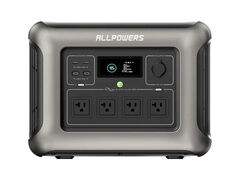
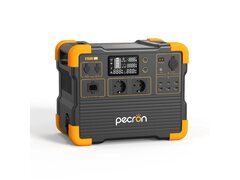
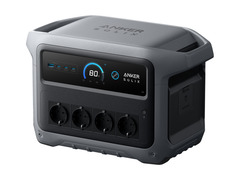
| Criterion | Vtoman Jump 2200 | Allpowers R1500 | Pecron E1500LFP | Anker Solix C1000 Gen 2 |
|---|---|---|---|---|
| Capacity | 1548 Wh | 1152 Wh | 1536 Wh | 1024 Wh |
| Continuous power | 2200 W | 1800 W | 1500 W | 2000 W |
| Expandable | yes, 3096 Wh | no | not stated | no |
| Jump starter | yes | no | no | no |
| Mobile app | no | no | not stated | no |
Against the Allpowers R1500, the Jump 2200 wins clearly on both capacity and available power, with its own jump starter function on top. Against the Pecron E1500LFP, capacity is close, but the Jump 2200 has 700W more continuous power and the same jump starter, which its rival lacks. Against the Anker Solix C1000 Gen 2, faster to recharge and quieter in everyday use, the Jump 2200 keeps the edge on raw capacity and possible expansion, an option the Anker's second generation doesn't offer.
None of these three rivals offers a built-in jump starter: that's the real differentiator for the Jump 2200 in this comparison, at the cost of a fan that's more present than the segment average.
Who it's for, and who should look elsewhere
The Vtoman Jump 2200 targets a specific profile, and it serves it well.
It's a great fit for motorhome or camper van use with daytime charging, for home backup power that values energy reserve and simplicity over an app, and for off-grid worksites where the jump starter can rescue a vehicle on top of running tools. The combination of capacity, power and possible expansion puts it ahead of several direct rivals on these specific use cases.
It's a weaker fit for three situations. Sleeping in the same space during a mains charge, first: the fan kicks in quickly and runs without a break. Remote control from a smartphone, next: the total absence of an app or wireless connectivity means staying close to the unit. Charging fast before heading off, finally: the advertised 4 hours turn into over 5 in practice, a gap worth building into trip planning.
That leaves the jump starter cable, missing from the standard box: anyone counting on this feature from day one should budget for it separately, and check its length against the vehicle in question.