


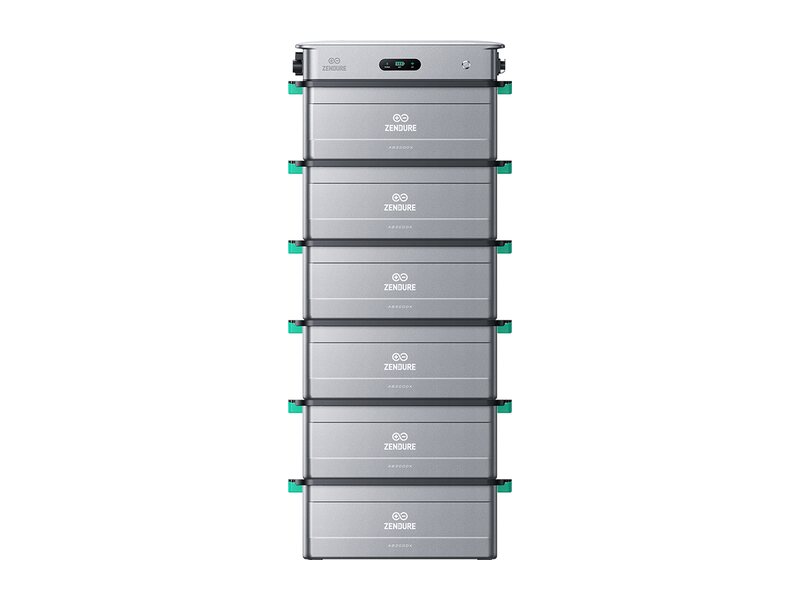
Zendure SolarFlow 2400 AC
(6 reviews)
AC-coupled storage rated 2400 watts both ways and expandable past seventeen kilowatt-hours, on a battery platform Zendure has since replaced.
Characteristics
- Power: 2400 W charging as well as discharging
- Storage: 2880 Wh LiFePO4 per module, up to 17.28 kWh
- Backup: Off-grid socket, 2400 W continuous, 3600 W peak
- Batteries: AB3000X only, not the AB3000L of the 2400 AC+
- 2400 W bidirectional and 6000 cycles
Detailed overview: Zendure SolarFlow 2400 AC 2880 Wh home battery
The Zendure SolarFlow 2400 AC is an AC-coupled home battery. Unlike the microinverters in the same family, it does not take solar panels directly: it sits on the AC side, between the installation and the home, and works just as well with existing photovoltaic production as with the grid alone.
Its nominal rating is 2400 watts in and out on the grid-tied terminal, at 230 volts and 50 hertz. Output ships configured at 800 watts and can be raised to 2400 watts through the app once the unit sits on a dedicated circuit, which Zendure says requires an electrician. Third-generation silicon carbide semiconductors bring the full AC round-trip efficiency to as much as 93 %. A compatible smart metre is needed for the system to follow household consumption in real time.
The entry configuration includes an AB3000X battery of 2880 watt-hours, that is 60 amp-hours at 48 volts, in lithium iron phosphate cells rated for 6000 cycles. Stacking six modules brings the system to 17.28 kWh, on a par with complete residential storage. The AB3000X battery can also be ordered separately to grow the installation later. Zendure is explicit that this hub accepts the AB3000X and no other module: the AB1000 and AB2000 families, in all their variants, are not supported.
That list now has a second half worth reading carefully: the SolarFlow 2400 AC belongs to a generation that has been superseded. Zendure has released the SolarFlow 2400 AC+, an all-in-one with 2.4 kWh of storage built in and expansion to 16.8 kWh, and the SolarFlow 2400 Pro, which keeps MPPT inputs for panels. Both are built around a new battery module, the AB3000L, and Zendure states that the AB3000L suits the SolarFlow 2400 Pro and the SolarFlow 2400 AC+ only, and is not compatible with the AB3000X or the SolarFlow 2400 AC. The exclusion runs in both directions and there is no adapter. If you already own a 2400 AC, the AB3000X is the module to buy and the only one that will work. If you are starting from scratch, the older platform remains on sale and discounted, but the choice of generation is made once and cannot be revisited later by swapping batteries.
An off-grid terminal handles the backup function, keeping the fridge, the router and the lighting alive during a cut. Zendure rates that socket at 2400 watts continuous with a 3600 watt peak for ten seconds, and the changeover takes about 15 milliseconds once the function has been enabled in the app. Grid-tied and off-grid operation can run at the same time, within a combined 2400 watts. Note that the enclosure's IP65 rating no longer applies once that socket is in use or the weatherproof cover is not properly closed. The unit measures 448 x 303.6 x 88 mm and weighs 10.12 kilos.
The AI-driven HEMS energy manager connects to over 840 European suppliers across 32 markets to exploit hourly tariffs: it charges when electricity is cheap, discharges at peak hours and protects the battery in winter. If your need is really a balcony with panels, look at the SolarFlow 800 Plus or the SolarFlow 800 Pro 2, which include MPPT trackers.
Full specifications
Detailed characteristics (EAN: 6976552198264)
Battery
| Technology?Battery chemistry; LiFePO4 lasts far longer and can be fully discharged, gel/AGM is maintenance-free and cheaper. | LiFePO4 (lithium) |
|---|---|
| Nominal voltage?Battery voltage (12, 24 or 48 V). | 48 V |
| Capacity?Capacity in amp-hours; multiply by voltage to get energy in Wh. | 60 Ah |
| Energy?Stored energy in watt-hours. | 2880 Wh |
| Cycle life?Rated number of charge/discharge cycles, at the stated depth of discharge. | 6000 cycles |
| Expandable up to?Maximum capacity reachable with add-on modules. | 17280 Wh |
Power and protection
| Output power?Maximum power delivered (for storages with a 230 V output). | 2400 W |
|---|---|
| Max discharge current (BMS)?Maximum current the BMS allows on discharge. | 54 A |
| Built-in BMS?Battery management system protecting against overcharge, deep discharge, short-circuit and overcurrent (lithium batteries). | Yes |
Solar section
| Micro-inverter?Power of the inverter that feeds energy back into the home grid. | 2400 W |
|---|
Connectivity
| Bluetooth?Monitoring and settings via an app over Bluetooth. | Yes |
|---|---|
| Wi-Fi?Remote control and updates over Wi-Fi. | Yes |
Durability and format
| Ingress protection?Water and dust resistance (IP rating). | IP65 |
|---|---|
| Maintenance-free?Sealed battery needing no water top-up (gel / AGM). | Yes |
| Weight?Weight of the battery. | 10.12 kg |
| Dimensions (L × W × H)?Length × width × height, in millimetres. | 448 × 303.6 × 88 mm |
Availability and warranty
| Market launch?Date the model first became available on the European market. Useful to place its generation: technology moves fast in this segment, and a device several years old may be at the end of its commercial life. | April 2025 |
|---|
User manual / Instructions for use (PDF)
Comparison
The useful comparison is no longer with balcony microinverters but with the two hubs that succeeded this one inside Zendure's own range, because the battery module is what separates them.
| Criterion | SolarFlow 2400 AC | SolarFlow 2400 AC+ | SolarFlow 2400 Pro |
|---|---|---|---|
| Storage in the unit | None, battery supplied alongside | 2.4 kWh built in | 2.4 kWh built in |
| Battery module | AB3000X | AB3000L | AB3000L |
| Maximum capacity | 17.28 kWh (6 modules) | 16.8 kWh (2.4 kWh plus 5 modules) | 16.8 kWh (2.4 kWh plus 5 modules) |
| Panels connected directly | No, AC coupled | No, AC coupled | Yes, MPPT inputs |
| Entry price at the maker | £1025.15 with one 2880 Wh module | £922.55 for the 2.4 kWh unit alone | £1127.75 for the 2.4 kWh unit alone |
| Modules shared with the others | None | With the 2400 Pro only | With the 2400 AC+ only |
Read that last row first. The AB3000X and the AB3000L hold the same 2880 watt-hours in the same chemistry, yet neither will connect to the other's hub, so the generation is chosen once and for all at the first purchase. The SolarFlow 2400 AC remains a coherent buy for anyone already holding AB3000X modules, or for anyone who wants the discounted platform with its eyes open. If you are starting from scratch with balcony panels, an MPPT unit such as the SolarFlow 800 Plus costs far less and does that job; against the same brand's AiO 2400, the 2400 AC triples the power and greatly extends the possible expansion.
Our tester's review: Julien De Jurquet
The SolarFlow 2400 AC marks a change of nature in Zendure's range, and that is worth understanding before buying. The SolarFlow 800 and its derivatives are microinverters: you plug solar panels into them. This one has no photovoltaic input, it is AC-coupled. It sits between your installation and the home, and stores electricity indifferently from your existing panels or from the grid when it is cheap. That is home-battery logic, not balcony-kit logic, and it opens a use case microinverters do not cover: pure tariff arbitrage, profitable without a single panel. The figures follow that ambition. The 2400 watt rating in both directions absorbs a production peak or covers a household's real evening consumption, where the regulatory 800 watts of a balcony kit only erase the standby baseline. Zendure ships the unit set to 800 watts of output by default and allows it to be raised to 2400 watts once an electrician has given it a dedicated circuit, which is a step worth budgeting for rather than discovering afterwards. The 2880 watt-hours of the supplied AB3000X battery represent a full evening for an average household, and stacking to 17.28 kWh puts the system on a par with conventional residential storage. The quoted 6000 cycles on LiFePO4 cells sit within today's serious standards, and the off-grid socket is more generous than the category norm at 2400 watts continuous with a 3600 watt peak. The point that has changed since launch, and the one that should be settled first, is that this unit is no longer the current generation. Zendure has released the SolarFlow 2400 AC+ and the SolarFlow 2400 Pro, both built around a new battery module, the AB3000L, and the brand states that the AB3000L is compatible with those two hubs only and not with the AB3000X or the SolarFlow 2400 AC. Nothing carries across. A 2400 AC already on the wall can only ever be extended with AB3000X modules, which Zendure still sells; a system started today with a 2400 AC is locked to that module for its whole life. That is not a reason to rule it out, since the older platform is discounted and its power rating is higher per module, but it is a decision to take deliberately rather than by accident. Two further points deserve attention before ordering. A compatible smart metre is required for the unit to read household consumption and decide when to charge or discharge, so it is part of the real cost. And the IP65 rating lapses as soon as the off-grid socket is in use or the cover is not properly closed, which Zendure states honestly. The buyer this suits is one who has already worked out the gap between off-peak and peak prices: that is where the payback lies, more than in solar self-consumption.
In-depth review Zendure SolarFlow 2400 AC: our full review 3.9/5 Read our full review → Efficiency 3.8 Portability and size not measured Weather resistance not measured Output ports not measured Capacity and expansion 4.3 Solar input and MPPT not measured Control and smart features 3.6 Installation and compliance 3.7 Build and endurance 3.8 Battery compatibility not measured Safety and protections not measured Storage battery compatibility not measured Control and smart features not measured Compliance and grid connection not measuredFrequently asked questions: Zendure SolarFlow 2400 AC 2880 Wh home battery
No, in both directions. Zendure states that the AB3000L is compatible with the SolarFlow 2400 Pro and the SolarFlow 2400 AC+ only, and not with the AB3000X or the SolarFlow 2400 AC. This hub accepts AB3000X modules exclusively, up to six of them for 17.28 kWh, and the AB1000 and AB2000 families are not supported either.
It depends where you start. If you already own AB3000X modules, this is the only hub that will drive them, and Zendure still sells both. If you are starting from nothing, the older platform is discounted and each module is rated higher on power, but the installation stays tied to a line the manufacturer has stopped developing, since no battery carries across to the newer hubs.
No, this is an AC-coupled unit: it has no photovoltaic input and no MPPT tracker. It sits on the 230 volt side and stores either the surplus from an existing installation or grid electricity. To connect panels you need a SolarFlow 800 Plus or Pro 2, or the newer SolarFlow 2400 Pro.
The off-grid socket is rated at 2400 watts continuous with a 3600 watt peak for ten seconds, and switches over in about 15 milliseconds once the function is enabled in the app. That covers a fridge, a router, lighting and a fair number of small appliances, though a hob or an oven will still exceed it.
The enclosure is IP65 rated, but Zendure states that the protection no longer applies once the off-grid socket is in use or the weatherproof cover is not properly closed. A sheltered position is preferable if you intend to use the backup function.
Yes, and above 800 W of inverter output, this installation moves out of the plug-and-play solar kit format: it follows the standard grid-connection procedure with Enedis, with a systematic Consuel certificate and the involvement of a qualified installer.
Need help choosing?
Other products in the "Plug and play solar batteries" category
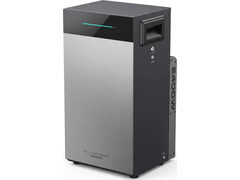
Allpowers BS2500 Pro
£1028.50
2600Wh of plug & play solar storage: the hybrid balcony battery that stores your production to release it in the evening and finally make self-consumption pay off.
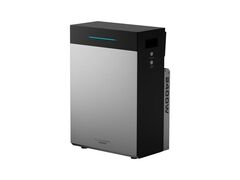
Allpowers BS5000 Pro
£1609.00 (1)
The bigger sister of the BS2500 Pro doubles the capacity: a plug and play balcony battery that stores your solar by day and takes over during a power cut.
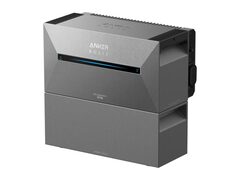
Anker Solix Solarbank 2 E1600 AC
£517.75 (7)
1.6 kWh of AC-coupled solar storage for your balcony: built-in 800W microinverter, dual MPPT, IP65 rating and a capacity expandable up to 9.6 kWh.
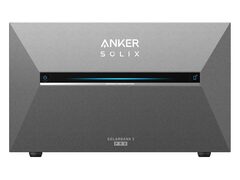
Anker Solix Solarbank 3 E2700 Pro
See price (7)
2688Wh of plug-and-play solar storage: 4 MPPT, a bidirectional 1200W microinverter and an AI that optimises your self-consumption on its own. Balcony solar finally pays off.
Published on 26/07/2026, updated on 25/08/2026