
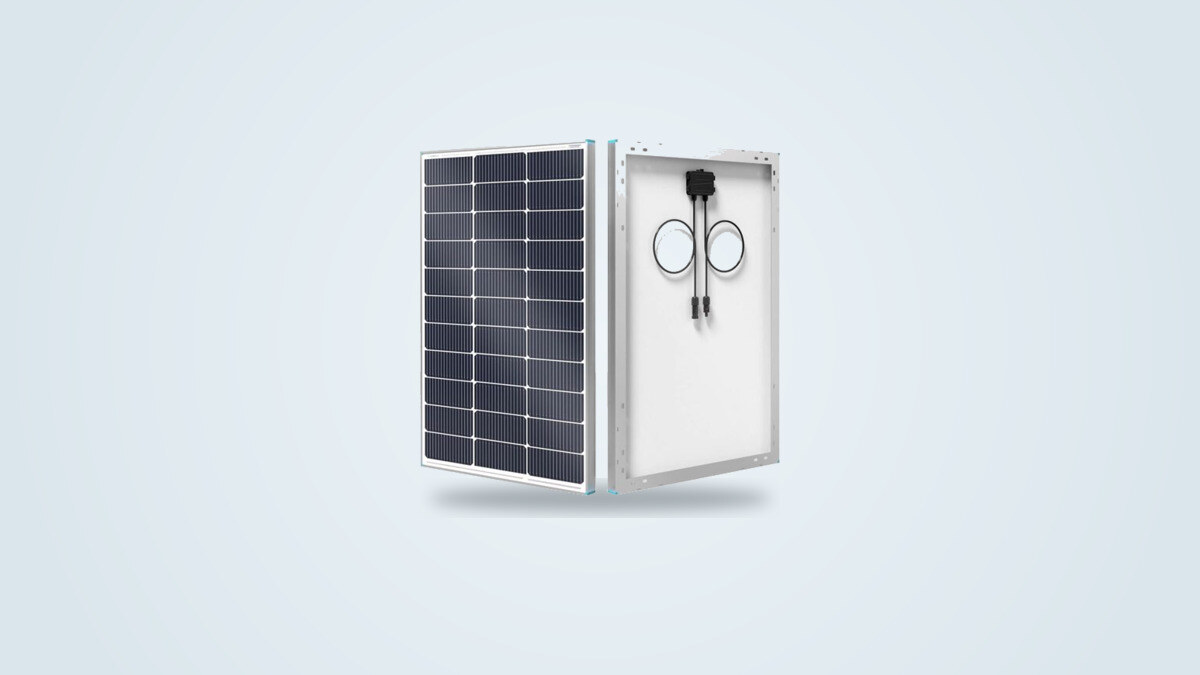
What the 20% module efficiency actually gets you
Module efficiency is the number that actually matters for comparing panels: it measures power output against the module's full footprint, glass and frame included, while cell efficiency (up to 25% here per Renogy) only measures the active silicon portion. At 20% module efficiency, this panel sits toward the upper end of today's 12V rigid panels, without being the single densest on the market.
The official datasheet also lists a -0.32%/°C temperature coefficient on peak power, a better figure than a typical PERC panel (usually -0.40% to -0.45%/°C). In practice, on an RV roof where cell temperature (NOCT) climbs to 47 °C within minutes of exposure, this panel loses a bit less output than an equivalent PERC panel under the same heat.
What the datasheet does not say is how much power an actual unit delivers. No independent measurement of this cell generation's real-world output turns up, whether on specialist American forums or elsewhere: one recent buyer, on a DIY solar forum, asked outright for independent lab data, and none ever surfaced in the thread. Renogy's own published curve shows how output falls with irradiance, useful context for why the rated 100W only shows up in full sun, the standardised test condition (1000 W/m², 25 °C).
N-type cells with 16 busbars: an advantage the whole industry shares
N-type cells are not a Renogy invention: they are the generation succeeding PERC across the photovoltaic industry as a whole. A PERC cell, boron-doped, suffers from light-induced degradation tied to boron-oxygen defects, which worsens with heat. Phosphorus-doped N-type cells do not share that mechanism and hold their output better as the module heats up, a common situation on a vehicle roof where surface temperature regularly tops 60 °C in full summer.
The other headline figure, 16 busbars against 5 to 9 on a typical panel, answers a real technical need. Busbars collect the current each cell produces and route it to the junction box: more of them shortens the path electrons travel, cutting resistive losses. The other benefit is microcrack resistance: on a cell with few busbars, a single crack can isolate a large chunk of the active surface, while 16 collection points give current alternate paths around any break. On a roof exposed to constant vibration and thermal cycling, that is a longevity argument more than an immediate performance gain.
Stated degradation versus the warranty floor: two different numbers
Renogy publishes two figures that should not be confused. The first is a stated degradation path: under 1% power loss in year one, then 0.4% a year after that. The second is a separate, more conservative contractual commitment: the power output warranty runs 25 years and guarantees at least 80% of rated output by then.
Run the stated path out over the full term and this panel would retain roughly 89% of its original output after 25 years, comfortably above the 80% floor Renogy guarantees in writing. That gap is not a contradiction: the stated path is an optimistic figure built for marketing copy, while the guaranteed floor is the threshold Renogy actually commits to acting on. It is this second, more conservative number that carries real weight if output ever falls short over the long run.
On the materials side, the warranty runs 10 years, covering the structure and workmanship independently of the electrical output question. This cell generation is still recent: no multi-year field data exists yet to say which of the two trajectories, the stated one or the guaranteed one, will end up closer to reality.
Weight and format: a realistic solo install
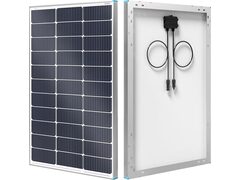
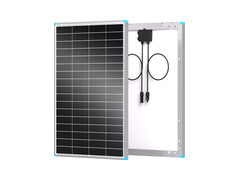
At 86.5 x 57.8 x 3cm for 5.9kg, this panel stays manageable for one person hoisting it onto an RV or van roof. Renogy lists 20 pre-drilled mounting holes in the frame, enough to position brackets without drilling into the aluminium yourself.
| Panel | Output | Weight | g/W |
|---|---|---|---|
| Renogy 100W N-type | 100 W | 5.9 kg | ≈ 59 |
| Victron BlueSolar 115W | 115 W | ≈ 8.5 kg | ≈ 74 |
| Offgridtec 100W | 100 W | ≈ 7 kg | ≈ 70 |
Set against output, this panel posts the best weight-to-watt ratio of the three references compared above, about 59 grams per watt against 70 to 74g/W for its alternatives. That gap matters most while carrying the panel up to the roof alone, less so in day-to-day use once it is fixed in place.
Once installed, the panel's angle stops moving: unlike a portable panel you tilt toward the sun, it takes light at whatever incidence the roof geometry sets, all year round. In high summer with the sun overhead, the gap against an optimal angle stays small; in winter or early morning, the loss from a shallow angle can become significant, a physical effect that touches any fixed panel identically, regardless of brand.
Weatherproofing and resistance to the elements
The official datasheet lists two separate protection ratings: IP65 for the junction box, IP67 for the solar connectors themselves, a step above. That split is common on this type of product: a properly sealed junction box on the back of a panel mounted flat on a roof stays fairly shielded from direct water spray, but the gap between the two ratings is worth knowing rather than assuming they match.
The stated operating range, -40 °C to 85 °C, comfortably covers what a vehicle roof sees across a European or British winter and summer alike. Renogy also states a wind load rating of 2400 Pa and a snow load rating of 5400 Pa for this rigid panel line, official documentation figures that no independent measurement currently confirms or contradicts.
No weatherproofing defect or leak turns up in the feedback available for this generation, though the volume of that feedback stays limited: a reassuring signal, not proof of multi-year durability.
MC4 connectivity: broad compatibility, a cable worth extending
The panel uses MC4 connectors, the near-universal standard across the solar industry, rated here at 22A with a maximum voltage of 1000V DC, well above this panel's own 5.31A short-circuit current. That headroom means the connector is never the limiting factor, including when wiring several panels in series or parallel.
On the practical side, the output cable measures just 60cm (14 AWG), a length that rarely reaches a controller mounted inside the vehicle on its own: an MC4 extension will be needed for most installs, an extra purchase and step to budget for.
This panel's voltage (22.79V open-circuit, 19.97V at maximum power point) sits well within the input range of virtually every 12V MPPT controller on the market, Renogy-branded or otherwise. No specific compatibility issue with a third-party controller turns up, but no cross-tested confirmation specific to this panel has been documented either: compatibility here follows from MC4 standard compliance and ordinary electrical values, a technical deduction rather than a direct confirmation.
Build quality, certifications and the brand's track record
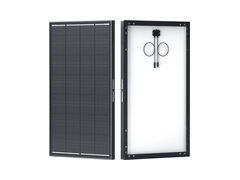
Construction follows the sector's usual standards: an anodised aluminium frame, 3.2mm low-iron tempered glass, a junction box with two bypass diodes (part number 15SQ045) to limit hot spots under partial shading. The panel is CE certified to the IEC61730 and IEC61215 standards, and built in an ISO 9001-certified factory. Its solar connectors also carry a UL-listed 600V DC system voltage rating, relevant beyond the CE marking for anyone sourcing components against North American codes.
Among early feedback, the handful of buyers who have spoken up publicly describe sturdy frames and cells in perfect condition on arrival, shipped in suitcase-style packaging; one unit arrived intact despite a dented box corner. That is not a statistically meaningful sample, but no report of cracking, delamination or a manufacturing defect turns up for this specific rigid panel generation.
On the brand's track record, a check of safety recall databases turns up nothing against Renogy's current rigid panel line. The brand has had two unrelated recalls in the past: a different, now discontinued flexible panel recalled in 2015-2016 over an overheating risk, and a LiFePO4 battery recalled in 2024 over a relay issue. Neither the technology nor the product category overlaps with this N-type rigid panel.
The real question: does the N-type premium make sense on a small 100W panel?
On an American DIY solar forum, a recent buyer of this panel ran straight into open scepticism: at a price close to a generic PERC panel, does the conversion gain (up to 25% at the cell level) really justify the difference on a format as modest as 100W? The question deserves a straight answer rather than a dodge.
The answer mostly comes down to use case. On the larger formats in the same line-up (175W, 200W), the density gain (more watts installed on the same patch of roof) clearly justifies a premium: every square inch of a van or RV roof is scarce. On a single 100W panel, often the first or only module in a small setup, that density argument carries less weight: available space is rarely the limiting factor for just one panel this size.
What holds up regardless of format: better heat tolerance and the slower stated degradation, two advantages that pay off on a panel meant to sit in place for years, whatever its wattage. Price plays into that balance too: at the time of writing, Renogy's own UK store had this panel discounted to around £65.99 against an £89.99 list price, a promotion worth double-checking at the time of purchase since it may not hold.
Who this panel suits, and who it does not
This rigid panel suits, first, anyone setting up a first fixed solar base on an RV, van, cabin or boat roof, working with a measured budget and a preference for a newer cell technology over a generic PERC panel. Its contained weight (5.9kg) and pre-drilled mounting holes make it a good pick for a solo install.
It suits less well anyone who needs a panel they can carry and re-angle through the day (a portable format serves that need better), anyone dealing with recurring partial shade at the install site (this panel has no anti-shading cell segmentation, so even a small shadow drags down the whole module the way it would on any classic series-wired panel), or anyone targeting a large installed output from day one, which will mean wiring several panels into the same MPPT controller anyway, not included here.