
What the 2048Wh (and the promised 12kWh) really mean
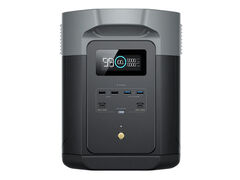
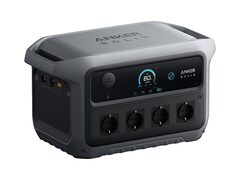
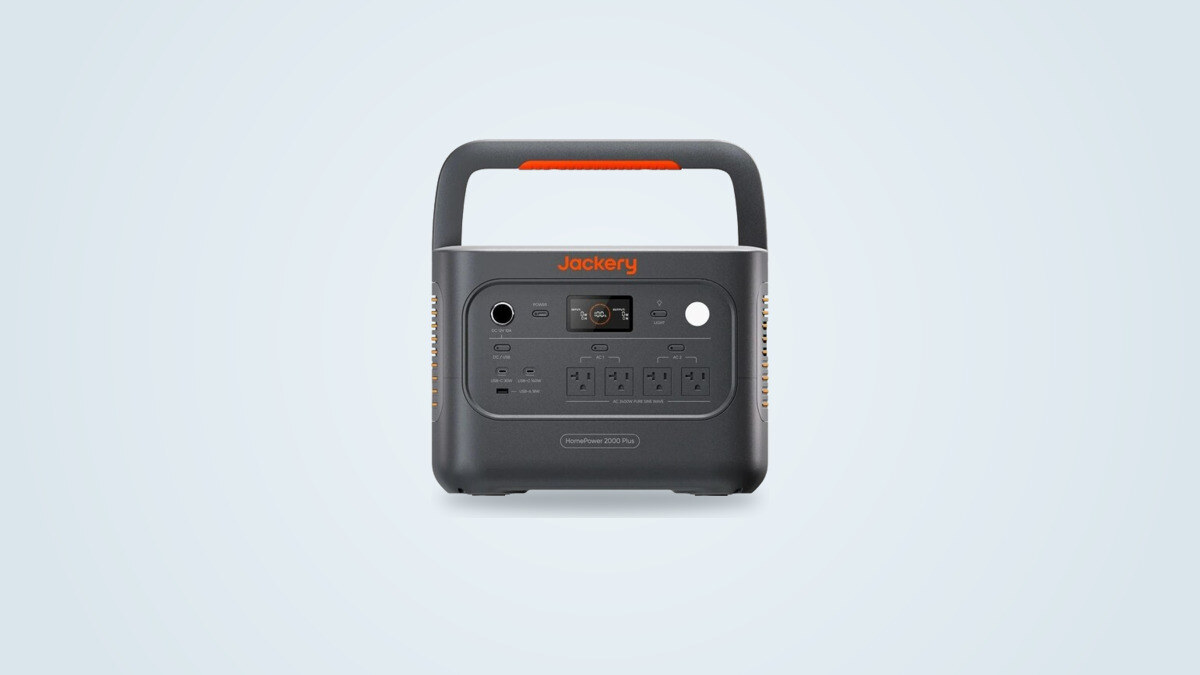
The HomePower 2000 Plus v2 ships with a stock 2048Wh LiFePO4 battery (51.2V, 40Ah) built into the unit: no extra accessory is needed to start using it. Its distinctive trait is the ability to scale up to 12kWh in total by adding Battery Pack 2000 Plus V2 units, an expansion battery sold separately that connects to the unit's DC expansion port. That 12kWh ceiling puts it clearly ahead of the EcoFlow Delta 2 Max (about 6.1kWh maximum) and the Anker Solix C2000 Gen 2 (about 4.1kWh), its two direct rivals in this starting-capacity bracket. One thing to watch: this expansion only works with the V2 version of the Battery Pack 2000 Plus, since the older pack (without V2) is not compatible with this new unit.
On real-world usable capacity, no lab has published a measurement on this exact unit yet, launched too recently for that. Applying the efficiency generally seen on the closest comparable architecture within Jackery's own range (around 94% delivered on the Explorer 2000v2, once the inverter's own overhead is accounted for), the HomePower 2000 Plus v2 should deliver around 1900Wh of real usable energy out of the claimed 2048Wh. That estimate still needs independent confirmation on this exact model: it rests on a comparable architecture, not a direct measurement.
How Jackery Priority Routing actually works
Jackery positions Priority Routing as this station's headline feature: a system meant to automatically cut secondary loads to protect priority devices once the battery drops below a threshold set in the app. The principle is real and useful for home backup use. But its scope needs clarifying: on the HomePower 2000 Plus v2, the four AC outlets are physically split into two fixed groups, AC1 and AC2, two outlets each. Priority routing therefore comes down to choosing, at the point of plugging in, which devices go on AC1 and which go on AC2, then letting the app cut the secondary group when needed.
That is not the same thing as integrating with a home's breaker panel. Jackery separately sells a Smart Transfer Switch capable of managing several real circuits of a home's electrical installation, but nothing in the HomePower 2000 Plus v2's current documentation suggests it ships with or supports that accessory. For a targeted backup setup (a fridge on AC1, a less critical device on AC2, for example), the feature does a genuinely useful job. For anyone picturing circuit-by-circuit control of their home's breaker panel, the name promises more than the unit delivers on its own.
A 10ms switchover: what it changes, what it does not prove
The HomePower 2000 Plus v2 claims a 10ms automatic switchover to battery during a mains outage, a figure that matches the fastest UPS-style stations already reviewed in this catalogue (the Anker Solix C2000 Gen 2 claims the same number) and puts it well ahead of its own Explorer 2000v2 sibling or the EcoFlow Delta 2 Max, both claimed at 20ms.
In practice, a switchover under 10 to 20ms goes unnoticed by a desktop computer or a home router, whose power supplies easily absorb a micro-outage of that length. That is a real argument for backing up a home network or a medical device like a CPAP machine, where continuity matters above all else. Still, this 10ms figure is a manufacturer spec sheet value: no lab has published an independent oscilloscope measurement on this exact unit to confirm it, and the gap with the 20ms claimed by rivals, plausible on paper, is not independently verified either.
2400W continuous, 4800W peak: across which circuits
The HomePower 2000 Plus v2 claims 2400W of continuous output and up to 4800W at peak, through a pure sine wave inverter. That 2400W figure exactly matches the EcoFlow Delta 2 Max and beats the Anker Solix C2000 Gen 2 (also 2400W continuous, but only 4000W at peak) and its own Explorer 2000v2 sibling (2200W continuous, 4400W peak). On paper, that is one of the strongest power ratings in its capacity bracket.
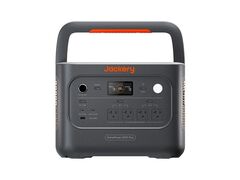
The four AC outlets are split into two distinct physical groups, AC1 (two outlets) and AC2 (two outlets), rather than four independent outputs. Two devices plugged into the same group therefore share the same line, which is common on this format of station but is worth knowing before buying if you plan to spread out a heavy load. No independent measurement currently confirms whether the claimed 2400W actually holds over an extended period, or whether thermal throttling kicks in beyond a certain run time: these remain open questions on this exact unit, as they do on almost every very recently launched station.
Mains and solar charging: 1.5 hours and 3.2 hours claimed
On mains power, the HomePower 2000 Plus v2 accepts up to 1800W of input, for a full recharge claimed in about 1.5 hours. That is one of the fastest mains recharges in its capacity bracket on paper, quicker than the nearly two hours claimed for the Explorer 2000v2 in its dedicated mode. On solar input, it tops out at 800W through a single MPPT tracker (two DC8020 ports), for a full recharge claimed at 3.2 hours in good sunlight: a solid figure, though behind the EcoFlow Delta 2 Max, which accepts up to 1000W of solar input.
A single MPPT tracker also means it cannot independently track two panel strings facing different directions: on a roof or setup with multiple orientations, overall yield will suffer more than on a station fitted with two trackers. Pass-through charging (using the station while it recharges) is supported, a useful point for extended backup use during a long outage.
Noise: 30dB claimed, no independent verification yet
Jackery claims a 30dB noise level in quiet mode, a figure that would make it quieter than a whispered conversation. That number is consistent with what the brand claims on comparable references in its range, but no independent measurement is available yet to confirm it on this exact unit, nor to characterise noise during fast mains charging (1800W) or at peak output, the two situations where a station's cooling fan of this power class typically has the most work to do.
This is not treated as a flaw in this review's score: the lack of independent measurement is a confidence gap worth flagging, not proof that the product is noisy. It does explain, though, why the noise axis of the rating below is deliberately left unscored for this model: a figure claimed only by the manufacturer does not stand in for a measurement.
Not yet available in the UK or Europe: what that actually changes
A key point for a UK, Irish or wider European reader: the HomePower 2000 Plus v2 on sale today only exists in its North American version, 120V and 60Hz. It is sold only in the US and Canada, directly through Jackery, with no localised store or retail presence in the UK, Germany, Italy or Spain for now. Used as is on UK or European 230V / 50Hz mains, it simply would not work without a dedicated voltage converter, an expensive fix that is rarely recommended for a station of this output.
This is not unique to the HomePower 2000 Plus v2: Jackery regularly launches new products on its North American market first, before any eventual wider rollout. For an immediate home backup need in the UK or elsewhere in Europe, an alternative already sold locally at 230V (the EcoFlow Delta 2 Max or the Anker Solix C2000 Gen 2, mentioned above) remains the sensible choice today. This model is still worth keeping an eye on: if a European version is ever released, most of its technical strengths (expandability, fast switchover, claimed cycle life) should carry over.
A name that invites confusion across Jackery's range
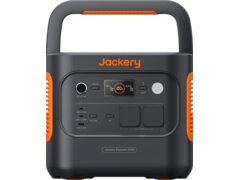
Jackery's catalogue currently multiplies very similarly named references around the 2000Wh bracket, with sometimes very different specifications. The same shopper can run into, almost side by side: the HomePower 2000 Plus v2 (this product, 2048Wh, 2400W, expandable to 12kWh, a HomePower-range unit built for home backup), the Explorer 2000v2 (2042Wh, 2200W, not expandable, a more general-purpose Explorer-range unit), the Explorer 2000 Plus (also 2042Wh, but a claimed 3000W and an expansion ceiling claimed at 24kWh, another Explorer-range reference) and the HomePower 2000 Ultra (a newer, more compact reference with its own fire-safety system, sold in Europe). Four products, four distinct spec sheets, a single shared number, « 2000 ».
| Reference | HomePower 2000 Plus v2 | Explorer 2000v2 | Explorer 2000 Plus |
|---|---|---|---|
| Stock capacity | 2048Wh | 2042Wh | 2042Wh |
| Continuous power | 2400W | 2200W | 3000W |
| Expandable up to | 12kWh | Not expandable | 24kWh |
| Market | US, Canada | International, including Europe | Mainly US |
The most misleading detail is probably that the Explorer 2000 Plus claims a higher expansion ceiling (24kWh) than the HomePower 2000 Plus v2 (12kWh): the HomePower is therefore not the most expandable station in Jackery's whole catalogue, only the most expandable among the other-brand rivals mentioned earlier in this review. Before buying, check the full exact name (HomePower or Explorer, Plus, v2, Ultra) and the model reference rather than trusting the single number « 2000 » printed large on the box or product page.
Build quality, warranty and reliability at this stage
The HomePower 2000 Plus v2 runs on LiFePO4 chemistry claimed for 6000 cycles at 70% capacity, well above the 3000 cycles typically claimed by direct rivals such as the EcoFlow Delta 2 Max. Its operating temperature range is claimed from -10 °C to 45 °C for both charging and discharging, a wide window for this format. No recall or safety notice has been identified for this reference to date.
On warranty, Jackery claims 5 years in total, but that period actually breaks down into 3 years of base coverage plus 2 additional years offered only after registering the product on the manufacturer's website. Without that step, coverage falls back to 3 years, a nuance worth knowing before the original box gets thrown away. For a purchase made from the UK or Europe, an eventual warranty return also means shipping back to the US, a practical hurdle that does not apply to a North American buyer. This unit has only been on the market for three months at the time of writing: it is still too early for any real track record on long-term reliability, a gap worth stating honestly rather than papering over with an artificially cautious score.
Who it suits, and who it does not
The HomePower 2000 Plus v2 is aimed first at a North American household looking for a fixed backup power plant that can grow over time: a fast switchover to protect a home network or a medical device like a CPAP machine, capacity expandable up to 12kWh to size autonomy to the household, and enough continuous output for a fridge, a freezer and most everyday appliances split across the two outlet groups.
It suits frequent nomadic use less well: at 18.8kg and built to stay in place, it is less nimble than an Explorer 2000v2 for a van or a job site where location changes often. And for a UK, Irish or wider European reader, the question barely applies yet anyway, as long as only the 120V North American version exists: a station already sold locally at 230V is the better bet for now, with this reference worth revisiting if a European version is ever announced.